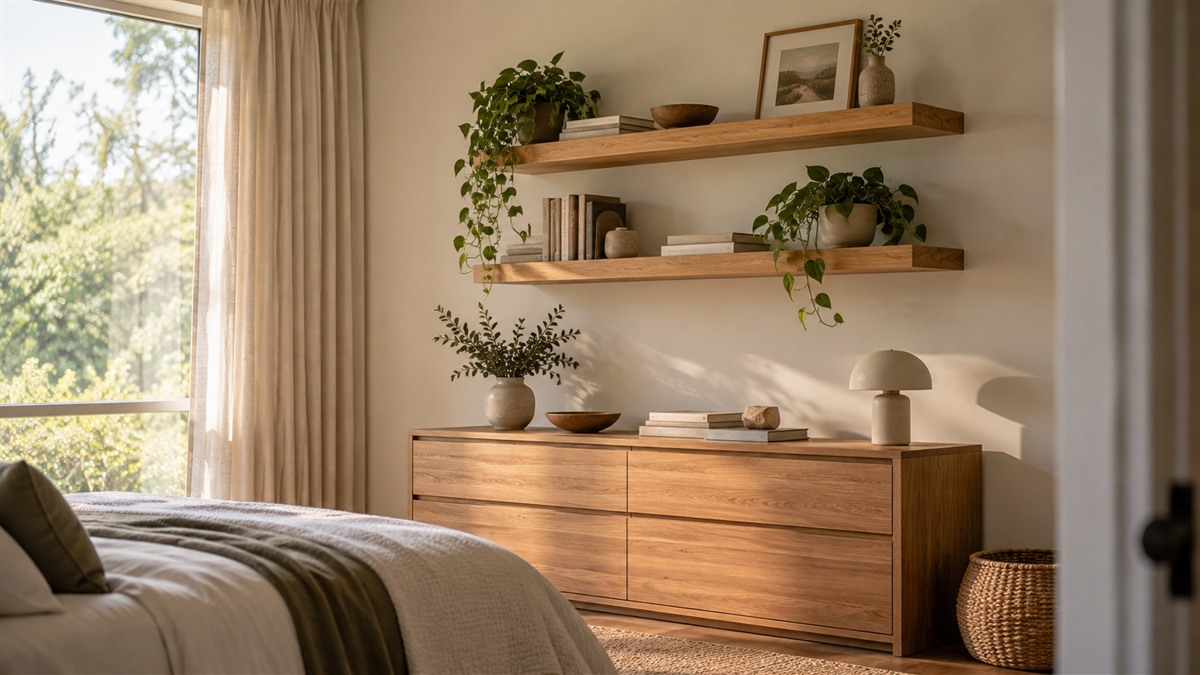
Best Depth for Floating Shelves in a Bedroom: What Changes With Depth
As an Amazon Associate we earn from qualifying purchases. Details
The best depth for floating shelves bedroom use is the shallowest depth that holds the items you plan to keep there, with the heavier items close to the wall. None of the pages we opened gives a depth figure for a bedroom shelf, so this guide does not name one. What the pages do explain is how depth changes three things: the load on the wall fixing, the amount the board moves with humidity, and whether an item can be reached and returned without strain. This guide works through each one, with the arithmetic shown.
Updated 19 October 2026
Author: Editorial team, home-shelving-guide.com
Quick answer
- The pages we opened do not give a depth figure for bedroom shelves, so choose depth by the items, the wall and the reach.
- Depth moves the load away from the wall, and the toggle anchor maker says that distance greatly reduces the allowable load on the anchor.
- Depth is also the board’s width in a floating shelf, and width is where a solid board moves most with humidity. A 10-inch board moves about twice as much across its depth as a 5-inch board in the same moisture swing.
- Keep the items you reach for at night within easy reach, because the Oregon State circular says an item must be easy to reach and replace.
Depth is the lever on the wall
A floating shelf projects from the wall, and the projection is its depth. Anything placed at the outer edge of that depth pulls harder on the wall fixing than the same item placed close to the wall. The Toggler FAQ page puts it plainly: “Moving objects away from the wall (e.g., the far end of a shelf or using a TV mount that swings away from the wall) significantly increases the effective weight of that object, greatly reducing the allowable load of that anchor.”
The plastic toggle sheet from the same maker says that holding strength varies directly with the strength and condition of the substrate, and inversely with the distance of the load from the wall. The phrase that matters for depth is the second part. A deep shelf lets a lamp base, a jar or a stack of books sit further from the wall, and each step outward reduces the load the anchor can take. A shallow shelf keeps the same items closer to the anchor.
This is the main reason a bedroom shelf should be no deeper than the items it holds. A bedside shelf that holds one clock and a small lamp needs far less depth than a shelf meant for a row of large books. The lamp base is the heaviest point, so place it nearest the wall, and let the lighter clock sit at the front.
The anchor maker’s planning rule still applies. The plastic sheet says that “Industry safety standards recommend using only 1/4 of ultimate tensile and shear values as the maximum load per anchor.” A deeper shelf does not change that rule. It only means the effective load of a given item is higher, so the same planning figure is reached with less weight at the front of the shelf.
Depth is the board’s width, and width moves
On a floating shelf the depth of the board is its width, the dimension that runs from the wall outward. That is the dimension in which solid wood moves most. The Oregon State University Extension bulletin on wood and moisture says that “Even after being dried, solid wood products shrink and swell as they lose or gain moisture.” It gives approximate shrinkage figures from the fiber saturation point down to zero moisture. The largest figure, about 8 percent, is along the tangential direction, and the radial figure is about 4 percent.
The bulletin also gives a worked example for a flatsawn board. It says, “A 10-inch wide flatsawn board dried from fsp (assume 30% MC) to 15% MC would shrink about 0.2 inch in width.” That is a board whose width is the depth of a shelf, moving from a 30 percent starting point to 15 percent. The arithmetic matches the radial figure: 10 x 0.04 x 0.5 = 0.2 inch, because the moisture change is half of the full range.
Now compare two depths in the same swing. A 6-inch deep shelf moves 6 x 0.04 x 0.5 = 0.12 inch, and a 10-inch deep shelf moves 10 x 0.04 x 0.5 = 0.2 inch. The difference is 0.2 – 0.12 = 0.08 inch. That is small, but a fixed shelf cannot move freely, and the movement can show up as a gap at the back of the board or a crack along the finish. The moisture change in this comparison is the only assumption, so the same reasoning holds for any other board.
The Purdue bulletin on furniture makes the wider point. It says that “Moisture content changes of only a few percent are sufficient to cause significant shrinking and swelling of wood.” A bedroom with a humidifier in winter, or a window that stays open in summer, can produce that kind of change. A deeper board sees more of it across its width.
The practical rule is simple. A deeper floating shelf is a wider board, and a wider board moves more. If the depth is set by the items, accept the movement and fix the shelf to a stud. If the depth is chosen only for appearance, pick the shallower board, because it moves less and loads the wall less.
Reach and the items in a bedroom
A bedroom shelf is often used for things you pick up at night and put back in the morning. The Oregon State circular on clothes closets gives a test that suits this use as well. It says, “The item must be suited to the type of storage and be easy to reach and replace.” An item that needs two hands, a step, or a careful lift will end up on the bedside table instead, and the shelf will fail its purpose.
Depth affects reach. A shelf deeper than the reach of the person using it leaves the back items hard to reach. A shelf that is shallow and wide holds the same number of items with less reach, and it keeps the heavy items close to the wall. For most bedside uses, a depth that puts everything within a forearm’s reach from the bed is the practical limit.
The pages we opened do not cover bedrooms directly. They do not describe what people keep on a bedroom shelf, how heavy those items are, or how often they are moved. The Oregon State closet circular cited above is the closest match, and it suggests the same test of reach and replacement.
Wood and the room
A bedroom shelf is usually made of solid wood or an engineered board, and the wood must suit the room. The Penn State Extension page on lumber drying says that wood used inside a home is usually dried to a moisture content around seven percent. The same page notes that “Typically, moisture contents lower than 14% should minimize problems with paints and other finishes, but if the moisture content is too high, blistering and peeling may occur.”
For a shelf that will be painted or stained, check the moisture first. A board that is wet when it is fixed will shrink as the room dries, and the finish will crack at the joints. A board that is too dry for the room will take up moisture and swell. Let the board sit in the bedroom for a few days before you fix it, so it reaches the room’s moisture level.
The Purdue bulletin on engineered boards adds a point that matters for shelves cut from panels. It says that “Plywood, hardboard and particleboard all tend to absorb moisture through the ends and edges of the panel faster than through the surface.” Seal every cut edge of an engineered shelf before you fix it to the wall, since the edges are where the moisture enters.
Choosing a depth in practice
Start with the items, not the shelf. List what the shelf must hold, and note which items are heavy. Put the heavy items near the wall, and place the light ones toward the front. Then choose the shallowest depth that holds the list without crowding. Measure the wall, since a bedroom wall with a headboard, a window or an outlet may limit the usable width.
Next, check the fixings. The CPSC report says a wood screw “is usually provided and must be installed in a stud”, which makes the stud the usual fixing for furniture. The Toggler sheets treat the one-quarter rule as a planning figure for each anchor. A deeper shelf needs a stronger fixing, because the lever is longer.
Last, check the board. Choose a board that is straight and dry, seal the cut edges, and consider a stain-blocking primer if the wood has knots or dark heartwood. The Purdue paint bulletin says that “When extractives discolor paint, moisture is usually the culprit.” That point is about the finish, but it is the same moisture that moves the board.
How we chose
We chose the pages in this guide because each speaks to one of the three questions that depth raises. The Toggler sheets and FAQ cover the load on the wall. The Oregon State bulletin and the Purdue bulletin cover movement with moisture. The Oregon State circular covers reach and replacement. We opened each page, extracted its text and checked each quoted sentence against that text before it went into the draft.
We did not use any product listing, price or review score to choose the advice. We did not use a blog for any depth figure, and this guide gives no depth number that the pages do not support.
What we could not verify
The pages we opened do not give a depth for a floating shelf in a bedroom, and they do not give a maximum depth for any shelf size. This guide does not claim one.
The pages do not give bending stiffness or span limits for shelf boards of any depth, so we cannot say how far a deep board sags under a book load. The arithmetic in this guide covers movement and the lever effect only.
The bulletin’s shrinkage figures are approximate, and they differ among species. The 0.2-inch and 0.12-inch comparisons use the radial figure for one assumed moisture swing, so the real movement of a given board will vary.
The pages do not describe typical bedroom items or their weights. The advice on reach is general and comes from a 1967 closet circular, which may not match modern bedroom furniture.
FAQ
What depth should a floating shelf be in a bedroom?
The pages we opened do not give a depth for bedroom shelves. Choose the shallowest depth that holds your items, keep the heavy items near the wall, and check the wall fixings for the load you plan.
Does a deeper shelf need a stronger wall fixing?
Yes, in the sense that a deeper shelf moves items further from the wall. The Toggler FAQ says that moving objects away from the wall greatly reduces the allowable load of the anchor. A deeper shelf therefore needs a stronger fixing or a lighter load at the front.
How much does a 10-inch shelf move compared with a 6-inch shelf?
In the same moisture swing from 30 to 15 percent, the radial figure gives about 0.2 inch for 10 inches and about 0.12 inch for 6 inches. The difference is about 0.08 inch. The real movement depends on the species and the board.
Can I use a deep shelf for books?
The pages we opened do not give book weights or a depth limit for books. A deep shelf can hold books, but the books nearest the front place the most load on the wall, so keep the heaviest ones at the back and close to the wall.
Is a bedroom shelf affected by the humidity in the room?
Yes. The Oregon State bulletin says wood gains and loses moisture with the air around it, and the Purdue bulletin says a few percent of moisture change can cause significant shrinking and swelling. Keep the room’s humidity steady where you can, and let a new board reach the room’s moisture level before you fix it.
Bottom line
For a bedroom floating shelf, choose the depth by the items you keep on it and by the reach you need, not by a number the pages do not give. Keep heavy items near the wall, remember that a wider board moves more across its depth, and fix the shelf to a stud where you can. For related guidance, see best standard reach in closet depth and best space saver shelves for bedroom.
Sources
- Oregon State University Extension, EM 8600, Wood and Moisture Relationships: the fiber saturation point, the directional shrinkage figures and the flatsawn width example
- U.S. Consumer Product Safety Commission, anchoring furniture and televisions report (2015): the stud fixing point and the drywall pull figure
- Oregon State University Extension, Extension Circular 691, Ideas for Better Clothes Closets (reprinted 1967): the reach-and-replacement test
- Purdue Extension, NCR-134, paint discoloration and extractives: the moisture point about paint discoloration
- TOGGLER, Plastic Toggle Anchors sheet (manufacturer PDF): the distance-from-wall point, the substrate point and the one-quarter planning rule
- TOGGLER, frequently asked questions (manufacturer web page): the far-end loading note and the close-to-the-wall limit
- Purdue Extension, FNR-163, The Shrinking and Swelling of Wood and Its Effect on Furniture: the moisture-change sensitivity and the directional shrinkage ranking
- Penn State Extension, Why Does Lumber Need to be Dried?: the indoor moisture target and the 14 percent paint guidance
- Purdue Extension, NCR-132, Finishing Exterior Plywood, Hardboard and Particle board: the cut-edge moisture point for engineered panels