Best Sink Drawer Organizer for Under-Sink Pull-Outs
As an Amazon Associate we earn from qualifying purchases. Details
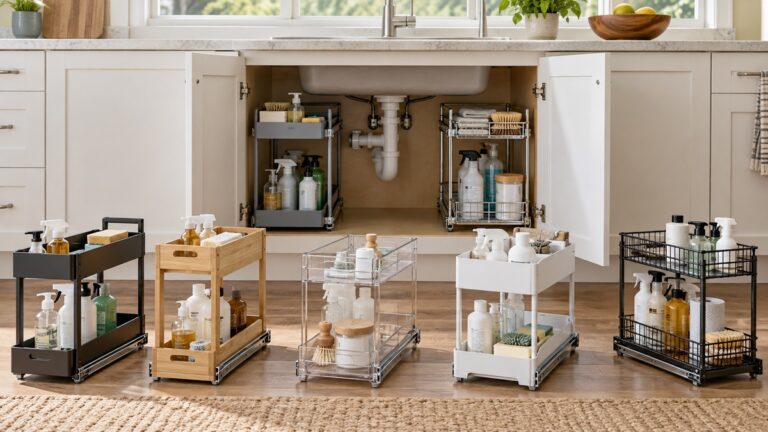
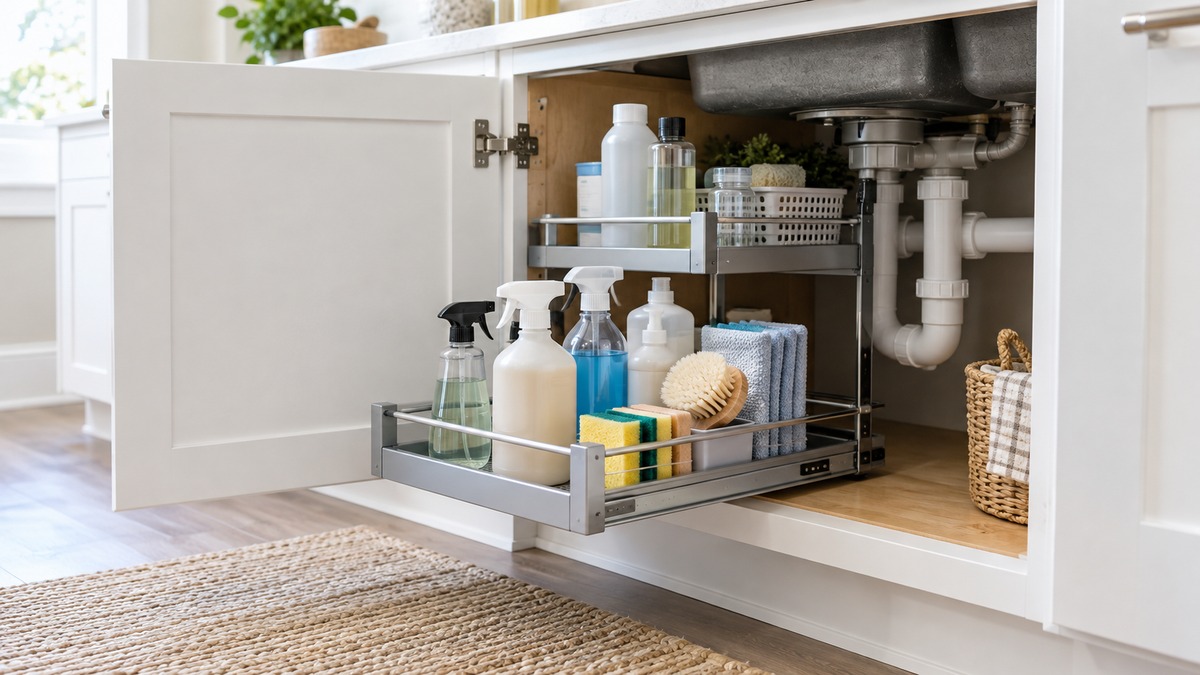
A sink drawer organizer is a pull-out unit for the cabinet under your kitchen or bathroom sink. It brings bottles, sponges and bags forward, so you do not have to reach into the back corner on your knees. This guide helps you match the design to your cabinet, your plumbing and the items you store. The four options below are under-sink pull-out drawers and slide-out baskets. Each one is described from its own listing, and every measurement comes from that listing. Where a listing leaves a detail out, this article says so instead of filling the gap. Measure your cabinet before you compare them, because most of these units are sold for a specific interior size.
Quick answer
Choose a pull-out drawer if you reach for cleaning supplies every day and your cabinet interior is at least as large as the listed minimum. Choose an L-shaped basket if pipes or a garbage disposal block the back of the cabinet. Before you buy, check three things on the listing: the interior size it requires, whether the weight figure is per drawer or total, and the mounting type. Skip any unit that will not fit the interior you measured. If you plan to store heavy jugs and the listing gives no weight figure, keep those jugs on the cabinet floor and use the organizer for lighter items.
What matters for a sink drawer organizer
Measure the inside of the cabinet, not only the door. Several listings in this group give a minimum interior size or a minimum door width, and the two numbers answer different questions. A door width tells you whether the unit can pass through the opening. The interior size tells you whether it will sit without hitting the back panel or the plumbing.
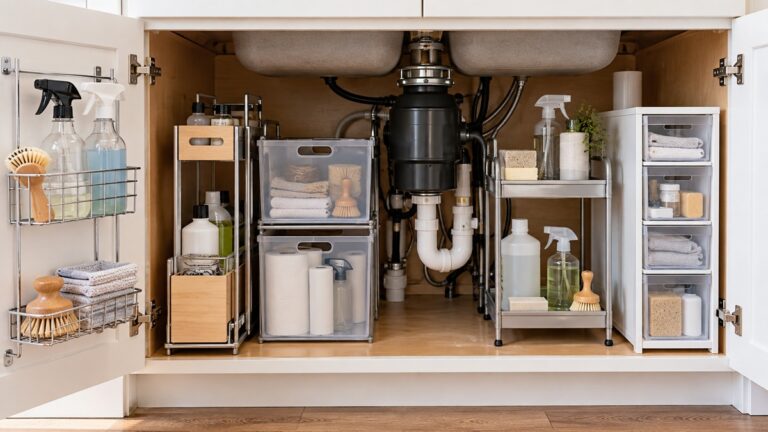
Plumbing clearance comes next. Under most sinks there is a supply line, a drain and sometimes a garbage disposal. A straight drawer can catch on these. One L-shaped option is built around that problem: its narrow top basket mounts left or right, and the listing says that clears your plumbing. Note which side your pipes sit on before you order. The garbage disposal layouts guide goes deeper into the clearance question if your cabinet has one.
The pull-out mechanism is the third factor. This group uses three designs. One is a single bottom drawer that slides out on glides. Another is a bottom shelf that slides out of its frame. A third is a stack of drawers on slides, with dividers between compartments. The design decides how far items come forward and how much of the cabinet you can see at once.
Weight figures need careful reading. One listing states 50 pounds as its weight capacity and says that figure is a total. Another says its shelf support rods hold up to 40 pounds, which describes the rods rather than the whole drawer. A third gives a maximum weight recommendation in kilograms, 30.06 kg, next to a capacity of 500 ml. These figures do not all say what they cover. One listing states no weight figure at all for its drawer, so read each one before you decide what to put inside.
Mounting and stability are the last factor. Some listings describe a unit that sits on non-slip pads. One lists its mounting type as adhesive, while its bullets describe pads on the cabinet floor, and the listing does not reconcile the two. Check the mounting field and the assembly note before you install anything.
According to the entry on drawers, a drawer is a box-shaped container that can be pulled out horizontally to reach what is inside, and drawers can be built from wood, composites, sheet metal or plastic. The materials in this group are mostly plastic, metal and PET, so read the material field on each listing closely.
How to choose
Use these rules as a starting point. Each one points to a different kind of cabinet. If you are still choosing between a slide-out and a stacked layout, the slide-out under-sink organizers guide compares the two in more depth.
Choose a single bottom pull-out if your cabinet has a clear back corner and you mainly store bottles of one height. A single drawer is easy to load and easy to see into. It suits a kitchen cabinet where dish soap, sponges and scrub brushes are the main contents.
Choose an L-shaped basket if pipes or a disposal take up the back and one side of the cabinet. This is the design the L-shaped option is built for. Measure the clearance on the side where your pipes sit before you buy, and compare that space with the listed minimum interior.
Choose a stacked multi-drawer unit if you have a wider cabinet and want to separate cleaning products from sponges and bags. Stacking gives you more compartments in the same footprint. Check the listing for the number of drawers and whether dividers come with the set.
Choose a unit with a stated weight figure if you store heavy items. If the figure covers the whole unit, match it to your heaviest jug. If it covers one shelf or one set of rods, add up what sits on each level and compare that total. If the listing gives no figure, choose a different design or keep heavy items on the cabinet floor.
Some readers should not buy any of these. Skip the group if your cabinet interior is smaller than the listed minimum. Skip it if you need a load rating that the listing does not state. Skip it if you want a fixed shelf for tall bottles, because a drawer limits the height you can use.
Measuring your cabinet step by step
Empty the cabinet first. Remove the bottles, the bucket and any trash bag, so you can see the walls, the floor and the pipes. A full cabinet hides the parts that limit fit.
Measure the width at the front, the middle and the back. Cabinets are not always square, and a side panel can bow in or stand out. Write down the smallest of the three readings, because that is the number a unit has to clear.
Measure the depth from the inside of the front edge to the back panel. Note whether the back panel is flat or has a cutout for the plumbing. A cutout can reduce the usable depth even when the cabinet looks deep enough.
Measure the height from the floor of the cabinet to the underside of the sink. Mark the spot where the drain and the supply lines come through. A drawer or basket that clears the walls can still catch on a pipe that sits higher than you expected.
Once you have three smallest readings, compare them with the listed minimum interior for each option. Only the options that clear every reading belong on your shortlist.
Options that fit this keyword
1. 2 Packs Under Sink Pull-Out Storage Organizers, 12.8 Inches, Black (Simple bottom pull-out)
Specs from the listing (checked 2026-10-11):
- Number of Drawers: 1
- Item Dimensions D x W x H: 8″D x 15″W x 12.8″H
- Material: Metal, Plastic
- Assembly Instructions Description: No assembly required
- Item Weight: 3.4 pounds
Pros
- The bottom drawer pulls out, so items at the back come forward without reaching
- The listing gives the size as 15 by 8 by 12.8 inches in a 2-count pack
- The easy-install bullet says no tools are needed for setup
Cons
- The listing states no weight figure for the pull-out drawer; the bullets only say it promises to bear more weight
- The listing's Item Weight is 3.4 pounds, with no note on whether that covers one unit or both
Best for: A plain under-sink cabinet where you want a basic pull-out and do not need a stated load figure.
Skip if: Skip it if you plan to store heavy jugs, because the listing gives no weight rating to check against.
View on Amazon (affiliate link)
2. Sevenblue 3-Pack 2-Tier Under Sink Organizers with Sliding Drawers (Sliding bottom shelf with rated rods)
Specs from the listing (checked 2026-10-11):
- Unit Count: 3 Count
- Number of Drawers: 1
- Frame Material: Metal
- Included Components: Basket, Cup and Hooks, Sliding Drawer
- Assembly Instructions Description: Included
Pros
- The bottom shelf slides out, and the bullets say you can adjust how far it pulls out
- The listing says the shelf support rods hold up to 40 pounds
- The included components are a basket, a cup with hooks and the sliding drawer
Cons
- The listing does not give a load rating for the drawer itself; the 40-pound figure applies to the support rods
- Two sizes exist, 15.6 by 8.5 by 14.2 inches and 12.1 by 6.3 by 14.2 inches, and the bullets ask you to measure first
Best for: A cabinet where you want a slide-out bottom shelf and a stated rod rating of 40 pounds.
Skip if: Skip it if your cabinet falls outside the two listed sizes, or if you need a stated load for the drawer itself.
View on Amazon (affiliate link)
3. REALINN Under Sink Organizer, L-Shaped 2 Tier Pull Out Cabinet Organizer (L-shaped basket around pipes)
Specs from the listing (checked 2026-10-11):
- Weight Capacity Maximum: 50 pounds
- Minimum Required Door Width: 15 inches
- Mounting Type: Adhesive
- Product Dimensions: 14.2″D x 10.6″W x 11″H
- Number of Drawers: 1
Pros
- The narrow top basket mounts left or right to clear plumbing
- Open wire mesh lets water and debris fall through instead of pooling on a solid tray
- The assembled size is listed as 14.2 by 10.6 by 11 inches
Cons
- The listing requires a cabinet interior of at least 11 in W x 15 in D x 16 in H, so a shallow cabinet will not work
- Mounting Type says Adhesive, but the bullets describe non-slip pads on the cabinet floor; the listing does not reconcile the two
Best for: An under-sink cabinet where pipes or a garbage disposal block a straight drawer.
Skip if: Skip it if the cabinet interior is smaller than the listed minimum of 11 by 15 by 16 inches.
View on Amazon (affiliate link)
4. Delamu 2-Tier Multi-Purpose Bathroom Under Sink Organizers and Storage, Stackable Kitchen Pantry (Stackable pull-out drawers)
Specs from the listing (checked 2026-10-11):
- Number of Packs: 2
- Capacity: 500 ml
- Maximum Weight Recommendation: 30.06 kg
- Product Dimensions: 13.19″D x 8.27″W x 10.63″H
- Material: PET
Pros
- Four slide-out drawers come with eight movable dividers, according to the bullets
- The bullets say you can stack three at a time to fit the space you have
- Aluminum alloy support rods and non-slip silicone stoppers sit at each base
Cons
- The title says 2-tier while the bullets describe four slide-out drawers; count the drawers you receive before you order
- The listing gives 30.06 kg as the maximum weight recommendation and 500 ml as capacity, without saying what each figure covers
Best for: A pantry or under-sink area where you want several small pull-out drawers you can use one at a time.
Skip if: Skip it if your cabinet is shallower than the listed 13.19-inch depth, or if you need one wide drawer.
View on Amazon (affiliate link)
Worked example: checking one cabinet against a listed minimum
For the comparison, use one listed minimum interior from this group: 11 inches wide, 15 inches deep and 16 inches high.
Step 1, width: 16 − 11 = 5 inches of side room.
Step 2, depth: 17 − 15 = 2 inches of depth room.
Step 3, height: 20 − 16 = 4 inches of height room.
Step 4, result: on paper the unit fits, with 5 inches to spare across the width, 2 inches of depth and 4 inches of height.
Step 5, plumbing check: a 2-inch depth margin leaves little room behind the unit. Measure where the supply line and drain run before you order. If the pipes sit in the back half of the cabinet, the margin may not be enough.
Where each design works best
Kitchen cabinets under a sink often hold dish soap, sponges, scrub brushes and spare bags. Bathroom cabinets hold cleaners, toilet brushes and backup toiletries. In both rooms the same rule applies: put the items you reach for most in the drawer, and keep rarely used containers at the back or on the floor. For a wider look at what to keep under the sink, see cleaning supplies organizers under the sink.
A pull-out drawer works best for items you lift out often. A basket with an open base works better for damp sponges and spray bottles, because water can fall through instead of pooling.
Common mistakes
Measuring only the door opening. A unit can pass through the door and still hit the back panel. Measure the interior at the back and at the height of the drawer, then compare those numbers with the listed minimum.
Treating every weight figure as the same. A total figure, a per-rod figure and a per-drawer figure answer different questions. Ask which one the listing gives before you load the unit.
Ignoring the mounting type. When one field says adhesive and the bullets describe floor pads, decide what you will do before the box arrives. Check the assembly note and the product images.
Buying more drawers than you need. A set with several small units can take up more room under the sink than one drawer. Count the compartments you actually use.
Skipping the assembly note. Most listings in this group say no tools are needed, but the note shows the exact steps and the parts count. Read it before you open the box.
What the listings leave out
Several listings do not state a load rating for the drawer itself. The figures they do give often describe the rods, the frame or the whole unit. The number of drawers is not always consistent between a title and the bullets. Colour fields differ across the group, so check the colour if the look matters to you. Layouts with two levels inside one cabinet are covered in two-tier under-sink organizers, which is useful if a single drawer feels too shallow.
Listings also differ on size. Some give one set of dimensions. Others offer two sizes. Compare the stated dimensions for the size you want against the interior you measured, not against the photo.
FAQ
Will a sink drawer organizer fit around a garbage disposal?
It can, if the design is built for that layout. The L-shaped option in this group says its narrow top basket mounts left or right to clear your plumbing. Measure where the disposal sits, then match that side to the listing before you order.
How much weight can a pull-out hold?
That depends on the listing. One gives 50 pounds as a total weight capacity. Another gives 40 pounds for its shelf support rods. A third gives a maximum weight recommendation in kilograms. If a listing gives no figure, keep heavy jugs on the cabinet floor.
Do these units need tools to install?
Most listings in this group say no tools are needed. One says the main frame comes mostly assembled and needs the uprights connected and the baskets positioned. Check the assembly note in each listing before you decide.
Can I store sponges and spray bottles in an open basket?
Yes, if the basket suits the items. One option describes open wire mesh that lets water and debris fall through, instead of pooling on a solid tray. Choose by how wet your items get, and wipe the base after use.
Are the sizes the same across listings?
No. Two listings in this group come in two sizes. Compare the stated dimensions for each size against the interior you measured, and do not assume that one size fits every cabinet.
What should I check on a listing before I buy?
Check the interior size the listing requires, the weight figure and what it covers, the mounting type, and the number of drawers. If two fields on one listing disagree, contact the seller or choose a listing that is consistent.
Bottom line
Measure the inside of your cabinet first, then choose the design that matches your plumbing. For a clear back corner and everyday supplies, a single pull-out drawer covers most needs. For pipes or a disposal in the way, pick an L-shaped basket. Skip any unit whose listed minimum interior is larger than your cabinet. Skip any unit whose weight figure does not cover your heaviest item. A listing that leaves out a weight figure can still hold light items, but do not assume it can carry a heavy load.
Sources
- Drawer (Wikipedia): defines a drawer as a box-shaped container that pulls out horizontally, and lists common materials.