Best Childrens Small Bookcase Picks for Nurseries and Kids Rooms
As an Amazon Associate we earn from qualifying purchases. Details
A childrens small bookcase does two jobs at once. It gives a child a place to see and reach books, and it keeps a small room from filling up with paper and toys. The good models sit low enough for a toddler to choose a book, stay stable when a child leans on them and fit the corner or wall you actually have. The options in this group vary a great deal: some are open shelves with front-facing covers, some add a drawer or fabric pockets, and a few are taller units with anti-tip hardware. This guide compares them by height, shelf layout, storage type and safety hardware, using only the figures each listing gives.
Quick answer
For a toddler who wants to pick books alone, choose a low, front-facing shelf with open tiers that sit within easy reach. For a room that also holds toys, pick a unit with a drawer, a toy bin or fabric pockets so that books and playthings share the same footprint. If the bookcase will be taller than a child’s head, look for anti-tip hardware and a wall fixing, and anchor the piece as the maker directs. Before you order, measure the wall or floor space, the path to the door and the height of the shelf you want a child to reach.
What matters for a childrens small bookcase
Height and reach
Reach decides whether a child can use the bookcase on their own. The LAMU is listed at 15.75 inches tall, and the suureks is listed at 15 inches tall, which places the books at a toddler’s eye level. Taller units such as the UTEX at 37 inches and the CHOEZON at 26.2 inches suit older children or a room where the bookcase doubles as storage for toys. A low unit is easy to use, but it will not hold many large picture books. A taller unit holds more, but it needs anchoring.
Front-facing display versus spine-out storage
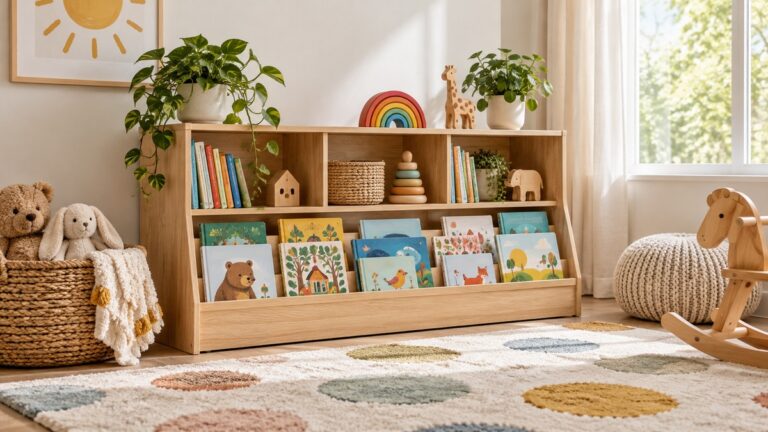
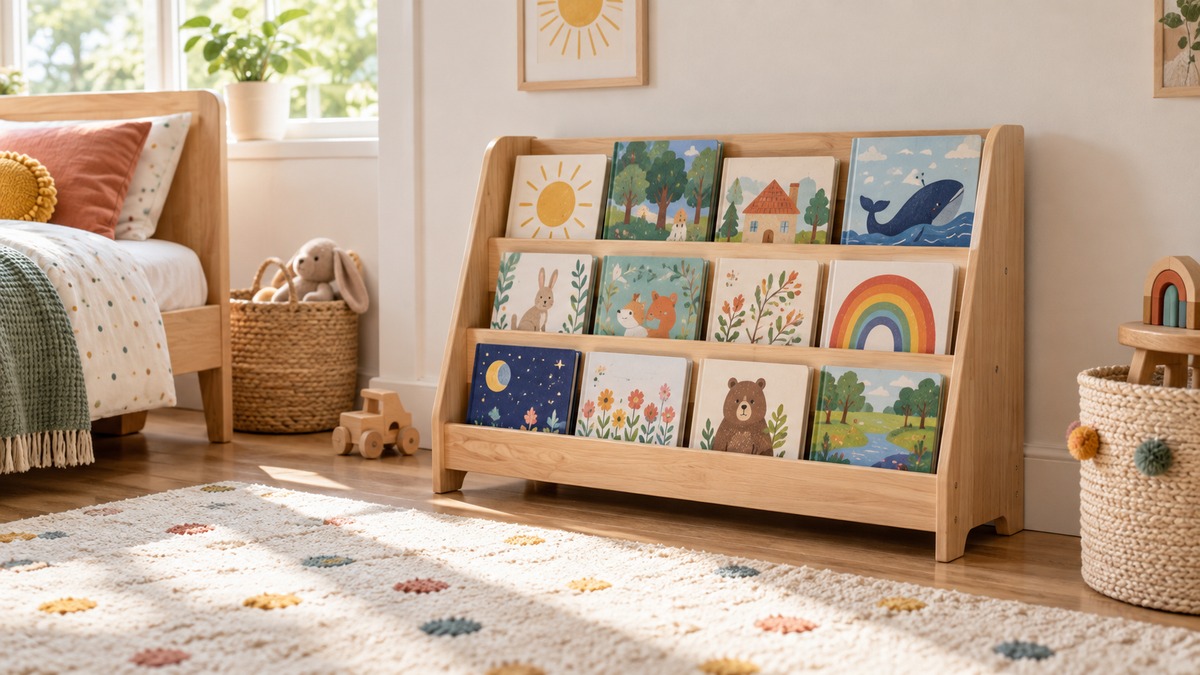
Front-facing shelves show the covers, which helps a child choose a book. The suureks bullets describe a Montessori front-facing design, and the AZSKY lists a front-facing display, while the NANATI describes an open double-sided design. Spine-out shelves hold more books in less space but hide the covers, so they suit a shelf that children rarely browse. Pick the layout that matches how the child uses the books.
Shelf count and what the numbers really mean
Shelf counts in these listings are not always consistent. The NANATI lists 30 shelves in one field, while its bullets say the unit holds 15 to 30 books. The LAMU lists four shelves and says it holds up to 20 books. The suureks lists four shelves in its specifications, yet its bullets describe a two-tier layout. Count the shelves when the unit arrives, and use the capacity in the bullets to plan how many books you can store.
Load and the drawer
A shelf or drawer has a load figure, and the listings give those figures in different fields. The UTEX gives 25 pounds for its other shelves and 20 pounds for the top, while its minimum weight field reads 15 pounds. Those numbers describe what the shelves can carry, which matters more than the weight of the bookcase itself when a child piles books on the top. Keep the heaviest picture books on the lower shelves, and keep the top for lighter titles.
Material and finish
Most of the bookcases here are pine or engineered wood. The suureks and LAMU are solid pine, and the AZSKY is pine as well. The CHOEZON and HOOBRO are engineered wood. Wood is a natural material with strong fibres that resist tension, which is why solid pine is common in children’s furniture. Engineered wood is a different product, and particle board is made from wood chips and a synthetic resin pressed under heat. Check the material line in the listing, and wipe finishes with a damp cloth so that paint and coatings stay intact.
Anti-tip hardware and stability
Children climb on furniture, and a tall unit can tip. The U.S. Consumer Product Safety Commission’s Anchor It campaign aims to prevent furniture and TV tip-overs that injure children, and it advises that existing furniture can be anchored with inexpensive anti-tip brackets. The CHOEZON lists an anti-tip device, and the UTEX lists an anti-tilt wall mount. The UTEX is 37 inches tall, so anchor it to the wall. Follow the maker’s mounting instructions for any unit taller than a child.
Room layout and the wall
A bookcase is part of the room’s traffic pattern. A unit placed in a corner keeps the floor clear, but it needs room to open the door of a toy bin or drawer. A unit against a wall gives the most shelf length, though it may block a radiator or a light switch. Leave a clear path from the door to the bookcase, so a child can reach it without stepping over boxes. If the room has a window, keep the bookcase out of the direct line of sun, since bright light can fade covers and the finish on wood over time.
Age, reach and how children use books
A toddler wants to pull books out and put them back, so a low shelf with a clear front suits that habit. An early reader likes to browse by spine, so a shelf with a slight slope or a clear divider helps. Older children often store books and games together, which makes a drawer or a toy bin more useful. Watch how the child moves through the room for a week before you buy, and choose the layout that matches the habit you see rather than the one you imagine.
Picks
1. Solid Pine Wood Kids Bookshelf, Double-Sided Nursery Book Shelves, Portable Toddler Bookshelf (Best for a low double-sided shelf with pockets)
Specs from the listing (checked 2026-10-13):
- Product Dimensions: 17.7″D x 16.1″W x 12.6″H
- Material: Fabric, Wood
- Item Weight: 3.8 pounds
- Installation Type: Freestanding
Pros
- The bullets describe four small pockets for toys, pens and small items.
- The bullets say the shelves have smooth rounded edges and anti-slip foot pads.
Cons
- The Number of Shelves field reads 30, while the bullets say the unit holds 15 to 30 books, so count the shelves yourself.
Best for: Toddlers' corners where a low, double-sided shelf can hold a small book collection.
Skip if: You need a closed cabinet, since this is an open double-sided shelf.
View on Amazon (affiliate link)
2. LAMU Kids Bookshelf, 4 Tier Solid Pine Wood Toddler Bookshelf, Book Shelf for Kids Rooms, Portable (Best for a low four-tier shelf for toddlers)
Specs from the listing (checked 2026-10-13):
- Product Dimensions: 13″D x 28.5″W x 15.75″H
- Number of Shelves: 4
- Material: Wood
- Installation Type: Freestanding
Pros
- The bullets say the four open tiers hold up to 20 books and sit low enough for toddlers to reach.
- The bullets describe a sturdy triangular structure that prevents tipping and wobbling.
Cons
- The item depth reads 1.97 inches, while the product dimensions give 13 inches deep, so the depth figures disagree.
Best for: Nurseries and playrooms where a low, lightweight shelf moves from room to room.
Skip if: You need a tall bookcase for large picture books, since the listing gives a height of 15.75 inches.
View on Amazon (affiliate link)
3. Solid Pine Wood Montessori Bookshelf for Kids – 2-Tier Double Sided Toddler Book Organizer (Best for a front-facing Montessori shelf)
Specs from the listing (checked 2026-10-13):
- Product Dimensions: 12″D x 15″W x 15″H
- Material: Pine
- Weight Capacity Maximum: 100 pounds
- Number of Shelves: 4
Pros
- The bullets describe a Montessori front-facing design where book covers face out for toddlers to choose.
- The bullets say the finish is a kid-safe water-based coating over smooth, rounded edges.
Cons
- The Number of Shelves field reads 4, while the bullets describe a two-tier layout, so count the shelves before you plan.
Best for: Families who want a solid pine shelf with covers facing out for an early reader.
Skip if: You need a very tall shelf, since the listing gives 15 inches as the height.
View on Amazon (affiliate link)
4. UTEX Kids Bookshelf, Children Bookcases with Drawer, Toy Storage Organizer (Best for a bookcase with a full-width drawer)
Specs from the listing (checked 2026-10-13):
- Weight Capacity Maximum: 25 pounds
- Number of Drawers: 1
- Material: Wood
- Product Dimensions: 12″D x 24″W x 37″H
Pros
- The bullets describe a full-width drawer on the bottom for book overflow, toys and art supplies.
- The bullets say the bookcase has anti tilt wall mounts and is certified by ASTM and CPSIA.
Cons
- The bullets give 20 pounds for the top and 25 pounds for the other shelves, while the minimum weight field reads 15 pounds, so the load figures conflict.
Best for: Kids rooms that need a bookcase, a drawer and toy storage in one footprint.
Skip if: You want a shelf under 24 inches wide, since the listing gives 24 inches as the width.
View on Amazon (affiliate link)
5. AZSKY Double Sided Toddler Book Shelf, Small Wooden Book Storage for Kids, Brown Mini Children Book (Best for two deep fabric pockets)
Specs from the listing (checked 2026-10-13):
- Product Dimensions: 14″D x 13.4″W x 14″H
- Material: Pine
- Number of Shelves: 2
- Installation Type: Freestanding
Pros
- The bullets describe two deep fabric pockets on both sides for reading books, coloring books and magazines.
- The bullets say the easy-to-clean surface wipes down without fuss.
Cons
- The Size field reads 15.7 inches while the height reads 14 inches, so check which dimension you need.
Best for: Nursery corners that need a small, portable shelf with pockets on two sides.
Skip if: You want a closed toy cabinet, since the listing describes open shelves with fabric pockets.
View on Amazon (affiliate link)
6. CHOEZON Kids Bookshelf and Toy Storage, Children's Bookcase with 2 Toy Cubes, Toddler Book Shelf (Best for mixed book and toy storage with anti-tip)
Specs from the listing (checked 2026-10-13):
- Size: 31.5″L x 11.9″W x 26.2″H
- Special Feature: Cloud-Inspired Design, Anti-Tip Device, Combination Book & Toy Storage
- Item Weight: 11 kg
- Material: Engineered Wood
Pros
- The special features list an anti-tip device alongside the combined book and toy storage.
- The bullets describe three book slots and two deep toy bins.
Cons
- The item weight is 11 kg, so the bookcase is heavy to move between rooms.
Best for: Playrooms that need book slots and toy bins in one piece with an anti-tip device.
Skip if: You need a low, open shelf for a toddler, since the listing gives a height of 26.2 inches.
View on Amazon (affiliate link)
How to choose the right childrens small bookcase
Start with height, then the layout, then the room. These questions narrow the list quickly.
- Choose a low front-facing shelf if the child will pick books alone. The suureks and LAMU sit low, and their covers face out.
- Choose a unit with a drawer or fabric pockets if toys share the space. The UTEX drawer and the AZSKY pockets keep small items out of the way.
- Choose a taller unit with anti-tip hardware if the bookcase will sit by a wall. The CHOEZON and UTEX both list tip-prevention features, though the UTEX is the taller of the two.
- Choose an open double-sided shelf if you want books visible from two sides. The NANATI and AZSKY both list two-sided layouts.
Then check the room. A narrow corner suits a slim, two-sided bookcase, and a wide wall suits a longer unit that spreads the books out. If you want a bookcase that moves between rooms, check the weight figure first, since the CHOEZON lists 11 kg and that is a two-person lift for many adults. For more layouts, read small wood bookcases, small bookcases for a nursery and small bookcases for a bedroom before you commit.
Suppose the shelves split the books into three groups of about the same size. Forty books split into three groups gives thirteen books on the lowest shelf, thirteen on the middle shelf and fourteen on the top. Every group is then small enough to see at a glance. If the shelf holds 15 to 20 books, the forty books need two bookcases, or a taller unit with a drawer for the overflow. Check the book count against the capacity in the bullets before you choose a single shelf.
Mistakes to avoid
- Buying a tall unit for a toddler’s room without anchoring it. A tall bookcase can tip, so use the anti-tip hardware and a wall fixing.
- Choosing by the shelf count alone. Some listings state a number of shelves that does not match the bullets, so count the shelves when the box opens.
- Forgetting the drawer or pocket load. A drawer full of toys can weigh more than the books, so treat the lower load figure as the limit.
- Overlooking the finish. Children often touch the front of a bookcase, so pick a finish you can wipe down.
- Buying a bookcase that is too high for the child. A shelf above reach is a shelf the child will never use.
- Skipping the room measurement. Measure the wall, the door swing and the walkway, because a bookcase that blocks the door is hard to live with.
- Stacking the heaviest books up high. The CPSC notes that children like to climb on furniture, so keep the heavy picture books low and the lightweight titles on top.
Worked example: height gap between two picks
The UTEX stands 37 inches tall and the LAMU stands 15.75 inches tall, so the difference is 37 – 15.75 = 21.25 inches. At that height the UTEX needs a wall anchor, so the extra height is a safety question as well as a fit question.
FAQ
What height is right for a childrens bookcase?
It depends on the child. A low unit around 15 to 16 inches tall suits a toddler who wants to reach books alone. A taller unit around 26 to 37 inches suits an older child or a room where the bookcase also stores toys. Choose the shelf the child can reach without help.
Is a front-facing bookcase better than spine-out shelves?
For a young child, front-facing covers help them choose a book. Spine-out shelves hold more titles in less space and suit a shelf that children rarely browse. Many families use both, with a front-facing shelf for the current books and a spine-out shelf for the rest.
How do I stop a children’s bookcase from tipping?
Use the anti-tip hardware the maker supplies, and fix the unit to the wall where the listing shows a mount. Do not rely on the weight of the books to hold it steady. Follow the mounting instructions, and check the fixings every few months.
Does a bookcase with a drawer hold toys well?
It can, if the drawer runs smoothly and the load stays within the figure in the listing. The UTEX drawer is described as full-width and useful for overflow books and toys. Keep heavy items low, and keep the drawer closed when a child climbs near it.
Are pine bookcases safer than engineered wood?
Solid pine is a natural wood with strong fibres, and many family buyers prefer it for that reason. Engineered wood can also work well when the finish is intact and the edges are smooth. Check the material line, and look for rounded corners and a finish you can wipe.
How many books can a small childrens bookcase hold?
The listings give different figures. The LAMU bullets say up to 20 books, and the Wisreach and NANATI listings give 15 to 40 books depending on the model. Use the number in the listing for the bookcase you choose, and remember that a picture book takes more shelf space than a board book.
Can I move a bookcase when the child outgrows it?
Yes, and that is one reason to check the weight and the frame before you buy. A light unit like the LAMU is easy to carry from the bedroom to the playroom or a classroom, because the listing presents it as portable. A heavier unit should be moved with two people and a clear path. Empty the shelves first, lift from the base, and re-anchor the unit in its new spot before a child uses it again.
Should the bookcase match the room colours?
It helps, but it is not required. A neutral finish such as the white of the CHOEZON or the cream of the NANATI blends into most rooms, while a stronger colour works as a feature wall. Choose the finish that you can wipe clean and that will still look fine when the child’s taste changes. A bookcase is a long-term piece, so a calm finish usually ages better than a bold one.
Bottom line
Choose a childrens small bookcase by height first, then layout, then the room. A low front-facing shelf suits a toddler who picks books alone. A taller unit with a drawer suits a room that also holds toys, and it needs an anti-tip fixing. Count the shelves, check the load figure in the listing, and anchor any unit taller than the child. Buy the bookcase that fits the wall and the reader you have.
Sources
- CPSC Anchor It!: anti-tip brackets and tip-over prevention for children’s rooms
- Bookcase: a bookcase is furniture with horizontal shelves, and shelves may be fixed or adjustable
- Wood: a natural material whose fibres are strong in tension
- Particle board: what particle board is made from