Best Thin Tall Narrow Shoe Rack: Two Options Compared
As an Amazon Associate we earn from qualifying purchases. Details
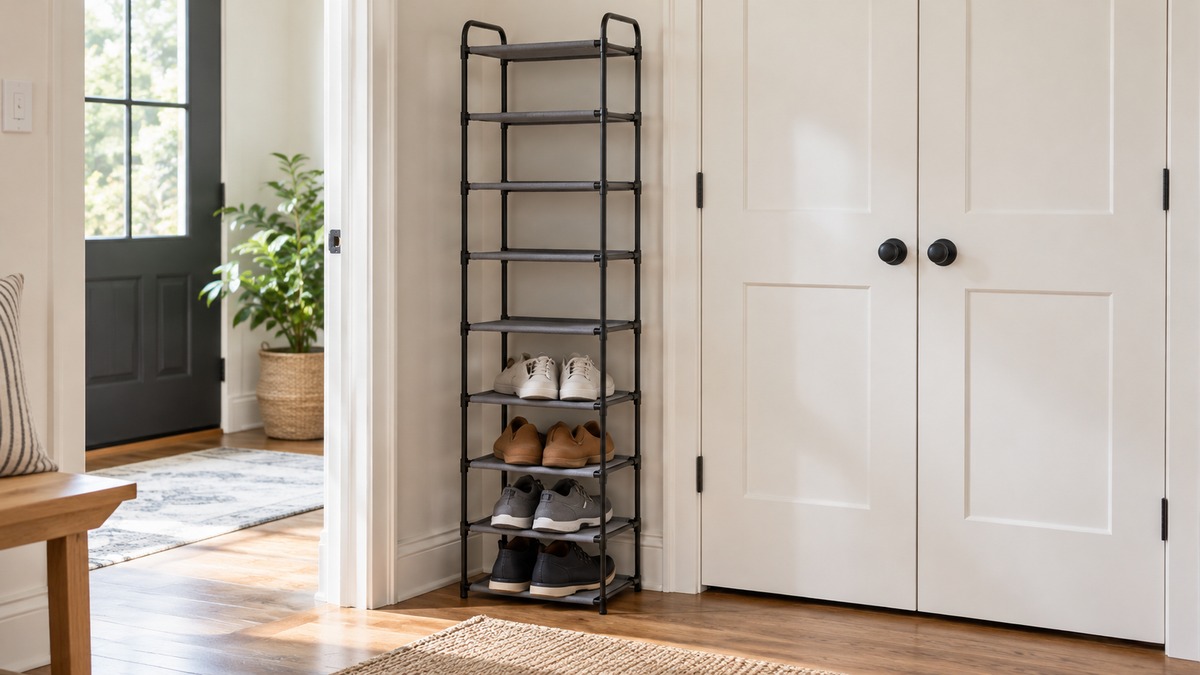
A thin tall narrow shoe rack is a freestanding rack with a small footprint that stacks shoes vertically, so it fits beside a closet door, in a hallway or in a narrow nook. This guide compares the two racks in this group that match that description. It explains how to read the footprint and height, how to interpret the stated weight limits, and why a tall rack needs anti-tip hardware. Read every dimension as the listing states it, because one listing gives conflicting sizes. Where a listing is silent, this guide says so rather than filling the gap.
Quick answer
Choose by footprint first. The six-tier rack’s bullets give a footprint of 11 inch by 10.2 inch, although its product dimensions field lists a width that conflicts with that footprint, so measure before you buy. The YATINEY is the taller option: 9.4 inches deep, 15.4 inches wide and 63.8 inches tall, with an anti-tip device in the box. Choose the YATINEY rack for a closet floor that needs eight tiers and a listed anti-tip device. Choose the six-tier rack for a tighter spot where six tiers are enough, and confirm the stability before you load it.
What matters for a thin tall narrow shoe rack
Four things change from one thin, tall, narrow rack to the next. They decide which listing fits your space.
Footprint and the measurements you actually need
The footprint is the width and depth the rack takes on the floor. It is the first number to match against your gap. The six-tier rack’s bullets say the rack needs an area of 11 inch by 10.2 inch, but its product dimensions field gives 35 inches as the width, and its item dimensions give 35.04 inches for one of the three sides. The listing gives two different shapes, so rely on neither set of numbers until you measure the rack in the listing’s photos or the maker’s sheet.
The YATINEY rack is consistent across its fields. The specs give 9.4 inches deep, 15.4 inches wide and 63.8 inches tall, and the size field matches. Its minimum required door width field reads 15.4 inches, which the listing does not explain further, so treat it as a number to check rather than as clearance advice.
Measure the gap beside your door or wall, then the height from the floor to the ceiling or to the closet shelf above. A rack that fits the gap can still fail on height.
Height and stability
Height is where a thin rack becomes a safety question. The US Consumer Product Safety Commission’s Anchor It! campaign warns that children like to climb on furniture, and that unsecured furniture is a hidden hazard in every room. The same guidance says existing furniture can be anchored with inexpensive anti-tip brackets, and that new furniture is often sold with anti-tip devices that should be installed right away. It also says to follow the manufacturer’s instructions to secure furniture properly.
The YATINEY rack includes an anti-tip device in its package, and its bullets describe four adjustable feet. The six-tier rack’s listing does not state an anti-tip device, and its bullets do not describe any anchoring. For either rack, the listing does not replace the anchoring step: install the included device, or anchor the rack to the wall if the maker’s instructions say to, and keep heavy shoes on the lower tiers.
Weight limits and what they cover
Weight figures in this group are not all alike. The YATINEY rack’s specs give a maximum of 132 pounds and a minimum of 22 pounds. Its bullets say the upper surface holds 44 lb, and that each metal shelf supports 22 lb. The listing gives both sets of numbers, so the 132 pounds figure cannot be checked against a per-shelf number, and this guide does not rely on it. The 22 lb per shelf figure is the one the bullets state directly.
The six-tier rack’s listing does not state a weight capacity. Its item weight of 1.5 kg describes the rack, not what the rack holds. If weight matters to you, the listing needs to give a figure before you load heavy boots on it.
Neither listing says whether its figure assumes a wall anchor or the rack’s own feet on a floor. Plan to keep heavy boots low and spread the load across the tiers.
Shelf type, openness and materials
The six-tier rack uses plastic plates on small iron pipes. Its title describes solid plastic shelves, and its bullets say the plastic is PP, which the listing says will not break from simple bending. Each tier uses the same part, so you can rearrange the tiers. The listing says the rack can be split into two 3-tier racks or into a 2-tier rack and a 4-tier rack.
The YATINEY rack uses L-shaped metal shelves on a slanted frame, plus one wooden shelf at the top. The specs name engineered wood and metal, with particleboard in the finish field. The bullets describe seven metal shelves and one wooden shelf, which the listing says can hold bags, books or decor. A slanted frame reduces slipping, according to the bullets.
Decide the look you want before the size, because the two racks differ in material and shelf type.
The picks
Each card below shows the listing’s specs, pros and cons. The notes after the cards cover what the cards do not answer: how each rack fits a real closet or hallway, and what to check before you buy.
1. 6 Tier Narrow Shoe Storage Rack, Compact Single Shoerack Stand for Slim Space, Stackable Tall Thin (Six tiers, narrow footprint)
Specs from the listing (checked 2026-10-16):
- Material: Metal, Plastic
- Number of Shelves: 6
- Product Dimensions: 10.2″D x 35″W x 11″H
- Installation Type: Freestanding
- Included Components: plastic plates, small iron pipe
- Special Feature: Waterproof
Pros
- The bullets state a footprint of 11 inch by 10.2 inch.
- The bullets say the same tier part can make two 3-tier racks.
- The bullets say installation takes 5 minutes.
Cons
- The product dimensions field lists 35 inches wide, which conflicts with the bullets, so rely on neither figure.
- The listing does not state a weight capacity or an anti-tip device.
- The room type field says living room, while the bullets mention hallways and bedrooms.
Best for: A tight spot beside a door or in a hallway where six tiers are enough.
Skip if: Skip it if you need a stated weight limit or an anti-tip device, because the listing gives neither.
View on Amazon (affiliate link)
2. YATINEY 8-Tier Tall Shoes Rack, Slim Shoe Organizer for Entryway, Large-Capacity Thin Shoe Rack (Eight tiers with anti-tip device)
Specs from the listing (checked 2026-10-16):
- Material: Engineered Wood, Metal
- Number of Shelves: 8
- Product Dimensions: 9.4″D x 15.4″W x 63.8″H
- Weight Capacity Maximum: 132 pounds
- Included Components: – 1 x Accessory Package, – 1 x Anti-Tip Device, – 1 x Assembly Manual, – 1 x Shoe Rack
- Special Feature: Adjustable, Anti-Tipping Device, L Shaped Narrow Shoe Rack, Quality Particleboard, Space Saving
Pros
- The specs and size field agree on a width of 15.4 inches and a depth of 9.4 inches.
- The package includes an anti-tip device and an assembly manual.
- The bullets say each metal shelf supports 22 lb.
Cons
- The specs list 132 pounds maximum, but the bullets give 44 lb for the top and 22 lb per metal shelf, so do not rely on 132.
- The bullets say the wooden shelf doubles as display space, so the rack is not all open wire.
- Assembly is required, and the listing says the necessary tools are provided.
Best for: A closet or entryway opening at least 63.8 inches tall that needs eight tiers.
Skip if: Skip it if your gap is narrower than 15.4 inches, or if you cannot secure the rack with its anti-tip device.
View on Amazon (affiliate link)
The six-tier plastic rack
This rack is the smaller of the two, with six tiers and a footprint the bullets give as 11 inch by 10.2 inch. It suits a narrow nook beside a door, where you need a few shelves for everyday shoes and do not need eight tiers. The bullets say installation takes five minutes, and the parts are the same on each tier. That makes it easy to split into two shorter racks if your space changes.
The listing has real gaps. It does not state a weight capacity, and it does not mention an anti-tip device. Its product dimensions field gives 35 inches as the width, which conflicts with the footprint in the bullets, so do not plan the space until you have checked that field against the photos or the maker’s sheet. Its room type field says living room, while the bullets mention hallways, dressing rooms and bedrooms. Read both fields before you assume the rack suits your room.
The YATINEY eight-tier slim rack
This is the taller, slimmer option: 9.4 inches deep, 15.4 inches wide and 63.8 inches tall. It has seven metal shelves and one wooden shelf, which the bullets say doubles as display space. The listing says it holds eight to sixteen pairs, which gives you a count to plan against. It includes an anti-tip device, an assembly manual and the shoe rack itself, so it is the better fit for a closet floor that needs a listed safety part.
The listing has two issues to weigh. The specs state a 132 pounds maximum, but the bullets give 44 lb for the top and 22 lb for each metal shelf, so use the per-shelf figure. It also needs assembly, and the listing says the tools are provided. The YATINEY rack is the choice for a height that clears 63.8 inches and a width that clears 15.4 inches. It is not the right choice for a gap narrower than that.
How to choose
Start with the gap. Measure the space from wall to door frame, and then measure the depth you can spare in front of the rack. If the space is shallower than 9.4 inches, the YATINEY rack does not fit as listed.
Choose the six-tier rack if you need six tiers, your gap is near 11 inches, and you do not need an anti-tip device, or you plan to install one yourself. Choose the YATINEY rack if you need eight tiers, the opening is at least 63.8 inches tall, and you want a listed anti-tip device in the box. Choose neither if the opening is shorter than the rack’s height, because it will not fit.
For a closet floor with more shoe storage needs, see best small shoe rack for closet floor. For a narrow closet where you want shoes off the floor, see best shoe storage for small closet. For a tall cabinet with doors instead of open tiers, see best tall narrow shoe cabinet with doors.
Check these points on every listing before you buy:
- The footprint, against the gap you measured, and whether the fields agree.
- The overall height, against the opening, including any closet shelf above.
- Whether the weight figure is per shelf or total, and whether the listing gives one at all.
- Whether an anti-tip device is included, or whether the listing says to anchor the rack.
- Which tiers hold heavy shoes, and whether the room type matches your space.
Clearance beside a closet door
Say the gap beside the door is 16 inches wide and the opening is 80 inches tall. For the six-tier rack, the bullets give 11 inches of width, so the leftover space is 16 – 11 = 5 inches. For the YATINEY rack, the specs give 15.4 inches of width, so the leftover space is 16 – 15.4 = 0.6 inches.
Compare the opening with the height of the YATINEY rack. Its height is 63.8 inches, so the headroom above it is 80 – 63.8 = 16.2 inches.
The YATINEY rack fits the gap with little room to spare, and it clears the opening with about 16 inches above it. If the gap is only a little wider than 15.4 inches, the YATINEY rack is a tight fit and the six-tier rack gives more clearance.
Mistakes to avoid
The first mistake is trusting the largest weight figure. The 132 pounds figure on the YATINEY rack conflicts with the bullets, and the per-shelf figure is the one to use.
The second mistake is measuring width only. A thin rack still needs its full height to clear the opening, and the height is what decides whether it fits.
The third mistake is skipping the anchor. The CPSC guidance says tall furniture should be secured and that anti-tip devices should be installed right away when the furniture comes with them. The listing for the six-tier rack does not state an anti-tip device at all.
The fourth mistake is ignoring the conflicting footprint. The six-tier rack lists 11 inch by 10.2 inch in its bullets and 35 inches in its product dimensions, so rely on neither until you check the field.
The fifth mistake is loading heavy boots on the top tier. Keep boots on the lower tiers, and keep the top for light pairs.
FAQ
How tall is too tall for a thin shoe rack?
Compare the rack’s height with the opening, including the space above the closet shelf. The YATINEY rack is 63.8 inches tall, so it needs an opening at least that tall. The six-tier rack’s listing does not give a height in its bullets, so measure its product dimensions before you decide.
Does a narrow shoe rack need to be anchored to the wall?
Follow the maker’s instructions. The CPSC guidance says tall furniture should be secured and that inexpensive anti-tip brackets can secure furniture that does not have one. The YATINEY rack includes an anti-tip device in its package. The six-tier rack’s listing does not state one, so check the instructions before you rely on the rack.
How many pairs fit on a thin shoe rack?
The YATINEY rack’s listing says it holds eight to sixteen pairs. The six-tier rack’s listing does not state a pair count, so count the tiers against the shoes you own.
Can I use a thin shoe rack in a hallway?
The six-tier rack’s bullets mention hallways, and the YATINEY rack’s room type field lists an entrance hall. Both fit a hallway if the footprint and height clear the space. Check the room type field on each, because the six-tier rack’s room type field says living room.
Is a plastic shoe rack strong enough for boots?
The listing for the six-tier rack says the PP plates will not break from simple bending. It does not state a weight capacity, so the listing does not confirm strength for boots. Keep boots on the lower tiers, and check the listing before you load heavy pairs.
How do I measure before buying?
Measure the gap at the floor, the depth you can spare in front of the rack, and the height from the floor to the closet shelf above. Then compare each figure with the footprint, depth and height in the listing, and note any field that conflicts.
Does a thin shoe rack need assembly?
The YATINEY rack requires assembly, and its listing says the assembly instructions are included and the necessary tools are provided. The six-tier rack’s bullets say installation takes five minutes, with the plates and iron pipes as its parts.
Bottom line
Choose the eight-tier slim rack if you need the most tiers, the opening is at least 63.8 inches tall, and you want an anti-tip device in the box. Choose the six-tier plastic rack if your gap is near 11 inches and six tiers are enough, and check the footprint and the anti-tip step before you load it. In either case, measure the gap and the opening first, and treat any figure the listing does not state as unknown.
Sources
- CPSC Anchor It! campaign: describes the tip-over hazard for children and the anti-tip brackets that can secure furniture, and says to follow the manufacturer’s instructions.