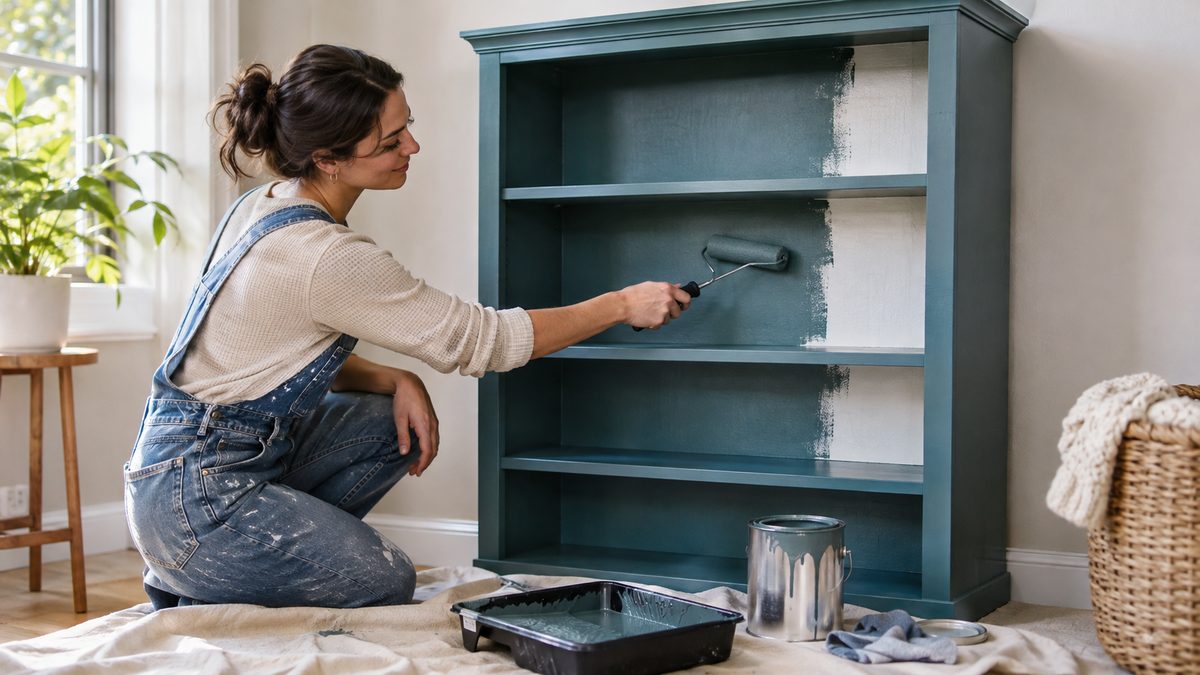
How to Paint a Bookshelf: Prep, Prime and Coat
Disclosure: As an Amazon Associate we earn from qualifying purchases.
To learn how to paint a bookshelf, work in four steps: check the surface for old lead paint, sand and clean it, prime it, then paint in thin coats. The two sources we opened agree on the order of the work. The Harris Brushes guide calls priming a highly important step, and the EPA says to take care with any old paint before you sand it. The sources do not give drying or cure times, so the label on your paint can sets those.
Quick answer
- If the shelf is old or the paint is chipping, check for lead before you sand. The EPA lists refinishing old furniture as a possible exposure.
- Sand from coarse to fine, then wipe away the dust.
- Prime, lightly sand the primer, then paint in thin, even coats along the grain.
- Follow the paint can for drying and cure time. The sources we opened give no numbers for either.
Check the shelf for old paint first
A bookshelf that has been painted or finished before can hide an older layer under the paint, and that layer may be the real concern. The EPA lists “Refinishing old furniture” among the activities that can increase exposure to lead. The same EPA page says “Do not attempt to remove lead-based paint yourself.” The page is written mainly about homes, noting that “If your home was built before 1978, it is more likely to have lead-based paint.” It does not describe a test for furniture, so the sources we opened do not tell you how to confirm whether a particular shelf has lead paint.
If the shelf is old and the finish is chipping, peeling or unknown, stop and get the question answered before you start sanding. If the shelf is newer and the finish is sound, the steps below apply. If you are still choosing which unit to buy or keep, see our guide to bookshelves for a small room.
Sand the surface from coarse to fine
The Harris Brushes guide describes sanding as the most time-consuming step, and says to start with a coarse grit and work “carefully from coarse to fine.” Where the piece has a varnish, the same guide says sanding can “successfully remove the layer of varnish,” so painting over a glossy varnish without sanding is a risk the guide does not recommend. Wear a dust mask while you sand. The guide says a mask helps make sure no harmful dust is inhaled.
If the shelf is old, the EPA advice applies to the sanding itself. “If you must sand, wet the area first, sand the minimum area needed and clean up thoroughly.” Sand only the area you need to, and clean up thoroughly afterward. When you finish sanding, the Harris Brushes guide says to “clean the excess dust away” before you move on, and to keep a clean cloth for the final wipe.
Fill holes and prime the wood
Fill nail holes, cracks and dents before the primer goes on. The Harris Brushes guide says “you can use wood filler to fill holes, cracks, or dents in the wood before painting,” and that “Once the filler is dry, sand it smooth.” Sand the filler smooth before you prime.
Priming is the step most people want to skip. The Harris Brushes guide calls it “a highly important step,” and notes that “some furniture paints can act as primers, others don’t have this capability so be sure to check the tin before applying.” It also says to pick a primer that will block stains from coming through the wood. For white paint, the guide says primer “prevents wood tannins from bleeding through and creating yellow stains.” Priming “helps seal the wood and prevents the paint from soaking into the fibres,” and the guide says priming is especially worth doing on a porous wood such as pine. The sources we opened do not say which primer type to use for a given paint.
Lightly sand the primer, then paint
Once the primer is dry, the Harris Brushes guide says to “lightly sand the primed surface,” and that “This creates a nice smooth surface for the paint to bind to.” The guide names fine sandpaper for this step. Clean the dust away again before you paint.
Paint in “thin, even layers” rather than one heavy coat. The guide says “Apply thin, even layers rather than one thick coat to prevent drips.” Brush in the direction of the wood grain, because the guide says to “always paint in the direction of the grain.” It also notes that painting against the grain “can cause the paint to settle unevenly.” The guide says white paint “typically requires at least two coats for full coverage.” That figure is for white paint; the sources we opened do not give a number for other colors.
Sand lightly between coats
Between coats, the Harris Brushes guide says to “lightly sand the wood between coats of paint.” It names a fine paper, “Fine-grit sandpaper (like 220-grit),” and says to “wipe away the dust before applying the next coat.”
Let the paint dry before you load it
The sources we opened do not give a drying time, a recoat time or a cure time for any paint, so this guide cannot give you one. Read the label on your can and wait for the time it gives before you put books on the shelf. Once the paint has cured and the shelf is in place, our guide to floating shelves that can hold weight explains how to think about load, which matters more than the paint for a shelf that is mounted on a wall.
The steps at a glance
The table below puts each step next to what the sources we opened say about it. A blank cell means the sources do not cover that step.
| Step | What the sources say | Source |
|---|---|---|
| Check for old finish | Refinishing old furniture can increase lead exposure | EPA |
| Sand | Work from coarse to fine; wet an old finish before sanding | Harris Brushes; EPA |
| Clean dust | Clean the excess dust away after sanding | Harris Brushes |
| Fill | Wood filler for holes, cracks and dents, then sand smooth | Harris Brushes |
| Prime | Highly important; check whether the paint can act as a primer | Harris Brushes |
| Sand the primer | Light sanding for a smooth surface to bind the paint | Harris Brushes |
| Paint | Thin, even layers, in the direction of the grain | Harris Brushes |
| Between coats | Light sanding with fine paper, about 220-grit, then wipe the dust | Harris Brushes |
| Dry and cure |
Mistakes to avoid
- Skipping the primer. The Harris Brushes guide calls priming “a highly important step,” and the step is what helps the paint bond to the surface.
- Sanding an old finish dry. The EPA advice is to “wet the area first” when you must sand.
- Painting over varnish without sanding it. The guide says sanding can “successfully remove the layer of varnish.”
- One thick coat. The guide says thin, even layers help “prevent drips.”
- Painting across the grain. The guide says this “can cause the paint to settle unevenly.”
- Loading the shelf too soon. The sources do not give a cure time, so the can label is the only guide here.
How we chose
We looked for pages that are not retailers and that cover the two things this guide needs: the lead question for an older finish, and the general steps for painting wood furniture. We opened one government page and one brush maker’s guide. We did not use retailer pages, product listings or review sites, and we did not copy any product claim. Two sources is the minimum for this kind of guide, so the paint steps rest on one how-to page, and the guide says so where that matters.
How we checked
- EPA, “Protect Your Family from Sources of Lead” (a government page), opened 2026-10-27 with curl.
- Harris Brushes, “How to Paint Furniture” guide (a brush maker’s guide), opened 2026-10-27 with curl. The page promotes the company’s own brushes and sandpaper. We used only the general steps and did not repeat its product claims.
Each quotation in this guide was checked against the text of the fetched page after the HTML tags were removed.
What we could not verify
- Drying, recoat and cure times for any paint. Follow the label.
- Whether a particular bookshelf has lead paint. The EPA page does not describe a test for furniture.
- How paint behaves on MDF, particleboard or laminate. The Harris guide is about wood furniture, and the sources we opened do not cover composite board.
- Which paint type, such as latex or enamel, suits a shelf. The sources we opened do not compare them.
- How long a finished surface lasts under daily use.
FAQ
Do I need to sand a bookshelf before painting it?
Yes. The Harris Brushes guide says to sand working carefully from coarse to fine, and that sanding the primed surface creates a nice smooth surface for the paint to bind to.
Is primer necessary?
The Harris Brushes guide calls priming a highly important step. It notes that some furniture paints can act as primers, so check the tin before applying.
How many coats of paint does a bookshelf need?
The Harris Brushes guide says white paint typically requires at least two coats for full coverage, applied as thin, even layers. The sources we opened do not give a number for other colors.
What if the bookshelf is old?
The EPA lists refinishing old furniture among activities that can increase lead exposure, and says do not attempt to remove lead-based paint yourself. If you must sand, wet the area first, sand the minimum area needed and clean up thoroughly.
Should I paint with the grain or across it?
With the grain. The Harris Brushes guide says to always paint in the direction of the grain, because painting against the grain can cause the paint to settle unevenly.
How long should I wait before putting books on the shelf?
The sources we opened do not give a drying or cure time for any paint. Follow the label on your paint can before you load the shelf.
Bottom line
If the old finish is chipping or you are unsure what is under it, stop and check for lead before sanding. If the surface is sound, sand from coarse to fine, prime, paint in thin coats along the grain, and wait for the can label before you load the shelf.
Sources
- EPA, “Protect Your Family from Sources of Lead”: https://www.epa.gov/lead/protect-your-family-sources-lead (opened 2026-10-27)
- Harris Brushes, “How to Paint Furniture”: https://harrisbrushes.com/guide/how-to/how-to-paint-furniture/ (opened 2026-10-27)


