How to Store Canned Food on Pantry Shelves
As an Amazon Associate we earn from qualifying purchases.
How to store canned food on pantry shelves comes down to four habits: keep cans in a cool, dry spot away from heat, keep them clean and off the floor, put newer cans behind older ones, and check each can for bulges, leaks and rust. University extension pages from North Dakota, Purdue, Texas A&M, Ohio State, Illinois and North Carolina agree on those habits. They disagree on temperature limits and on how long a can keeps, so this guide puts the figures side by side and does the shelf arithmetic for you.
Quick answer
- Choose a cool, dry, dark spot. Texas A&M gives 50 to 70 degrees Fahrenheit as the ideal pantry range, and North Dakota State says not to put cans above the stove or under the sink.
- Put new cans behind old ones, and write the purchase date on each can, as the North Dakota State publication advises.
- Expect the shelf-life figures to differ: Purdue says to try not to keep canned foods more than one year, while three other extension pages give up to 18 months for high-acid foods and two to five years for low-acid ones.
- Throw away bulging cans, and check dented, rusty and leaking cans before you shelve them.
Pick the spot: temperature and location
The pages agree on the kind of place and disagree on the numbers. Texas A&M says pantry storage conditions should be “dry, cool, and dark” and gives an ideal range of 50 to 70 degrees Fahrenheit, adding that higher temperatures speed up deterioration. North Dakota State says to store canned foods in “a cool, dry place.” The table lines up every temperature figure we found.
| Source | Temperature figure | What it ties to |
|---|---|---|
| Texas A&M AgriLife Extension (revised 04/22) | 50 to 70 degrees F is ideal | Higher temperatures speed up deterioration |
| Purdue Extension (CFS-423-W) | Above 70 degrees F | Shelf life is shorter above that |
| Ohio State University Extension, Wayne County blog | Above 70 degrees F; not above 95 degrees F | Shorter shelf life above 70; no storage above 95, such as in a shed or garage |
| Virginia Tech Cooperative Extension (revised October 2025) | Below 85 degrees F; optimum 50 to 70 degrees F | Canned vegetables stored in a cool, dry area |
| Los Angeles Regional Food Bank guide (version 1, 2018) | Below 85 degrees F; over 100 or below 30 degrees F can damage cans | Written for a food pantry that distributes food |
| North Dakota State University Extension (reviewed June 2025) | No number | Cool, dry place; avoid temperature extremes |
The figures are not contradictions so much as different lines. Seventy degrees marks where shelf life starts to shorten in the Purdue and Ohio State pages. The 85 figure from Virginia Tech and the food-bank guide is a recommended ceiling, the Ohio State page’s 95 is a do-not-exceed limit, and the food-bank guide puts damage above 100. Virginia Tech’s optimum of 50 to 70 matches the Texas A&M range. The 50 to 70 range from Texas A&M is the narrowest, and the other pages do not rule it out. If your pantry runs warm in summer, the 70-degree line is the one to aim under, which is our reading rather than a rule in any one page.
Location matters as much as the number. The pages name places to avoid:
- Above the stove or under the sink (North Dakota State; North Carolina A&T).
- A basement, a garage or a damp spot (North Carolina A&T).
- The cabinets over the range, near the dishwasher or by the refrigerator exhaust, because the temperature there is too warm for food (Purdue).
- Anywhere near a water heater or hot pipes (Texas A&M).
Texas A&M puts the positive version this way: store foods in the coolest cabinets, away from the range, oven, water heater, dishwasher or any hot pipes. An interior cabinet or a closet pantry away from appliances fits that description. For ideas on turning a closet into a pantry, see our guide to turning a small closet into a pantry.
Set up the shelf: off the floor, clean, oldest in front
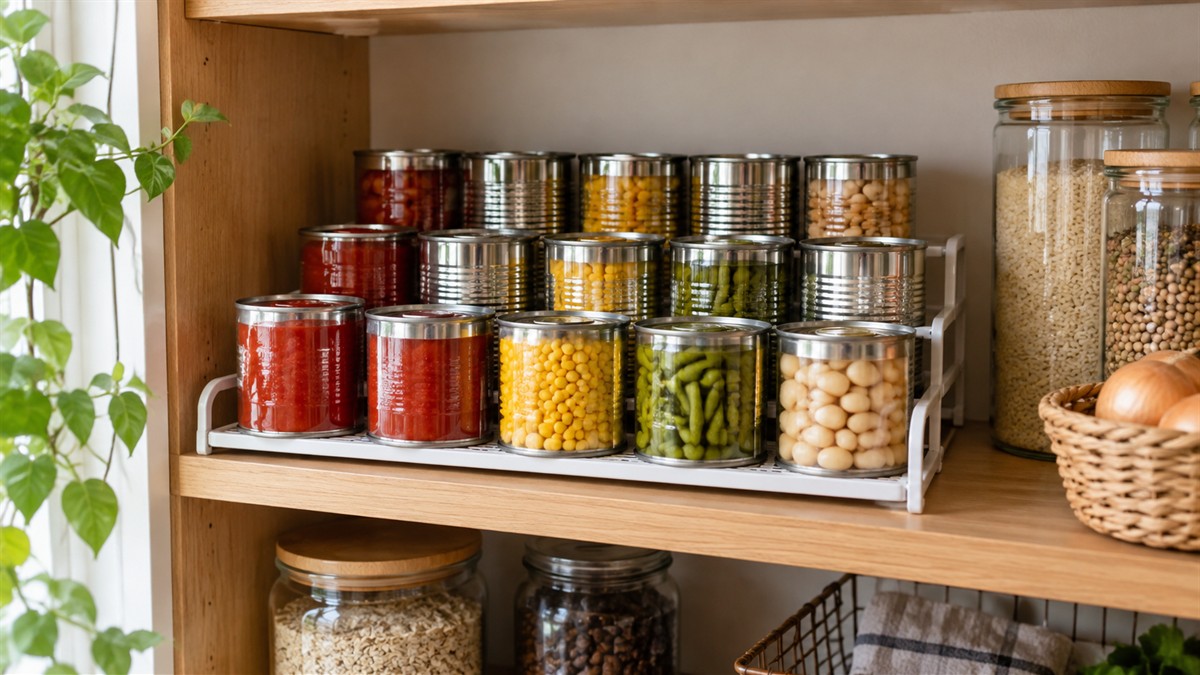
Texas A&M adds three shelf rules in one passage. Keep commercially canned foods “clean and free of dust, which can drop into them when opened.” Store foods off the floor and away from walls to allow for circulation. Keep them away from light and heat as much as possible. A food-bank guide hosted by Cerritos College is stricter about the wall: it says to store cans and boxes off the floor and 18 inches away from the wall. That figure comes from a distribution pantry, and a home shelf that sits against the wall cannot meet it, so treat it as a different setting from your kitchen.
For order, three pages say the same thing. The Ohio State blog describes the first-in, first-out rule: use the oldest products first and place newly bought cans behind the same products already on the shelf. North Carolina A&T says to store newer food packages behind older ones. North Dakota State goes a step further and says to write the date of purchase on the packages when you get home and to arrange your cupboards in first-in, first-out order. Purdue notes that dusty cans or torn labels may indicate old stock, which is a useful test at the store.
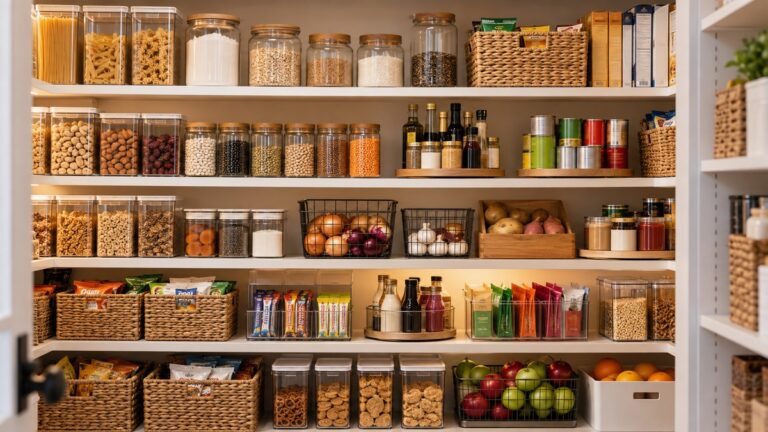
The pages do not say which shelf height suits heavy cans, how deep a shelf should be, or how to arrange cans by size, so those choices stay yours. For shelf options in a small kitchen, see our guide to small kitchen pantry shelving. If your pantry is under a staircase, our guide to pantry storage under stairs covers that layout.
How long cans keep: where the sources differ
The shelf-life figures split into two groups. Three pages give a range by acid level: 12 to 18 months for high-acid foods such as tomatoes and fruit, and two to five years for low-acid foods such as canned meat and vegetables. Purdue gives a shorter and flatter number. The table shows each page in its own words, with our conversion to months in the last column (1 year = 12 months).
| Source | High-acid canned food | Low-acid canned food | In months (our conversion) |
|---|---|---|---|
| North Dakota State University Extension | Up to 18 months | Two to five years | Up to 18; 24 to 60 |
| North Carolina A&T Extension | 12 to 18 months | Two to five years | 12 to 18; 24 to 60 |
| Ohio State University Extension, Wayne County | 12 to 18 months | 2 to 5 years, but “for best practice, use within the year” | 12 to 18; 24 to 60 |
| Purdue Extension (CFS-423-W) | Try not to keep canned foods more than one year; juices not more than nine months | No split by acid level; the same one-year guidance | 12; juices 9 |
The same Ohio State blog adds a second figure for best quality: use home-canned foods within one year and commercially processed cans within two years. North Dakota State lists home-canned food at one year from the date of canning. So the Ohio State page alone carries several horizons: within the year for best practice, within two years for commercially processed cans, and 12 to 18 months or two to five years by acid level. The top of the low-acid range (60 months) is five times Purdue’s 12 months (60 ÷ 12 = 5). None of the pages explains the gap, and the Purdue publication carries no date in the text we read, so it may reflect older practice.
Illinois Extension frames the question differently. It says the pack date printed on canned foods is the date they were packaged, and that canned foods “will be safe but may have changes in taste and texture for many years after this date.” North Dakota State says a “best if used by” date tells you how long a product keeps its best flavor or quality, and that it is not a safety date. Virginia Tech says canned vegetables remain safe after the use-by date, though overall quality and nutritional value may have diminished. So the shelf-life numbers describe quality, and the cans themselves are judged by the checks in the next section.
To turn the ranges into dates, add the months to the month you bought the can. The table assumes a purchase in January 2026, which is our own example.
| Horizon | Months added | Check-by month (from January 2026) |
|---|---|---|
| Purdue one-year guidance | 12 | January 2027 |
| High-acid, upper end (three pages) | 18 | July 2027 |
| Low-acid, lower end (three pages) | 24 | January 2028 |
| Low-acid, upper end (three pages) | 60 | January 2031 |
A pantry that holds both fruit and canned meat needs two rules, one for each acid group, or a single conservative rule of your own. If you choose the single rule, the pages support using the one-year horizon as the check point, with the rest of the range as an upper limit.
Check each can before and after you shelve it
All of the pages that cover can condition point to the same three signs. Bulges come first. Purdue’s can-safety tips say: “Bulging cans — Spoiled! Throw away!” The Ohio State blog says that if cans are bulging, the food inside is spoiled and they should be discarded. Illinois Extension says not to use food from swollen cans, because that is a sign Clostridium botulinum could be growing inside and producing toxins that will make you sick. North Dakota State adds that you should not buy or use food from cans that are leaking or bulging.
Dents are less clear. The pages draw the line in different places, so the table shows each one.
| Source | What it says about dents |
|---|---|
| Purdue Extension | Do not buy cans with dents on the side seam or on the rim seams at the top or bottom; check carefully for leakage and throw leaky cans away |
| North Dakota State University Extension | Do not buy or use food from cans with sharp dents, especially in the seam |
| Ohio State University Extension, Wayne County | Dents in the side seam or rim seams mean the food was exposed to air |
| Virginia Tech Cooperative Extension | Discard badly dented, swollen and rusty cans |
| University of Florida IFAS Extension, Sarasota County | A small dent on an otherwise sound can leaves the food safe; discard cans with deep dents, large enough to lay a finger into |
Read together, the pages point at seams and depth. A can that is dented on a seam or on the rim, or dented sharply or deeply, belongs in the trash. The Florida page is the only one that says a small dent on an otherwise sound can leaves the food safe to eat, and the other three pages do not mention small dents away from the seams. If you are unsure which category a dent falls in, the pages do not offer a way to judge it beyond the finger depth, so follow the stricter pages and discard the can.
Rust needs a second look. Purdue says to check rusty cans for leakage because the rust may have penetrated the can. The Ohio State blog says not to use cans that have leaks, or food in rusty cans. The pages do not say how to tell surface rust from rust that has gone through the metal, and the Ohio State wording is the stricter of the two.
Finally, a can that misbehaves when opened is a reason to stop. The Florida page says that a can that hisses loudly while its contents spurt out forcefully is a strong indication the food is unsafe and should be discarded, and that you should never taste or use the food.
Not every canned food belongs on the pantry shelf
The Florida page makes a point that is easy to miss: not all canned foods are shelf stable. It names ham and seafood as items that are not safe to eat at room temperature and says they are labeled as requiring refrigeration. Read the label before a can goes on the pantry shelf. North Dakota State also covers cans after opening: for best quality, remove the food from the can and put it in another covered container before refrigerating or freezing it. The Ohio State blog says that once a can is opened it becomes perishable.
Shelf arithmetic: how much food weight sits on a shelf of cans
The pages we opened give no weight limit for a home pantry shelf, so we cannot say how many cans a given shelf holds. What they do give is the weight of food in each can size. The University of Nebraska–Lincoln can-size chart lists approximate food weights, which exclude the can itself. The table multiplies each weight by 12 cans, our assumed count for one shelf, and converts ounces to pounds by dividing by 16.
| Can size (UNL chart) | Food weight per can | 12 cans in ounces | 12 cans in pounds |
|---|---|---|---|
| No. 303 | 15 to 17 ounces | 12 × 15 = 180 to 12 × 17 = 204 | 11.25 to 12.75 |
| No. 2 | 20 ounces | 12 × 20 = 240 | 15.0 |
| No. 2½ | 27 to 29 ounces | 12 × 27 = 324 to 12 × 29 = 348 | 20.25 to 21.75 |
| No. 10 | 6½ pounds to 7 pounds 5 ounces | 12 × 104 = 1,248 to 12 × 117 = 1,404 | 78.0 to 87.75 |
The No. 10 row converts 6½ pounds to 104 ounces (6.5 × 16) and 7 pounds 5 ounces to 117 ounces (7 × 16 + 5). A dozen No. 303 cans hold about one-seventh the food weight of a dozen No. 10 cans (11.25 ÷ 78 ≈ 0.14, comparing the low ends of both ranges). The chart weighs the food only, so the steel adds to each figure. Compare your total with the load rating from the maker of your shelf, because the pages we opened do not state one for any shelf.
How we chose
This guide uses pages that we opened on 2026-10-21 and whose text contained what we cite. We looked for university extension publications on pantry storage first, then for can-condition checks, then for can-size data. We kept the Purdue publication, although it has no date, because it covers cupboard storage in the most detail, and we flag it where its numbers differ. The Los Angeles Regional Food Bank guide is a nonprofit document for distributing food, and we label it that way. Pages from the USDA Food Safety and Inspection Service, FoodSafety.gov, the CDC, the University of Minnesota and Clemson refused our download, so we did not use them. Virginia Tech’s guide, revised in October 2025, is the most recent extension page in the set.
We did not rank the pages. Where they disagree, the tables show both figures. The temperature comparison, the month conversions and the weight arithmetic are our own calculations from the stated figures.
Mistakes to avoid
- Storing cans above the stove or under the sink. North Dakota State and North Carolina A&T both name these as places to avoid.
- Keeping cans in a garage or shed. The Ohio State blog says not to store canned goods above 95 degrees, such as in a shed or garage.
- Stacking new cans in front of old ones. The Ohio State blog and North Carolina A&T both say to place newer cans behind older ones.
- Using a bulging can. Purdue, Ohio State and Illinois Extension all say to throw it away or not to use it.
- Leaving dust on the cans. Texas A&M says to keep cans clean and free of dust.
- Treating a best-by date as a safety date. North Dakota State says it is not a safety date.
What we could not verify (what the sources do not say)
The pages we opened do not give a shelf height for heavy cans, a shelf depth, a shelf load rating, or a can count per shelf, so those parts of the arithmetic use our own assumptions. They do not explain why Purdue’s one-year figure is so much shorter than the other pages. They do not say how to judge surface rust or a dent that is neither small nor deep. The Purdue publication is undated, the Ohio State blog is dated April 2016, and the food-bank guide is written for distribution pantries rather than homes. The can-size chart gives the weight of the food and says nothing about the weight of the can.
Frequently asked questions
Where is the best place to store canned food in the house?
A cool, dry, dark cabinet or closet away from the stove, oven, dishwasher, water heater and hot pipes. Texas A&M gives 50 to 70 degrees Fahrenheit as the ideal range, and North Carolina A&T says to avoid basements, garages and spots near the stove or under the sink.
How long can canned food stay on the shelf?
It depends on the page. Three extension pages give up to 18 months for high-acid foods such as tomatoes and fruit and two to five years for low-acid foods such as meat and vegetables. Purdue says to try not to keep canned foods more than one year.
Is a dented can safe to use?
Not always. The Florida page says a small dent on an otherwise sound can leaves the food safe, but it says to discard cans with deep dents. Purdue says not to buy cans with dents on the side seam or the rims, North Dakota State says not to buy or use cans with sharp dents, and the Ohio State blog says dents in the seams mean the food was exposed to air.
Should I keep canned food off the floor?
Yes. Texas A&M says to store foods off the floor and away from walls so air can circulate, and the food-bank guide says to store cans and boxes off the floor.
Do I need to date canned food?
North Dakota State says to write the date of purchase on each package when you get home and to arrange the cupboard in first-in, first-out order. The date lets you apply whichever shelf-life figure you choose.
Can I leave leftovers in the open can?
Move them. North Dakota State says that for best quality you should put the food into another covered container before refrigerating or freezing it, and the Ohio State blog says an opened can becomes perishable.
Bottom line
Shelve canned food cool and dry, oldest in front and dated, and discard any can that bulges, leaks or is dented on a seam.
Sources
- https://www.ndsu.edu/agriculture/extension/publications/questions-and-answers-about-storing-canned-and-packaged-food (opened 2026-10-21)
- https://www.extension.purdue.edu/extmedia/CFS/CFS-423-W.pdf (opened 2026-10-21)
- https://agrilifeextension.tamu.edu/wp-content/uploads/2025/04/safe-home-food-storages.pdf (opened 2026-10-21)
- https://wayne.osu.edu/news/points-ponder-while-cleaning-out-pantry (opened 2026-10-21)
- https://extension.illinois.edu/food-safety/room-temperature-storage (opened 2026-10-21)
- https://www.ncat.edu/caes/cooperative-extension/covid-19/stocking-up.php (opened 2026-10-21)
- https://blogs.ifas.ufl.edu/sarasotaco/2021/06/03/disaster-preparedness-consider-shelf-stable-food-safety/ (opened 2026-10-21)
- https://ext.vt.edu/content/pubs_ext_vt_edu/en/348/348-960/348-960.html (opened 2026-10-21)
- https://food.unl.edu/how-interpret-can-size-numbers (opened 2026-10-21)
- https://www.cerritos.edu/financial-aid/_includes/docs/ShelfLifeGuide.pdf (opened 2026-10-21)
Disclosure: As an Amazon Associate we earn from qualifying purchases.