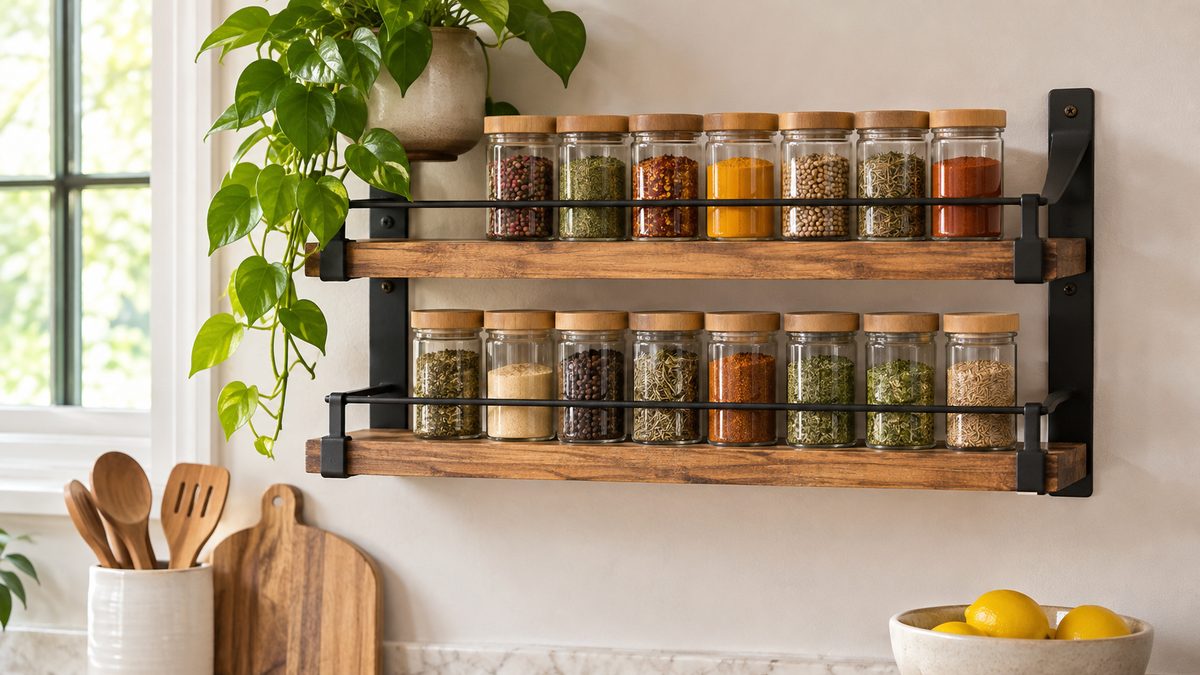
How to Store Spices on a Kitchen Wall Shelf
How to Store Spices on a Kitchen Wall Shelf
As an Amazon Associate we earn from qualifying purchases.
To store spices on a kitchen wall shelf, keep them in airtight containers, place the shelf away from the stove, the sink and direct sunlight, and fix the shelf to a wall stud or to anchors rated for the load. Penn State Extension says spices and herbs “should be stored in airtight containers in dry places away from sunlight and heat.” A wall shelf can meet those conditions, but only if you choose the spot carefully. The location usually matters more than the shelf itself.
Quick answer
- Pick a wall that is not beside the range, the oven or the sink. Penn State Extension warns that “Placing the spice rack above the stove quickly reduces the quality of those flavorings.”
- Store every spice in an airtight container, and keep the containers closed between uses.
- Find a stud for the shelf bracket. If you cannot, use anchors rated for the load and check the wall type first.
- Label each container with the date you bought or made the spice, and replace any spice whose aroma has faded.
Why the spot on the wall matters more than the shelf
A spice shelf does not protect spices by itself. What protects them is the environment around the jar. The Penn State Extension guidance on staple foods lists three things to avoid: sunlight, heat and moisture. A wall shelf is often placed close to exactly the sources of those conditions, because the kitchen wall near the cooking area is where people want the spices to be within reach.
Before you drill anything, look at what sits under and beside the shelf. Consider these questions:
- Is the shelf within about a forearm’s reach of a range hood, a stovetop or an oven vent?
- Is it directly above a dishwasher, a sink or a window that gets afternoon sun?
- Will steam from cooking reach the shelf every day?
If the answer to any of these is yes, consider another wall, such as one beside a pantry door or a wall away from the cooking zone. The sources we opened do not give a required distance from a stove. Judge the distance by the heat and steam your own kitchen produces.
Keep the wall shelf away from the stove and the sink
The University of Illinois Extension guidance on homemade seasoning blends gives the same rule in plain words: keep them in “a cool, dry place (not near a stove or sink).” The reason is the same for store-bought spices. Heat and steam speed up the loss of aroma and flavor, and a spice that has lost its aroma is still a spice you have to throw away.
Heat from the cooking zone
A spice that sits in the warm air above a burner will lose its character faster than one in a cupboard. If your only wall is above the range, consider moving the spices to a cabinet and using the wall shelf for items that are not heat-sensitive, such as dry goods in sealed packaging. For ideas on shelving in a compact kitchen, see our guide to shelf ideas for a small kitchen. The sources do not say how far above a burner a shelf must be, so treat this as a judgment call rather than a rule.
Moisture near the sink
Moisture is the second risk. Powdered spices can clump when humid air reaches them, and the sources recommend airtight containers for that reason. A shelf beside the sink gets splashes and steam, so the containers need closed lids and dry hands when you reach for them.
Choose containers that stay airtight
Penn State Extension recommends airtight containers for spices and herbs. On an open wall shelf, containers do more than hold the spice. They block light and air from the spice and keep dust off the lid. Choose jars or tins with a lid that seals firmly and that you can open with one hand while cooking.
Avoid leaving spices in their original paper or thin bags on an open shelf. Once a bag is opened, move the spice into a container with a tight lid. Use a container that is the right size for the amount you use. A large jar of a rarely used spice exposes it to more air each time you open it.
Clear containers let you see the spice, but they also let in light. If you use clear jars, store them so that the front of the shelf is not in direct sun. Dark or opaque containers help if the wall gets bright light for part of the day.
Mounting the shelf safely
A spice shelf is light compared with a bookcase, but it still needs a secure mount. A shelf that pulls away from the wall can drop jars, and glass jars that land on a tile floor can break. The CPSC staff report on anchoring furniture gives a basic rule for any wall fixture: “a wood screw is usually provided and must be installed in a stud.” If a bracket can be fixed into a stud, that is the most reliable choice.
Find a stud first
For a wider look at spice shelf designs, see our guide to spice shelves for the kitchen. Use a stud finder to locate a wall stud, then mark the center of the stud where the bracket screw will go. Confirm the stud with a test hole or a second reading, because a stud finder can read a pipe or wire as a stud. Use screws long enough to reach well into the stud. The sources we opened do not give a screw length for a spice shelf, so follow the length in the bracket instructions.
If you need anchors
If the bracket does not land on a stud, use anchors rated for the wall and the load. The CPSC staff report says that “Drywall anchors are strongest when pulled at an angle parallel to the wall (a shearing force).” In practice that means a shelf that puts the weight straight out from the wall pulls on anchors in a way they are not built for. Choose a shelf with a bracket that supports the weight below the shelf, and place the anchors so that the load is spread across more than one point.
Check the wall type before you buy anchors. Drywall, plaster and masonry need different anchors. The sources we opened do not give a load rating for any anchor, so read the anchor package and the shelf’s hardware notes, and keep the spices light enough for what the hardware says it can hold. Do not assume a generic anchor will hold a loaded spice rack.
If you plan to hold more than a few jars, our guide to floating shelves that can hold weight explains what to look for in the hardware. Once the shelf is up, give it a gentle push before you load it. If it moves, stop and fix the mount before you add the jars.
Arrange the spices so you can see and reach them
A wall shelf works best when each spice has one place. Group spices by how often you use them. Keep the everyday spices at the front, within easy reach, and put the less-used ones toward the back or on a higher shelf. Put one spice in each container, and keep the label facing out so you can read it without taking the jar down.
If you cook with many blends, keep the blends separate from the single spices. Blends are easier to lose track of because their names are less obvious. A single shelf can hold a small set of basics and one shelf can hold blends, if you have room for two shelves.
For a small kitchen with limited wall space, a tiered rack can make better use of the same wall. If you are comparing layouts, our guide to the best three-tier spice shelves covers how tiers change the reach and the visibility of each spice.
Whole spices and ground spices
Whole spices keep longer than ground ones. Penn State Extension says that “Whole spices and herbs will maintain their quality longer than ground ones.” If you buy in bulk, store the whole spice and grind only what you need for a recipe. This also means that a ground spice on a wall shelf loses quality sooner than a whole one in the same spot.
The extension guidance also gives a time frame for ground spices. Penn State Extension says to “Evaluate the freshness of ground spices and all herbs after six months.” That is a checkpoint, not a fixed expiry date. A spice bought in a large jar may be past its best long before a small jar of the same spice, so buy the amount you will use in about six months when you can.
Label, date and rotate
Labels are the simplest way to keep a wall shelf honest. Write the spice name and the date you bought or made it on a label or directly on the lid. The University of Illinois Extension guidance on homemade blends recommends labeling with the name, the date and the expiration date, and to “Plan to use within 6 months.”
When you buy a new jar of a spice you already have, move the older jar to the front so you use it first. This is a simple habit, and it keeps the older spice from sitting at the back of the shelf until it fades.
Check whether a spice is still good
You do not need a special test. Penn State Extension recommends checking the aroma: “Check the aroma of spices and herbs to determine freshness.” It adds: “If the characteristic aroma of the spice or herb has faded, replace it.” Open the jar, smell it and compare the smell with what you expect from that spice. A spice with little smell will also give little flavor to a dish.
Penn State Extension also notes that the freezer can extend shelf life. This is an option for some spices, but a wall shelf is not a place to freeze anything. If you use the freezer, let the container reach room temperature before opening it, to limit condensation. The sources we opened do not say which spices freeze best.
How we checked
- Penn State Extension, “Storing Staple Ingredients in the Kitchen”: opened 2026-10-28, https://extension.psu.edu/storing-staple-ingredients-in-the-kitchen
- University of Illinois Extension, “Spice It Up!”: opened 2026-10-28, https://eat-move-save.extension.illinois.edu/blog/spice-it
- CPSC staff report TR-15/001, “Preliminary Evaluation of Anchoring Furniture and Televisions Without Tools”: opened 2026-10-27, https://www.cpsc.gov/s3fs-public/pdfs/Tipover-Prevention-Project-Anchors-without-Tools.pdf. This is a staff report. The report says it “has not been reviewed or approved by” the commission.
Each quoted sentence was matched against the text of the page as fetched. The CPSC report covers anchoring furniture, not kitchen shelves, so its points about studs and anchors are general only.
How we chose
This guide covers placement, containers, mounting and freshness, because those are the questions a reader asks before putting spices on a wall. Each point is either taken from one of the three sources above or stated as a judgment with its assumption. We did not rank products for this topic, and we left out advice that the sources do not support, such as a shelf load or a spacing from the stove.
What we could not verify
- The sources we opened do not give a minimum distance between a spice shelf and a stove, oven or sink.
- The sources do not give a weight limit for a kitchen wall shelf or for any anchor.
- The sources do not give a screw length or anchor size for a spice shelf.
- The sources do not say which spices keep best in the freezer.
- The sources do not say how long a spice keeps when stored on an open wall shelf compared with inside a cabinet.
Mistakes to avoid
- Mounting above the range. Penn State Extension says that placing the spice rack above the stove “quickly reduces the quality of those flavorings.” Move the spices or the shelf.
- Leaving spices in open bags. The extension guidance calls for airtight containers, so move the spice into a sealed container once it is opened.
- Keeping old jars at the back. Spices that are not used will fade. Check the aroma and replace what has lost it.
- Hanging the shelf on drywall without a stud. The CPSC report says a wood screw “must be installed in a stud.” Use a stud or an anchor rated for the wall and the load.
- Using the freezer as a storage plan. The freezer can extend shelf life, but it does not replace a good storage place on the shelf.
FAQ
Can I store spices on an open kitchen wall shelf?
Yes, if the shelf is away from the stove, the sink and direct sunlight, and the spices are in airtight containers. Penn State Extension says spices and herbs “should be stored in airtight containers in dry places away from sunlight and heat.”
Is it bad to store spices next to the stove?
Yes. Penn State Extension says that “Placing the spice rack above the stove quickly reduces the quality of those flavorings.” The sources we opened do not give a set distance, so keep the spices well away from the cooking zone.
What containers are best for spices on a wall shelf?
Use airtight containers, such as jars or tins with a lid that seals. Penn State Extension recommends airtight containers for spices and herbs, and the University of Illinois Extension recommends “Use airtight containers or jars” for homemade blends.
How do I know if a spice has gone bad?
Check the aroma. Penn State Extension says that “If the characteristic aroma of the spice or herb has faded, replace it.” The sources do not give a fixed expiry date for every spice.
Should I drill into drywall for a spice shelf?
Find a stud if you can. The CPSC staff report says that “a wood screw is usually provided and must be installed in a stud.” If you cannot reach a stud, use an anchor rated for the wall type and the load, and check the hardware notes for the limit.
How long do ground spices last?
Penn State Extension says to “Evaluate the freshness of ground spices and all herbs after six months.” That is a checkpoint for freshness, and the aroma test is still the better guide.
Bottom line
Store spices on a kitchen wall shelf only where the spot is dry, out of direct sun, and well away from the stove and sink. If the wall fails that test, use a cabinet instead. If it passes, mount the shelf into a stud, use airtight containers, and replace any spice whose aroma has faded.
Sources
- Penn State Extension, “Storing Staple Ingredients in the Kitchen”, https://extension.psu.edu/storing-staple-ingredients-in-the-kitchen (opened 2026-10-28)
- University of Illinois Extension, “Spice It Up!”, https://eat-move-save.extension.illinois.edu/blog/spice-it (opened 2026-10-28)
- CPSC staff report TR-15/001, “Preliminary Evaluation of Anchoring Furniture and Televisions Without Tools”, https://www.cpsc.gov/s3fs-public/pdfs/Tipover-Prevention-Project-Anchors-without-Tools.pdf (opened 2026-10-27)


