Best Shoe Organizer Dresser: 5 Picks and How to Choose
As an Amazon Associate we earn from qualifying purchases. Details
If you want a shoe organizer dresser setup that works, start with two numbers: the space you have and the number of pairs you own. This guide compares five shoe organizers by stated size, stated capacity and stated weight limit, then explains which one fits which situation. Every figure below comes from the product listing, and where a listing is unclear or contradicts itself, the article says so. It also helps you decide whether a shoe organizer belongs on or beside the dresser at all. Pair counts in listings are the seller’s estimate, so treat them as a starting point. Read the picks, measure the spot, then choose.
Quick answer
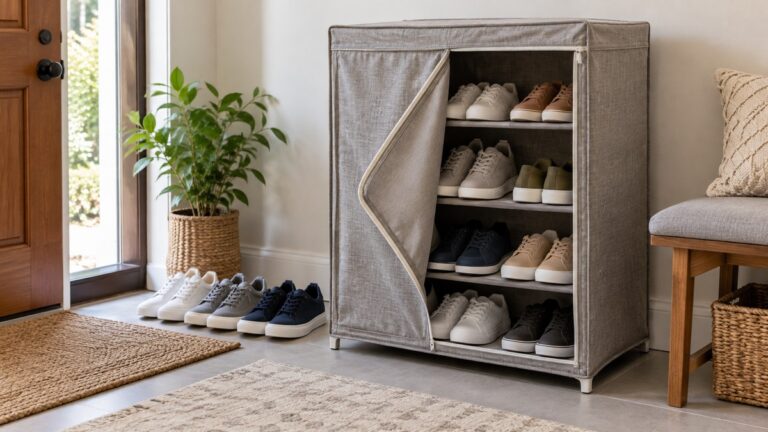
Start with the enclosed six-tier cabinet if you want shoes hidden from dust and pets. Its listing gives an outside size of 12″D x 27.8″W x 41.9″H and says it holds 18–24 pairs. Choose the narrow 10-tier rack if you have a tight, tall spot and can secure it to the wall. Choose the fabric organizer if you need it to fold flat between uses. Choose the walnut two-drawer cabinet if you want drawers and an anti-tipping device. Use the clear stackable box only for a small set of shoes. If your shoes already fit on your closet floor, you may not need any of these.
How to choose a shoe organizer for a dresser setting
Several listings in this set name closets, entryways and bedrooms as the intended room. A dresser adds one more constraint: the space on top, beside it, or in front of it. Four checks decide the fit.
- Footprint. Measure the open area first. Compare it with the outside size in the listing, not the inside. Overall dimensions and shelf interior dimensions often differ, so quote and check both where the listing gives them.
- Pairs per unit. The listings in this set state 14, 16–24, 18–22 and 18–24 pairs. Count your own shoes, add room for boots, then choose.
- Enclosed or open. Doors and covers protect shoes from dust. One listing says its enclosure keeps shoes “hidden, dust-free, and less accessible to pets.” Open shelves let you grab a pair quickly, but they collect dust. For more on closed designs, see closed shoe organizers and narrow shoe cabinets with doors.
- Weight limits. Say whether a figure is per shelf or total. One listing gives “up to 10 lbs per layer” and a separate maximum of 50 pounds for the unit. Those figures measure different things, so do not add them together.
- Tip-over. The U.S. Consumer Product Safety Commission (CPSC) advises that new furniture such as dressers is sold with anti-tip devices that should be installed right away. Tall shelving units need the same care.
Products that fit this
Five options below suit a dresser setting. Each card shows the listing’s own specs, pros and cons.
1. 6-Tier Shoe Storage Cabinet with Fabric Cover, Hard Flip Doors, Holds 18–24 Pairs, Enclosed (Best overall)
Specs from the listing (checked 2026-10-13):
- Product Dimensions: 12″D x 27.8″W x 41.9″H
- Number of Shelves: 6
- Number of Doors: 3
- Material: Metal, Plastic, Polypropylene
- Installation Type: Freestanding
Pros
- Outside size 12″D x 27.8″W x 41.9″H
- Six shelves and three doors in the specs
- Enclosed flip-up doors described as dust-free and less accessible to pets
Cons
- No shelf weight rating in the listing
- Each door must be lifted to reach shoes
Best for: Closed storage in a bedroom or entryway with 12 inches of depth to spare
Skip if: You need to grab a pair quickly without lifting a door
View on Amazon (affiliate link)
2. VILICK Shoe Rack with Cover Narrow Shoe Organizer with 4 Side Pockets 10 Tier Tall Shoe Storage (Best for a tight, tall spot)
Specs from the listing (checked 2026-10-13):
- Product Dimensions: 11.8″D x 17.7″W x 62.2″H
- Number of Shelves: 10
- Weight Capacity Maximum: 50 pounds
- Included Components: Dust Cover, Fabric Shelf, Metal Tube, Plastic Connector, Small Wooden Hammer
- Material: Fabric, Metal, Plastic
Pros
- Product dimensions 11.8″D x 17.7″W x 62.2″H
- Ten shelves in the specs
- Zipped dust cover with 4 side pockets
Cons
- No anti-tip hardware in the included components
- Two weight figures: up to 10 lbs per layer and 50 pounds maximum
Best for: A narrow, tall spot near a dresser where the unit can be secured
Skip if: You want a closed cabinet or cannot secure a 62.2-inch-tall unit
View on Amazon (affiliate link)
3. Plus Size 2 Pack Shoe Organizer for Closet, Foldable Shoe Storage Box (Best for flat storage)
Specs from the listing (checked 2026-10-13):
- Item Dimensions L x W x H: 17″L x 17″W x 12.99″H
- Capacity: 59 liters
- Number of Compartments: 16
- Closure Type: Flip Top
- Water Resistance Level: Waterproof
Pros
- Item dimensions 17″L x 17″W x 12.99″H
- Capacity 59 liters and 16 compartments
- Clear PVC lid and mesh pocket
Cons
- Material field holds a seller badge rather than a material, so material comes from the bullets
- Fabric walls rather than a rigid cabinet
Best for: Shoes stored out of sight between uses, such as under a bed or in a closet
Skip if: You want a rigid cabinet that stands up to heavy use
View on Amazon (affiliate link)
4. Shoe Cabinet Storage, Modern Freestanding Organizer with 2 Flip Drawers, Narrow Shoe Rack (Best with drawers)
Specs from the listing (checked 2026-10-13):
- Product Dimensions: 9.4″D x 31.5″W x 38″H
- Weight Capacity Maximum: 80 pounds
- Number of Drawers: 2
- Additional Features: Anti-Tipping Device
- Material: Engineered Wood
Pros
- Product dimensions 9.4″D x 31.5″W x 38″H, the shallowest depth of these five picks
- Two drawers in the specs, with flip-drawer access described in the bullets
- Weight Capacity Maximum of 80 pounds for the top, per the listing
Cons
- About 14 pairs of adult shoes, the lowest pair count of these five picks
- The listing gives no boot count; children's shoes are described at about 20 pairs
- Engineered wood material, so it is not metal or fabric
Best for: Drawer storage in an entryway or hallway with a tip-over device
Skip if: You need more than 14 pairs or mainly store boots
View on Amazon (affiliate link)
5. Sturdy Clear Shoe Organizer with Magnetic Door, Stackable Shoe Storage Box (Best for small sets)
Specs from the listing (checked 2026-10-13):
- Item Dimensions L x W x H: 13.5″L x 10.5″W x 7.2″H
- Capacity: 7.5 pounds
- Storage Volume: 119.9 cubic centimeters
- Closure Type: Magnetic
- Material: Polypropylene
Pros
- Item dimensions 13.5″L x 10.5″W x 7.2″H per box
- Magnetic front door, per the specs
- Walls described as “thick, clear, and built to hold its shape”
- Six boxes in the set, per the specs
Cons
- Storage volume figure does not match the outside size
- Capacity of 7.5 pounds is a weight, not a volume
Best for: A small set of shoes in a closet or drawer
Skip if: You own boots or a full closet of pairs
View on Amazon (affiliate link)
Best overall: the enclosed six-tier cabinet
This cabinet’s listing gives an outside size of 12″D x 27.8″W x 41.9″H, with six shelves and three doors. The listing gives a fabric top and a metal frame. It says assembly is tool-free and that the surface wipes clean with a damp cloth. The listing does not give a shelf weight rating, so keep heavy boots on the lowest shelf until you have checked the weight the maker allows. Skip it if you need to grab a pair in a hurry, since each door must be lifted to reach the shoes.
Best for a tight, tall spot: the 10-tier rack with cover
The listing gives 11.8″D x 17.7″W x 62.2″H, and its bullets say it “can easily store 18-22 pairs of shoes.” The cover zips closed and has 4 side pockets for small items. One shelf can be removed “to store shoe boxes, high boots, toys or other large items.” The weight figures are “up to 10 lbs per layer” and a maximum of 50 pounds for the unit. The included components do not list any anti-tip hardware, so plan how you will secure a 62.2-inch-tall unit before you buy. Skip it if you want a closed cabinet, since the cover is a zipped fabric panel.
Best for flat storage: the fabric organizer, two-pack
The listing gives 17″L x 17″W x 12.99″H, a capacity of 59 liters and 16 compartments. The bullets say it “folds flat to 1.38″ thick” when not in use. It has a flip top with a zipper and a clear PVC lid. Its material field holds a seller badge instead of a material, so the material comes from the bullets: Oxford fabric with reinforced PP boards. Skip it if you want a rigid cabinet, because the walls are fabric.
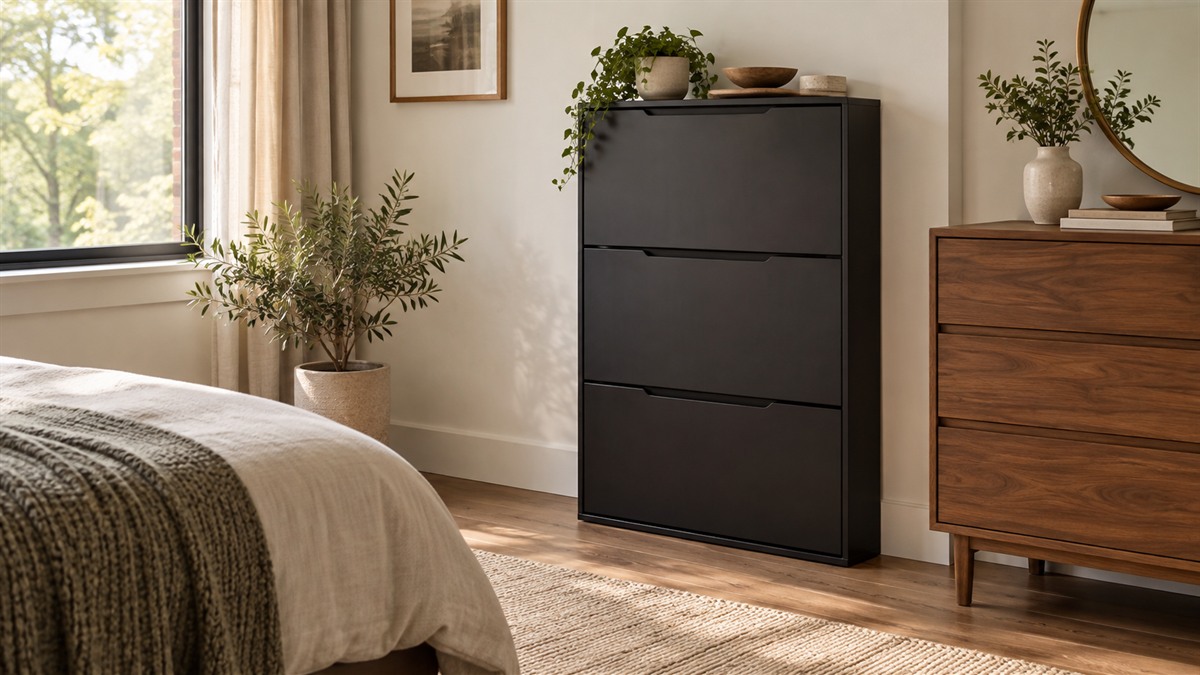
Best with drawers: the walnut two-drawer cabinet
The listing gives 9.4″D x 31.5″W x 38″H and says the cabinet has two flip drawers. It states that the top can “withstand up to 80 pounds” and that the cabinet “can accommodate about 14 pairs of adult women’s shoes and adult men’s shoes.” The anti-tipping device “can be fixed to the wall to prevent tipping.” The listing states an engineered wood material and assembly with numbered parts. Skip it if you need more than 14 pairs or mainly store boots, since the listing gives a shoe count only.
Best for small sets: the clear stackable box
The listing gives 13.5″L x 10.5″W x 7.2″H for each box and a six-box set. It has a magnetic front door and a stacking system the bullets call a “stackable peg-lock system.” The bullets say the large capacity “allows sneakers to stand upright.” Two figures conflict. The listing gives a storage volume of 119.9 cubic centimeters, which does not fit a box of that outside size, and a capacity of 7.5 pounds, which is a weight. Rely on the outside size only. At 7.2 inches tall, the box will not stand boots upright. Skip it for boots or for a full closet of pairs.
Worked example: two narrow racks side by side
Step 1: two 10-tier racks, each 17.7 inches wide, need 2 times 17.7 equals 35.4 inches of floor width before any gap for the cover. Step 2: the six-tier cabinet is 27.8 inches wide, so the pair is 35.4 minus 27.8 equals 7.6 inches wider than that cabinet. Check: 27.8 plus 7.6 equals 35.4. For more storage ideas, see small closet shoe organizer ideas.
Depth is the second check, and it can rule out a unit even when the width works. Neither leaves room for the doors, drawers or cover to open, so measure how far each one moves before you buy.
Mistakes to avoid
- Buying by pair count alone. Pair counts are seller estimates, and they depend on shoe size and boot height.
- Ignoring height. A 62.2-inch unit and a 38-inch cabinet need very different wall space, so measure the height of your spot, not only its floor area.
- Skipping tip-over hardware. The CPSC advice on dressers and tall furniture applies to shoe storage that is tall or top-heavy.
- Mixing up weight figures. A per-layer figure and a total figure are different numbers.
- Trusting a single number. When a listing gives two sets of dimensions that do not match, use the outside size from the main specs and measure your own space.
FAQ
Can a shoe organizer sit on top of a dresser?
Only if the top has room for the organizer’s outside footprint, plus clearance for the doors or drawers. Measure the open top’s width and depth, then compare them with the outside size in the listing. Check that nothing above, such as a mirror or lamp, blocks the door.
Should I anchor a tall shoe rack to the wall?
Yes, if the unit is tall and has anti-tip hardware. The CPSC runs a public campaign, “Anchor It!,” to prevent furniture and TV tip-overs. Check your wall type first: drywall, plaster or masonry. A stud finder locates the wood or metal framing studs behind a wall, so anchor into studs or use rated anchors.
How many pairs does a shoe organizer hold?
Seller counts for these five options run from 14 pairs up to 24 pairs. These are seller estimates, and the real number depends on shoe size, heel height and boots. Count your own shoes and leave some room for new pairs.
Are fabric shoe organizers waterproof?
The fabric organizer’s listing gives “Waterproof” as its water resistance level, but its bullets describe Oxford fabric with PP boards. Let wet shoes dry before you store them, whichever organizer you choose.
Can I store boots in these organizers?
Some can. The 10-tier rack’s bullets say one shelf can be removed to store high boots. The clear box’s 7.2-inch height rules out most boots. Compare your boot height with the shelf or box before you buy.
Do I need a shoe organizer at all?
You may not. If your shoes already fit on a closet floor, in drawers, or in a shoe rack you own, you do not need to buy one. Buy only when shoes spill out of the space you have or when they need protection from dust or pets.
How do I measure a dresser top for a shoe organizer?
Measure the width and depth of the open top, then subtract any lamps, jewelry trays or boxes you keep there. Compare the remaining area with the listing’s outside size. Measure the height from the top to the ceiling or to any shelf above, and check how far the doors or drawers open. Write the numbers down before you shop.
Which pick is the best overall?
The enclosed six-tier cabinet. Its listing gives the outside size, the shelf count, the door count and a dust and pet cover. Its listing gives no shelf weight rating, so check that before you store heavy boots.
Checklist before you buy
- Write down the open space. Record the width, depth and height above the spot. Compare those numbers with the outside size in the listing, not the inside size.
- Count your pairs. Add the boots you own, then compare the total with the pair count in the listing. Treat that count as an estimate.
- Check the weight figure type. A per-shelf or per-layer number and a total number answer different questions, so note which one the listing gives.
- Look for anti-tip hardware. If the listing does not include it, plan how you will secure a tall unit, and check your wall type first.
- Confirm the assembly note. Where a listing says assembly is tool-free, check that the parts in the box match the instructions before you start.
- Read the material line. If the material field is missing or does not name a material, use the bullets for the material and treat them as the seller’s description.
Bottom line
Choose the enclosed six-tier cabinet if you want closed storage and can spare 12 inches of depth and 27.8 inches of width. Choose the narrow 10-tier rack for a tight, tall spot, and plan how to secure it. Choose the fabric organizer for flat storage, the walnut cabinet for two drawers, or the clear box for a small set. Measure the spot, count your pairs and check the anti-tip details before you buy. If your shoes already fit, skip the purchase.
Sources
- U.S. Consumer Product Safety Commission, Anchor It!: anti-tip devices for dressers and tall furniture, and the tip-over campaign
- Wikipedia, Stud finder: a stud finder locates wood or metal framing studs behind walls