Best Shoe Cubby Storage: How to Choose the Right Cubbies
As an Amazon Associate we earn from qualifying purchases. Details
Shoe cubby storage works when the cubbies fit the shoes you own, the space you have and the way you reach for a pair each morning. This guide helps you decide which kind of cubby unit suits a closet, hallway or mudroom. It explains the measurements that decide fit, the trade-off between open cubbies and units with doors, and the anchoring questions that matter for tall shelves. Every spec named here comes from a product listing, so you can check each number on the page before you buy.
Quick answer
Start with three questions: how tall your tallest shoe is, how much width and depth your floor space allows, and whether you need the shoes hidden. Open cubbies are the simplest choice for sneakers, flip flops and low-profile shoes. A bench-style unit with a wider footprint suits a hallway where you sit down to change shoes. Neither product in this set states that it has doors, so if doors are a must, look at a different product type. Check the height, depth and door width on the listing, and anchor any tall unit to the wall. The ClosetMaid cube unit suits low-profile shoes, and the shoe storage bench suits a bench-style stack in an entry.
What matters for shoe cubby storage
Shoe height and cubby opening
Measure your tallest pair before you measure the unit. A cubby that fits a sneaker can be too short for a boot with a tall shaft. Stand the shoe upright inside the cubby and check the clearance above the toe and heel, not only the width. Open cubbies show you exactly what is inside, which saves time on busy mornings. They also collect dust, so plan a regular wipe-down.
Depth from front to back
Depth decides whether a shoe sits flat or hangs over the front edge. Compare the listing’s inside depth with the length of your longest shoe. When a listing gives only an outside depth, treat the inside depth as unknown until you check the listing. Shoes that overhang the front can slide out when you reach for a pair beside them, so a little spare depth helps.
Doors or an open front
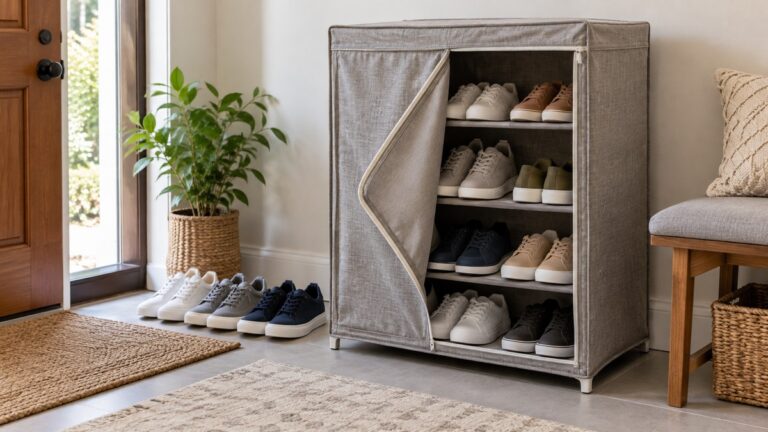
Doors keep shoes out of sight and dust out of the cubbies. They also add hinges, a deeper footprint and a door to open in a tight hall. If a closed front matters to you, search for that feature directly. For a closed-front option, see tall narrow shoe cabinets with doors. The open-front units below are the ones you can compare directly on their listings.
Footprint in a narrow space
Narrow hallways and closets punish any unit that sticks out past the wall line. Measure the clear width of the floor, then subtract the space you need to open a closet door or walk past. Stackable modules give you flexibility, because you can use one in a corner and add another later. A bench-style unit is easier to sit on while you change shoes, but it asks for a longer wall. For more layouts, see hallway shoe storage ideas.
Wall anchoring and tip-over
Tall shelving and shoe towers can tip, especially when the upper cubbies are loaded. The CPSC advises that existing top-heavy furniture can be anchored with inexpensive anti-tip brackets. Use studs or rated anchors, check whether the wall is drywall, plaster or masonry, and read the hardware notes that come with the unit. Neither listing in this set states an anti-tip kit, so plan the anchor yourself and follow the maker’s mounting instructions.
Materials and finish
Read the material line before you compare sizes. The ClosetMaid listing gives the material as Wood with a laminated finish. The bench unit’s material field says Engineered Wood, while one of its bullets says high-quality MDF board. MDF is one kind of engineered wood, so the two terms are related, but the listing does not say which panel the unit uses. Medium-density fibreboard is generally denser than plywood and stronger than particle board. Particle board is the lightest and weakest type of fiberboard, as the general reference on particle board explains. Ask the seller, or check the listing photos, before you assume either one.
1. ClosetMaid 15 Cube Stackable Storage Organizer for Shoes, Bags, Crafts, Hobbies with Wood Shelves (Best for low-profile shoes)
Specs from the listing (checked 2026-10-13):
- Product Dimensions: 11.63″D x 24.09″W x 19.29″H
- Number of Shelves: 15
- Material: Wood
- Mounting Type: Floor Mount
- Item Weight: 9.48 kg
Pros
- The listing gives each cube opening as 5.75-inch H X 4.5-inch W X 11-inch D, which suits flip flops and sandals.
- The listing says the hardware is included to stack the unit with other ClosetMaid stackable organizers.
- The listing gives a product footprint of 11.63 inches deep by 24.09 inches wide.
Cons
- The listing sizes the openings for low-profile shoes, so it is not a unit for tall boots.
- The listing does not state a weight limit, an anti-tip kit or whether wall anchors are included.
- The listing gives the height as 19-38 inches, so check the assembled height against your wall before you buy.
Best for: Flip flops, sandals and low-profile shoes stored in a closet or mudroom, where open cubes make each pair easy to find.
Skip if: Skip it if you need to store tall boots or want a bench to sit on, because the listing sizes its openings for low-profile shoes.
View on Amazon (affiliate link)
2. Shoe Storage Bench Cubby with 9 Cubbies, Wood Shoe Rack Organizer Cabinet (Best for a bench-style stack)
Specs from the listing (checked 2026-10-13):
- Product Dimensions: 11.8″D x 27.6″W x 17.7″H
- Number of Shelves: 9
- Material: Engineered Wood
- Furniture Finish: White
- Item Weight: 18.5 pounds
- Minimum Required Door Width: 27.6 inches
Pros
- The listing gives 9 cubbies and says the unit can easily store 9 pairs of shoes.
- The listing gives an overall size of 11.8 inches deep, 27.6 inches wide and 17.7 inches high.
- The listing names the unit as freestanding and lists waterproof as a special feature.
Cons
- The listing names engineered wood as the material, but one bullet calls it high-quality MDF board, so the panel type is unclear.
- The listing gives the color as Brown and the furniture finish as White, while a bullet describes a white finish, so check the photos.
- The listing gives an item weight of 18.5 pounds, so plan the move before you fill the cubbies.
Best for: A hallway or bedroom wall that can take a unit 27.6 inches wide, for a household that needs nine cubbies and no more.
Skip if: Skip it if you need doors, if the panel type matters for your room, or if your doorway cannot meet the minimum required door width of 27.6 inches the listing gives.
View on Amazon (affiliate link)
How to choose the right shoe cubby
Use one rule for each situation rather than a single best answer.
Choose open cubbies if your shoes are mostly sneakers, sandals and flats, and you want to see every pair at a glance. Open cubbies are quick to scan and easy to refill, which suits a closet where the same few pairs rotate.
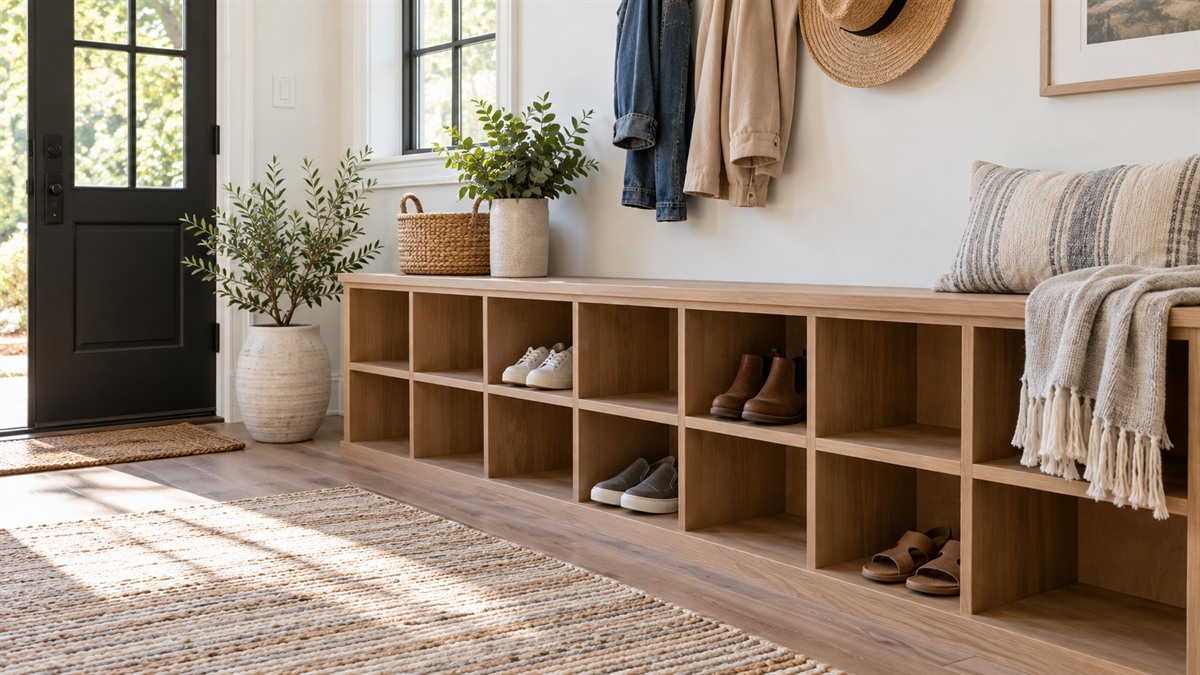
Choose a bench-style unit if you need a place to sit while you change shoes. The wider top gives you a seat and a clear spot for a bag. Check the listing width against the wall you plan to use, and leave room for your feet. For an entry layout, see entryway shoe storage.
Choose a stacking unit if your floor is narrow but your wall has height. A tall stack saves floor space, but it must be anchored, so add the anchor hardware to your shopping list before you order.
Choose a unit with doors if dust or visibility is the main problem. Doors add width and depth, so measure the clearance before you commit. For a compact closet, compare shoe storage for a small closet as well.
Read each listing in the same order every time: product dimensions first, then the cubby or opening size, then the weight and mounting notes, then the material. Doing it the same way for each unit keeps one listing from pulling your attention away from the numbers that matter.
What the listings leave out
The ClosetMaid listing does not state a weight limit, and it does not say whether a figure is per shelf or total. The bench listing does not state a weight limit either. Neither listing states an anti-tip kit. The bench listing’s bullet says tools are included, but its included components field lists only assembly instructions, so confirm what is in the box before you start the build. Where a listing is silent, treat the gap as a question for the seller or the manufacturer rather than a detail you can assume.
A shopping checklist before you order
- Measure the tallest pair of shoes you own, including boots.
- Measure the clear floor or wall space, and note where the door swings.
- Compare the listing’s inside depth with your longest shoe.
- Note the listed material and finish, and whether the listing names one or two materials.
- Check whether the listing states an anti-tip kit or anchoring hardware.
- Confirm the minimum required door width if the unit must pass through a doorway.
- Count the pairs each person uses, then add at least one spare cubby.
Layout ideas for a narrow floor
In a closet, a unit can sit under a hanging rod. In a mudroom, it can sit beside the door where coats hang. Keep the path to the door clear, because a unit that sticks out past the wall can catch a bag or a heel.
Think about the order of use too. Put the shoes you wear most often at the front or on the lowest cubby, and store spare pairs higher up or further back. If children share the space, keep their pairs low, where they can reach them without climbing. The CPSC notes that children like to climb on furniture, so anchor any tall unit and keep tempting objects off the top.
Say 4 people with 3 pairs each: 4 times 3 = 12 pairs.
If you choose the 9-cubby bench unit, it offers 9 cubbies, and the gap is 12 pairs minus 9 cubbies = 3 pairs. Those three pairs can sit on a mat beside the unit or move to a second module.
If you choose the ClosetMaid unit instead, its cube count is 15, so 15 cubbies minus 12 pairs = 3 cubbies left over for seasonal shoes or a spare pair for each person.
The example is a rule of thumb, not a measurement of your home. Count your own pairs before you choose, and remember that boots and winter shoes often need a space of their own.
Common mistakes
Measuring width and forgetting height. A unit can fit the wall and still be too short for a tall boot. Measure the opening, not only the outside.
Using the outside depth as the inside depth. An outside figure includes the frame and the back panel. Compare the inside depth with the longest shoe you own. When a listing shows only one depth figure, say so to yourself and check again before you buy.
Skipping the anchor on a tall unit. A unit that tips onto a child causes far more harm than a crooked shelf. Anchor any tall unit, and do not rely on the weight of the shoes to hold it in place.
Trusting one field when two disagree. Listings sometimes give a width in the specs and a different width in the bullets. When they differ, measure your own space and trust the tape measure.
Ignoring the doorway you must pass through. A unit can clear the wall and still fail at the door. Check the minimum required door width when the listing gives one, and measure the doorway yourself.
Buying for today’s pairs only. Households add shoes over time. Leave at least one spare cubby, or choose a stackable module that can grow with you.
Bench footprint against the cube unit
The bench-style unit lists 11.8 inches deep and 27.6 inches wide, so its footprint is 11.8 x 27.6 = 325.68 square inches. The cube unit lists 19 to 38 inches tall when assembled, while the bench stands 17.7 inches high, so the height range is the figure to compare with your wall.
FAQ
Will a shoe cubby fit boots?
Some units will and some will not. Measure your tallest boot, then compare it with the opening height the listing gives. Stand the boot upright inside the cubby before you decide. If the listing does not give an opening height, you cannot confirm the fit from the page alone.
Do shoe cubbies need to be attached to the wall?
Tall units should be anchored, as the wall anchoring section explains. Shorter bench units still need a stability check once they are loaded, because a full top shelf changes the balance of any unit.
What is the difference between open cubbies and cubbies with doors?
Open cubbies let you see every pair and reach one quickly. Doors hide shoes and reduce dust, but they add hinges, depth and a door to open in a tight hall. Neither product in this set states that it has doors.
Why do two measurements on a listing not match?
Listings sometimes give the outside size in one field and a different size in the bullets. When that happens, rely on the number you can check with a tape measure in your own space.
Can I stack shoe cubbies?
Some units are built to stack. The ClosetMaid listing says hardware is included to stack the unit, which adds height in a closet without adding floor width. Stacking adds weight at the top, so anchor the stack to the wall.
How deep should a shoe cubby be?
Measure your longest shoe and make sure the cubby is deeper than that length, with room to reach in. The ClosetMaid listing gives 11 inches as the maximum depth to fit shoes, so compare your longest pair with that figure.
Is a bench-style unit a good fit for a hallway?
It can be, if the wall is long enough and the path stays clear. The bench listing gives a minimum required door width of 27.6 inches, so confirm the unit can pass through your doorway before you order.
Bottom line
Buy open cubbies for sneakers and sandals in a closet or mudroom if you do not need doors. Choose a bench-style unit when a seat matters more than a narrow footprint. Anchor any unit that stands taller than your reach, and check the listing for opening height, inside depth and door width before you buy. If doors are essential, this set does not cover that feature, so search for a closed-front product directly.
Sources
- CPSC Anchor It! campaign: anti-tip brackets for top-heavy furniture, and keeping tempting objects off the top of furniture
- Medium-density fibreboard: MDF is an engineered wood product and is generally denser than plywood
- Particle board: particle board is the lightest and weakest type of fiberboard