Best Shoe Bench Storage: How to Choose by Space and Shoe Count
As an Amazon Associate we earn from qualifying purchases. Details
Shoe bench storage solves two problems at the door: somewhere to sit while you put shoes on, and somewhere to keep pairs off the floor. This guide helps you decide whether a bench with cubbies fits your entryway or hallway, and what to check on a listing before you order. Start with three questions: how many pairs you need to store, how much floor depth you can spare, and whether you need a seat that takes real weight. The sections below explain each choice, then show the pick that matches this keyword. Where a listing stays silent on a detail that matters, this guide says so instead of filling the gap.
Quick answer
Choose a shoe bench with storage when you want one piece that offers open cubbies and a flat top in a small footprint, and your entry or hall has floor room for a freestanding unit. Choose a tall cabinet with doors instead if you want shoes hidden, or if you own more pairs than a low bench can hold. Before you buy, check the cubby count, the footprint measurements, and the finish. Then check whether the listing states a seat weight limit. If it does not, treat the bench as storage first, and do not load it as a seat for heavy use until the maker confirms what it supports.
What to measure before you shop for shoe bench storage
Count pairs, not cubbies
Start with the number of pairs that live by the door. Include adult shoes, boots, sandals, and sneakers for every person in the home, then add a few spare pairs if you rotate seasonal footwear. Compare that total with the cubby count in the listing. A cubby count is only useful if the cubbies are big enough for your footwear. Boots take more height and width than sneakers, so a cubby that holds one pair of sneakers may not hold one pair of tall boots. Read the listing for cubby dimensions. If it gives none, measure your tallest pair before you commit.
Measure floor depth and width at the door
Measure the spot before you browse. Note the distance from the wall to the door swing, the width you can spare, and any radiator, vent, or outlet the unit must clear. A common rule of thumb is to leave enough floor to open the door fully and step past the bench without turning sideways. Then compare those numbers with the depth and width in the listing, not with the photo. Product photos show staging, camera angle and props, so they are a poor guide to real size. When a listing gives both an overall size and a shelf interior size, compare them too, because the two often differ and the interior size is what your shoes must fit.
Decide between a seat and storage only
A shoe bench can be built as a seat, as a shelf unit with a flat top, or as both. Those three designs carry different loads, so the difference matters. Look for a seat or top weight limit in the listing. If the listing gives none, assume the bench is for storage and that it has no stated seat rating. Ask the maker before you use it as a regular seat for an adult. This is the single most common gap in shoe bench listings, and it changes how you should use the piece in your home.
Choose open cubbies or closed doors
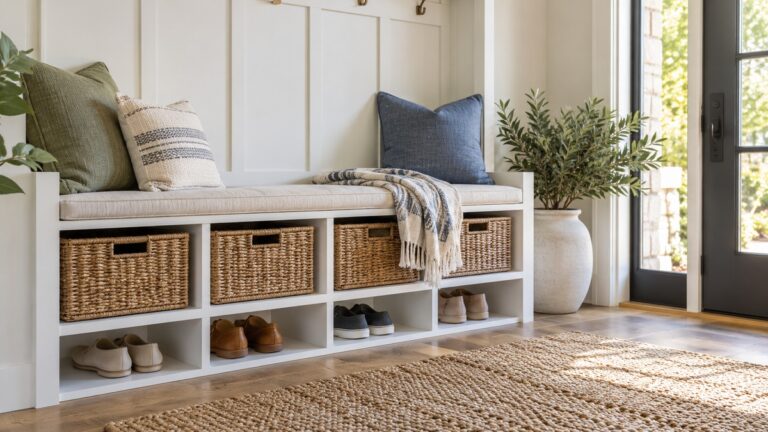
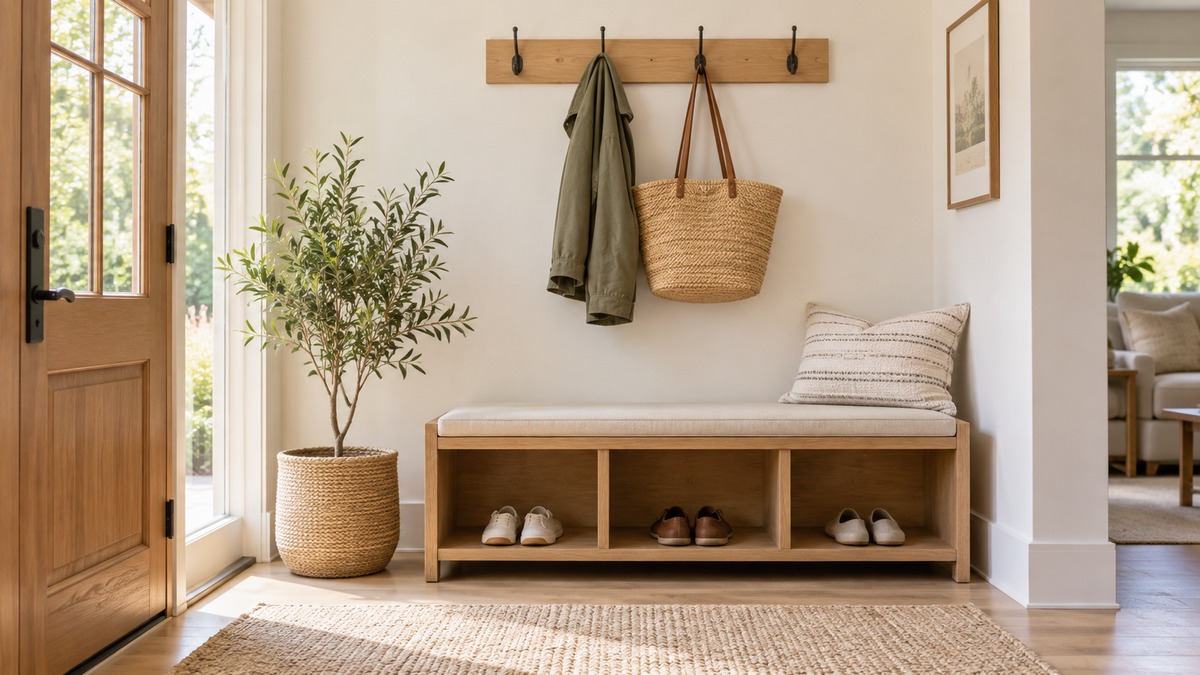
Open cubbies let you see and grab a pair fast, and they make it easy to put the right pair back in the right place. They also show clutter, and dust can settle on the shoes. Doors or a lid hide the shoes but add a moving part, and they need clearance to swing open in a narrow hall. Read the listing for doors, a lid, or a cushioned top. If none are stated, assume open storage and plan your entry around that.
Freestanding or anchored to a wall
A freestanding unit stays in place through its own weight and where you set it. A unit that is tall or top-heavy needs more attention. The U.S. Consumer Product Safety Commission, through its Anchor It campaign, says top-heavy furniture can tip and that existing furniture can be anchored with inexpensive anti-tip brackets. The same campaign warns that children like to climb furniture, which makes unsecured units a hidden hazard in every room. If you fix a unit to the wall, a stud finder helps you find framing behind the drywall. A magnetic stud finder detects the metal fasteners that hold the wallboard to the studs, and an electronic one senses changes in wall density. Follow the maker’s mounting instructions, and do not assume a generic anchor will carry the unit.
Check finish and color together
Finish is a common mismatch on shoe bench listings. Some listings give one color in a color field and a different finish in another field, and their bullet points may use a third word. Read the color, the finish, and the bullets together. Buy only when the listing agrees with itself. If you want a white bench to match a white door or wall, confirm the finish field, because a photo can make a brown or gray unit look white.
Look at assembly and weight
Assembly and weight matter more for an entry bench than for a bedroom piece, because you may carry it through a front door or up a short flight of steps. The listing’s item weight tells you how much you will lift. The listing’s component list tells you whether the unit ships as parts. Check whether tools are included and whether the instructions describe the steps in plain order. If the listing says assembly is quick, read the steps for the number of parts before you decide.
How to choose between your options
Use these rules to decide quickly.
Choose a shoe bench with open cubbies if your pairs are mostly sneakers and sandals and you want to grab one fast. Choose a closed cabinet with doors if you want shoes out of sight or if the entry is visible from the living room. Choose a bench only as a storage piece when the listing gives no seat rating, and sit on it only for short periods until the maker confirms a load.
Choose a freestanding unit when you rent, when your walls are plaster or masonry, or when you cannot find a stud where you want the unit. Choose an anchored unit when the piece is tall, when it sits near a play area, or when you have children who climb. For a closet or small room, a shelf-style organizer can work better than a bench, and the tall narrow shoe cabinet with doors guide covers that option in more depth.
Choose a bench with a hook rail or a top shelf only when the listing names those parts. If it does not, plan for a separate hook or coat rack on the wall. The entryway shoe storage guide covers layouts that combine a bench with wall hooks, and the hallway shoe storage guide covers narrow runners.
The pick for this keyword
1. Shoe Storage Bench Cubby with 9 Cubbies, Wood Shoe Rack Organizer Cabinet (Shoe bench with 9 cubbies)
Specs from the listing (checked 2026-10-13):
- Material: Engineered Wood
- Product Dimensions: 11.8″D x 27.6″W x 17.7″H
- Item Weight: 18.5 pounds
- Number of Shelves: 9
- Color: Brown
- Furniture Finish: White
- Installation Type: Freestanding
- Minimum Required Door Width: 27.6 inches
Pros
- The listing gives 9 cubbies in a 3-tier layout and says the unit can store 9 pairs of shoes.
- The listed footprint is 11.8 inches deep by 27.6 inches wide, so you can compare it with your entry wall.
- The listing names the unit freestanding with a floor mount type, so no wall fixing is listed.
- The listing names Waterproof as a special feature, though it does not say what that covers.
Cons
- The listing does not state a seat or top weight limit, and it does not say whether the top is built to be sat on.
- The color field says Brown while the finish field says White, so the listing contradicts itself on finish. Confirm it before you buy.
- The listing does not state a maximum load for the shelves or the top.
- The listing does not mention doors, a lid, or anti-tip hardware.
- Room types are listed as bedroom and hallway, so the listing does not present the unit as an outdoor piece.
Best for: Entryways and halls with a few pairs of shoes, a freestanding spot at least 11.8 inches deep, and no need for closed storage.
Skip if: Skip it if you need a seat rated for regular adult use, closed storage with doors, or a unit fixed to a wall.
View on Amazon (affiliate link)
This listing describes a shoe bench with storage most directly, so it is the pick for this keyword. The title and the bullets both describe a shoe rack with a bench-style top, and the listing gives a 9-cube, 3-tier layout. Its footprint is listed as 11.8 inches deep and 27.6 inches wide, with an item weight of 18.5 pounds. Two gaps decide whether it suits your entry. The color field says Brown while the finish field says White, so confirm the finish before you buy. The listing also does not state a seat weight limit, so use the top for storage unless the maker confirms it can take a person’s weight.
Check the arithmetic again: four people with three pairs each gives twelve pairs, and nine pairs fit on the bench, which leaves three. Those three pairs could go on a closet shelf, a second unit, or a wall hook. If your household keeps more boots than sneakers, reduce the count for the bench and count the boots separately, because boots take more room per pair.
Mistakes that make a shoe bench disappoint
- Buying from the photo. Staging makes small units look larger. Use the listing dimensions and measure your floor before you order.
- Counting cubbies as pairs. A cubby count is a rough guide. Boots and wide shoes take more room, so measure your largest pair.
- Sitting on a storage piece. If the listing gives no seat rating, do not treat the top as a seat for daily use.
- Skipping anchoring for tall units. A top-heavy unit near a child’s reach needs anti-tip hardware. Follow the maker’s instructions.
- Ignoring contradictory fields. A color field and a finish field that disagree tell you to check the product page, not to guess.
- Forgetting the door swing. A bench that fits the wall may block the door once the door opens.
Worked example: bench footprint against the doorway
The bench lists 11.8 inches deep and 27.6 inches wide, so its footprint is 11.8 x 27.6 = 325.68 square inches. Its 17.7 inches of height and 18.5-pound item weight are listed separately, so measure the doorway as well as the floor before you order.
FAQ
How many pairs of shoes fit in a shoe bench with storage?
It depends on the cubby size and the height of your shoes. Count the cubbies in the listing, then measure your tallest pair. Sneakers and sandals fit more easily than tall boots, so a count of pairs is only an estimate until you test the cubby against your own shoes.
Can I sit on a shoe bench with storage?
Only if the listing states a seat or top weight limit that you can accept. Many storage benches are built for shoes, not for daily sitting. If the listing is silent, ask the maker before you use the top as a seat for an adult.
Is an open shoe bench good for a hallway?
It can be, if the hall is wide enough for the bench and the door swing. Open cubbies make it quick to grab a pair, but they show clutter. Measure the hall floor and check whether the bench blocks a traffic path before you buy.
Do I need to anchor a shoe bench to the wall?
Anchor a unit that is tall, top-heavy, or near children who climb. The Consumer Product Safety Commission advises anchoring top-heavy furniture with anti-tip brackets. Check whether the listing includes anti-tip hardware, and follow the maker’s instructions for any wall fixing.
How do I measure space for a shoe bench in an entryway?
Measure the wall space, the depth from the wall to the front edge, and the door swing. Add room for your feet while you sit or stand. Compare these numbers with the listing’s overall dimensions, not the photo.
White or brown: which finish should I choose?
Choose the finish that matches your door, wall, and floor, then confirm it in the listing. If the color and finish fields disagree, check the product page or the maker’s photos before you buy. Do not rely on the photo alone.
Can I use a shoe bench outdoors?
Only if the listing says it is made for outdoor use. A waterproof special feature does not tell you how the unit handles sun, rain, or frost. If the listing lists indoor room types only, treat it as an indoor piece.
Does a shoe bench come assembled?
Check the listing for assembly details. Many shoe benches ship in parts and need assembly with included tools. Read the instructions before you buy, and confirm whether the listing includes all the parts you need.
Bottom line
If your entry has floor space for a freestanding unit, your pairs fit the cubby count, and the listing confirms the finish and any seat terms, a shoe bench with open storage is a practical choice. If you need closed storage or a seat you can use every day, choose a cabinet with doors or ask the maker about the load before you buy.
Sources
- CPSC Anchor It! campaign: anti-tip brackets for top-heavy furniture and the tip-over hazard for children who climb
- Stud finder: how magnetic and electronic stud finders locate framing behind walls