Best Way to Organize Clothes in Small Space
As an Amazon Associate we earn from qualifying purchases. Details
The best way to organize clothes in a small space is to decide what must hang, fold everything else, and use the height of the closet instead of the floor. The pages we opened agree on that order: declutter first, hang only what needs a hanger, stack a second rail where long garments are few, and keep out-of-season clothes somewhere else. They disagree on exact rod heights by a few inches, and we show that below. This guide turns their numbers into a height check you can run on your own closet. It recommends no specific products, because the sources we opened are about method and dimensions.
Quick answer
Empty the space and sort first. Hang only what creases or needs a hanger, and fold the rest into drawers, shelves or boxes. Add a second rail under a rail that holds few long items, use slim hangers, and keep shelves close together so height is not wasted. Move out-of-season clothes under the bed, to a loft or into vacuum bags, and rotate every few months.
What the person typing “best way to organize clothes in small space” wants
The reader has more clothes than closet. They want a method that fits a shallow or short closet, a wardrobe, or a bedroom with no closet. They need steps they can follow in one afternoon and numbers to check against their own space.
Step 1: Declutter before you buy anything
Livingetc advises emptying the closet and working one small area at a time. It quotes Lucy Williams, founder of Please Organise Me, on having separate bags for rubbish, donations, items that belong elsewhere, and items to mend. It also suggests rotating seasonal clothing every few months. The article gives no number for how much to remove, so decide by what you wore in the last season.
Step 2: Decide what hangs and what folds
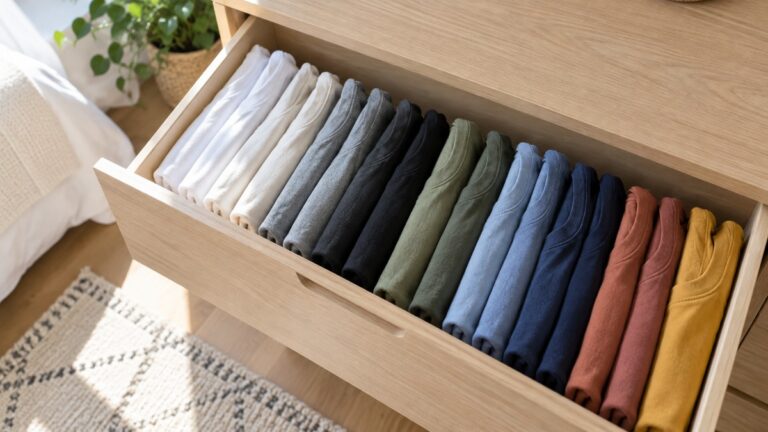
Hanging uses depth. Hunker says hanging clothes take 2 ft of depth, and Closet & Beyond gives 24 in as the minimum hanging depth. Folding uses shelf and drawer space instead. Tribesigns says a garment rack suits dresses, jackets and shirts, and a dresser or chest of drawers suits folded items such as sweaters, jeans and pajamas. Livingetc quotes professional organizer Vicky Silverthorn on folding non-creasing clothing vertically in drawers, so you can see each item at once. These are tips from named experts and a furniture seller, not tested results.
Step 3: Use the height
| Zone | Source figures |
|---|---|
| Single rod, long garments | 65 to 70 in (Closet & Beyond); 66 in (Bob Vila); 68 in (Hunker); 60 to 66 in (Tint Tone and Shade) |
| Double rods | 40 in and 80 in (Closet & Beyond); 40.5 in and 81.75 in (Bob Vila); 42 in and 84 in (Hunker) |
| Short hanging section | 36 to 40 in (Tint Tone and Shade) |
| Shelf gap | 12 to 15 in (Tint Tone and Shade) |
| Drawer height | 6 to 8 in each (Tint Tone and Shade) |
| Rod distance from rear wall | At least 12 in (Bob Vila) |
| Space above the rod | At least 2 in between the rod and the shelf above (Bob Vila) |
| Top shelf | 84 in high, at least 16 in deep (Hunker) |
Where the sources conflict
- Single rod height: four pages give four different values, from 60 to 70 in. Treat the range as tolerance and set the rod for your longest garment.
- Upper rod: 80, 81.75 or 84 in. Bob Vila says the heights allow adults to reach from standing, but does not explain how an 81.75 in rod is reached. Test it with your own arm.
- Long coats: Bob Vila lists them on the single 66 in rod in one section and on the upper 81.75 in rod in another.
- Short hanging: Tint Tone and Shade says 36 to 40 in. The double-rod tables above put the lower rod at 40 to 42 in. The two figures are measured differently, so do not mix them.
Worked example: how tall must a closet be for double hanging?
Tint Tone and Shade lists a short hanging section at 36 to 40 in and says double hanging stacks two short sections. Two sections need 2 x 36 = 72 in at the low end and 2 x 40 = 80 in at the high end.
- A 72 in (6 ft) wardrobe: fits two short sections only at the 36 in figure, with nothing left for the rods, shelf or base.
- An 84 in (7 ft) wardrobe: leaves 84 minus 80 = 4 in at the 40 in figure, and 84 minus 72 = 12 in at the 36 in figure.
- A loft above long hanging: the same page gives long hanging at 60 to 66 in and a loft at 18 to 24 in, which adds up to 78 to 90 in. An 84 in wardrobe holds the low end of that range only; an 8 ft (96 in) wardrobe holds all of it with 6 to 18 in to spare.
These sums use the sources’ own numbers. They do not account for rod thickness, the base or the top panel, so measure your closet and subtract those before you buy a rod.
Ideas that save space
Add a second rail
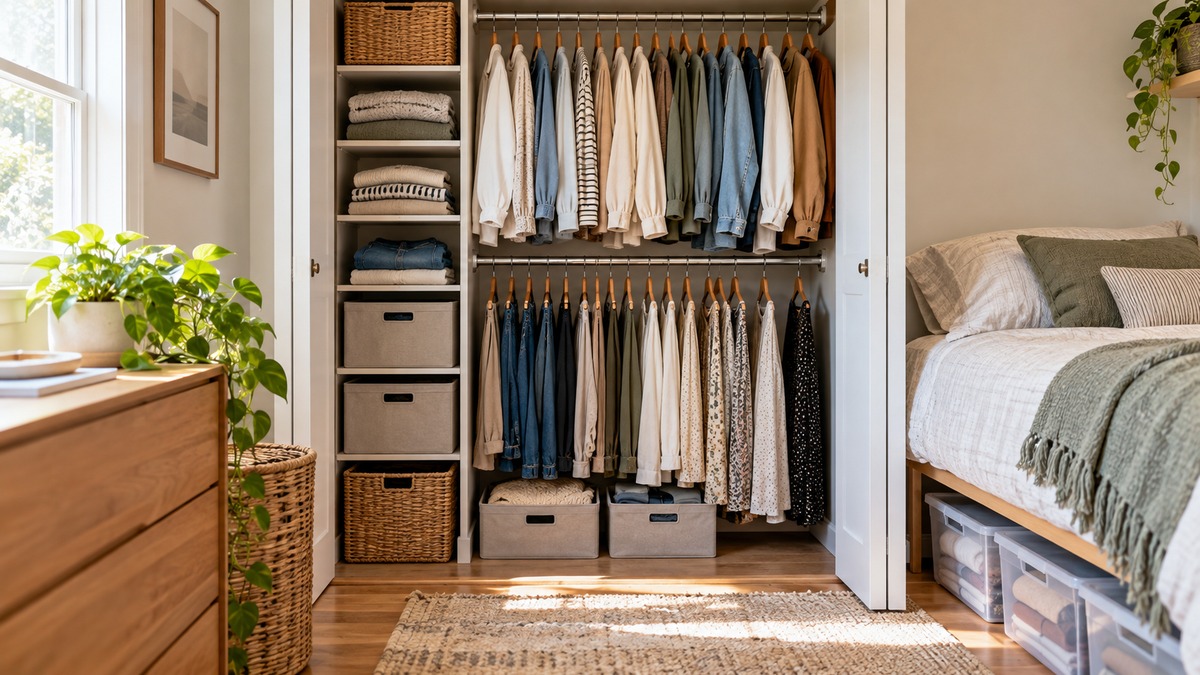
Silverthorn, quoted by Livingetc, suggests a second rail where you have space under a rail with few long items. Shirts and folded pants fit under it more easily than dresses.
Choose slim hangers
The same article suggests slimline hangers and advises checking the size before ordering. It gives no measurement for how much room they save.
Keep shelves close together
Silverthorn advises keeping shelves close together so height is not wasted. Tint Tone and Shade gives a shelf gap of 12 to 15 in.
Use the doors and the top
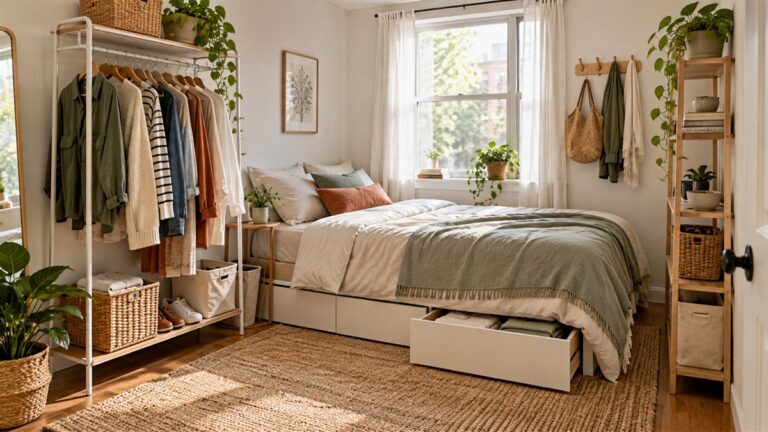
Livingetc suggests using the inside of wardrobe doors with wall hooks and putting moth-proof boxes on top of the wardrobe if it does not reach the ceiling. It also suggests storing out-of-season clothes under the bed, in a loft, or in vacuum bags.
Keep daily clothes at easy height
Closet & Beyond advises storing daily-use items between waist and shoulder height.
Under-bed storage for seasonal clothing
Tribesigns calls under-bed storage a backup closet for seasonal items such as winter coats, extra bedding and luggage. It is not meant as a daily replacement.
Mistakes to avoid
- Buying organizers before decluttering. Livingetc starts with emptying and sorting.
- Hanging items that could fold. Hanging uses 24 in of depth, folding uses a shelf.
- Setting a rod less than 12 in from the rear wall (Bob Vila’s minimum).
- Stacking two hanging sections in a closet that is too short. The example above shows the sums.
- Trusting one rod height. Our four sources give four values.
Who should skip this method
If you have very few clothes and a closet that already holds them, you may not need a second rail or new shelves. If your closet is under 22 in deep, Hunker says it is too shallow for hanging clothes, and folding plus a separate rack becomes the plan.
FAQ
Should I fold or hang?
Hang what creases, fold what does not. Livingetc quotes an organizer on folding non-creasing clothes vertically in drawers.
How deep should my hanging space be?
Closet & Beyond says 24 in minimum, and 26 to 28 in for long items such as coats. Tint Tone and Shade allows 22 to 24 in.
Where do out-of-season clothes go?
Livingetc suggests under the bed, a loft, or vacuum bags. Tribesigns says under-bed storage works as a backup closet.
How many shelves fit in my closet?
Divide the usable height by the shelf gap. Tint Tone and Shade gives 12 to 15 in per gap, so 60 in of height holds 4 to 5 gaps. That is our arithmetic, so subtract shelf thickness first.
Is a second rail worth it?
Silverthorn suggests it where there is space under a rail with few long items. If most of your clothes are dresses or coats, the space under the rail may be needed for them.
Sources we opened (2026-10-18)
- Livingetc: small closet ideas
- Tint Tone and Shade: Standard Wardrobe Dimensions and Space Guide
- Bob Vila: The Perfect Closet Rod Height for Hanging Clothes
- Closet & Beyond: Standard Closet Dimensions guide
- Hunker: What Are Standard Closet Dimensions?
- Tribesigns: 7 Ways to Create Clothing Storage in a Bedroom