Small Room With No Closet Ideas
As an Amazon Associate we earn from qualifying purchases. Details
A small room with no closet needs a place to hang clothes, a place to fold them, and floor space left to walk. The sources used here give one number that decides most of the choices: a wardrobe or rail needs about 22 to 24 in of depth for standard hangers, plus 30 to 36 in of clear floor in front of doors. This guide lists seven ways to add clothing storage, shows where the sources disagree, and runs the floor-space arithmetic on an example room so you can repeat it with your own tape measure. It recommends no specific products, because the sources used here give dimensions and ideas, not model reviews.
Quick answer
Pick the storage that fits the clothes you actually own. A garment rack suits dresses, jackets and shirts. A dresser or chest of drawers suits folded items. A wardrobe cabinet hides everything but takes the most floor. Under-bed storage is for out-of-season items. Before buying anything, tape the footprint on the floor, add the front clearance (30 to 36 in for doors), and check the total against the room.
What the person typing “small room with no closet ideas” wants
The reader has a bedroom or a small multi-use room with no built-in closet. They want hanging space, somewhere for folded clothes, and a plan that does not block the door or the bed. They need numbers to check a piece of furniture against the room before they buy it.
Seven ways to add clothing storage
Tribesigns, a furniture seller, lists seven options in an article dated September 2026. We summarise them here without numbers, because that article gives no sizes.
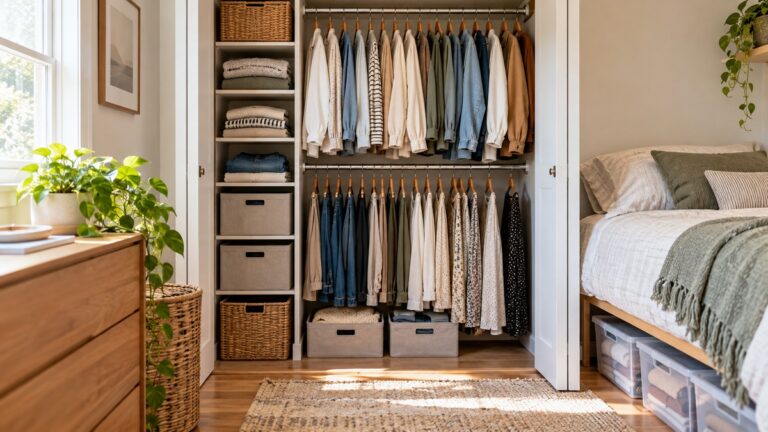
- Freestanding closet organizer. A unit that combines a hanging rod with shelves.
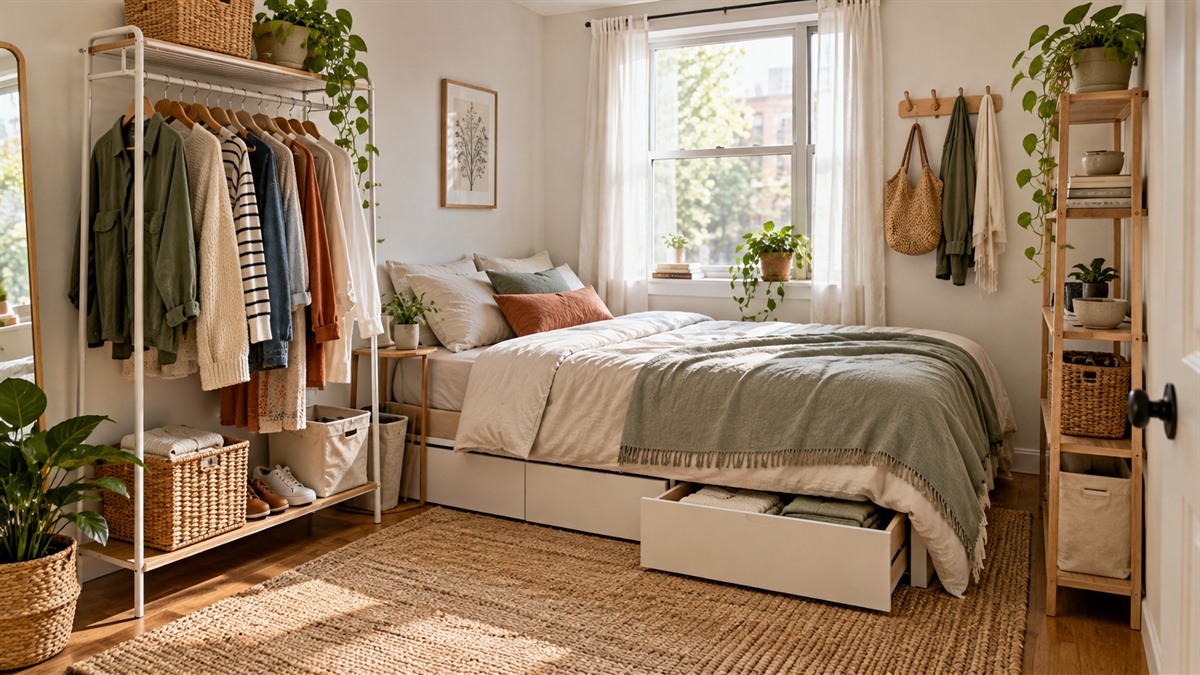
- Garment rack. It suits dresses, jackets and shirts, but it does not store folded items or shoes, so the article suggests adding shelves, baskets or a nearby dresser.
- Dresser or chest of drawers. For folded clothes such as sweaters, jeans and pajamas.
- Wardrobe cabinet or armoire. Enclosed storage that hides clothing behind doors. The article says it needs more floor space and is less flexible than open organizers, and warns that a large wardrobe can crowd a small bedroom.
- Under-bed storage. The article calls it a “backup closet” for seasonal items such as winter coats, extra bedding and luggage, not a daily replacement.
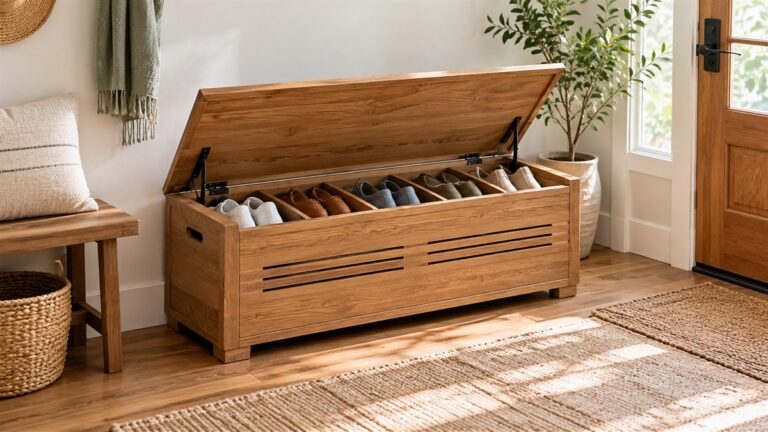
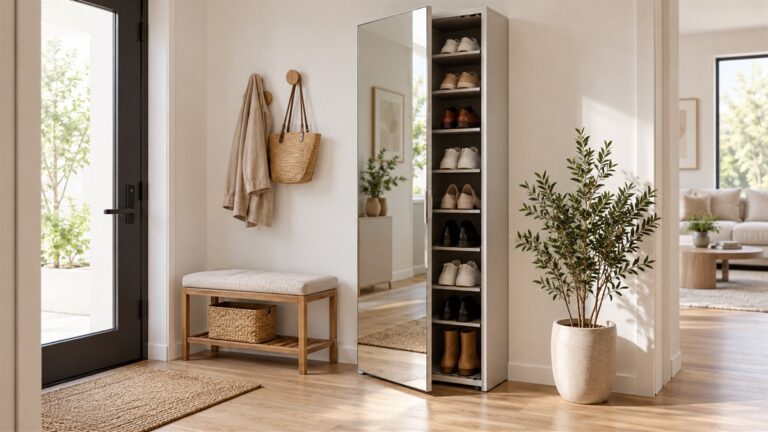
- Wall space. Tall, narrow furniture beside the bed or behind a door adds capacity without a wide footprint.
- Open closet zone. A corner set up with an organizer, mirror, baskets, a small bench and lighting.
Livingetc adds one more idea for rooms where there is space to build: a half-wall room divider can separate a small closet area from the bedroom without breaking up the room much. The article gives no sizes for it.
The numbers the sources give
| Item | Tint Tone and Shade (wardrobe guide, 2026) | Closet & Beyond (2025) |
|---|---|---|
| Wardrobe depth | 22 to 24 in (24 in ideal for most bedrooms) | 24 in |
| Wardrobe width | Single module 18 to 24 in; double 36 to 48 in; full 5 to 8 ft or more | 24 to 96 in |
| Wardrobe height | Commonly 7 to 8 ft | 72 to 96 in |
| Hanging depth | 22 to 24 in fits hangers comfortably | 24 in minimum; shallow 18 to 22 in closets are not practical for hanging |
| Clearance in front | 30 to 36 in for door opening and movement | Drawers or swinging doors need space so they do not block |
| Rod heights | Short hanging 36 to 40 in; long hanging 60 to 66 in | Single rod for long garments 65 to 70 in; double rods at 40 and 80 in |
Where the sources conflict
- Depth: Tint Tone and Shade allows 22 in and calls 24 in ideal. Closet & Beyond treats 24 in as the minimum and calls 18 to 22 in impractical for hanging. A 22 in deep unit passes one guide and fails the other.
- Clearance in front: only one source gives a number (30 to 36 in). The other gives no figure, so we use 30 to 36 in as a working range and not as a rule.
- Height: Tint Tone and Shade lists long hanging at 60 to 66 in and a loft at 18 to 24 in. That adds up to 78 to 90 in. The top of that range is taller than a 7 ft (84 in) wardrobe, though it fits in 8 ft. This is our arithmetic, not a figure on the page.
- Dates: the Tint Tone and Shade page shows two different dates (February and October 2026), so we cannot say which is current.
A wardrobe in an 8 by 10 ft room
Take an example room that is 8 ft (96 in) by 10 ft (120 in). We choose a double-module wardrobe at the middle of the Tint Tone and Shade range: 42 in wide and 24 in deep. The room and the choice are made up for the example.
- Depth plus clearance: 24 in of wardrobe plus 30 to 36 in in front is 54 to 60 in of floor measured out from the wall, and 42 in along the wall.
- On the 120 in wall: the wardrobe uses 54 to 60 in of the 96 in width of the room, which leaves 36 to 42 in. Along the wall it uses 42 of 120 in and leaves 78 in.
- On the 96 in wall: the wardrobe uses 54 to 60 in of the 120 in length, which leaves 60 to 66 in. Along the wall it uses 42 of 96 in and leaves 54 in.
- A 22 in deep unit: 22 plus 30 to 36 in is 52 to 58 in, 2 in less than the 24 in unit. It passes the Tint Tone and Shade range and fails the Closet & Beyond 24 in minimum for hanging.
- The bed: the example leaves out the bed. A bed needs floor too, so draw both footprints on the floor with tape and compare the total with the room.
The room is made up and the arithmetic uses only the numbers in the table. The point is the method: depth plus front clearance, compared with the room.
Small-room tips from the sources
- Sliding doors save circulation space (Tint Tone and Shade). A hinged door needs swing space, and the page gives no figure for it.
- Double hanging stacks two short sections vertically, and modular sections work better than one large compartment (Tint Tone and Shade).
- Light finishes, or a colour that matches the walls, and floor-to-ceiling designs keep a wardrobe from looking heavy (Tint Tone and Shade).
- Glass doors feel more open, and lining the glass with fabric can hide clutter (Livingetc, as the article’s own claim).
- Store out-of-season clothing under the bed, in a loft or in vacuum bags, and rotate every few months (Livingetc).
Mistakes to avoid
- Buying a rack and nothing for folded clothes. Tribesigns says a garment rack does not store folded items or shoes.
- Counting only the wardrobe and forgetting the front clearance.
- Choosing a unit under 22 in deep for standard hangers. Closet & Beyond calls 18 to 22 in impractical for hanging.
- Trusting one source’s number for a whole plan. Our two dimension sources disagree on depth, so measure your own hangers.
Who should skip these ideas
If the room is too small to hold a 22 to 24 in deep unit plus 30 to 36 in of clearance, a deep wardrobe will not work. Fold more and hang less, use a dresser or wall-mounted storage, and keep a small rail for the few items that must hang.
FAQ
How deep should a wardrobe be for hangers?
Tint Tone and Shade gives 22 to 24 in with 24 in as ideal. Closet & Beyond gives 24 in as the minimum. Measure your own hangers and coats.
How much floor space should I leave in front?
Tint Tone and Shade says 30 to 36 in for door opening and movement. Closet & Beyond gives no figure but says drawers and swinging doors must not block the space.
Is under-bed storage enough?
Tribesigns calls it a backup closet for seasonal items, not a daily replacement.
What rod height should I use?
For a single rod, Closet & Beyond gives 65 to 70 in and Bob Vila gives 66 in. For short hanging, Tint Tone and Shade gives 36 to 40 in, and Closet & Beyond puts a lower double rod at 40 in.
Do I need a wardrobe at all?
Not always. A garment rack plus a dresser covers hanging and folded clothes. A wardrobe adds doors that hide everything but needs more floor, per Tribesigns.
Sources (2026-10-18)
- Tribesigns: No Closet? 7 Ways to Create Clothing Storage in a Bedroom
- Tint Tone and Shade: Standard Wardrobe Dimensions and Space Guide
- Closet & Beyond: Standard Closet Dimensions guide
- Livingetc: small closet ideas
- Bob Vila: The Perfect Closet Rod Height for Hanging Clothes