Ways to Store Shoes in Small Spaces
As an Amazon Associate we earn from qualifying purchases. Details
Shoes take more floor than almost anything else near a front door, and a small space gives you little floor to spend. The workable answers fall into a few approaches: go vertical with a narrow tower, use a rack that adjusts to the gap you have, or double up the storage you already own with stackers. This guide explains each approach with the figures from three Amazon listings we opened, one per approach, so you can see real widths, loads and pair counts instead of guessing. It also shows where those listings contradict themselves, gives a worked footprint example, and covers the safety and moisture points that matter for a shoe stack in a closet or hallway.
Quick answer
If you have a gap of 11 in or more, a vertical tower stores the most pairs per inch of wall: the HOOBRO 8-tier lists 8 pairs in an 11 in by 11 in footprint. If the gap is wider and you want to adjust it, the Detsuk expandable rack spans 17.5 in to 30.7 in. If you already have a shelf or a closet floor, shoe stackers add a second layer without buying furniture. Start by measuring your gap, then match it to one approach below.
What you are solving
A small entryway or closet usually has three constraints: a narrow gap, no spare wall to drill into, and a household that wears more than one pair a day. The right method depends on which constraint is tightest. A tall tower solves narrow floor. An adjustable rack solves an odd-sized gap such as the space under a bench. Stackers solve a shelf that is wide enough but too tall for a single layer of shoes.
How we researched this
We searched Amazon for “ways to store shoes in small spaces” and picked one listing for each approach: an expandable rack, a set of stackers, and a vertical tower. Each page was opened once on 2026-10-17 and the numbers below come only from those pages. We did not test any of these products, so nothing here describes how they perform in a home. We also opened the US Environmental Protection Agency’s mold and moisture guide and the US Consumer Product Safety Commission’s Anchor It site for the moisture and tip-over points. Where a listing gives two numbers that disagree, we show both.
At a glance: the 3 picks, by their own spec fields
| Pick | Capacity | Weight limit | Flag |
|---|---|---|---|
| HOOBRO 8-Tier Vertical (narrow tower) | 8 pairs; 11″L x 11″W x 44.5″H | 22 lbs total (spec block) vs. 11 lbs per layer (a bullet — 8 layers at 11 lbs would far exceed 22 lbs) | Comparison table lists 53 in height for its first column vs. 44.5 in in the bullet — plan on the lower weight total and confirm height for your chosen size |
| Detsuk Expandable 2-Tier | Title says 4-9 pairs; a bullet says 6-9 pairs; a summary line says 6-9 pairs per tier — figures conflict | 50 lbs per tier | Width adjusts 17.5 to 30.7 in; no tier height stated — use the lowest pair count (4) to plan |
| MOVDEET 24-Pack Shoe Slots | 3 height settings: 3.7, 5.8, 7.7 in; stacks 2 pairs per slot | Not stated | One bullet says not suitable for heavy items like athletic shoes; brand text on the same page says it suits sports shoes — treat the bullet as the more cautious statement |
Specs are from each product’s Amazon listing, checked 2026-10-17. All three listings contain internal conflicts on capacity or weight — plan around the lower, more cautious figure in each case.
Approach 1: stack vertically with a narrow tower
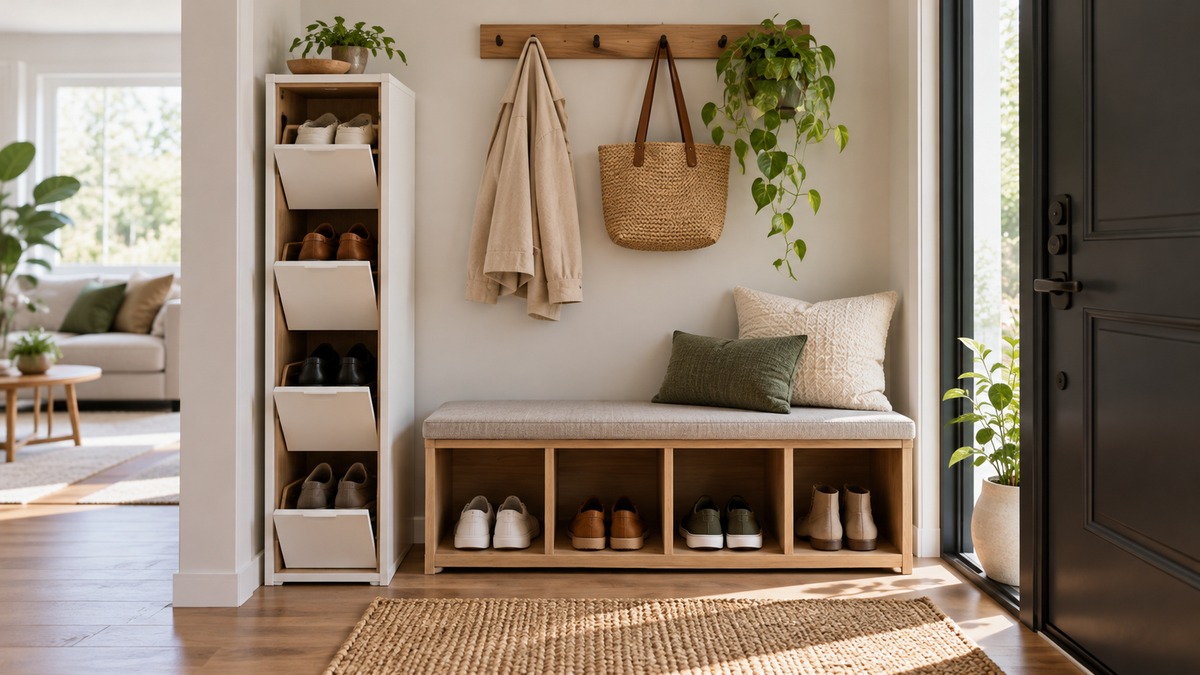
A tower trades width for height, so it suits a gap between a door and a wall. The HOOBRO 8-tier vertical shoe rack is a good example of the numbers to check.
HOOBRO 8 Tiers Vertical Shoe Rack, Wooden, with Hooks
Specs (from the listing, checked 2026-10-17): The bullet lists a size of 11 in long, 11 in wide and 44.5 in high for an 8-pair unit. Particleboard and metal. The listing says removable shelves hold boots and heels, side hooks hold keys and bags, and anti-tipping accessories are provided. The specification block gives a weight of 17.1 lb. The size menu includes an 11 in wide version and a 19.7 in wide version, and 10-tier options.
Conflict to check: one bullet says each layer can bear up to 11 lb, while the specification block gives a maximum static load capacity of 22 lb for the whole unit. Eight layers at 11 lb would add up to far more than 22 lb, so the two figures cannot both describe the same thing. The comparison table on the page also lists a height of 53 in for its first column, against 44.5 in in the bullet. We do not resolve this. Plan on the lower total, 22 lb, and confirm the height for the size you pick.
Best for: a narrow wall gap where you want eight pairs in about 121 sq in of floor.
Skip if: you own heavy boots; the stated total is 22 lb.
View on Amazon (affiliate link)
Approach 2: use a rack that adjusts to your gap
An expandable rack works in the space under a bench, on a closet floor, or along a short wall, because its width changes. The Detsuk 2-tier rack is a clear example.
Detsuk Expandable Metal Shoe Rack, 2 Tier
Specs (from the listing, checked 2026-10-17): The width adjusts from 17.5 in to 30.7 in. Steel tubing, with each tier supporting up to 50 lb according to the listing and its Safety Information. Hand-tightened screws, no tools, and a stated assembly time of about 3 minutes. The listing includes silicone pads to protect floors. A 3-tier version is listed as holding 6 to 12 pairs.
Conflict to check: the title says it holds 4 to 9 pairs, the bullet says its two open shelves hold 6 to 9 pairs, and a summary line says 6 to 9 pairs per tier. These cannot all be right. Use the lowest figure, 4 pairs, to plan, and expect more only for small shoes.
Best for: a gap that is not a standard width, such as beneath an entryway bench.
Skip if: you wear tall boots daily; the listing does not give a tier height.
View on Amazon (affiliate link)
Approach 3: double up with stackers
Stackers sit on an existing shelf and create a second level, so they help when you already have shelf width but the shoes use only the bottom few inches of each level.
MOVDEET 24 Pack Shoe Slots Organizer for Closet
Specs (from the listing, checked 2026-10-17): Clear PET plastic with a non-slip texture. The listing says each slot has three height settings, 3.7 in, 5.8 in and 7.7 in, and that you can stack two pairs per slot. The listing describes a snap-on design for building a tower, an outer baffle 7.5 cm taller than a standard holder, and a pull hole for taking shoes out.
Conflict to check: one bullet says the slots are not suitable for heavy items like athletic shoes or mesh sneakers, while the brand text on the same page says they suit flat shoes, sports shoes and high heels. If you plan to stack sneakers, read the bullet as the more cautious statement.
Best for: flats, sandals and slip-ons on a shelf where headroom is wasted.
Skip if: you need to stack heavy sneakers or boots.
View on Amazon (affiliate link)
Footprint worked example
For example, take a 36 in entryway wall. The Detsuk at its widest, 30.7 in, leaves 5.3 in clear, and at its narrowest, 17.5 in, it leaves 18.5 in. Three HOOBRO towers side by side would span 33 in and hold 24 pairs by the listing’s 8-pair figure, which is 0.73 pairs per inch of wall. The Detsuk at 17.5 in wide holds between 4 and 9 pairs by its own contradictory figures, which is 0.23 to 0.51 pairs per inch. The pair counts come from the listings and the per-inch arithmetic is ours. Neither is a tested result, but it shows why a tower gives the most pairs per inch of wall and the adjustable rack gives the most flexibility.
Check the weight and the wall
A loaded tower is a tall, narrow object, so it can tip. The HOOBRO listing says anti-tipping accessories are provided. The US Consumer Product Safety Commission’s Anchor It campaign lists five steps for anchoring furniture: attach a bracket to the wall, move the furniture close, attach the other bracket to the furniture, connect the strap to both brackets, and tighten the strap. See anchorit.gov. Loads matter too: the HOOBRO lists 22 lb in total, so a heavy pair of boots could use a large share of it.
Keep shoes dry
Damp shoes in a closed closet are a moisture question. The US Environmental Protection Agency advises keeping indoor humidity below 60 percent, ideally 30 to 50 percent, and says to dry water-damaged items within 24 to 48 hours to prevent mold growth; read it at epa.gov. That guidance is about water damage in general, so applying it to wet shoes is our reading rather than the EPA’s wording. In practice it argues for open racks near the door over covered stacks for shoes that get rained on.
How to pick
- Measure the gap in width, depth and height, and the swing of any door.
- Choose a tower for a gap of 11 in or more with spare height, an adjustable rack for an odd width, and stackers for a shelf you already own.
- Check the stated load against your heaviest shoes, not your lightest.
- If a listing gives two figures, plan on the lower one.
Mistakes to avoid
- Buying on pair count alone. The Detsuk page gives three different counts.
- Loading a tower unevenly with all the weight on the top tier.
- Skipping the anchor on a tall unit.
- Stacking damp shoes in a closed space.
Frequently asked questions
What is the narrowest way to store shoes?
A vertical tower. The HOOBRO 8-tier lists an 11 in by 11 in footprint for 8 pairs.
Can I adjust the width of a shoe rack?
Yes. The Detsuk expandable rack spans 17.5 in to 30.7 in according to its listing.
How many pairs does the Detsuk hold?
The listing gives three different counts: 4 to 9 pairs in the title, 6 to 9 pairs on two shelves in a bullet, and 6 to 9 pairs per tier in a summary line.
Can shoe stackers hold sneakers?
The MOVDEET listing contradicts itself: one bullet says it is not suitable for athletic shoes, and the brand text says it suits sports shoes.
Should I anchor a shoe tower?
The HOOBRO listing says anti-tipping accessories are provided, and the US Consumer Product Safety Commission recommends anchoring furniture with shelves to the wall.