How to Organize a Bathroom Without Built-in Storage
As an Amazon Associate we earn from qualifying purchases.
How to organize a bathroom without storage starts with sorting the items you use every day, then placing them between 15 and 48 inches above the floor, the band the ADA Standards use for unobstructed forward reach. Keep items off surfaces that stay wet, and anchor any freestanding unit to a wall. The pages we opened do not give a storage volume for a bathroom, so the numbers below are planning arithmetic.
Quick answer
- Sort items into a daily group and an occasional group before you choose any shelf or unit.
- Place daily items between 15 and 48 inches above the floor.
- Treat the 40 to 48 inch shelf band as a rule only for toilet rooms built to ADA Section 603.4.
- Keep stored items off surfaces that stay damp, and run the fan when you shower.
- Anchor any freestanding unit to the wall with hardware that suits your wall type.
The height bands in one table
The table lists each height band the pages we opened state, the section it comes from and the use it fits. Where a page does not state a figure, the cell says not stated.
| Height band | Inches above floor | Where it comes from | Fit for |
|---|---|---|---|
| Unobstructed forward reach | 15 to 48 | Access Board, Chapter 3, Section 308 | Daily items you can reach without a step |
| Forward reach over an obstruction deeper than 20 inches | Maximum 44 | Access Board, Chapter 3 | Items reached over a vanity or sink counter |
| Shelves in toilet rooms built to Section 603.4 | 40 to 48 | Access Board, Chapter 6, Section 603.4 | Accessible toilet rooms only |
| Bottom of an over-toilet unit | not stated | not stated in the pages we opened | Measure the tank and the wall first |
Worked numbers
- Vertical band for daily items: 48 minus 15 equals 33 inches.
- Toilet-room shelf band: 48 minus 40 equals 8 inches.
- Three levels 15 inches apart, starting at 18 inches: 18, 33 and 48 inches. All three sit inside the 15 to 48 inch band.
- Over a counter deeper than 20 inches, the top of the usable band drops: 48 minus 44 equals 4 inches less reach.
- Daily items in trays: 24 items divided by 6 items per tray equals 4 trays. The 24 and the 6 are planning assumptions, not measured figures.
Start with an inventory of daily items
Start with a list. Write down the items you use each day, such as toothbrushes, hand soap, a hairdryer and clean towels. Set weekly and seasonal items apart on a second list. The second list can live in a closet or a bin outside the room, which frees space without buying a new unit.
For under-sink options, see our guide to what to put under the sink.
Use the reach band for daily items
The Access Board guide describes a 15 to 48 inch range for unobstructed reach. Its wording limits the range to operable parts, such as controls, so it is not a storage standard. The text still gives a usable starting band, and the limit is written as follows: the range “applies only to those portions of elements that are operable.” Use the band as a planning range.
An obstruction changes the top of the band. The guide says: “If the forward reach to operable parts extends over an obstruction, such as a counter, clearances for toes and knees is required below.” It also says the maximum drops when the reach is deep: 44 inches when the depth of reach over an obstruction exceeds 20 inches. A vanity or sink counter can act as that obstruction, so the top of the usable band over a deep counter is 44 inches, not 48.
For a corner option that uses the space above a counter, see our guide to corner shelves for a bathroom counter. Check its height against the 44 inch figure before you mount it.
Plan the three zones of the room
The zones below divide the wall from the floor up. The first two use Access Board figures, and the third is a planning choice rather than a rule from the pages.
| Zone | Inches above floor | What goes here | Basis |
|---|---|---|---|
| Daily zone | 15 to 48 | Toiletries, towels and cleaning tools you use each day | Access Board unobstructed reach band |
| Over-counter zone | Up to 44 | Light items reached over a deep vanity | Access Board obstruction limit |
| Backup zone | Above 48 | Spare paper goods and items you reach a few times a month | Planning choice; the pages state no rule |
For a drawer or shelf that sits under a vanity, see our guide to under-vanity organizers.
Use the daily zone for anything you need at least once a day. Reserve the backup zone for items you reach less often, because the band ends at 48 inches and a higher item may need a step. The pages we opened state no weight limit for any zone, so keep heavy items out of the backup zone. For daily items kept in a closed cabinet, see our guide to under-cabinet bathroom organization.
Shelves in toilet rooms built to ADA Section 603.4
Chapter 6 of the Access Board’s ADA Standards covers toilet and bathing rooms. Section 603.4, titled Coat Hooks and Shelves, says: “Shelves shall be located 40 inches (1015 mm) minimum and 48 inches (1220 mm) maximum above the finish floor.” That text applies to accessible toilet rooms that follow the 2010 ADA Standards. An ordinary home bathroom does not have to follow it, so treat the 40 to 48 inch band as a design limit rather than a home rule.
The band is narrow. Subtracting 40 from 48 leaves 8 inches of height for the whole band, so plan one level and measure the bin before you buy. For a floating option in a small bathroom, see our guide to floating shelves for a small bathroom, which covers the wall-mounted choice.
Freestanding and over-toilet units need an anchor
A unit that stands on the floor or sits over the toilet can tip, and a tipping unit is a safety problem. A bookcase assembly manual hosted on Lowes’ document server says: “Serious or fatal injuries can occur from furniture tipping over.” The same manual adds: “To help prevent furniture from tipping over it must be permanently attached to the wall.” It also says the buyer must choose hardware for the wall: “You will need to provide wall anchors and screws applicable for your wall type.”
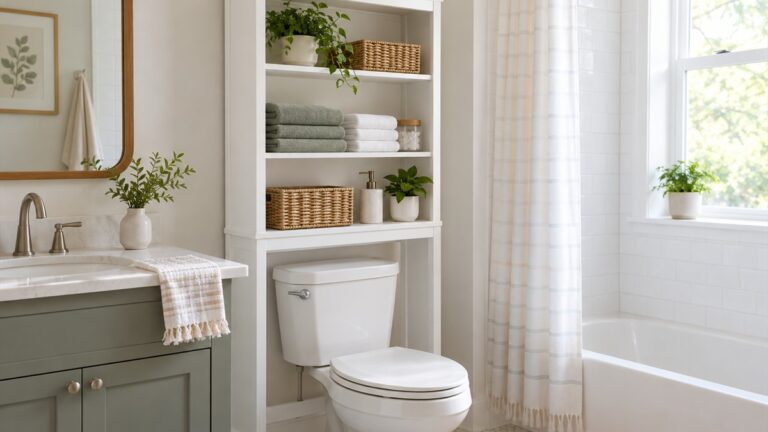
That manual is for a bookcase, not a bathroom unit, so read the instructions for the unit you plan to buy. The same manual recommends straps “suitable for the unit weight and wall materials”, which means the hardware depends on both the unit and the wall. For a space-saving option over the toilet, see our guide to space-saving storage over the toilet, and for a freestanding shelf in the same spot, see freestanding shelves over the toilet.
Keep stored items dry
Moisture is the larger risk in most bathrooms without built-in storage. The EPA’s brief guide says: “Places that are often or always damp can be hard to maintain completely free of mold.” It also says: “Mold may begin growing indoors when mold spores land on surfaces that are wet.” A towel or a box of paper goods left on a wet shelf sits on exactly that kind of surface, so keep stored items off surfaces that stay damp.
The guide’s first habit is ventilation: “Run the bathroom fan or open the window when showering.” The second is a humidity target: “If possible, keep indoor humidity below 60 percent (ideally between 30 and 50 percent)”. The pages we opened do not state how any shelf or bin material handles water, so the target and the habit are the controls you can rely on from these sources.
For a wall-mounted option with a towel bar, see our guide to floating shelves with a towel bar, and for a small wall shelf, see small bathroom wall shelves.
Measure before you buy
Measure the room before you choose a unit, and write each number on one sheet.
- The wall length that has no door swing across it.
- The depth of the vanity or sink counter, measured from the wall to its front edge.
- The height of the floor to the bottom of the tank and the top of the tank, if you plan an over-toilet unit.
- The height of the ceiling, to check the backup zone above 48 inches.
- The wall type behind the planned mount, so the anchors match it.
With the sheet in hand, run the numbers. A vanity deeper than 20 inches brings the 44 inch limit into play, so measure its depth first. If the wall is shorter than the unit, the unit will not fit, and no height band changes that result.
How we chose
The pages in this guide are the ones we opened with curl on 2026-10-21: two Access Board pages on the ADA Standards, the EPA brief guide on mold and moisture, and a bookcase assembly manual hosted on Lowes’ document server. Each one is a standard, a government guide or a manufacturer instruction that states a figure or rule we could quote. We checked every quote against the text of the page we opened.
Search results also showed retail and design pages about bathroom storage. We left those out, because they gave no standard and no cited figure. We did not choose products for this guide and did not add any product link.
What we could not verify
None of the pages we opened gives a storage volume for a bathroom, a clearance beside a tub, or a typical vanity depth. The Access Board figures are for accessible design, so they work here as planning limits, not as rules for every home. None of the pages says how a shelf, bin or cabinet handles water, so do not assume that any material is waterproof. The bookcase manual is for a different product, and its wall advice is general. We did not find a university extension page on bathroom storage in our search, so this guide does not rely on one.
Mistakes to avoid
- Treating the 40 to 48 inch band as a home rule. Section 603.4 covers shelves in accessible toilet rooms that follow the 2010 ADA Standards.
- Putting daily items above 48 inches. The unobstructed band ends at 48 inches, so an item above it may need a step to reach.
- Ignoring the lower limit over a deep counter. The Access Board text lowers the maximum to 44 inches when reach over an obstruction is deeper than 20 inches.
- Mounting a freestanding unit with the wrong hardware. The manual says the anchors must suit the wall type, and it says the buyer may need to supply them.
- Keeping stored items on surfaces that stay damp. The EPA guide ties mold growth to surfaces that are wet.
FAQ
Can I organize a bathroom with no built-in storage?
Yes. Sort the items you use every day, group them in trays, and place those trays between 15 and 48 inches above the floor. Use a freestanding unit only if its manual allows it, and anchor it to the wall.
What height should bathroom shelves be?
The pages we opened give no single height for a home bathroom. They give 15 to 48 inches for unobstructed forward reach, and 40 to 48 inches for shelves in toilet rooms built to ADA Section 603.4. Measure your own reach before you set a height.
Do I need to anchor an over-toilet shelf to the wall?
The bookcase manual we opened says a unit must be permanently attached to the wall to help prevent tipping. Read the instructions for the unit you buy, and use anchors that suit your wall type.
Does the 15 to 48 inch band apply to my bathroom?
Not automatically. The Access Board text belongs to the 2010 ADA Standards, and it applies to projects that must follow those standards. For a home bathroom, use the band as a planning range for daily items.
How often should I check stored items for moisture?
The EPA guide says to act quickly when moisture appears. Its wording is: ‘If you see condensation or moisture collecting on windows, walls or pipes act quickly to dry the wet surface and reduce the moisture/water source.’ Check stored items after you shower, and move any that feel damp.
Can I hang items on the back of the bathroom door?
The pages we opened do not address door hooks, so they give no weight rating and no door clearance. Check the door swing and the hook rating yourself before you load it.
Bottom line
Keep daily items between 15 and 48 inches above the floor, keep them off surfaces that stay damp, and anchor any freestanding unit to a wall with hardware that suits your wall type.
Sources
- https://www.access-board.gov/ada/chapter/ch06/ (opened 2026-10-21)
- https://www.access-board.gov/ada/guides/chapter-3-operable-parts/ (opened 2026-10-21)
- https://www.epa.gov/mold/brief-guide-mold-moisture-and-your-home (opened 2026-10-21)
- https://pdf.lowes.com/productdocuments/5fb3cfee-5d31-4584-bc98-7570fa0c8256/67894620.pdf (opened 2026-10-21)
Disclosure: As an Amazon Associate we earn from qualifying purchases.