Closed shoe organizer: picks and how to choose
As an Amazon Associate we earn from qualifying purchases. Details
A closed shoe organizer keeps shoes out of sight and away from dust, using a door, a lid, a fabric cover or a sealed box. It suits an entryway that faces the street, a closet floor that collects dust or a bedroom where shoes should not be on display. This guide explains how to choose a closed organizer by enclosure, access, footprint and stated weight limit. It also shows what to check on a listing before you buy, because enclosures differ more than their titles suggest. The five picks below include a cabinet with doors, covered racks, and stackable boxes, each with the specs its listing gives.
Quick answer
Choose a closed shoe organizer by how you want to reach your shoes. A cabinet with doors keeps shoes fully hidden but needs room to open the doors. A covered rack lets you remove the cover and see the shoes at a glance. Stackable boxes suit shoes you rarely wear and are easy to move. Check the enclosure type, the height and footprint, the stated weight limit and whether the unit needs anchoring. If you need to grab a pair quickly each morning, a cabinet with doors may slow you down. If you want dust control above all, pick a cabinet or a box rather than an open rack.
What matters for a closed shoe organizer
Enclosure type
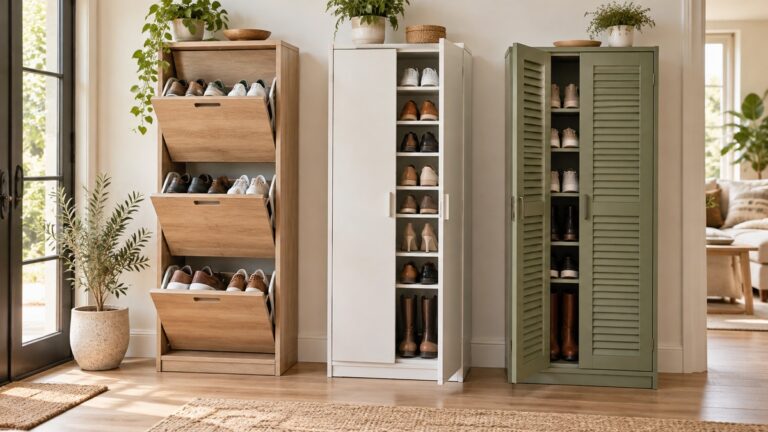
A closet is an enclosed space with a door, used for storage, particularly of clothes. A piece of furniture such as a cabinet serves a similar purpose on a smaller scale. A closed shoe organizer is one of those smaller storage pieces, and its enclosure can take several forms. A cabinet has doors, usually with a door on each bay. A covered rack has a fabric cover that zips or fastens over the tiers. A box has a lid or a closing mechanism. Each form protects shoes from dust in a different way, and each changes how easy it is to see what you have.
Read the enclosure field and the bullets together. Some listings describe a cover as removable, which means the rack is open when the cover is off. Others describe a fully enclosed design, which means the shoes stay covered until you open the door. The difference matters when you plan to store shoes you wear every day.
Access and clearance
A cabinet with flip-up or swing doors needs clear space to open. A flip-up door lifts above the cabinet, so it needs room overhead. A swing door needs room in front. Measure the space in front of the organizer and above it before you choose a flip-up design. A cover that zips is easier to fit in a narrow closet, but it still needs room to be pulled down and reattached.
Access also depends on how many tiers the unit has. A tall unit with many tiers holds more pairs, but the top tiers are harder to reach without a stool. A shorter unit with fewer tiers keeps the shoes within easy reach.
Footprint and height
Shoe organizers take up floor space and vertical space. Measure the floor first, then the height from the floor to the lowest ceiling feature, such as a light fixture or a shelf. Look at the product dimensions and the overall size. Some listings give more than one set of figures, and the figures may not agree. When they differ, use the larger figure for your planning and confirm with the seller before you buy.
Tall units can tip, so anchoring matters. The US Consumer Product Safety Commission’s Anchor It! campaign was created to prevent furniture tip-overs from seriously injuring children. Its advice is to anchor furniture with anti-tip brackets and to install any anti-tip devices that new furniture ships with. Where a listing mentions anti-tip hardware, use it. Where it does not, plan to anchor a tall unit to the wall, using a stud where possible and a rated anchor where a stud is not available.
Weight limits
A closed organizer holds shoes, and shoes are heavier than they look when stacked. Look for the weight figure, check whether it is per shelf or for the whole unit, and check whether it assumes the unit is fixed to a wall. Some listings give a maximum weight and a minimum weight, and the two figures can contradict each other. If the listing gives no figure, treat the unit as unrated and keep heavy boots on the lowest tier.
Dust, moisture and cleaning
A closed organizer keeps dust off the shoes, but it does not necessarily keep moisture out. Read what the listing says about dust and water separately. A listing that describes dust protection is making a different claim from one that describes water resistance. Cover fabrics and plastic boxes are usually easier to wipe than open racks, but a removable cover still needs cleaning on its own schedule. Let a damp shoe dry fully before you close the door or the lid. Dust also settles on the top of a closed unit, not only inside it. Wipe the top of a cabinet or the lid of a box on the same schedule as the floor. A removable cover can be shaken out or brushed, and it should be aired out before you refit it, because a cover that has stayed damp can hold a smell.
Size range and fit
Some listings give the shoe size range a unit can hold. That is useful for a family that shares an organizer, because a box or a tier that is too short for a long boot will push the boot out of its slot. Check the stated size range and the interior height before you buy boots, and check the depth before you buy wide shoes. A listing that gives no size range does not mean the unit is too small, but it does mean you should measure a pair before you order.
When you compare organizers, list the shoes you own with their heights and widths. Sneakers and flats usually fit a standard tier, while boots, tall heels and work shoes may need a taller opening. A cabinet bay or a box can look roomy on a listing and still feel tight when a boot is pushed in. Measure your tallest pair, then compare that height with the interior measure the listing gives. If the listing gives only an outside measure, assume the inside is smaller and leave a margin.
How to choose
- Choose a cabinet with doors if you want shoes fully hidden and you have room to open the doors.
- Choose a covered rack if you want to remove the cover and see the shoes, and you want a narrow footprint.
- Choose stackable boxes if you rarely wear the shoes and want to move them or stack them.
- Choose a unit with a stated weight limit and anchoring hardware if it stands tall or sits against a wall.
- Skip any listing whose enclosure, colour or weight contradicts itself until the seller clarifies.
If you have a narrow closet, compare tall narrow shoe cabinets with doors and shoe storage cabinets for small spaces before you choose a covered rack. If you want to stack shoes in a closet, see shoe stackers for closets for a comparison of stacking options.
1. 6-Tier Shoe Storage Cabinet with Fabric Cover, Hard Flip Doors, Holds 18–24 Pairs, Enclosed (Enclosed cabinet with flip-up doors)
Specs from the listing (checked 2026-10-13):
- Product Dimensions: 12″D x 27.8″W x 41.9″H
- Number of Doors: 3
- Material: Metal, Plastic, Polypropylene
- Installation Type: Freestanding
- Included Components: Cover, Racks, User Manual
Pros
- The fully enclosed lift-up door design keeps shoes hidden and dust-free
- The listing says assembly is tool-free with step-by-step instructions
Cons
- The listing gives six drawers in one field and three doors in another, so check how it opens
- The lift-up doors need clear room above the unit to open fully
Best for: Readers who want shoes hidden in an entryway or closet and have room to open the doors.
Skip if: Skip it if you need to reach a pair quickly, since the doors must lift before you see the shelf.
View on Amazon (affiliate link)
2. VILICK Shoe Rack with Cover Narrow Shoe Organizer with 4 Side Pockets 10 Tier Tall Shoe Storage (Narrow covered tower with zip cover)
Specs from the listing (checked 2026-10-13):
- Product Dimensions: 11.8″D x 17.7″W x 62.2″H
- Weight Capacity Maximum: 50 pounds
- Back Style: Closed Back
- Material: Fabric, Metal, Plastic
- Included Components: Dust Cover, Fabric Shelf, Metal Tube, Plastic Connector, Small Wooden Hammer
Pros
- The zip cover keeps dust and dirt off the shoes
- Four side pockets on the cover hold small items such as keys
Cons
- The listing describes dust protection, not water protection
- The listing gives 50 pounds as a maximum and 10 pounds per layer in a bullet, which describe different limits
Best for: Closet or entryway users who want many pairs in a narrow footprint with a dust cover.
Skip if: Skip it if you need a sealed or waterproof cabinet.
View on Amazon (affiliate link)
3. ROJASOP 10 Tier Shoe Rack with Covers,Large Capacity Stackable Tall Shoe Shelf Storage to 50-55 (Tall covered rack with closed back)
Specs from the listing (checked 2026-10-13):
- Product Dimensions: 9.8″D x 33.8″W x 68.9″H
- Back Style: Closed Back
- Weight Capacity Maximum: 100 pounds
- Number of Shelves: 11
Pros
- The bullets describe a metal frame with plastic connectors and non-woven back panels
- The cover has four pockets for extra small items
Cons
- The title says 10 tiers, while the specs list 11 shelves
- At 68.9 inches tall, the listing does not mention anti-tip hardware, so check before loading the top tiers
Best for: Users who need many pairs in a narrow footprint and accept a freestanding covered rack.
Skip if: Skip it if you need the shoes fully enclosed or a weight rating per shelf.
View on Amazon (affiliate link)
4. LANTEFUL Shoe Rack with Covers – 10 Tiers Tall Shoe Rack Organizer Large Capacity Shoe Shelf (Tall rack with removable covers)
Specs from the listing (checked 2026-10-13):
- Product Dimensions: 9.8″D x 33.8″W x 62.2″H
- Weight Capacity Maximum: 100 pounds
- Material: Metal, Non-wovens
- Special Feature: Adjustable, Portable, Rust Proof, Space Saving, Stackable
- Number of Shelves: 10
Pros
- The cover is removable, so the rack can be used open or covered
- The listing points to an assembly video on its product details page
Cons
- The covers come off, so the shoes are not enclosed unless you fit them
- The listing gives 100 pounds as a maximum and 10 pounds as a minimum
Best for: Users who want a tall rack with removable covers and will fit the cover when they need dust protection.
Skip if: Skip it if you want doors or a cabinet that stays closed.
View on Amazon (affiliate link)
5. Kuject X-Large Shoe Storage Boxes 12 Pack, Clear Stackable Shoe Organizer (Stackable closed boxes)
Specs from the listing (checked 2026-10-13):
- Color: Black
- Item Dimensions L x W x H: 13.2″L x 10.1″W x 6.42″H
- Maximum Weight Recommendation: 1 kg
- Closure Type: Buckle
- Water Resistance Level: Waterproof
Pros
- The listing says the boxes fit shoes up to men's size 11 and women's size 12
- The boxes stack and fold, which the listing names as features
Cons
- The title says clear, while the color field says black
- The maximum weight is 1 kg in one field, while a bullet claims over 10 KG
Best for: Users who want closed, stackable boxes for shoes they rarely wear.
Skip if: Skip it if you need a clear box or a weight rating you can rely on.
View on Amazon (affiliate link)
Checking the enclosure before you buy
The enclosure is the feature that makes an organizer closed, so check it first. Look for words such as enclosed, closed back, lift-up door or cover. Then check whether the enclosure is permanent or removable. A removable cover is useful if you want to air out the shoes in summer or see your stock at a glance. A permanent door keeps the shoes sealed, but it also hides them when you are in a hurry.
Next, check the back. A closed back stops dust from settling on the rear of the shoes and stops the shoes from showing through a gap. An open back gives airflow, which some owners prefer for shoes that need to dry. Both choices are valid, but they are not the same product, so read the back style field before you compare prices of the similar units side by side.
Finally, check the closing method. A zip, a buckle, a switch, a lid or a door hinge each adds a moving part. Moving parts are useful when they work reliably, and a closing method that is hard to open is a daily annoyance. Read the bullets for how the closing works, and avoid a design whose closing method you cannot picture in your space.
A cabinet 27.8 inches wide would leave part of that space free. 36 minus 27.8 equals 8.2, so 8.2 inches remain beside the cabinet for a box or a shoe brush. If the rack has six tiers and each tier holds four pairs, the rack holds 24 pairs. 6 times 4 equals 24. Repeat the same steps with the width and the tier count from the listing you choose, and check the door swing before you finalise the position.
Mistakes to avoid
- Buying an enclosed unit without measuring the door clearance. A flip-up door needs room above the cabinet, and a swing door needs room in front.
- Choosing a tall unit and skipping anchoring. The CPSC advice applies to tall furniture, whatever its listed weight.
- Assuming dust protection means water protection. Read what each listing claims for each.
- Ignoring the size range for boots. A short tier or box will not hold a tall boot without bending it.
- Trusting one weight figure. If a listing gives a maximum and a minimum, ask which one the maker means.
- Storing damp shoes inside a closed unit. A closed space holds moisture as well as dust, so let shoes dry first.
- Buying boxes for shoes you wear every day. Boxes are slower to open than a rack or a cabinet.
FAQ
Is a closed shoe organizer better than an open rack?
It depends on how you use your shoes. A closed organizer keeps dust off and hides the shoes. An open rack lets you see and reach each pair quickly. Choose closed storage for shoes you wear rarely or for an entryway that needs to look tidy.
Do I need to anchor a closed shoe organizer?
Anchor any unit that is tall for its width, any unit a child could climb, and any unit that stands against a wall. Use a stud where possible, and follow the maker’s instructions and the listing’s hardware notes.
Can I put wet shoes in a closed organizer?
Let them dry fully first. A closed space holds moisture as well as dust, and a damp shoe can leave marks on the shelf or the cover. Open the cabinet or remove the cover while the shoes air out.
How many pairs does a closed organizer hold?
The listing states a figure in most cases, and the figure depends on the shoe size and type. A tier that holds four pairs of sneakers may hold fewer boots. Check the stated capacity and the size range, then count the tiers before you buy.
Are closed boxes better than a cabinet for a closet?
Boxes suit shoes you wear rarely, and they can be stacked and moved. A cabinet suits daily shoes if you have room for the doors to open. Choose boxes for storage and a cabinet for access.
Can a cover be removed on a covered rack?
Some listings say the cover is removable, and some do not. Where the cover is removable, the rack can be used open or closed. Check the bullets for that detail before you buy, because a non-removable cover changes how you clean and access the shoes.
What should I check on the weight limit?
Check whether the figure is per shelf or for the whole unit, and whether it assumes the unit is anchored. If the listing gives one figure as a maximum and another as a minimum, contact the seller before you rely on either number.
Worked example: the tier load
The listing gives 10 pounds per layer in one bullet and a 50-pound maximum elsewhere. Six tiers at 10 pounds each would be 60 pounds (6 x 10), which is above the 50-pound maximum, so the two figures cannot both apply to a full six-tier load. Plan around the lower number until the seller explains it.
Bottom line
Choose a closed shoe organizer by how often you reach your shoes. For daily shoes with room to open doors, choose a cabinet. For a narrow closet with a view of the shoes, choose a covered rack. For shoes you rarely wear, choose stackable boxes. Check the enclosure, the anchoring and the stated weight limit, and skip any listing whose details conflict until the seller explains them.
Sources
- Closet, Wikipedia: what a closet is and how a cabinet serves a similar storage purpose
- Drawer, Wikipedia: what a box-shaped storage container is and what it can be built from
- CPSC: Anchor It!: tip-over risk for furniture and anti-tip brackets for tall units