Plastic corner shelf: what the listings show and how to choose
As an Amazon Associate we earn from qualifying purchases. Details
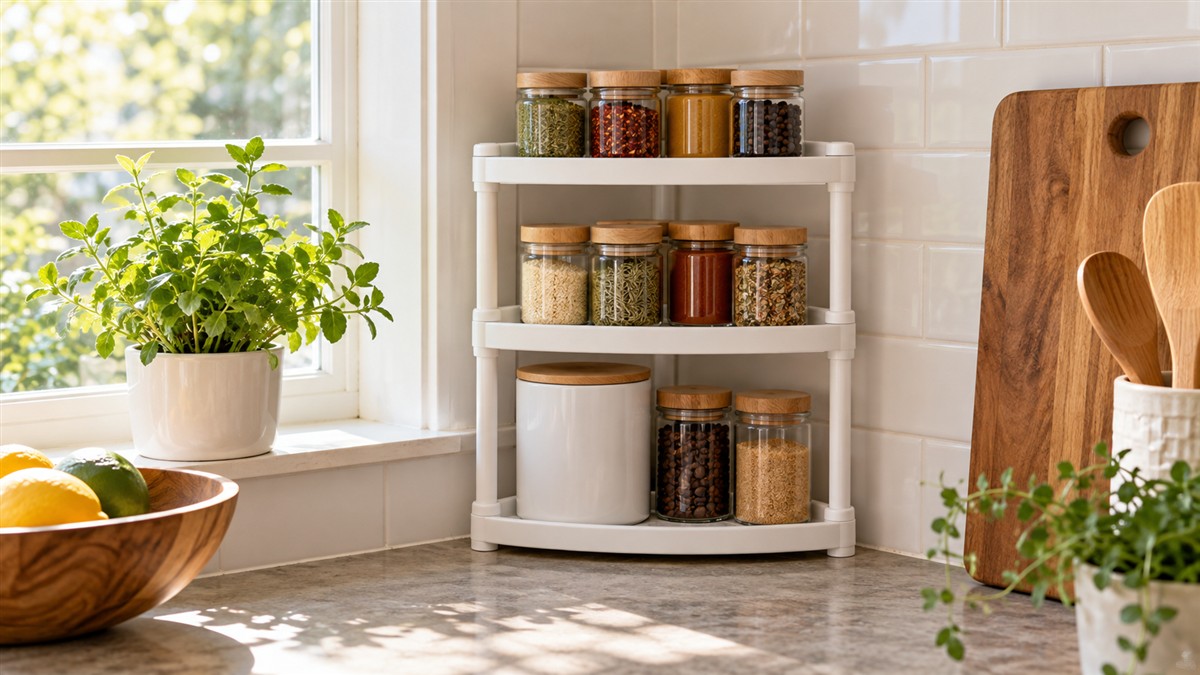
A plastic corner shelf is a small shelf made to fit an inside corner, usually on a countertop, a vanity or a wall. Many readers who search this phrase want a shelf that will not rust, will not mark a surface and is light to move. This guide helps you test that wish against real listings. None of the corner shelves in this guide is made mainly of plastic. Most are metal, wood or bamboo, and the one plastic item in the set is a pack of wall clips for wire shelving. The sections below show how to read the material field, what each mounting type means and which picks suit a kitchen, a bathroom or a wall corner.
Quick answer
If you need a plastic corner shelf, read the material field of every listing before you buy. Many corner shelves are iron, wood, bamboo or metal with plastic connectors, so a plastic word in the title does not mean the whole shelf is plastic. Choose a countertop corner shelf for a kitchen or vanity, and a corner caddy for a shower or bathtub. Check the number of tiers, the footprint on the surface and whether the shelf is freestanding or fixed to a wall. If the listing does not say the material, do not assume it is plastic.
What matters for a corner shelf
Material and what it changes
The material field tells you what the shelf is made from, and it changes how the shelf looks, how it is cleaned and how it is fixed. Iron and metal frames tend to give a firm, upright shelf with a painted or powder-coated finish. Wood and bamboo give a warmer look and suit a kitchen or bathroom with natural tones. A plastic shelf, if you find one, is usually easier to lift and clean with a damp cloth, but the listing still needs to say so. Read the material field first, then the title, then the bullets, because the title may name a plastic part that is not the main frame.
Many storage products mix materials. A metal rack can use plastic connectors, and a wood shelf can use a metal bracket. The question to ask is which part carries the load. If the listing does not say, ask the seller before you assume the shelf is light or strong.
Countertop, shower and wall mounting
Corner shelves fall into three mounting groups. A countertop corner shelf sits on a flat surface. A countertop is a raised, firm, flat, horizontal surface built for work in kitchens and bathrooms, and it is usually supported by cabinets at a comfortable height. A countertop shelf therefore suits spices, coffee supplies or toiletries that you reach often.
A shower or bathtub corner caddy hangs from or sits in the corner of a wet area. Its job is to hold bottles and soap off the floor. Because it sits in a wet space, check whether the listing describes a moisture-resistant material, and check that the caddy is meant for a shower rather than a dry room.
A wall-mounted corner shelf is fixed to two walls or to one wall with a bracket. A shelf is a flat, horizontal or sloping plane used for storage, raised off the floor and often anchored to a wall or supported by brackets. Use a wall stud where you can, and follow the maker’s instructions for any anchor the listing names.
Tiers and adjustability
A tiered corner shelf stacks storage vertically. That helps when the footprint is small but the items vary in height. An adjustable shelf lets you move each tier to fit tall bottles or short jars. Check whether the listing says the tiers adjust, and whether the adjustment uses holes, rails or clips. A tier that adjusts on a listing with no detail about the mechanism is still a tier you should test before you load it.
Footprint and clearance
A corner shelf takes up more room than its width suggests, because the tiers project forward. Measure the corner, then measure the depth you can spare. Leave space for a tap, a socket or a cabinet door to open. Some listings give a product size and a separate item size, and the two figures may not match. When they do not match, use the larger figure for your planning.
Weight and load
A corner shelf holds only what the listing says it will hold. Look for a weight figure, check whether it is per shelf or for the unit, and check whether it assumes the shelf is fixed to a wall. If the listing gives no figure, treat the shelf as unrated. Keep heavy jars and bottles on the lowest tier and lighter items on the upper tiers.
How to choose
- Choose a countertop corner shelf if the goal is spices, coffee or everyday kitchen items.
- Choose a shower or bathtub caddy if the goal is shampoo, soap and razors in a wet corner. For a bathtub edge, also compare bathtub corner organizers.
- Choose a shelf with adjustable tiers if your items vary in height.
- Choose a shelf that names its material and its mounting type, and skip any listing that gives only a title.
- Skip any listing whose material or dimensions contradict each other until the seller clarifies.
If you are looking at wall corners rather than countertops, compare corner wall shelves for a living room and catty corner shelves before you commit to a countertop unit.
1. 3 Tier Adjustable Countertop Organizer Corner Shelf (Black countertop corner shelf)
Specs from the listing (checked 2026-10-13):
- Material: Iron
- Product Dimensions: 7.8″D x 23.62″W x 16.22″H
- Number of Shelves: 3
- Special Feature: Adjustable
- Item Weight: 2.26 kg
Pros
- The listing says the three tiers are adjustable
- The bullets say the smooth cover wipes clean with a damp cloth
Cons
- The listing gives the material as iron, not plastic
- Two dimension sets in the listing do not match, so measure before you buy
Best for: Readers who want a black metal corner shelf for a countertop, desk or vanity.
Skip if: Skip it if you need a plastic shelf or a wood look.
View on Amazon (affiliate link)
2. Kitchen Countertop Organizer, 2 Tier Corner Shelf, Spice Rack (Wood and metal countertop corner)
Specs from the listing (checked 2026-10-13):
- Material: Wood
- Product Dimensions: 5.9″D x 15.7″W x 11.8″H
- Item Weight: 4.4 pounds
- Included Components: Iron rack, wooden board, screws, wrench, and instruction manual.
- Number of Shelves: 2
Pros
- The bullets say it can be set up as a stacked, side-by-side or L-shaped shelf
- The listing says pre-drilled holes make installation simple
Cons
- The listing gives the material as wood, so it is not a plastic shelf
- The listing does not state a weight capacity for the tiers
Best for: Readers who want a wood and metal countertop shelf for spices or coffee supplies.
Skip if: Skip it if you need a published weight rating for heavy jars.
View on Amazon (affiliate link)
3. Bamboo Corner Shower Caddy Corner Shelf Stand (Bamboo shower corner caddy)
Specs from the listing (checked 2026-10-13):
- Material: Bamboo
- Mounting Type: Corner Mount
- Product Dimensions: 11.8″D x 11.8″W x 27.5″H
- Number of Shelves: 1
- Installation Type: Corner Mount
Pros
- The bullets describe bamboo that resists moisture in a humid shower
- The listing includes installation instructions and screws
Cons
- The listing describes it for showers and bathtubs, so it is a bathroom item
- The listing gives one shelf, although a bullet mentions multiple shelves
Best for: Readers who need a corner caddy for a shower or bathtub.
Skip if: Skip it if you need a countertop shelf or a plastic shelf.
View on Amazon (affiliate link)
Where plastic does show up
Plastic parts are common in storage, even where the main shelf is metal or wood. A plastic clip can hold a wire shelf to a rail. A plastic connector can join the tubes of a shelving rack. A plastic cover can protect a shelf from dust. These parts matter because they affect how the unit goes together and how it is cleaned.
The one plastic item in this set is a pack of wall clips for wire shelving. The listing sells the clips with screws and expansion tubes, and it describes them as a way to secure a wire shelf to a wall. Those clips are not a corner shelf, so they will not hold books or bottles on their own. If you want a plastic-based shelf for a corner, check whether it is a shelf or an accessory, and whether the listing describes the plastic as the frame or only as a fitting.
Checking a corner shelf listing before you buy
Start with four checks, in the same order each time. First, confirm what the shelf is for. A listing may name a kitchen, a bathroom, a desk or a closet, and the room type field often lists more than one. A shelf meant for a dry kitchen counter is not the same as a caddy for a wet shower corner, even when both sit in a corner.
Second, confirm the material of the frame and of any visible surface. Look at the material field, the finish field and the bullets together. If the bullets describe a smooth cover or a coating, read whether that cover is part of the frame or added over it. The finish affects cleaning, and a listing that gives only a finish name, without a material, tells you less than one that gives both.
Third, confirm the size. Compare the product dimensions with the item dimensions, and confirm the depth, because the depth decides how far the shelf projects into the room. If the listing gives a shelf count, check that it matches the number of tiers in the bullets. A mismatch is not a disaster, but it tells you the listing needs a second look before you rely on it.
Fourth, confirm the fixing. Some corner shelves stand on the surface, some hang from a rail, and some are screwed to a wall. The included parts usually show which method the maker expects. A listing that includes screws and written instructions is describing a fixing method. A listing with no fixing details should be treated as freestanding until the seller confirms otherwise.
Where a check fails, do not buy on the strength of the title. Ask the seller one question about the field that is unclear, and wait for the answer before you order. Keep a note of the answer with the listing, so that the figure you measured for the corner is the figure the shelf actually has.
A corner shelf with a 7.8 inch depth would sit against the wall in the corner. 24 minus 7.8 equals 16.2, so 16.2 inches of counter stay free on the first side. 18 minus 7.8 equals 10.2, so 10.2 inches stay free on the second side. Those leftover strips are where a kettle or a cutting board fits. Repeat the calculation with the depth from the listing you choose and the counter you have measured.
Mistakes to avoid
- Buying a corner shelf by its title. A plastic word can refer to a connector, a clip or a cover, while the frame is metal or wood.
- Assuming a corner shelf is light enough to move without a plan. Check the item weight before you decide where it will sit.
- Forgetting to measure the depth. A shelf that fits the corner can still block a tap or a door.
- Loading a tier beyond the listing’s stated figure. If the listing gives no figure, do not treat the tier as rated.
- Mounting a shelf into a wet area without checking that the listing is for that use.
- Ignoring a contradiction between the product size and the item size. One of the figures is probably wrong, so ask before you buy.
FAQ
Is a plastic corner shelf good for a kitchen?
It can be, but check the material field first. Many kitchen corner shelves are metal or wood, and a plastic word in the title may refer to a small part. If the listing names a plastic frame, check the item weight and the stated capacity before you load it with spices or jars.
Can I use a corner shelf in the shower?
Only if the listing is made for a shower or bathtub corner. A countertop shelf is not designed for a wet corner. Choose a caddy that describes moisture resistance, and follow the mounting instructions for its fixing method.
Do corner shelves need to be attached to the wall?
Some do, and some are freestanding. A countertop corner shelf usually stands on its own. A wall-mounted shelf needs a fixing. Use a stud where possible, and follow the maker’s instructions for any anchor the listing names.
How much can a corner shelf hold?
Only what the listing says. Look for a weight figure, and check whether it is per shelf or for the whole unit. If no figure is stated, do not treat the shelf as rated for heavy bottles or jars.
What is the difference between a countertop shelf and a wall shelf?
A countertop shelf sits on a flat surface, usually a kitchen or vanity counter. A wall shelf is fixed to one or two walls. The countertop type takes up counter space, and the wall type takes up wall space, so choose by which surface you have free.
Are plastic clips a corner shelf?
No. The plastic clips in this set are wall clips for wire shelving, sold with screws and expansion tubes. They hold a wire shelf in place, so they are an accessory rather than a shelf.
Should I choose a corner shelf with adjustable tiers?
Choose adjustable tiers if your items vary in height. Check whether the listing says the tiers adjust, and how. If the listing gives no detail, test the adjustment before you load the shelf.
Worked example: corner strips and the weight
A corner shelf that is 7.8 inches deep leaves 16.2 inches on one side of a span of 24 inches (24 – 7.8), and 10.2 inches on the other side of a span of 18 inches (18 – 7.8). The 2.26 kg weight converts to about 4.98 pounds (2.26 x 2.2046), which does not match the 4.4 pounds given elsewhere, so check the weight on the product page.
Bottom line
If you want a plastic corner shelf, read the material field first, because few corner shelves are plastic. Choose a countertop corner shelf for a kitchen, a caddy for a shower and a wall shelf for a corner you can fix to. Measure the depth, check the weight figure and skip any listing whose figures disagree until the seller explains them.
Sources
- Countertop, Wikipedia: what a countertop is and how it is supported by cabinets
- Shelf (storage), Wikipedia): what a shelf is and how shelves are anchored or supported
- Wood, Wikipedia: wood as a natural material, for comparison with engineered panels