Best Shoe Entrance Storage: Two Options for a Front Door Gap
As an Amazon Associate we earn from qualifying purchases. Details
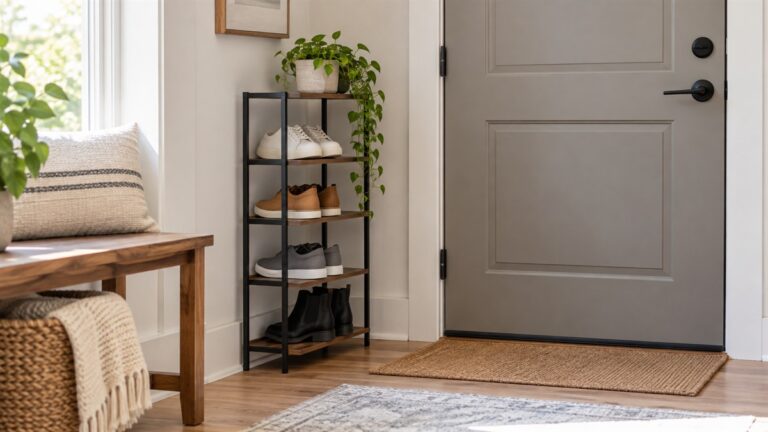
Shoe entrance storage has one job: keep shoes off the floor where people come in. The space is often narrow, and it sits where coats, bags and keys also land. This guide covers the two racks in this group that the listings describe for an entryway, porch or mudroom. It explains how cubby size, footprint and stacking decide fit, and what the listings do and do not state. It also shows which other shoe storage in the group is aimed at under-bed or general use. Measure the entrance first, then compare the figures.
Quick answer
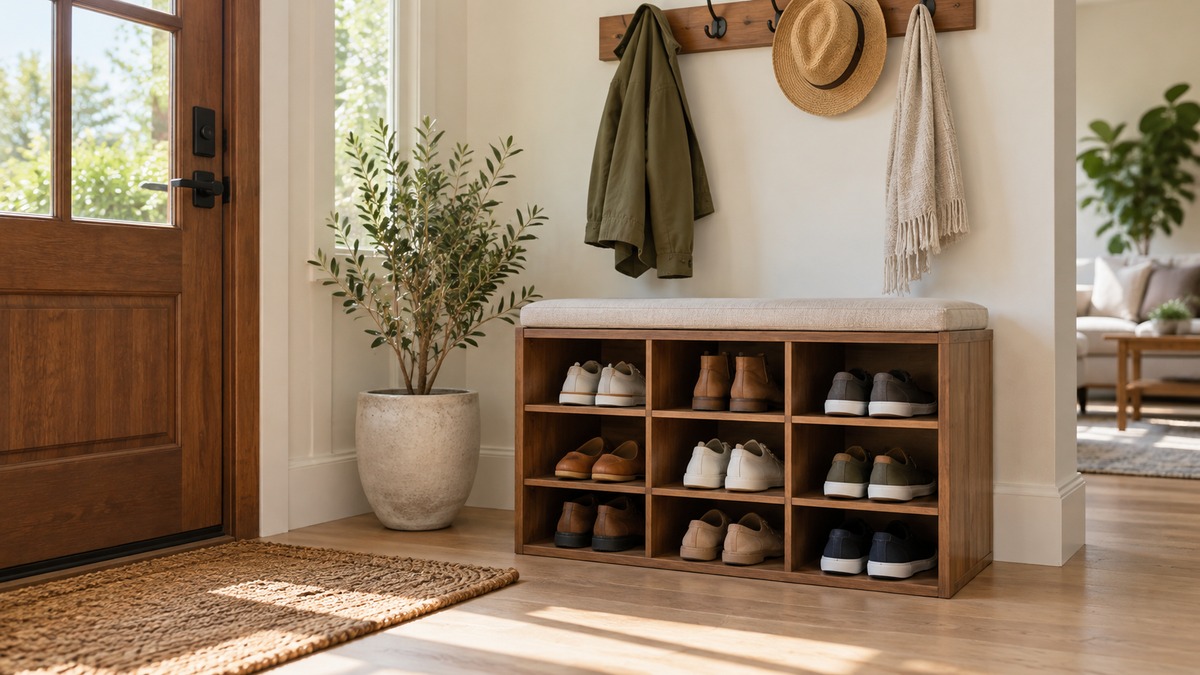
Choose the nine-cube shoe bench if you want a freestanding unit with one cubby for each pair of shoes near the door. Choose the fifteen-cube stackable organizer if you have space for a stack and your shoes are low-profile. Its openings measure 5.75 inches high, 4.5 inches wide and 11 inches deep, so boots and tall shoes will not fit. Neither listing states a weight capacity. The nine-cube shoe bench is described in its listing as suitable for the entrance porch and front door. Its footprint is 11.8 inches deep and 27.6 inches wide, so check the wall space before you order.
What “entrance” changes about a shoe rack
An entrance rack is not the same as a closet rack. Shoes arrive wet or dusty, and they wait near the door for the next trip out. Good entrance storage keeps them off the floor and out of the path.
Footprint matters first. The rack has to fit the wall beside the door without blocking the swing of the door or the walkway. Measure from the wall to the front of the rack, and check the door’s swing path.
Cubby size matters second. A cubby is an opening sized for one pair. Boots and tall shoes need deeper and taller openings than flat sandals. Measure your tallest pair before you compare cubby counts.
Stacking matters third. A stackable organizer grows taller as you add units. The taller the stack, the more important anchoring becomes. The US Consumer Product Safety Commission advises securing top-heavy furniture with anti-tip devices, and it says to follow the manufacturer’s instructions.
Mounting type matters last. Both racks in this guide sit on the floor. Neither listing describes anti-tip hardware for the unit itself, so ask the seller before you stack or place a tall rack in a high-traffic spot.
Reading the listing before you buy
Start with the dimensions. The shoe bench lists 11.8 inches deep, 27.6 inches wide and 17.7 inches high in its dimension fields. Its specification block also gives a minimum required door width of 27.6 inches, which is worth checking against your entrance.
The organizer lists 11.63 inches deep, 24.09 inches wide and 19.29 inches high. A bullet gives a height range of 19 to 38 inches when assembled, which depends on how many units you stack. Use the range that matches your plan, not the single figure.
Check the finish. The shoe bench’s color field says brown, while its finish field says white and a bullet describes a modern white finish. Confirm the finish with the seller before you pick a room color.
Check the weight. Neither listing gives a weight capacity. The shoe bench’s bullet says it has strong load-bearing capacity, but it gives no number. The organizer gives an item weight of 9.48 kg, but no load figure. Do not plan a shelf of heavy boots until you have confirmed a limit.
Check the assembly claims. The shoe bench says tools are included, but its included components line lists only assembly instructions. The organizer says all hardware is included, and its included components line lists installation and assembly hardware and a shoe organizer.
How to choose
Choose the nine-cube shoe bench if:
- you want a freestanding unit with one cubby for each pair in a single piece
- your entrance has room for a unit about 27.6 inches wide and 11.8 inches deep
- you want a unit whose listing states a waterproof special feature
Choose the fifteen-cube stackable organizer if:
- you want more openings than the bench and can stack units
- your shoes are low-profile, with the height and depth of flat sandals or flip flops
- you have a closet, entryway or mudroom where a stack will stay put
Skip either one if your shoes are taller than the stated openings. Skip the stacked unit if you cannot anchor it or if children climb near the door. You may not need a rack at all if a single bench or a wall hook already holds the daily pairs. For other entrance layouts, compare entryway shoe storage, hallway shoe storage and small shoe racks for a closet floor.
1. Shoe Storage Bench Cubby with 9 Cubbies, Wood Shoe Rack Organizer Cabinet (Nine-cube shoe bench)
Specs from the listing (checked 2026-10-13):
- Product Dimensions: 11.8″D x 27.6″W x 17.7″H
- Number of Shelves: 9
- Item Weight: 18.5 pounds
- Minimum Required Door Width: 27.6 inches
- Installation Type: Freestanding
- Material: Engineered Wood
Pros
- The listing describes it as suitable for an entrance porch and front door
- The listing says it stores nine pairs of shoes in nine cubbies
- The listing states a freestanding installation type with a waterproof special feature
Cons
- The color field says brown while the finish field and a bullet say white
- The included components line lists only assembly instructions, while a bullet says tools are included
- The listing gives no weight capacity, only a general claim of strong load-bearing
Best for: A reader who wants a freestanding nine-cube unit beside a front door and has a wall space about 27.6 inches wide.
Skip if: Skip it if your entrance is narrower than the stated 27.6-inch door width, or if you need a stated weight limit.
View on Amazon (affiliate link)
2. ClosetMaid 15 Cube Stackable Storage Organizer for Shoes, Bags, Crafts, Hobbies with Wood Shelves (Fifteen-cube stackable organizer)
Specs from the listing (checked 2026-10-13):
- Product Dimensions: 11.63″D x 24.09″W x 19.29″H
- Number of Shelves: 15
- Item Weight: 9.48 kg
- Mounting Type: Floor Mount
- Included Components: Installation & Assembly Hardware, Shoe Organizer
- Recommended Uses For Product: Coats, Shoes
Pros
- The listing gives fifteen openings and names entryway and mudroom use in its title
- The listing states that stacking hardware is included
- The listing gives a height range of 19 to 38 inches when assembled, depending on the stack
Cons
- The openings measure 5.75 inches high, so boots and tall shoes will not fit
- The listing gives no weight capacity and no anti-tip hardware for the unit
- The listing describes it for low-profile shoes such as flip flops and sandals
Best for: A reader with low-profile shoes who wants many openings by the door and room to stack.
Skip if: Skip it if your shoes are taller than 5.75 inches or if you cannot anchor a tall stack.
View on Amazon (affiliate link)
Products that fit this
Two racks in this group are described for an entryway, porch, mudroom or closet entrance. Each write-up below covers what its listing states and what to check before buying. The cards show the specifications, so the write-ups focus on fit.
A nine-cube shoe bench for a front door
This freestanding unit has nine cubbies in a three-tier layout. Its listing describes it as suitable for the entrance porch, front door, living room and bedroom. It is made of engineered wood, and a bullet says the wood is MDF board. Its weight is 18.5 pounds. The listing says it can store nine pairs of shoes. The color field and the finish field disagree, so check the finish. The listing states a minimum required door width of 27.6 inches, which is also the bench’s width. Measure your entrance before you order.
A fifteen-cube stackable organizer for shoes
This stackable unit has fifteen openings for shoes, bags and small items. The title names entryway and mudroom use. Its openings measure 5.75 inches high, 4.5 inches wide and 11 inches deep. The listing says it is ideal for flip flops, sandals or other low-profile shoes smaller than those measurements. The height is 19 to 38 inches when stacked, and the listing says the hardware is included for stacking. The item weighs 9.48 kg. Those openings are the main limit for an entryway.
Fitting 14 pairs into the cubbies
Suppose you own 14 pairs of shoes. Check each cubby against the actual size of your shoes before you rely on the count.
Step 1: 14 minus 9 equals 5 pairs left after the nine-cube bench is full.
Step 2: the fifteen-cube organizer has 15 cubbies. 15 minus 5 equals 10 cubbies spare, if all five remaining pairs are low-profile enough to fit.
Check: 9 plus 5 equals 14, which matches the number of pairs.
If any of the five pairs are boots, the organizer cannot hold them. Those pairs need a different place, such as a bench with taller openings or a closet floor.
Measuring your entrance step by step
Start at the door. Note which way it swings and how far the leaf opens before it reaches the wall beside it. The rack must stay outside that arc.
Measure the wall beside the door at floor level and again at about 18 inches high. The shoe bench is 17.7 inches high, so the upper measurement tells you whether a hook or coat rack above it will clash with the unit.
Measure the walkway from the front of the rack to the opposite wall. Leave enough room for one person to pass with a bag. Hallways that look wide can narrow quickly once a rack sits in them.
Check the floor for a baseboard, a register or a cable that could block the back of the unit. A rack that sits on a raised edge will not stand level.
Write the figures down next to the listing numbers. The bench lists 11.8 inches deep and 27.6 inches wide. The organizer lists 11.63 inches deep and 24.09 inches wide. Compare each against the space you measured, not against the figure you hope to fit.
Which pairs fit which opening
The organizer’s listing gives its opening size: 5.75 inches high, 4.5 inches wide and 11 inches deep. That size is what matters for shoe fit. A pair must be smaller than all three figures to sit in one cubby.
The listing calls those openings ideal for flip flops and sandals. It does not describe boots, and boots are generally taller than a flat sandal. If the boots in your entrance are taller than the opening, they will not fit, and the organizer is the wrong choice for them.
The shoe bench’s listing does not give a cubby opening size. It says the unit holds nine pairs, but it does not say which pairs or how tall. Measure your tallest pair and the cubby height in the store or from the maker’s drawing before you rely on the nine-pair figure.
Many households keep both daily shoes and seasonal boots by the door. A practical split is to keep the daily pairs in the bench and store boots elsewhere. That keeps the bench from filling with the one category its listing does not describe.
Before you order
Confirm the bench’s finish. The color field says brown, and a bullet says white. Ask the seller which is correct.
Confirm the bench’s included parts. The components line lists only assembly instructions, and a bullet says tools are included. Ask whether a screwdriver is in the box.
Confirm the organizer’s stacked height. The listing gives 19 to 38 inches depending on how many units you stack. Choose the number of units before you buy.
Confirm the weight limit for each rack. Neither listing gives a number, so ask for one or plan to keep heavy bags off the top shelves.
Confirm that you can anchor a stack. The listing for the organizer does not describe anti-tip hardware for the unit. Plan a fixing point that suits your wall and your floor.
Mistakes to avoid
Measuring the wall instead of the walkway is the first mistake. A rack that fits the wall may block the door swing or the path to the closet.
Buying on cubby count alone is the second. Count the cubbies, then check that the shoes fit the opening height and depth.
Stacking a tall unit without anchoring is the third. The organizer’s stacked height runs to 38 inches, and neither listing describes anti-tip hardware for the unit itself. Ask the seller, and follow the maker’s instructions.
Trusting a load claim without a number is the fourth. Neither listing gives a weight capacity, so do not load boots or heavy bags until you have a stated figure.
Ignoring the finish is the last. The shoe bench lists two finishes, brown and white. Check the color before you order.
FAQ
Can a shoe bench go in a small entryway?
Possibly. The bench is 27.6 inches wide and 11.8 inches deep according to its dimension fields. Measure the space beside the door, and check that the bench leaves room for the door to swing and for people to pass.
How many pairs of shoes does each rack hold?
The shoe bench’s listing says it stores nine pairs. The organizer has fifteen openings, but its listing describes them as sized for low-profile shoes. Count your pairs and measure them against the openings before you decide.
Will boots fit in these racks?
Probably not in the organizer. Its openings measure 5.75 inches high, and the listing calls it ideal for low-profile shoes. The bench does not give opening sizes, so measure your boots against the cubby before you buy.
Do these racks need tools?
The bench’s included components line lists only assembly instructions, although a bullet says tools are included. The organizer lists assembly hardware and a shoe organizer. Check both listings before you order, because the answer changes what you need at home.
Can I stack the organizer?
Yes, the listing says it can be stacked, and it includes hardware for that. Stacking raises the unit to a height of up to 38 inches. Anchor the stack or follow the maker’s instructions, and keep heavy items low.
Is the bench waterproof?
The listing states waterproof as a special feature. Treat that as the seller’s claim. For entrance use, check how the surface is finished, and wipe up wet shoes promptly.
Bottom line
Choose shoe entrance storage by measuring the entrance first. Use the nine-cube bench if you want one freestanding unit with a cubby for each pair near the door, and check the 27.6-inch width. Use the fifteen-cube organizer if you have room to stack and your shoes are low-profile, and anchor any stack you build. If your shoes are taller than the openings, or your entrance is narrower than the bench, you may not need either rack, and a wall hook or a closet shelf may serve better.
Sources
- CPSC Anchor It campaign: advises securing top-heavy furniture with anti-tip devices and removing tempting objects from the top.
- Closet (Wikipedia): describes a closet as an enclosed space with a door used for storage, which frames the entrance and closet use.