Best Door Shoe Storage: Two Options and How to Choose
As an Amazon Associate we earn from qualifying purchases. Details
Door shoe storage is the category of shoe racks and cubby units that sit by a front door, in an entryway, or in a closet near the door. This guide compares the two options covered here that are built to hold shoes. It explains what each listing states about size, shelf count, weight, finish and assembly. It also shows how to measure your own space before you order, so the unit you pick fits both the floor and the shoes you own. If you only have a few minutes, start with the quick answer.
Quick answer
Choose the stackable cube organizer if you want a closet or mudroom unit with fifteen small openings for low-profile shoes such as flip flops and sandals. Choose the nine-cube bench-style rack if you want a floor unit for an entrance, porch or hallway. The rack’s listing gives its footprint as 27.6 inches wide and 11.8 inches deep. Neither option has doors, so pick one only if open cubbies suit your door. Measure the floor space by your door before you order.
What matters for door shoe storage
Five things change which unit fits a door. Check each one against your own entry before you read the picks.
Shoe height and opening size
The opening height decides which shoes fit. The first pick’s cube openings are listed at 5.75-inch high, 4.5-inch wide and 11-inch deep, and the listing says the unit is ideal for shoes smaller than that. Boots and tall sneakers will not fit a 5.75-inch opening. Measure your tallest pair of shoes before you buy, and compare that height with the opening height in the listing.
Floor footprint and depth
Measure the floor, not only the wall. The cube unit’s listing gives a size of 19-38-inch high, 24.13-inch wide and 11.63-inch deep when assembled. The rack’s footprint is 27.6 inches wide, 11.8 inches deep and 17.7 inches high. A unit that sits deeper than the door swing can block the path into the room, so leave space for the door to open fully.
Weight when loaded
Shoe units get heavy as soon as they are full. The cube unit’s listing gives an item weight of 9.48 kg, and the rack’s listing gives 18.5 pounds. Neither listing states a loaded capacity for the shelves, so do not assume the unit can carry a full load of boots or boxes. Lift the empty unit with help when you set it up, and decide where it will stand before the first fill.
Tipping and anchoring
Both units are short, but the advice from the U.S. Consumer Product Safety Commission applies to any furniture that can tip. Its guidance says existing furniture can be anchored with inexpensive anti-tip brackets, and that new furniture sold with anti-tip devices should have them installed right away. If you use a taller shoe cabinet by the door, anchor it to the wall. Follow the maker’s instructions for the hardware, and check the wall type before you drill.
Finish and material
The cube unit is listed as wood with a laminated finish in espresso. The rack is listed as engineered wood, and its bullets mention MDF board. Medium-density fibreboard is made from wood fibre mixed with wax and a resin binder, then formed into panels under high heat and pressure. The rack’s listing gives two different colors, brown in one field and white in another, so confirm the finish before you order.
How to choose
Choose the cube organizer when your shoes are low and you have more pairs than a bench can hold. Its fifteen openings give you many small cubes, and the listing says it stacks with other compatible organizers. It suits a closet floor or a mudroom corner where the door swings clear. For a closet-specific comparison, see closet shoe storage ideas.
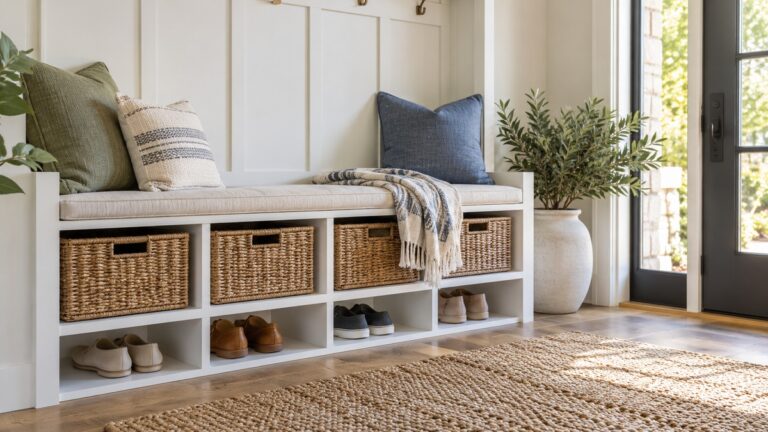
Choose the nine-cube rack when you want a floor-level bench for a front door, porch or hallway. The listing calls it a shoe storage bench cubby and says it holds nine pairs of shoes. The open cubbies make each pair easy to see at a glance. For entrance-focused options, see entryway shoe storage and hallway shoe storage.
Before you choose either one, open your entry door fully and watch where it swings. If the door meets the unit, the unit is in the wrong place, and a narrower or lower option may be the better fit. Move the unit to a side wall where the door does not sweep across it.
Choose neither if you want doors to hide your shoes. Neither listing states doors, so look for a unit whose listing names doors if that matters to you. For tall cabinet styles with doors, see shoe storage cabinets for small spaces. Also choose neither if your shoes are taller than the openings listed.
What the listings leave out
Neither listing gives a shelf load rating, so the safe loaded weight is unknown from the page. Neither listing states a warranty period for the unit. The cube unit’s finish fields, espresso and laminated, agree with each other, so the finish question applies mainly to the rack. For the rack, the listing gives the depth of the whole unit but does not describe the inside depth of each cubby. Ask the seller, or check the product page’s details panel, before you buy if any of these points matter to your setup.
The picks
Both picks are floor units, so neither one hangs on the wall. That matters if your entry has little floor space but a clear wall above the bench line. In that case you need a wall-mounted or door-hung option, which is a different product type and is not covered here. Read each write-up below, then compare the listed sizes with your measurements from the checklist.
The first pick: stackable cube organizer for a closet or mudroom
This pick has fifteen compartments in total, which is the most small cubes of the two. The cube openings are small, so it suits low sandals, flip flops and slim-soled shoes that the listing names. It is a floor unit with a laminated espresso finish. The listing says the hardware is included and that the unit is compatible with other stackable organizers from the same line. Its item weight is 9.48 kg, so choose its spot before you assemble it.
The second pick: nine-cube bench-style shoe rack
This pick is a nine-cube unit that the listing calls a shoe storage bench cubby. It is described as a three-tier design for an entrance porch, front door, living room or bedroom. Its footprint is 27.6 inches wide, which needs more open floor than the first pick. The color fields conflict, so compare the finish against the listing before you buy, and keep in mind that the bullets describe a white finish.
1. ClosetMaid 15 Cube Stackable Storage Organizer for Shoes, Bags, Crafts, Hobbies with Wood Shelves (Best for a closet or mudroom floor)
Specs from the listing (checked 2026-10-13):
- Number of Shelves: 15
- Product Dimensions: 11.63″D x 24.09″W x 19.29″H
- Item Weight: 9.48 kg
- Recommended Uses For Product: Coats, Shoes
Pros
- The listing describes fifteen compartments with openings of 5.75 inches high, 4.5 inches wide and 11 inches deep.
- All hardware is included, and the listing says the unit is easy to assemble with that hardware.
Cons
- The 5.75-inch opening height rules out boots and tall sneakers, so this suits low shoes only.
- The listing gives an item weight of 9.48 kg, which makes the unit heavy to move once it is stacked.
Best for: Closet or mudroom floors where you want many small cubes for sandals and flip flops.
Skip if: Skip it if your shoes are taller than 5.75 inches or if you need a seat to put shoes on.
View on Amazon (affiliate link)
2. Shoe Storage Bench Cubby with 9 Cubbies, Wood Shoe Rack Organizer Cabinet (Best for an entrance or hallway bench)
Specs from the listing (checked 2026-10-13):
- Number of Shelves: 9
- Product Dimensions: 11.8″D x 27.6″W x 17.7″H
- Item Weight: 18.5 pounds
- Color: Brown
- Furniture Finish: White
- Room Type: Bedroom, Hallway
Pros
- The listing describes nine cubbies in a vertical layout, and says it holds nine pairs of shoes.
- The listing gives overall size as 11.8 inches deep, 27.6 inches wide and 17.7 inches high.
Cons
- The listing gives two different finish colors, brown in the color field and white in the finish field.
- The item weight is 18.5 pounds, and the listing does not state a loaded capacity.
Best for: An entrance, porch or hallway where open cubbies and a bench shape suit the space.
Skip if: Skip it if you need a specific finish color, or if you need a unit with doors.
View on Amazon (affiliate link)
Worked example: does the unit fit your wall space?
Start with 30 minus 2 equals 28 for the left gap. Then 28 minus 2 equals 26 for the right gap, which leaves 26 inches of usable width.
Now compare that width with each unit. The first pick’s listed width is 24.13 inches, so 26 minus 24.13 equals 1.87, which leaves about 1.87 inches to spare. The second pick’s listed width is 27.6 inches. Twenty-six is less than 27.6, so that unit will not fit this wall space at all. Recheck both subtractions once more before you buy, and measure your own wall, because a real door frame and trim may take more room than this example allows.
Measuring checklist before you order
Work through these four steps before you choose a unit. Write down each number so you can compare it with the listing.
- Measure your tallest shoe from the sole to the top of the shoe. Keep that height in mind when you read the opening size.
- Measure the open floor width along the wall, then subtract the gap you want on each side.
- Measure the depth from the wall to the front edge of the door swing, not only the wall to the door frame.
- Note the wall type: drywall, plaster or masonry. A stud finder locates wood or metal framing studs behind a wall, and the maker’s instructions say which hardware suits your wall.
- Check the floor for slope or unevenness. Both listings describe a floor mount, and a freestanding unit on an uneven floor can wobble. Neither listing states leveling feet, so check the product page for adjustable feet before you order.
Mistakes to avoid
Buying by height alone is the first mistake. A shoe unit can be tall and still have openings too small for boots, so check the opening size, not only the overall height. The second mistake is measuring the wall but not the door swing. A unit that stands in the path of an opening door becomes a daily obstacle.
The third mistake is trusting one color field. The rack’s listing gives two finishes, so compare the photos with the color field before you order, and keep the return policy in mind. The fourth mistake is placing a tall unit near the door without anchoring it. Anti-tip hardware is a small addition compared with the risk of a fall, so install it when the unit is tall enough to tip.
The fifth mistake is filling the top shelf of a short unit with heavy boxes. Neither listing states a loaded capacity, so keep heavy items low and light items high.
The sixth mistake is skipping the wall-type check. Drywall, plaster and masonry take different hardware, and the maker’s instructions name what they support. Do not improvise a mount on a wall you have not identified.
FAQ
Will a shoe unit fit beside a door that opens into the entryway?
It depends on the clear width and the door swing. Use the worked example to subtract the gaps, then compare the result with the unit’s listed width. Leave room for the door to open fully before you choose.
How tall a shoe can the cube unit hold?
The listing gives cube openings of 5.75 inches high, so the unit is meant for low-profile shoes. Sandals and flip flops fit. Boots and tall sneakers will not, so measure your tallest pair first.
Does either unit have doors?
Neither listing states doors. If you want doors that hide shoes, look for a product whose listing names doors, and read the details before you buy.
Do I need to anchor a shoe rack to the wall?
Both units here are short, and their listings describe a floor mount. The U.S. Consumer Product Safety Commission advises anchoring furniture that can tip, and says existing furniture can be anchored with inexpensive anti-tip brackets. Follow the maker’s instructions for any hardware, and anchor any taller unit you add by the door.
Can I stack the cube unit with another unit?
The listing says the unit is compatible with other stackable organizers and includes hardware for stacking. Check that any second unit is listed as compatible before you buy it.
Which finish should I trust on the rack?
Neither color field is reliable on its own, because the fields disagree. Look at the photos on the product page, confirm the finish in the listing, and buy only after that check.
How heavy is the rack?
The listing gives 18.5 pounds as the item weight. It does not state a loaded weight, so plan how you will move the unit once you add shoes and boxes.
Bottom line
Choose the cube organizer for low shoes and a closet or mudroom floor. Choose the nine-cube bench for an entrance or hallway where open cubbies suit the space. Choose neither if you need doors, and choose neither if your shoes are taller than the listed openings. Before you check out, measure the opening height, the floor width and the door swing, then confirm the finish on the listing.
Sources
- U.S. CPSC, Anchor It!: anti-tip brackets for furniture that can tip
- Medium-density fibreboard: how MDF is made and how it compares with particle board
- Stud finder: what a stud finder locates behind a wall