Best Bathroom Sink and Storage Picks for Pedestal and Vanity Sinks
As an Amazon Associate we earn from qualifying purchases. Details
Bathroom sink and storage is mostly a question of what sits under the basin and beside it. A pedestal sink leaves an open column and very little floor, so storage has to wrap around the base or stand next to it. A vanity sink already has a cabinet, which hides the pipes but can waste the back and the corners. This guide sorts the options by sink type, then explains the measurements and weight figures that decide whether a piece actually fits. Every pick below is described only through the size, weight and mounting details its own listing gives, so you can compare them directly.
Quick answer
If you have a pedestal sink, look at a freestanding cabinet or a triangle corner shelf that stands beside the base. If your sink sits in a vanity, an under-sink pull-out organizer gives you reach into the back of the cabinet without kneeling. Pick enclosed storage when towels and cleaning supplies should stay out of sight, and open trays when you reach for bottles every day. Before you order, measure the cabinet opening, the depth behind the pipes and the height of the space you want to fill, because most pieces in this group are sized for one particular layout.
What matters for bathroom sink and storage
Sink type sets the shape
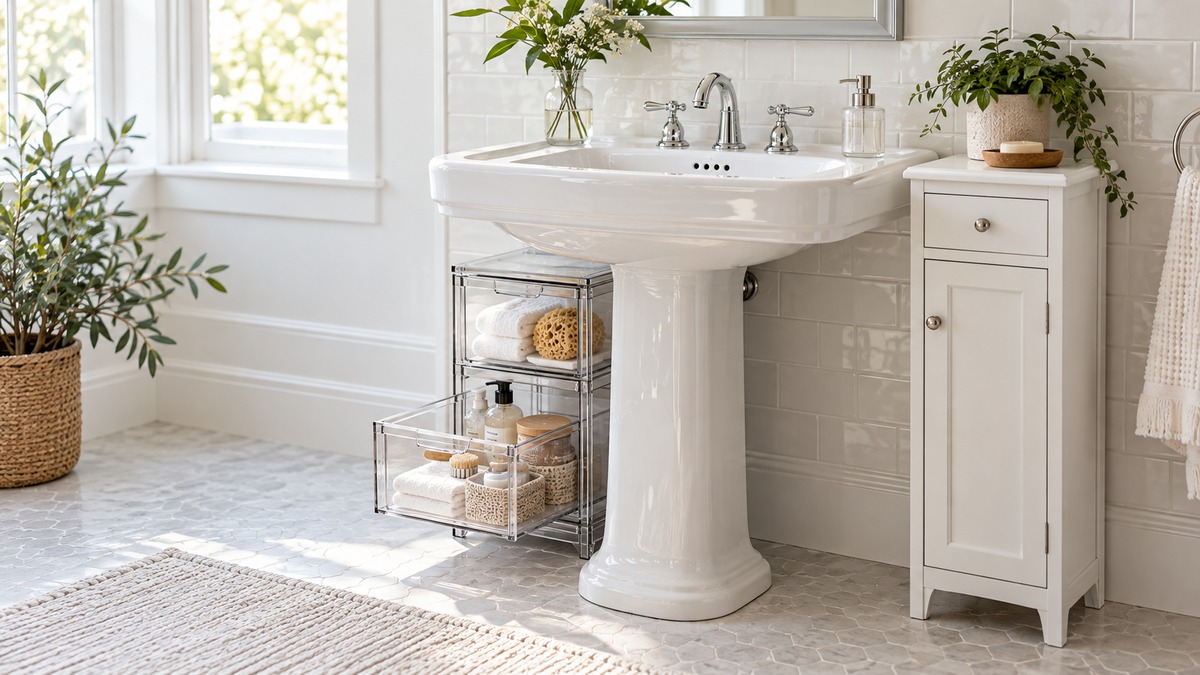
Pedestal sinks and vanities need different answers. The TEENFON cabinet is built around a pedestal base, with a U-shaped cutout that the listing describes as sliding snugly around the sink. The CADUKE pieces are corner shelves that stand beside the column instead. A vanity has its own cabinet floor, so the open question there is how to use the back and the two sides, which is where the Aekenr, Delamu and PXRACK pull-out organizers come in. Start by naming your sink type, because a piece that suits one layout often blocks the other.
Clearance around the pipes
Pipes and the drain are the main constraint under any basin. The PXRACK bullets describe a C-shaped frame meant to fit under a sink without hitting the plumbing, and the Cozivellia listing pre-cuts U-shaped openings for the same reason. Those details help, but they only work if your drain and supply lines sit where the frame expects them. Put a tape measure to the pipe height and to the distance from the back wall before you buy. A piece that fits the cabinet on paper can still catch a trap arm once it is loaded.
Weight figures measure different things
Weight numbers in this group are not interchangeable. The PXRACK lists a maximum weight of 100 pounds, which is a load rating for its trays. The Aekenr lists a shelf weight capacity of 50 pounds, which is also a load figure. The Cozivellia lists 24 pounds, but that is the cabinet’s own weight. Item weight tells you how hard a piece will be to lift and move, while a capacity tells you what it can hold. Read the field name on each listing before you put two numbers side by side.
Materials: engineered wood, steel and plastic
Several cabinets here are listed as engineered wood. Particle board is an engineered wood product made from wood chips and a synthetic resin, pressed under heat. It is cheaper, denser and more uniform than conventional wood and plywood. Medium-density fibreboard, or MDF, is made by breaking wood residuals into fibre and forming panels under high temperature and pressure; it is generally denser than plywood and stronger than particle board. The organizers are a different story. The Delamu and Aekenr baskets are listed with metal frames and a coated finish, which handles splashes and damp air differently from wood. Read the material line, then decide which kind of moisture your bathroom sees every day.
Anti-tip hardware for taller pieces
Most of the pieces here are short, but the TEENFON lists an anti-tip device among its included components, and any cabinet with doors and drawers can tip when a drawer is pulled out fully. The U.S. Consumer Product Safety Commission advises securing top-heavy furniture, and notes that existing furniture can be anchored with inexpensive anti-tip brackets. Use the hardware the maker supplies, follow its mounting instructions, and do not rely on a single screw in a weak wall.
Overall size versus usable size
Overall dimensions and interior dimensions often differ, and this group has a few clear cases. The PXRACK listing gives a 15.9-inch depth in one field and a 5 by 5 by 5 inch item size in another, which cannot describe the same piece. The CADUKE listing gives two different size sets for the same shelf. When fields disagree, rely on your own measurement of the opening and the space you want to fill, and treat the listing numbers as a starting point.
Reach and how far you have to bend
Storage that sits low under a sink is only useful if you can reach it without a struggle. Pull-out trays and sliding drawers solve that problem, because the back of the cabinet comes to the front. A fixed shelf at the back of a vanity still forces you to kneel and dig. A corner shelf beside a pedestal sits at waist height in many layouts, which makes everyday items easier to grab. Think about who uses the bathroom and how often. A child, an older adult or a shared household will reach in very different ways, and that changes which layout is comfortable.
Humidity, splashes and cleaning
Bathrooms are damp, so the finish matters. Listings in this group mention rust resistance, powder coating, waterproof engineered wood or a hollow design that lets water drain. Those features reduce the damage from splashes, but they do not replace regular wiping. Choose pieces you can lift out, rinse and dry without tools. Open trays are the easiest to clean. Enclosed cabinets are easier to protect from steam because the contents stay dry, but they need the interior wiped out now and then.
Picks
1. TEENFON 24″ Pedestal Sink Storage Cabinet with 2 Doors & 1 Drawer (Best for pedestal sinks with enclosed storage)
Specs from the listing (checked 2026-10-13):
- Product Dimensions: 13.2″D x 23.6″W x 25.6″H
- Material: Engineered Wood
- Number of Doors: 2
- Number of Drawers: 1
- Installation Type: Freestanding
Pros
- The listing describes a U-shaped cutout that slides around the sink.
- It lists anti-tipping, moisture resistance and soft-close as features.
Cons
- The listing gives an item weight of 24.3 pounds, so it is not a light move.
Best for: Pedestal sinks where the base needs a cabinet with two doors and one drawer.
Skip if: Your pipes sit outside the 7.9-inch U-shaped opening the listing describes.
View on Amazon (affiliate link)
2. Bathroom Vanity Sink Cabinet, Under Sink Storage Cabinet with 2 Doors, Waterproof Pedestal Sink (Best for a desktop plus enclosed storage)
Specs from the listing (checked 2026-10-13):
- Product Dimensions: 13.9″D x 27.6″W x 25.6″H
- Item Weight: 24 pounds
- Number of Doors: 2
- Material: Engineered Wood
Pros
- The listing separates a desktop for daily toiletries from an enclosed cabinet for towels.
- It describes water-resistant engineered wood with elevated legs.
Cons
- The listing gives an item weight of 24 pounds, which makes it heavy to reposition.
Best for: Vanity spaces that need a top surface and a closed cabinet in one piece.
Skip if: You need a tall unit, since the listing gives a height of 25.6 inches and the cabinet sits on legs.
View on Amazon (affiliate link)
3. CADUKE Pedestal Sink Shelf, 2 Pack Under Sink Organizers and Storage, Black (Best corner shelf that stands beside a pedestal)
Specs from the listing (checked 2026-10-13):
- Material: Engineered Wood, Metal
- Installation Type: Freestanding
- Number of Shelves: 2
- Shape: Triangular
Pros
- The listing says the triangle shelf can stand freely or sit snugly against a wall.
- The corner units can be separated or combined, according to the bullets.
Cons
- The listing gives two different size sets for the same shelf, so measure your own corner before ordering.
Best for: Pedestal sinks with an empty corner that needs open shelves.
Skip if: You need an enclosed cabinet, because the listing describes open tabletop shelves.
View on Amazon (affiliate link)
4. Under Sink Organizer and Storage for Bathroom and Kitchen – 2 Pack 3 Tier (Best for a vanity cabinet with pull-out trays)
Specs from the listing (checked 2026-10-13):
- Shelf Weight Capacity: 50 pounds
- Number of Shelves: 3
- Mounting Type: Cabinet Mount
- Finish Types: Matte
Pros
- The bullets describe an adjustable height design with an L-shape that fits around pipes.
- Each tray comes with four bottom suction cups to limit sliding when loaded.
Cons
- Setup is described as tool-free, with no detail on how the hooks grip the cabinet wall.
Best for: Vanity cabinets that are deep enough for tall bottles and cleaning supplies.
Skip if: Your cabinet is shallower than the 14.96 inch depth the listing gives.
View on Amazon (affiliate link)
5. Delamu 2-Tier Multi-Purpose Bathroom Under Sink Organizers and Storage, Stackable Kitchen Pantry (Best for seeing contents through clear drawers)
Specs from the listing (checked 2026-10-13):
- Included Components: Anti-Slip Mat, Clear Acrylic Drawer, Plastic Base, Sturdy Metal Rods
- Number of Packs: 2
- Product Dimensions: 13.19″D x 8.27″W x 10.63″H
- Material: PET
- Maximum Weight Recommendation: 30.06 kg
Pros
- The listing says the acrylic lets you see the inside clearly.
- The sets stack, and the bullets say you can stack 3 at a time.
Cons
- Two sizes are listed, and the larger one measures 10.63 inches tall, so confirm which fits your cabinet.
Best for: Under-sink or pantry use where you want to see small bottles without pulling every drawer.
Skip if: You need one deep bin for bulky cleaners, since these are drawers with dividers.
View on Amazon (affiliate link)
6. PXRACK Under Sink Organizer, Adjustable Height, 2 Tier Pull Out Under Cabinet Organizer, Slide Out (Best for tall bottles with adjustable tiers)
Specs from the listing (checked 2026-10-13):
- Weight Capacity Maximum: 100 pounds
- Number of Shelves: 2
- Product Dimensions: 15.9″D x 11.8″W x 16.9″H
- Installation Type: Undercounter
- Product Care Instructions: Hand Wash Only
Pros
- The listing gives a maximum weight of 100 pounds for the unit.
- The bottom tier is described as able to hold items up to 13 inches tall.
Cons
- The listing's item dimensions read 5 by 5 by 5 inches, which conflicts with its 15.9-inch depth, so measure your cabinet instead.
Best for: Sinks with tall cleaning bottles and cabinets that vary in height.
Skip if: You want a fixed-height rack, because this one adjusts across five levels.
View on Amazon (affiliate link)
How to choose the right piece
Start with the sink, then the space, then the load. These rules narrow the field quickly.
- Choose a pedestal cabinet or a corner shelf if your sink has an open base. The TEENFON and CADUKE pieces are built for that shape.
- Choose a pull-out organizer if your sink sits in a vanity with a cabinet floor. The Aekenr, Delamu and PXRACK options all slide out so you can reach the back.
- Choose an enclosed cabinet if towels and cleaning supplies need a door. The Cozivellia pairs a desktop with two doors.
- Choose open trays if you want to see every bottle at a glance. The Delamu drawers are clear, so you can check the contents without pulling the whole unit out.
Then check the load. If you plan to store heavy cleaners, look for a capacity figure rather than the item weight. If you plan to store light items such as cotton pads and hair ties, a lower rating is fine, and the cost of a bigger piece is not worth it. For more options by layout, read pedestal sink storage cabinets and under-sink pull-out organizers before you commit.
The bottles go on an open top shelf that you can reach without bending. The rolls go in an enclosed cabinet beside the base. Six bottles plus four rolls equals ten items in total. Six on the open shelf and four in the cabinet keeps the everyday bottles in reach and the backup stock hidden. Write down the depth the bottles need, then compare it with the depth the listing gives before you choose a piece. If the bottles are taller than the shelf height, look at the tiered options in bathroom corner storage before you buy.
Mistakes to avoid
- Buying on the item weight alone. That number tells you how heavy the piece is, not how much it can hold.
- Skipping the pipe measurement. A cutout that looks right on the listing can still land on the trap.
- Trusting one dimension field. When the overall size and the item size differ, measure the opening yourself.
- Hanging a shelf on a weak anchor. Do not assume the shelf’s rating applies to a generic anchor. Find the studs first, because a stud finder locates the framing behind the wall, and use the hardware the maker supplies.
- Forgetting the door swing. A cabinet door that opens into the path of the toilet or the sink takes away the space you were trying to gain.
- Ignoring the finish. A coated steel tray and an engineered wood cabinet react to steam differently, so wipe both dry after showers.
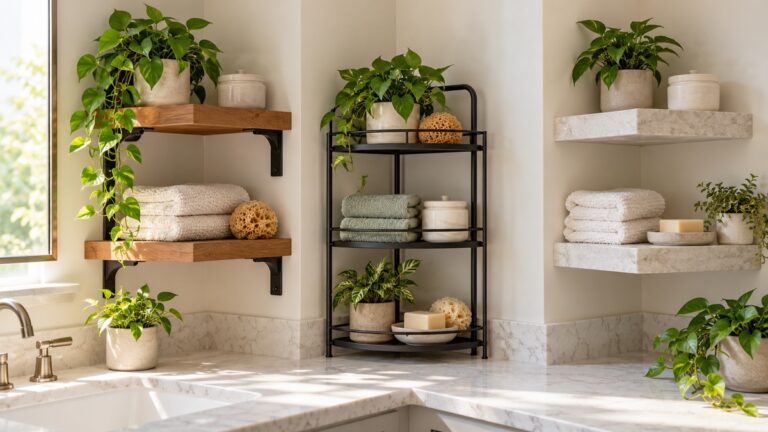
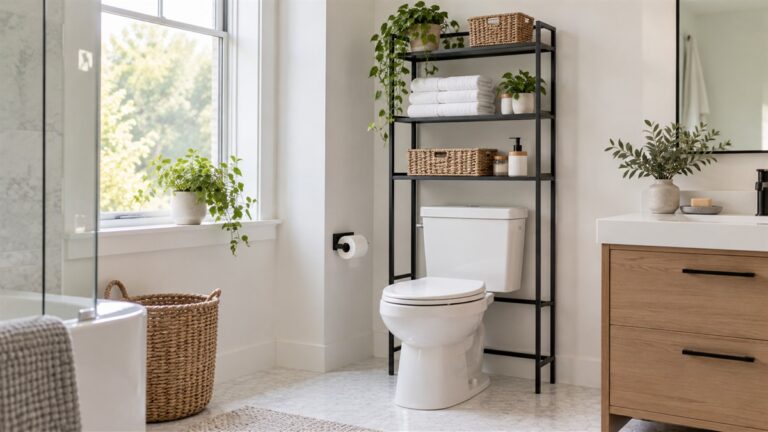
- Choosing by the photo. Product photos often show a styled scene with decorative items on the shelves. The footprint and the opening sit in the size fields, so start there.
- Loading the top tier first. A tray rated for 50 pounds still needs its heaviest bottles on the base, where they sit lowest and tip least.
FAQ
Will a pedestal sink storage cabinet fit around my sink?
It depends on the cutout and the pipe position. Compare the cutout dimensions in the listing with the space behind your sink, then measure the actual pipe height before you order. A pedestal cabinet with a U-shaped opening is designed for that shape, but the fit still depends on your plumbing and the wall behind the base.
What is the difference between item weight and weight capacity?
Item weight is the piece’s own weight. Weight capacity is how much the piece can carry. A cabinet can weigh 24 pounds and hold far less than that in cleaners, so read the capacity field when you plan what goes inside.
Do under-sink organizers need drilling?
Many listings here are described as tool-free, using suction cups, adhesive strips or a cabinet mount. Check the mounting type on each listing, and confirm that your cabinet floor is smooth and dry before you set the unit in place. Some listings mention a drill-free setup but still show screws in the hardware list, so read the included components line.
Should I buy a cabinet or open shelves?
Buy a cabinet if you need to hide clutter and keep towels from getting splashed. Buy open shelves if you want quick access and expect to wipe the surface often. Many bathrooms use both, with a cabinet for backups and an open tray for daily items.
How do I mount a bathroom shelf safely?
Find the studs first, use the hardware supplied, and check the wall type before you drill. Do not assume a rating applies to every anchor. Follow the maker’s mounting instructions for any tall unit, and tie tall pieces to the wall where the listing shows an anti-tip device.
Why do two listings show different sizes for the same piece?
Sellers sometimes list the overall footprint in one field and the item or packed size in another. When the numbers disagree, measure the space yourself. The listing numbers are a guide, and the opening you measure is the number that decides the purchase.
Is an engineered wood cabinet suitable for a bathroom?
Engineered wood can work in a bathroom when the finish is sealed and the cabinet is wiped dry after showers. Particle board and MDF are both pressed products, so edges and joints need the most attention. Look for a water-resistant or moisture-resistant finish in the listing, and keep the floor under the cabinet dry.
Bottom line
Choose by sink type first. If you have a pedestal, pick a cabinet or corner shelf designed for the base. If you have a vanity, pick a pull-out organizer that clears the pipes. Then check the capacity field, the overall size and the mounting notes before you add anything to your cart. Measure the space you have, match it to the layout, and buy the piece that fits the job.
Sources
- CPSC Anchor It!: secure top-heavy furniture with anti-tip brackets
- Particle board: what particle board is made from
- Medium-density fibreboard: how MDF is made and how it compares
- Stud finder: locating framing studs behind walls