Best Paint for Wood Shelves: Primer, Moisture and Finish Choice
As an Amazon Associate we earn from qualifying purchases. Details
The best paint for wood shelves is usually a good-quality primer followed by a topcoat that suits the room, applied to wood that is dry enough to take it. The extension pages we opened do not name a brand, and they were written mostly for house paint and exterior siding. Their advice still fits an interior shelf, because the same moisture, extractives and primer rules apply. This guide sets out the order of work, explains how to choose between latex and oil-based paint, and marks where the pages stop short of a shelf.
Updated 19 October 2026
Author: Editorial team, home-shelving-guide.com
Quick answer
- Check the moisture of the wood first. Penn State Extension says moisture contents lower than 14 percent should minimize problems with paints and other finishes.
- Prime bare wood before the topcoat. Purdue Extension says a primer should be used whether the top coat is oil-based or latex-based.
- Use a stain-blocking primer on knotty or dark wood. Purdue notes that extractives can bleed through a finish, and that some latex primers are made for woods that have them.
- Recoat within a set window. Purdue warns that waiting more than two weeks before a topcoat over an oil-base primer can leave a surface that will not bond well.
Dry wood comes first
Paint is the last thing that goes on a shelf, so it has to sit on wood that will not move or release moisture under it. Oregon State University Extension says that “Loss or gain of moisture also may interfere with paint adhesion and increase susceptibility to stain, decay, and insects.” A board that is too wet will take a coat of paint poorly, and the paint will show that failure as blisters or peeling.
Penn State Extension gives a working number. It says, “Typically, moisture contents lower than 14% should minimize problems with paints and other finishes, but if the moisture content is too high, blistering and peeling may occur.” A moisture meter is the simplest way to check. Read a few spots along the board, avoid the ends, and use the highest reading as the working figure. If the reading is above 14 percent, leave the board in the room until it dries down.
The room matters as much as the meter. Penn State Extension explains that “Wood is hygroscopic which means it will gain or lose moisture until it is in equilibrium with the moisture in the air around it.” A board that is painted while it is wetter than the room will keep giving up moisture after the finish is on, and a board that is drier than the room will take moisture from the air. Bring the wood into the room where the shelf will hang, let it settle for several days, and measure again before the primer goes on. The wood should be close to the room’s level, not just below the 14 percent line.
Purdue Extension names moisture as the main cause of early failure on wood. Its paint failure bulletin says, “The most common cause of premature paint failure on wood is moisture.” It also notes that “Porous paints are particularly vulnerable to moisture penetration.” The bulletin is about house paint on exterior wood, so the detail on outdoor weather does not apply to a shelf. The principle does: a finish cannot hold on wood that is still moving with moisture.
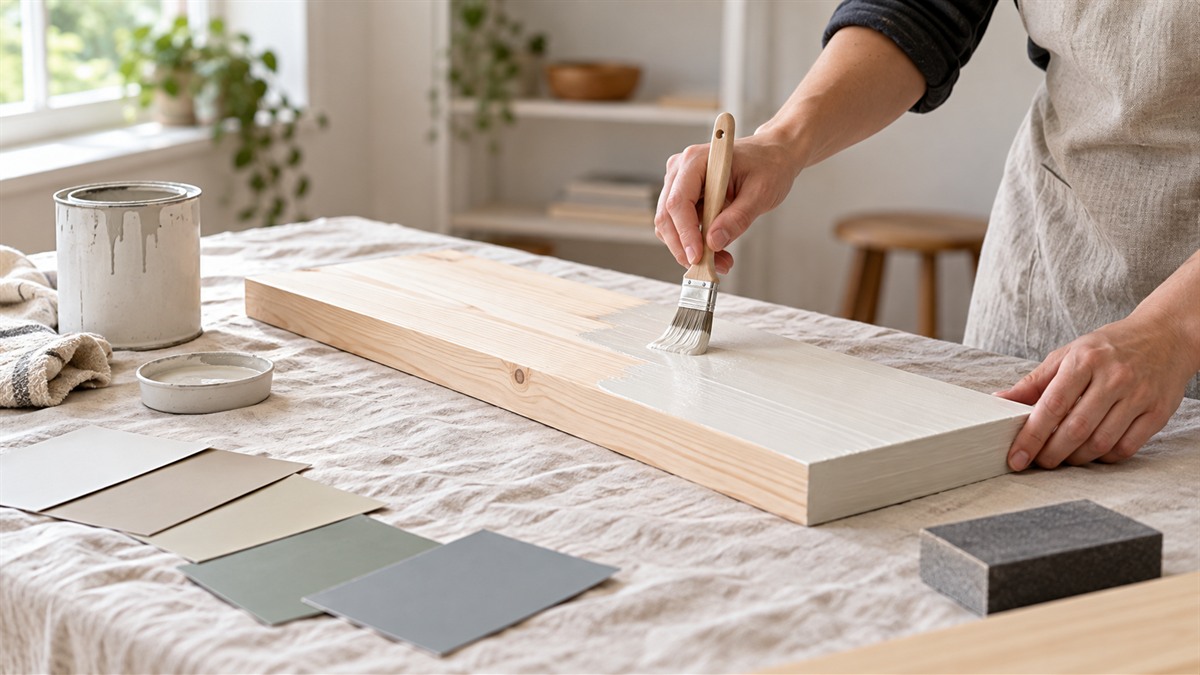
Prime the bare wood
Primer is the layer that makes the rest of the job work. The Purdue paint bulletin on wood finishing says, “Since the primer coat forms a base for all succeeding paint coats, it is very important.” On a shelf, the primer is the coat that goes straight onto raw wood, so it sets how even the topcoat will look and how long it will last.
Primer also controls what comes through from the wood. The same bulletin says that “The primer seals in the extractives so that they will not bleed through the top coat.” Extractives are the water-soluble compounds in the wood, and the Purdue discoloration bulletin explains where they come from: “Dark colored heartwood contains water-soluble extractives, while sapwood does not.” The bulletin adds that “These extractives can occur in both hardwoods and softwoods.” So a pine shelf with knots and an oak shelf with dark heartwood both need the primer.
The bulletin says a primer should be used “whether the top coat is an oil-base or latex-base paint.” That settles the first question on any shelf. Prime first, then choose the topcoat. For woods with water-soluble extractives, the bulletin notes that “Some latex-based primer paints are also designed for use over these woods” so a latex-based primer is a choice, not a mistake.
Latex or oil-based topcoat
The choice between latex and oil-based paint is a matter of use and clean-up as much as performance. The Purdue wood finishing page explains the basic difference: “Latex-based paints and stains are water borne, and oil or alkyd paints are solvent borne.” It also says, “Latex paints are generally easier to use since water is used in clean-up.” Oil-based paint needs solvent for cleaning, which is a practical reason many home painters choose latex for an interior shelf.
Oil-based paint has its own advantages. The same page says that “In comparison, oil-based paints require organic solvents for clean-up, and some are resistant to moisture movement.” So oil-based paint is more resistant in some formulations, and the cost is a harder clean-up and a longer wait between coats. For a shelf in a damp room, check the label for moisture resistance before you choose.
The Purdue paint failure bulletin says that “Thin coatings of new, oil-based paint are the most likely to blister.” That point is written about exterior wood heated by sun, but it teaches the same lesson for an indoor shelf: apply the topcoat in full coats, not thin ones, and let each coat dry properly.
Timing between coats
Timing is easy to overlook. The Purdue bulletin on paint failure warns that “If you wait longer than two weeks before applying a top coat to an oil-base primer, soap-like materials may form on the surface and interfere with the bonding of the next coat of paint.” A shelf that is primed and left for a month before its topcoat can fail at the bond between the two layers.
Plan the job so that the primer and the topcoat go on within a short time. If the project will pause, use the time to check the wood’s moisture again, and sand the primer lightly before the topcoat. The Purdue wood finishing bulletin adds that “Surface contamination from dirt, oil and other foreign substances must be eliminated” before a coat goes on.
A simple coat plan
A common plan is one coat of primer and two topcoats, which makes three coats in all. The pages we opened do not set a coat count for shelves, so treat three coats as a planning choice rather than a figure from the pages we opened. Multiply the coats by the number of shelves to plan the work. For four shelves, 4 x 3 = 12 coats in all.
The plan changes with the wood. A knotty board may need a spot of knot sealer before the primer, and the Purdue discoloration bulletin says moisture is usually the culprit when extractives discolor paint. If the wood is already stained or has tannin marks, the primer must be stain-blocking, and it may need an extra coat on the affected area.
Shelf-specific steps
The sequence below follows the pages we opened and applies them to a wall shelf. Each step is a practical reading of the pages we opened, and the table shows where each step comes from.
| Step | What the pages say | Where it comes from |
|---|---|---|
| Measure the moisture | Keep it below 14 percent before painting | Penn State lumber page |
| Clean the surface | Remove dirt, oil and other foreign substances before any coat | Purdue wood finishing page |
| Seal knots and dark areas | Use a stain-blocking primer on extractive woods | Purdue discoloration and wood finishing pages |
| Prime the whole shelf | A primer is needed under oil or latex topcoats | Purdue wood finishing page |
| Recoat within the set window | Do not wait more than two weeks over an oil-base primer | Purdue paint failure page |
| Allow the finish to cure | The pages we opened do not give a cure time for shelves | Paint maker’s label |
The last row is a gap. The pages we opened do not give a cure time for a shelf topcoat, so this guide does not give one. Follow the paint maker’s drying and cure times, which are on the label.
How we chose
We chose the pages in this guide because each one is a university extension publication that covers paint on wood or the moisture that affects it. The Purdue bulletins give the primer, extractive and paint-type points. The Penn State page gives the moisture target. The Oregon State bulletin covers the link between moisture and paint adhesion. We opened each page, extracted its text and checked each quoted sentence against that text before it went into the draft.
We did not use any product listing, price or review score to choose the advice. We did not name a paint brand, because the pages we opened do not compare brands, and a brand comparison would need data we did not find in them.
What we could not verify
The pages we opened do not compare paint brands, finishes or sheens for a shelf, and they do not say which topcoat holds up best under a load of books. This guide does not rank paints.
Most of the Purdue bulletins are written for exterior house paint on siding, trim and plywood. Their points on primers, extractives and timing transfer to an interior shelf, but their notes on weather and sun do not. We have marked the places where the advice comes from exterior work.
The pages do not give a cure time for a shelf topcoat, a dry time for a particular oil or latex paint, or a recoat time for every primer. Use the paint maker’s label for those figures.
The pages do not say how paint holds up on engineered boards such as particleboard or plywood. The Purdue plywood bulletin notes that such panels absorb moisture through their edges, which points to sealing the cut edges, but it does not give a paint system for them.
FAQ
Do I need primer before paint on a wood shelf?
The Purdue wood finishing bulletin says a primer should be used whether the topcoat is oil-based or latex-based. It also says the primer forms the base for all later coats, and it seals in extractives that could bleed through the topcoat.
What moisture level is safe for painting wood?
Penn State Extension sets 14 percent as the upper working line for paints and other finishes. Above that line, the page says blistering and peeling may occur, so measure the board before you prime it.
Should I use latex or oil-based paint on a shelf?
Either can work with a primer. The Purdue bulletin says latex paints are generally easier to use because water is used for clean-up, and oil-based paints need solvents but some are resistant to moisture movement. Pick the one that suits the room and your clean-up plan, and check the label for moisture resistance.
What if the wood has knots or dark stains?
Use a stain-blocking primer. The Purdue discoloration bulletin says extractives can discolor paint, that moisture is usually the culprit, and that extractives occur in both hardwoods and softwoods. A primer that seals the extractives is the main defense.
How long can I wait between primer and topcoat?
The Purdue paint failure bulletin says that waiting longer than two weeks before a topcoat over an oil-base primer can leave soap-like material on the surface. Plan to topcoat within a short time, and check the paint maker’s guidance for the window that applies to your product.
Bottom line
Dry the wood below 14 percent, prime the bare board, seal the knots and dark areas with a stain-blocking primer, and topcoat within a short window. Latex is easier to clean up and oil-based paint has its own moisture resistance, so choose by the room and the label. For a related shelf project, see best cabinet paint for kitchen cabinets and best floating wood shelves above toilet.
Sources
- Purdue Extension, NCR-133, Paint Failure Problems and Their Cure: the moisture cause, the porous-paint point, the blister note and the two-week recoat window
- Purdue Extension, NCR-135, wood finishing and primer guidance: the primer role, the extractive seal, the latex and oil comparison and the clean-up points
- Purdue Extension, NCR-134, paint discoloration and extractives: the heartwood extractives and the moisture-as-culprit point
- Penn State Extension, Why Does Lumber Need to be Dried?: the 14 percent moisture guidance for paints and finishes
- Oregon State University Extension, EM 8600, Wood and Moisture Relationships: the moisture and paint adhesion point
- Penn State Extension, Understanding Equilibrium Moisture Content: the equilibrium principle for wood in a room