Basement Shelves for Totes: Lift, Measure and Choose
As an Amazon Associate we earn from qualifying purchases. Details
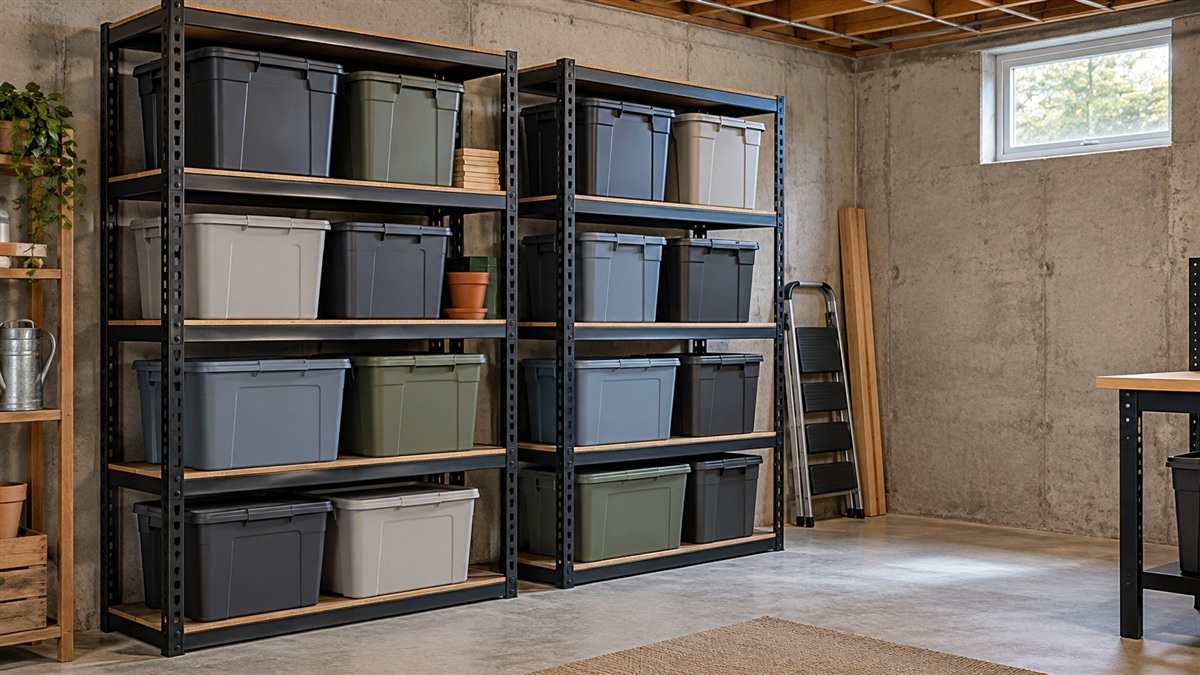
Basement shelves for totes are shelves or tote racks that hold plastic storage bins off the floor, so the floor can be cleaned and the bins are easier to reach. Readers want to know which rack will carry the load, how many totes fit, and whether a tall unit needs anchoring. Short answer: choose a rack whose listing states a capacity, confirm whether that figure is per shelf or for the whole unit, measure the tote against the shelf space, and keep totes in lidded plastic rather than cardboard. The nine listings below are tote racks and shelving units, and the figures quoted come from the listing titles.
Updated 19 October 2026
Quick answer
- Pick a rack whose listing states a capacity, and find out whether that figure is per shelf or for the whole unit. Most listings in this set do not say.
- Keep totes at least six inches off the floor. Penn State Extension gives that clearance for storage containers so the floor can be cleaned.
- Use plastic totes with tight-fitting lids. Penn State Extension advises against cardboard boxes for stored items.
- Measure the tote and the shelf clearance before you buy, because none of the listing titles gives the number of totes that fit on one tier.
What a basement changes for tote storage
A basement is a floor-level space, and the floor is where most storage problems start. Penn State Extension’s decluttering guidance treats the floor as the main concern for storage containers. It says that “All items, including storage containers, should be at least six inches off the floor for easier floor cleaning.” The reason given there is cleaning, not moisture. A rack that lifts totes off a concrete slab meets that rule, but the rule does not show that the rack protects anything from damp.
Moisture is a separate question. Penn State Extension’s pest guidance tells readers to “reduce humidity in basements and other moist areas of the home, such as bathrooms and kitchens.” The University of Maryland Extension page on household insects lists “managing moisture in and around the home” among its management steps, and it says that “using a dehumidifier are some examples of management techniques to help reduce or eliminate an indoor insect problem.” Both pages are about pests. Neither gives a humidity target for a basement, and neither says which storage rack or tote material handles damp best.
For that reason this guide treats moisture as a planning issue rather than a product feature. Lift the totes, keep the lids closed, and look at the room’s humidity before settling the storage plan. None of the listings in this set states a moisture rating, so none of the figures below should be read as a damp-proof rating.
Why the container type matters
Penn State Extension’s decluttering guide gives two lines on containers. The first is: “Place items in plastic containers with tight fitting lids. This will make it easier to clean and help to eliminate pest problems.” The second is: “Do not use cardboard boxes to store items.” Those two lines are the only container guidance this article relies on. They support lidded plastic totes for basement storage, and they are the reason this guide notes which totes in the set come with lids.
The extension text does not compare plastic with cardboard for moisture, and it does not say that a lid keeps water out. A lid helps with pests and cleaning, as the source states. Any broader claim, such as a sealed or waterproof tote, would need a manufacturer’s own statement, and none of the listings here gives one.
Tote racks and plain shelving: how they differ
Two kinds of product appear for this keyword, and the difference changes how you should measure.
The first is the tote rack: a stack of open shelves sized for bins. The Sterilite 4-Tier Tote Rack is listed with four 27 gallon totes, and two other listings are described as 27 gallon tote racks with five tiers. These are built around a bin, so the tote footprint is the first measurement to make.
The second is plain steel or plastic shelving that a tote can sit on. The Plano unit, the two Amazon Basics steel units, the Sterilite 5 Shelf Unit and the 72 H garage shelving unit are described by shelf count and stated capacity, not by a tote size. These are flexible, but they leave the fit to you. Measure a tote’s length and width against the shelf width and depth, and allow for the lid.
The Sterilite Industrial Storage Tote with Lids is the only bin-only listing in the set. It is included because the keyword is about totes as well as racks. A tote on its own holds nothing up. It still needs a shelf or a rack under it.
The data table
The table uses only the figures printed in each listing title. Nothing is added from elsewhere, and a missing figure is marked as not stated.
| Listing (short name) | Figure in the listing title | Shelves or tiers in title | Tote size in title |
|---|---|---|---|
| 27 Gallon Tote Storage Rack, 5-tier | 250 lb capacity | 5 tiers | 27 gallon |
| SafeRacks 27 Gallon Tote Storage Rack 2-Pack | none stated | 5 tiers | 27 gallon, two racks |
| Sterilite 4-Tier Tote Rack with 4-Pack totes | none stated | 4 tiers | 27 gallon, four totes |
| Sterilite 5 Shelf Unit | none stated | 5 shelves | not stated |
| Plano 4-Shelf Plastic Storage Shelves | 200lb capacity | 4 shelves | not stated; 48 x 23 x 14 in |
| Amazon Basics 4-Shelf Adjustable Steel Wire Rack | 350 lbs capacity | 4 shelves | not stated |
| Amazon Basics 4-Shelf Steel Wire Storage Shelves | 200 lbs per shelf | 4 shelves | not stated |
| 72 H Garage Shelving, 5-tier | 2500 LBS | 5 tiers | not stated; 72 H |
| Sterilite Industrial Storage Tote with Lids, 4-Pack | none (a tote, not a shelf) | not applicable | 27 gallon, four totes |
A “none stated” entry means the title gives no capacity. It does not mean the rack has no limit. The Amazon Basics steel units give a per-shelf figure in one title and a whole-unit figure in another, so read each title on its own terms.
Two calculations from the listing figures
The arithmetic below uses only figures from the table. Each formula is set out so you can rerun it with the numbers on your own listing.
Formula 1, volume of a set: number of totes multiplied by the gallons per tote. For the four-pack of 27 gallon totes, 4 × 27 = 108 gallons. That is the storage volume of the set, not a weight rating. It tells you how much room the totes add, and nothing about how much the shelf can carry.
Formula 2, a shared-load test: if a listing’s total figure were shared evenly across its tiers, each tier would carry the total divided by the tier count. For the 250 lb figure on the 5-tier rack, 250 ÷ 5 = 50 lb per tier. For the 350 lbs figure on the four-shelf adjustable rack, 350 ÷ 4 = 87.5 lb per shelf. The titles do not say that the load is shared evenly, or whether the figure is per shelf or total. So these numbers are a way to test a figure before you rely on it, not a rating for the product.
Formula 3, load on one shelf: total load on a shelf equals the number of totes on that shelf multiplied by the full weight of one tote. For example, six totes that each weigh 30 lb when full put 6 × 30 = 180 lb on one shelf. The 30 lb value is an invented example and is not a figure for any tote or product. Weigh a full tote on your own scale before you use this formula.
Formula 2 is most useful when a title gives only a total. Formula 3 is the one to use for your own totes, because it tells you what you actually put on a shelf.
Measure before you buy
Measuring takes about as long as reading the listings, and it prevents the most common mistake. Take these steps in order.
- Measure one full tote with its lid on: outside length, width and height. Use the tote you will actually buy, since two sizes can share a volume with different footprints.
- Measure the clear height between two adjacent tiers on the rack you are considering, not the overall height of the unit. The Plano title gives 48 x 23 x 14 in, but the title does not say whether that is the shelf opening or the whole unit.
- Measure the wall space, the door swing and any pipe, duct or beam that the rack must clear. A 72 H unit needs more vertical room than a short shelf.
- Count how many totes you want on each tier, then check the shelf width and depth against the tote footprint, allowing a margin for the lid and for hand room.
- Write down the full weight of your heaviest tote when it is loaded. Use Formula 3 to get the shelf load, and compare it to the figure the listing states, after you confirm whether that figure is per shelf.
Taking these five steps first makes the choice between the nine listings much simpler, because most of the differences in the table are about dimensions and about what the title states.
Choosing by the job the totes do
The job decides which figure matters most. Light, seasonal totes, such as linens or holiday decorations, put far less load on a shelf than totes packed with tools or books. The listing titles give no weight for a full tote of any kind, so the buyer has to estimate the load from the contents.
For light loads, the size and tier count often matter more than the capacity. A rack with five tiers and a clear height that fits your tote may serve well even if its title gives no capacity, because the load is small. For heavy loads, a per-shelf figure in the title is the first thing to check, and the Amazon Basics steel unit with a 200 lbs per shelf title is the only listing here that states a per-shelf figure in plain words.
For mixed loads, keep the heaviest totes on the lowest tier. This is a planning choice made in this article, not a figure from any listing or source. It keeps the heaviest items where a lift is shortest and where a fall would be least likely, and it leaves the top tier for lighter bins that are reached less often.
Reading the listing titles
Several terms in the titles need a plain reading.
“Tier” and “shelf” are used for the same thing in most titles. Read the count, not the word, when comparing products. A “5-tier” rack and a “5 Shelf Unit” both have five horizontal levels in the title.
“Gallon” in a tote title describes volume. A 27 gallon tote holds 27 gallons of space. It does not tell you how much the tote weighs when full, and it does not tell you how much the rack can hold.
“NSF” appears in the SafeRacks title. The title says the rack is an NSF bin shelf, and nothing else. The sources we opened do not say what that designation covers for this rack, so this article reports it only as the listing states.
“LBS” and “lbs” in the titles appear in both upper and lower case. The title gives a number; it does not say whether that number is for each shelf or for the whole unit. Treat every such figure as a claim that needs confirming from the maker before it sets a limit for your totes.
“Heavy-duty” and “industrial” are descriptions in the titles. They are not measured values. The listings do not give the gauge of the steel or the thickness of the plastic, so these words should not be used to rank the products.
Where tote racks fit in a basement
A basement often has an uneven floor, a water heater, pipes, a stair run and a utility area. Plan the rack around those, not around the largest open wall. The Plano title gives a 23 inch dimension, and the 72 H unit gives a 72 inch height. Check each against the wall and the ceiling clearance, and check the doors and the path to the stairs before the rack is placed.
If you want shelving in a basement that also has wire products, the notes on wire shelving weight limits in the wire shelf weight limit notes cover a different wire product, so read them for their own listing and not as data for these products. For a different metal unit, the 5-shelf metal storage rack post covers another listing with its own figures.
Keep at least a clear walkway through the basement. The sources we opened do not give a width for a walkway, so measure the path you actually use, including the stairs and any door that opens into the area.
Tip-over and anchoring
The CPSC’s 2015 report on anchoring furniture and televisions is the main safety document we opened. Its scope is narrower than a tote rack. In its words, “The standard covers chest-type furniture and other clothing storage units taller than 30 inches.” The sources we opened do not say that wire or tote racks fall under that standard, and the report is about furniture and televisions. So this article uses it only for principles, not as a rating for any product in the table.
Two statements from the report apply in principle. The first is: “a slack tether will allow the furniture or television to wobble in place before fully tipping over.” The second is: “Rather, a wood screw is usually provided and must be installed in a stud.” The second is a statement about furniture anchors. For a tall rack, the practical reading is to follow the maker’s instructions and, where those instructions allow, to fix into a stud rather than into drywall alone.
The 72 H Garage Shelving unit has the tallest height in the table, so it deserves the anchoring check most. The 72 H figure is in the title. The anchoring instructions are not in the listing data, and this article does not give them. Read the maker’s instructions for any tall unit before it is loaded, and do not assume that a tall rack is stable because it has a large capacity figure.
Mistakes that cause problems
- Reading a title capacity as a per-shelf figure when the title does not say so. Several listings here give one figure for a whole unit or leave the basis unclear.
- Buying a tote rack before measuring the tote. Only some listings name a tote size, and the tote size is the measurement that decides the fit.
- Storing totes in cardboard boxes, which Penn State Extension says not to use for stored items.
- Setting totes directly on the floor, which the same extension guidance advises against for cleaning reasons.
- Applying a figure from one product to another. Each listing stands on its own title, and the figures do not transfer.
- Leaving out the lids. The extension source ties the tight-fitting lid to pest control and cleaning.
How we chose
We started from one Amazon results page for the keyword basement shelves for totes, read on 19 October 2026. The page gave nine listings. All nine are kept here because each one is a tote rack, a tote, or a shelving unit that a tote could sit on, which is the intent behind the keyword. No product was added from outside that page, and none was removed on the basis of its price or its rating. Neither price nor rating is used in this article.
The selection rule concerns fit to the keyword, not quality. This article describes what each listing states and does not rank the products. It does not say that one listing is better than another.
For the safety and storage points, we used pages published by a federal agency and by two university extension services. Each quoted sentence was matched against the text of the saved page. The pages are listed in the source list at the end of the article.
Where a point rests on the listing title alone, the article says so. Where a point is our planning choice, such as keeping the heaviest totes on the lowest tier, the article labels it as such.
What we could not verify
- Dimensions, weight capacities, materials and any other specification that is not printed in the listing title. The data behind this article contains the title figures only, so the table is limited to them.
- Whether a stated capacity is per shelf or for the whole unit, except where the title says so. Most titles do not say.
- The clear height between tiers on each rack, and the number of totes each tier can hold.
- The moisture resistance of any rack, tote or shelf. The extension pages give general moisture advice for homes, not a rating for any product.
- Whether the 2500 LBS figure on the 72 H unit refers to a single shelf, the whole unit, or a specific way of setting the unit up. The title gives no detail.
- Whether the CPSC standard applies to any tote rack or metal shelving unit in this set. The report’s scope is clothing storage units taller than 30 inches and furniture.
- The anchoring instructions for any product in this set. Those belong to the maker’s manual, which is not part of the data behind this article.
- Whether the NSF designation in one title covers a specific performance claim for that rack.
1. 27 Gallon Tote Storage Rack, Heavy-Duty Storage Bin Rack Organizer, 5-Tier Standing Storage Bin (Five-tier tote rack with a 250 lb figure in the title)
Pros
- The title states a 27 gallon tote size for this rack.
- The title states five tiers and a 250 lb capacity.
Cons
- The title does not say whether 250 lb is per shelf or for the whole rack.
- The title gives no shelf width or depth.
Best for: a basement wall with room for a rack sized to 27 gallon totes, where the load is light to moderate and the basis of the figure can be confirmed with the maker
Skip if: you cannot confirm whether 250 lb applies per shelf, or your totes are heavy when full
View on Amazon (affiliate link)
2. Plano 4-Shelf Plastic Storage Shelves, 48 x 23 x 14 in, 200lb Capacity, Pantry, Office, Closet (Four-shelf plastic unit with a size and capacity in the title)
Pros
- The title gives the size as 48 x 23 x 14 in.
- The title states a 200lb capacity.
Cons
- The title does not say whether 200lb is per shelf or for the whole unit.
- The title does not name a tote size for the shelves.
Best for: lidded totes on a plastic shelf in a pantry, office or garage-type space where the length in the title fits the room
Skip if: the 48 inch length does not fit your wall, or your totes are heavy and the basis of the 200lb figure matters to you
View on Amazon (affiliate link)
3. SafeRacks 27 Gallon Tote Storage Rack 2-Pack, 5-Tier NSF Bin Shelf, Silver (Two-pack of 27 gallon tote racks with NSF in the title)
Pros
- The title says the pack contains two 27 gallon tote racks.
- The title states five tiers and an NSF designation.
Cons
- The title gives no weight capacity for either rack.
- The title does not say what the NSF designation covers for this rack.
Best for: a basement that needs two racks for two sets of totes, where the buyer will confirm weight limits from the maker
Skip if: you want one rack only, or you need a stated weight figure before you buy
View on Amazon (affiliate link)
4. Amazon Basics 4-Shelf Adjustable Heavy Duty Steel Wire Rack Storage Shelving, Garage Shelving, 350 (Adjustable four-shelf steel wire rack with a 350 lbs figure)
Pros
- The title states a 350 lbs capacity.
- The title describes the rack as adjustable.
Cons
- The title does not say whether 350 lbs is per shelf or for the whole rack.
- The title does not give a shelf size.
Best for: a basement that needs adjustable tier spacing for totes of different heights
Skip if: the 350 lbs figure is the only reason you are buying it and you need the per-shelf basis first
View on Amazon (affiliate link)
5. Sterilite 4-Tier Tote Rack with 4-Pack 27 Gallon Industrial Storage Totes (Tote rack sold with four 27 gallon totes)
Pros
- The title pairs a four-tier rack with four 27 gallon totes.
- The title names the totes in the set, so the tote size is stated.
Cons
- The title gives no weight capacity for the rack.
- The title does not say whether the totes have lids.
Best for: a first-time buyer who needs both the rack and the tote size in one set
Skip if: you already own totes and need only shelving
View on Amazon (affiliate link)
6. Sterilite Industrial Storage Tote with Lids for Garage, 27 Gallon, 4-Pack (Four 27 gallon totes with lids, without a rack)
Pros
- The title says the totes have lids.
- The title gives a 27 gallon size in a four-pack.
Cons
- The title is for totes only, so it adds no shelf support.
- The title gives no dimensions for the tote.
Best for: a basement where a rack or shelf is already in place and lidded totes are needed to fill it
Skip if: you are looking for a rack, since this listing does not include one
View on Amazon (affiliate link)
7. Sterilite 5 Shelf Unit, Heavy-Duty Plastic Storage and Utility Shelving Rack (Five-shelf heavy-duty plastic unit)
Pros
- The title says the unit has five shelves.
- The title describes the unit as heavy-duty plastic storage and utility shelving.
Cons
- The title gives no weight capacity.
- The title does not give the shelf width or depth.
Best for: lidded totes on a plastic shelf where the shelf opening can be measured first
Skip if: you need a stated weight figure before you buy
View on Amazon (affiliate link)
8. 72 H Garage Shelving 2500 LBS Heavy Duty Storage Shelves, Adjustable 5 Tier Metal Shelving Unit (Five-tier adjustable metal unit with a 2500 LBS figure in the title)
Pros
- The title states a 2500 LBS figure.
- The title gives a 72 H height and five tiers.
Cons
- The title does not say whether 2500 LBS is per shelf or for the whole unit.
- The listing data gives no brand for this unit, so the maker's instructions are harder to locate.
Best for: a tall unit in a basement where the wall can take anchoring and the 72 inch height fits
Skip if: the 72 H height does not fit your ceiling, or you cannot anchor a tall unit
View on Amazon (affiliate link)
9. Amazon Basics 4-Shelf Steel Wire Storage Shelves for Garage, Adjustable Metal Shelving Unit, 200 (Four-shelf garage steel unit with a 200 lbs per shelf figure)
Pros
- The title states 200 lbs per shelf.
- The title describes the unit as adjustable metal shelving.
Cons
- The title does not give a shelf width or depth.
- The title does not say how the unit is set up for the 200 lbs figure.
Best for: a basement or garage-type space where a per-shelf figure is the main concern
Skip if: you need a shelf width or depth that the title does not give
View on Amazon (affiliate link)
FAQ
Can I store totes directly on a basement floor?
Penn State Extension says storage containers should be “at least six inches off the floor for easier floor cleaning.” That advice is about cleaning. It does not say how damp a basement floor must be before a different approach is needed, so for moisture the extension pages give only general advice to reduce humidity.
Are plastic totes better than cardboard in a basement?
Penn State Extension advises plastic containers with tight-fitting lids and says “Do not use cardboard boxes to store items.” The extension text gives pests and cleaning as the reasons. It does not compare how plastic and cardboard handle moisture, so this article does not make that comparison.
Does a 250 lb or 2500 LBS figure mean each shelf holds that much?
No listing in this set makes that clear. The 250 lb figure on the 5-tier tote rack, the 350 lbs figure on the four-shelf adjustable rack and the 2500 LBS figure on the 72 H unit are printed in the titles without a clear per-shelf or whole-unit label. Use the maker’s instructions to confirm the basis. The arithmetic in this article is a way to test a figure, not a substitute for the maker’s number.
Should I anchor a tote rack to the wall?
The CPSC report’s principles are that a slack tether lets furniture wobble before it tips, and that a wood screw installed into a stud is the fixing the report describes as usual. The sources we opened do not say whether a tote rack needs anchoring, so the maker’s instructions decide. For a tall unit, checking the anchoring is a sensible step, though that advice is this article’s planning choice.
Will a dehumidifier protect stored totes?
The sources do not say that a dehumidifier protects stored totes. The University of Maryland Extension page lists a dehumidifier among moisture management techniques for an indoor insect problem, and Penn State Extension says to reduce humidity in basements. Neither source gives a humidity target, so measure the basement before you buy one.
How many totes fit on one tier?
None of the listing titles gives this number. Measure one tote with its lid on, then measure the clear space between tiers on the rack you are considering, and count from those two figures.
Bottom line
The rule that settles most choices here is this: buy the rack whose listing states a capacity you can match to the full weight of your totes, and confirm from the maker whether that figure is per shelf. Keep the totes in lidded plastic, lift them off the floor, and measure the tote and the clear height before you order. Then follow the maker’s instructions for anchoring any tall unit.
Sources
- U.S. Consumer Product Safety Commission, “Preliminary Evaluation of Anchoring Furniture and Televisions Without Tools” (2015 PDF): the clothing storage unit scope, the slack tether point and the stud fixing
- Penn State Extension, Better Kid Care, “Clean, Uncluttered Space”: the six inch floor clearance, plastic containers with tight lids and the cardboard advice
- Penn State Extension, “Common Urban Pests: Identification, Prevention, and Control”: reducing humidity in basements
- University of Maryland Extension, “Identifying Common Household Insect Pests”: managing moisture and the dehumidifier as management techniques