Best Record Storage: Six Holders, Crates and Boxes Compared by Capacity and Shelf Load
As an Amazon Associate we earn from qualifying purchases. Details
The best record storage keeps each record upright, on edge, with dividers or walls that stop the stack from leaning, on a base that can carry the weight. The Library of Congress says to store every format upright, and its guidance on shelving says the weight of grooved discs has to be carried by sturdy shelves. This guide compares six listings from six brands. It uses only the capacities, dimensions and bullets that each listing gives, and it points out where those numbers disagree.
Quick answer
- Store records upright, on edge. The Library of Congress gives that rule for all formats, and the National Archives says not to stack discs on top of one another.
- Use dividers or walls. The University of Illinois advises full-height dividers spaced 4 to 6 inches apart, and warns that discs shelved at an angle without dividers can warp.
- Check the shelf figure against the weight. The Library of Congress puts grooved discs at 35 or more pounds per shelf-foot, so a listed shelf figure deserves a second look before you load it.
- Match the holder to the room. Open crates and holders suit records you reach for often, and the DocSafe box locks and collapses for storage you rarely open.
What the preservation guidance asks for
Record storage has three jobs. It keeps each record upright, stops the stack from leaning, and holds the records in a room that stays dry and steady. The Library of Congress care guide for audio materials says to “Store all formats upright: discs and reels on edge; cassettes on long edge; cylinders standing on end.” For LPs and 12-inch records, that means on edge. Lying a record flat in a box is the habit the guide is written against.
The same guide asks for shelving that is “sturdy enough to support the heft and weight concentration of these materials.” It gives the reason in its own parenthesis. Grooved discs average “35+ pounds per shelf-foot,” and the weight of a full shelf sits along its centerline, which “can cause some shelving to collapse.” The warning is about the middle of the shelf, where the weight of a full row concentrates, and a listing that gives only an end-to-end figure does not answer it.
The National Archives puts the orientation rule in plainer words. It says to “Shelve discs such as LPs, 45s, and 78s vertically and in their sleeves/albums,” and it adds, “Do not stack discs on top of one another.” A holder that lets records pile flat works against that advice even when the pile fits the space.
The University of Illinois’s guide to phonograph discs gives the spacing rule. It says “Similarly sized discs should be stored together vertically,” and that “Shelves should have full-height and full-depth dividers spaced 4 to 6 inches apart that are secured at the top and bottom.” Its reason is the one most owners miss: “Grooved discs are heavy. They can exert pressure and warp if too many discs are shelved together at an angle without dividers.”
All three sources are written for libraries and archives. None of them tests a consumer product. They set the rules a holder should meet, and the six listings below are judged against those rules, not against lab results.
Weight and capacity: the arithmetic
The listings give capacity in three forms: a record count in the title or bullets, a box size in inches, and a shelf or load figure in pounds. You can check one against another with simple division. Every number below comes from a listing or from the Library of Congress figure quoted above, and each formula is written next to its result.
Start with the shelf load for the Vfelf crate. Its bullets give a length of 14.4 inches. Divided by 12, that is 1.2 feet (14.4 ÷ 12 = 1.2). At the Library of Congress average of 35 pounds per shelf-foot, a full 1.2-foot section weighs about 42 pounds (35 times 1.2 = 42). The Vfelf specifications give a shelf weight capacity of 35 pounds. A crate loaded to its 60-record claim could therefore weigh more than the stated shelf figure. The listing does not say how that 35-pound figure was measured, so treat it as a number to confirm rather than a limit to rely on.
Next, records per inch. The DocSafe bullets say its box holds 100+ 12-inch records, and the box is 13 inches wide, so 100 ÷ 13 = 7.7 records per inch of width. The Dmevkic bullets say three cubes hold 120 to 150 records, which is 40 to 50 per cube. Each cube’s interior is 11.4 inches wide, so 40 ÷ 11.4 = 3.5 and 50 ÷ 11.4 = 4.4 records per inch. The Vfelf count gives 60 ÷ 14.4 = 4.2 records per inch of length.
These ratios assume that records stand side by side across the width, and none of the listings says so. The DocSafe ratio is almost double the Dmevkic and Vfelf ratios. That spread suggests the counts rest on different assumptions, such as record thickness or how tightly records are packed, and no listing says which. Use the ratios to compare listings with each other, not to plan a purchase.
Title against bullets is the third check. The 3IngSeagulls title says 100+ records, while its bullets say the crate can “hold up to 80+ units of records.” The gap is 20 records, which is 25 percent of 80. Plan around the lower figure until the seller confirms the count.
Two listings cannot be ranked this way at all. The Modern Vinyl title gives 160-200 LP storage for a rack listed at 13 by 16 by 31 inches, but the listing does not say which dimension the records stand along, so no division is possible. The UUOBQN listing gives no count and no weight figure.
The Dmevkic specifications also list a “Weight Capacity Maximum” of 300 pounds for the unit. That is a whole-unit figure, and the Library of Congress average is per shelf-foot. The two figures measure different things, and a comparison between them would be wrong.
The six listings at a glance
| Listing (brand) | Type | Stated capacity | Listed size or weight | Listed shelf or load figure |
|---|---|---|---|---|
| MODERN VINYL two-tier rack | Metal rack with quick assembly | 160 to 200 LPs, title only | 13 by 16 by 31 inches, 5 pounds | None given |
| Vfelf wooden crate | Open crate with dividers | 60+ records, bullets | 14.4 by 12.1 by 11.8 inches | 35 pounds, specifications |
| DocSafe lockable box | Collapsible box with a combination lock | 100+ 12-inch records, title and bullets | 13 by 13 by 13 inches, 1.5 pounds | 12 pounds capacity, specifications |
| 3IngSeagulls cube crate | Solid wood cube, 12 screws | 100+ in title, 80+ in bullets | 15.15 by 13.58 by 9.96 inches, 6.6 pounds | 1 cubic foot, specifications |
| Dmevkic three cubes | Stackable floor cubes | 120 to 150 records for three cubes | Interior 11.4 by 12.6 by 13 inches per cube | 300 pounds maximum, specifications |
| UUOBQN tabletop holder | One-shelf wood and metal holder | None given | Not given | None given |
The table shows what each listing states, not what each one holds in use. The shelf column mixes figures: some are per shelf, some are for the whole unit, one is a capacity with no stated method, and one row has nothing. Read every row as the listing’s own claim.
How each type fits a room
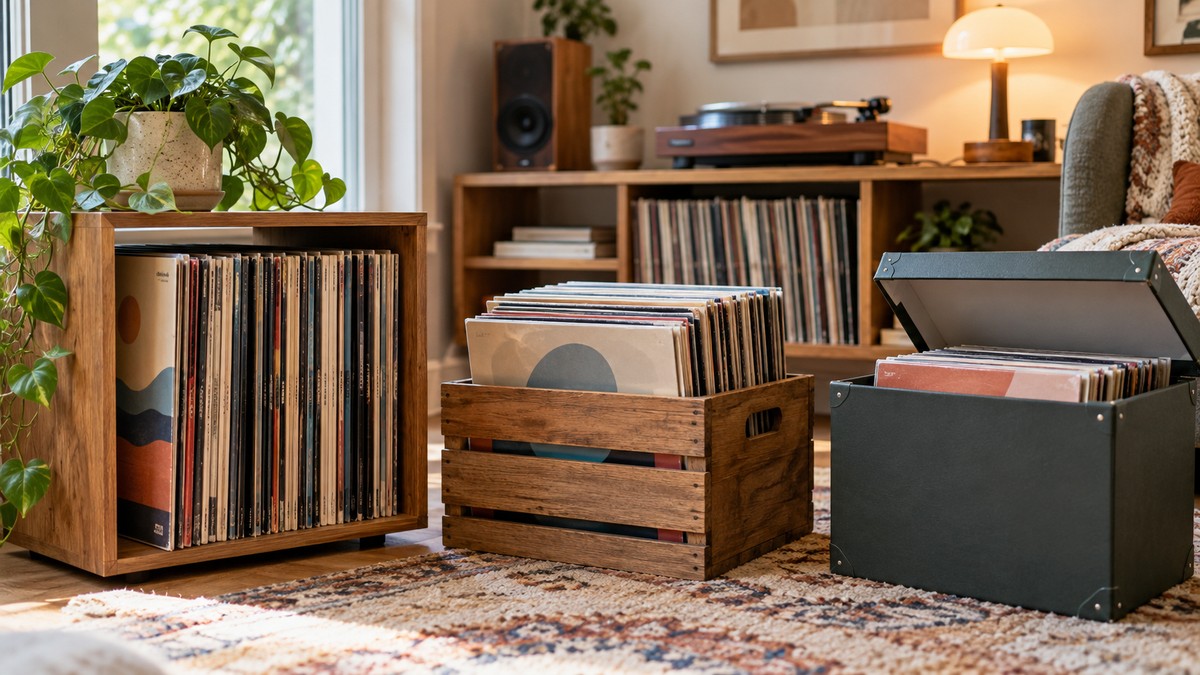
Open crates and holders keep records visible and within reach. The Vfelf bullets describe an open-front design with dividers, and its specifications list the crate as freestanding and indoor. The UUOBQN specifications list a tabletop accent shelf with one shelf, for a home office or a living room. An open holder works well where you pull records out often. The Library of Congress asks for a clean environment for home collections, so an open holder in a dusty room needs more attention than a closed one.
The DocSafe box is the only listing here with a lock. Its specifications list 36 liters of storage volume and a collapsible build, and its bullets describe a combination lock design. A closed box suits records you store and seldom pull out, or records you need to move. It is not a shelf you browse.
The Dmevkic cubes stack, and the bullets say they can be arranged for different spaces. The bullets also describe using the cubes as a TV stand for books and magazines. That suits a room with a wall to fill, but each cube is a separate storage space, so check the interior of each one against the records you own before you buy.
The 3IngSeagulls crate is solid wood, assembled with 12 screws according to its bullets. Its bullets call it a piece of furniture to display, which makes it a choice for a room where the records are part of the decor. The specifications give the overall size, but the listing does not say which of its dimensions a 12-inch record needs.
The MODERN VINYL rack is a two-tier metal rack. The title and specifications describe quick assembly and a matte black finish, and the specifications list 5 pounds for the whole rack. The listing gives no shelf type, so check whether the records would sit exposed to dust in your room.
Where to keep the records
The National Archives and the Library of Congress agree on the room, but they give different numbers. The National Archives gives “55-70 degrees Fahrenheit and 30-55% relative humidity (RH)” and says: “Avoid storing home collections in places with unregulated climates such as an attic or garage.” The Library of Congress gives “a cool (room temperature or below), relatively dry (about 35-40% relative humidity or RH), clean, and stable environment” for home collections, and it asks owners to avoid “attics, basements, and other locations with high risk of leaks and environmental extremes.”
Light matters as well. The Library of Congress asks for “Minimal exposure to all kinds of light; no exposure to direct or intense light.” A holder by a window that gets direct sun works against that advice, whatever its listing says. Choose an inside wall that stays steady through the year and sits out of direct sun.
If you can measure the room, aim for the narrower band the two sources share: cool, dry, steady, and away from the attic or garage. A closet inside the house is often a practical place. The National Archives notes that “A closet or unused rooms are often good choices,” although its own range is the one to check against.
Reading the listing before you buy
Start with the record count. Use the bullets or the title, and check whether the count is for 12-inch records, 7-inch records, or a mix. The Vfelf bullets name 7, 10 and 12 inch records, while the DocSafe bullets name 12-inch records only. A count for mixed sizes will hold fewer 12-inch records than the same box holds in 7-inch sleeves, and no listing here gives that split.
Next, check the dimensions against your shelf. The listing’s length is the measure that matters for records that stand side by side, and the depth tells you whether the holder will fit the shelf in front of it. Measure the shelf before you order, and leave room to lift a record out without knocking the next one.
Then check the shelf or load figure against the weight of the records you own. The Library of Congress average of 35 pounds per shelf-foot is the yardstick, and a figure that is lower than that average for the length you need is a reason to check the listing again.
Finally, check whether the holder has dividers. The Illinois guide asks for full-height dividers spaced 4 to 6 inches apart. The Vfelf specifications list “With Dividers,” and the Dmevkic listing describes three separate cubes, but the other listings do not name dividers in the text we extracted.
Mistakes to avoid
- Laying records flat to fit more in a box. The Library of Congress says to store all formats upright, and the National Archives says not to stack discs.
- Filling a crate end to end with no dividers. The University of Illinois asks for dividers spaced 4 to 6 inches apart, and warns about discs shelved at an angle.
- Trusting the title count without reading the bullets. The 3IngSeagulls listing gives two different counts.
- Putting a holder in an attic or a garage. The National Archives names both as unregulated climates for home collections.
- Assuming a shelf figure covers a full load. The Library of Congress puts the weight along a shelf’s centerline, and the listings do not say how their figures were tested.
For a small room where records share space with books, our small bookcase for bedroom guide covers that layout question. For another wire shelf and its weight limit, see our ClosetMaid wire shelf weight limit guide.
The six picks
1. MODERN VINYL Record Holder – Vinyl Record Storage Rack 2 Tier – Matte Black Metal – 160-200 LP (Two-tier matte black metal rack for 160 to 200 LPs)
Pros
- The title gives 160 to 200 LP storage on two tiers
- The specifications list 13 by 16 by 31 inches and 5 pounds for the whole rack
- The title says quick assembly, with no tools named in the text we extracted
Cons
- The bullets did not appear in our extraction, so the description rests on the title and specifications
- The listing does not say which way the records stand in the rack
Best for: A buyer who wants an open metal rack with a stated LP count in a small footprint
Skip if: You need a closed box that keeps records covered
View on Amazon (affiliate link)
2. Vinyl Record Storage, Wooden Crate Vinyl Holder with Dividers for Albums & Magazine Rack Organizer (Wooden crate with dividers for up to 60 records)
Pros
- The bullets give 14.4 by 12.1 by 11.8 inches and say the crate fits up to 60 records in 7, 10 and 12 inch sizes
- The specifications list With Dividers and a 35 pound shelf weight capacity
- The bullets say all necessary tools are included for setup
Cons
- At 14.4 inches long, the Library of Congress average of 35 pounds per shelf-foot puts a full crate near 42 pounds, above the listed 35
- The bullets describe an open-front design, and no cover is listed
Best for: An owner who wants open access and dividers in one crate
Skip if: The records need a closed box or a lock
View on Amazon (affiliate link)
3. DocSafe Vinyl Record Storage Box with Lock, Fireproof and Water Resistant Record Organizer Storage (Lockable collapsible box for 100 12-inch records)
Pros
- The bullets describe a combination lock and a box that collapses for storage
- The specifications list 13 by 13 by 13 inches and 36 liters of storage volume
- The bullets say the box holds 100+ 12-inch records placed vertically
Cons
- The specifications list a 12 pound capacity, and the listing does not say what that figure counts
- The fireproof and flame test wording in the bullets is a listing statement with no test report named
Best for: A collector who wants a box that locks and can be moved
Skip if: You want an open holder you can browse without opening a box
View on Amazon (affiliate link)
4. 3IngSeagulls Vinyl Record Storage Crate Wooden Record Holder, Classic Cube Record Organizer Storage (Solid wood cube crate for records, 15 inches long)
Pros
- The specifications give 15.15 by 13.58 by 9.96 inches and 6.6 pounds, with wood as the material
- The bullets say assembly takes 12 screws
- The bullets call it a piece of furniture to display
Cons
- The title says 100+ records but the bullets say 80+ units, a 25 percent gap
- The specifications give a 1 cubic foot capacity that the listing does not turn into a record count
Best for: An owner who wants a wooden crate that doubles as display furniture
Skip if: You need the 100 record count in the title to be exact
View on Amazon (affiliate link)
5. Dmevkic 3 Cube Vinyl Record Storage (Three stackable cube units for 120 to 150 records)
Pros
- The bullets say three cubes hold 120 to 150 records
- The bullets give interior cube dimensions of 11.4 by 12.6 by 13 inches
- The specifications list a 300 pound maximum weight capacity for the unit
Cons
- The bullets describe iron mesh and composite board, and the listing gives no finish or thickness
- The bullets also describe a TV stand use, so the cubes may double as display furniture
Best for: A bedroom or living room owner who wants modular cubes that stack
Skip if: You want a holder with a lid or a lock
View on Amazon (affiliate link)
6. Wooden Vinyl Record Storage Holder, Brown (Walnut-finish tabletop holder for a shelf of LPs)
Pros
- The bullets describe anti-slip pads and strong metal supports
- The specifications list Detachable, Portable and Scratch Resistant
- The bullets describe an elegant walnut finish
Cons
- The listing gives no record count or weight figure
- The listing gives one shelf, so it cannot be sized from the listing
Best for: A buyer who wants a small holder for a favorite set of LPs in a living room or office
Skip if: You need to store a full collection
View on Amazon (affiliate link)
How we chose
We searched Amazon.com in Chrome on 21 October 2026 for “best record storage” and read the first results page. We kept listings whose title or bullets describe a holder, crate, box or cube for records. We dropped record player stands with a storage shelf, because they are playback furniture first. We also dropped listings that were not record holders at all.
We opened six listings from six brands, one listing per brand, and read each title, the first bullets and the specification table where the page showed one. The picks cover five storage types: an open holder, an open crate, a lockable box, a set of stacking cubes and a solid wood crate. We did not use price, rating or rank, because Chrome did not return those reliably for these listings.
What we could not verify
- Whether any record count is accurate. None of the listings says how the count was made.
- How any shelf or load figure was measured. That covers the Vfelf 35-pound shelf figure, the DocSafe 12-pound capacity and the Dmevkic 300-pound maximum.
- Whether the DocSafe box meets the UL94 flame test named in its bullets. The listing names the test and gives no report.
- Which 3IngSeagulls count is right, 80 or 100.
- The full description of the MODERN VINYL rack. Its bullets did not appear in our extraction, so its description comes from the title and specifications only.
- The rest of the bullets for the Vfelf, DocSafe, 3IngSeagulls and Dmevkic listings. The extracted text ends partway through several bullets, so claims later in those bullets are not part of this comparison.
- Record player stands with a storage shelf, which we did not open.
FAQ
Should I store records flat or upright?
Upright, on edge. The Library of Congress says “Store all formats upright: discs and reels on edge; cassettes on long edge; cylinders standing on end.” The National Archives adds that discs should be shelved vertically and not stacked on top of one another.
How many records fit in a crate?
Start with the listing’s count, then check the width. The Vfelf bullets give up to 60 records in a 14.4-inch crate, which works out to about 4.2 records per inch of length. That ratio comes from the listing’s own numbers and is not a measured count.
Is a lockable box better than an open holder?
It depends on how often you reach in. A lock and a collapsible build suit storage you rarely open, such as the DocSafe box. An open holder suits records you play often. The Library of Congress asks for a clean and stable environment, so an open holder needs a room that stays clean.
Can I keep records in a closet or a garage?
Keep them in a closet or a room inside the house, and avoid an attic or a garage. The National Archives says to avoid “unregulated climates such as an attic or garage,” and the Library of Congress lists attics and basements among locations with a high risk of leaks and extremes.
How do I check that a shelf will hold a full row of records?
Divide the shelf length by 12 to get feet, then multiply by the Library of Congress figure of 35 pounds per shelf-foot. A 14.4-inch crate comes to about 42 pounds when full, which is above the 35-pound figure the Vfelf listing gives. Treat the listing’s figure as a claim to confirm, and load a shelf in stages while you watch how it sits.
Bottom line
Choose an upright holder or crate with dividers, and check the shelf figure against the weight of your records using the Library of Congress average of 35 pounds per shelf-foot. Pick a lockable box for storage you rarely reach into, and an open crate or holder for records you play often.
Sources
- Library of Congress, Care, Handling and Storage of Audio Visual Materials (opened 2026-10-21): https://www.loc.gov/preservation/care/record.html
- National Archives, Audio Guidance: Condition of Materials and Storage (opened 2026-10-21): https://www.archives.gov/preservation/formats/audio-storage.html
- University of Illinois Preservation Self-Assessment Program, Phonodisc collection guide (opened 2026-10-21): https://psap.library.illinois.edu/collection-id-guide/phonodisc