Clothes Storage on Top of a Dresser: Tip-Over Safety
As an Amazon Associate we earn from qualifying purchases. Details
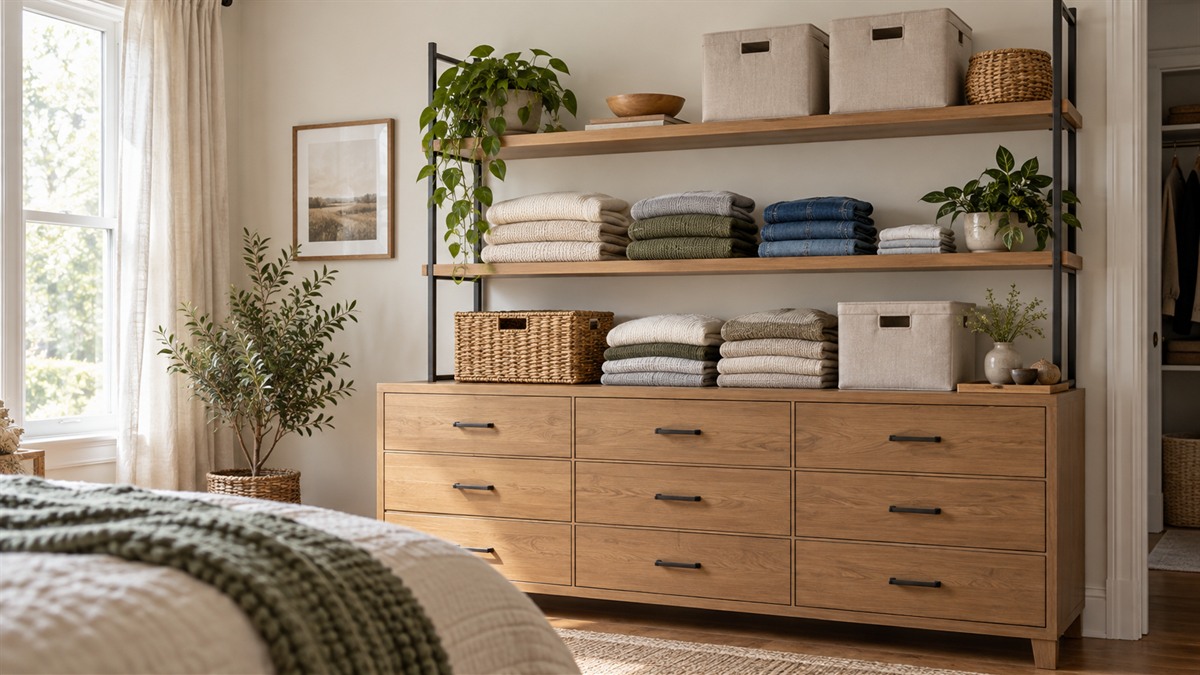
Clothes storage on top of dresser units is a practical use of space, but the top of a dresser is also high and far from the floor. The U.S. Consumer Product Safety Commission tested dressers for tip-over in its 2015 report on anchoring furniture, and it measured the drawer side of that risk. The report does not measure items stacked on the top surface, so the answer for top storage is a planning question with clear limits. This guide shows what the report measured, what it left out, and how to plan the anchor.
Updated 19 October 2026
Author: Editorial team, home-shelving-guide.com
Quick answer
- The CPSC dresser test loaded the bottom drawer. It did not load the top surface, so the report gives no figure for clothes stacked on top.
- A chest or dresser taller than 30 inches falls under the clothing storage unit standard the report describes, which requires a tip-restraint system.
- A dresser with a 39 lb television on it needed about 2 to 4 lb more pull to tip than the bare dresser, according to the report. The report gives no figure for clothes.
- Anchor the dresser to a stud with a tight tether, since the report says slack lets the unit wobble before it tips.
- The wall anchor is the weak point. A drywall anchor has no strength requirement under the standard’s strap rule.
What the CPSC dresser test loaded
The CPSC staff used a secondhand five-drawer dresser on a demonstration floor. The report gives its size as 49 inches tall, 36 inches wide and 18 inches deep. The staff attached a tether to one wall anchor and loaded the bottom drawer. The report describes the scene directly: the dresser was tested as it would be in “an incident involving children climbing up the drawers of a dresser.”
That is the load the report measured. It is a drawer load, applied low on the unit, and the report measured the tension on the tether while the dresser tipped. It is not a top-surface load, and the sources we opened do not describe clothes, baskets or boxes stacked on a dresser top.
The results for the drawer load are short:
| Setup | Load in bottom drawer | Tension on tether reported |
|---|---|---|
| Bare floor | 100 lb | about 8 lb |
| Carpet squares and pads under each leg | 100 lb | about 10 lb |
The report says the anchor needs a strength the standard sets for dressers. In its words, the standard “requires that anchors provided with dressers hold a minimum of 50 lbs. of force.” The two measured tension figures are well under 50 lb, but the test was one setup with one anchor, so they describe that setup and nothing more.
The freestanding dresser and the television
The report also measured how hard a dresser must be pulled before it tips when it stands on its own, without a tether. Its dresser needed about 13 lb of pull with no television on it, and the report gives 13 to 18 lb for the dresser and the media cabinet it tested. The report then loaded the dresser with a 39 lb cathode ray tube television and measured again. The pull needed to tip rose only by about 2 to 4 lb.
The calculation is short. Increase in pull divided by the bare figure gives the share of extra pull. With a 2 lb increase on a 13 lb base, 2 / 13 = 0.15, or about 15 percent. With a 4 lb increase, 4 / 13 = 0.31, or about 31 percent. These are the report’s figures for one dresser on one floor, and they are not a rule for clothes on top.
The television result matters because it shows that weight placed on a dresser changes the pull needed to tip it, even though the increase in this case was small. The report measured a television, not clothes, so the figure shows a direction without giving a number for your items. A planning total for a loaded dresser should therefore start from the bare-dresser figure and add the weight of the top load on top of it, rather than reusing the bare figure as it stands.
Why the wall end still decides the outcome
The report’s point about the wall end applies to top storage as well. It says the standard checks the strap, but “the drywall anchor that holds the strap to the wall has no strength requirement.” A tether that holds a dresser under load depends on what the anchor is screwed into, not only on the strap’s rating.
The report also says why a stud is the usual choice: “Rather, a wood screw is usually provided and must be installed in a stud.” Its description of the drawer test shows the tether tension with a drywall anchor set 18 inches from the floor, but the sources do not give a figure for a stud anchor, so the stud advice is the usual method and not a measured figure.
The report explains what finding a stud takes: “This means that consumers will need a stud finder (or need to poke holes in the wall to determine the stud’s location), a drill, a screwdriver, and several minutes of time.” A stud finder is the faster route of the two methods the report describes.
Keeping the tether tight
The report makes a point about slack that matters more for a dresser with items on top. It says a slack tether “will allow the furniture or television to wobble in place before fully tipping over.” Once the tipping motion starts, the report adds, the impulse force on the tether “may exceed the tether’s rated load capacity.” So the tether should be taut from the start, and it should be checked after the dresser is moved or the top is loaded.
The report lists ways to take up slack, including a cord lock, a friction tensioner and a cleat on the furniture. The sources do not rank them, so pick the one the dresser’s instructions allow.
Planning the anchor for a loaded top
The sources give a planning rule for toggle anchors, but not for a tether on a dresser. If a toggle is used for any part of the wall fixing, the maker’s rule is one quarter of the ultimate value. The SNAPTOGGLE sheet gives 238 lb for the BA size in 1/2 inch drywall, so the planning figure is 238 / 4 = 59.5 lb per anchor. The plastic toggle sheet gives the same rule without a table, and its FAQ adds that “this ultimate holding value is for objects held closely to the wall.”
That FAQ point matters for clothes on top. Items stacked toward the front or the far edge of a dresser top are away from the wall, and the maker says that moving objects away from the wall greatly reduces the allowable load of an anchor. A planning total should therefore assume that top items sit as close to the wall as the dresser allows.
A practical load plan
The sources do not give a weight limit for the top of a dresser, so this guide does not set one. What a reader can do is write a plan that is easy to check.
- Add the weight of everything you plan to keep on the top surface. Use real weights, not guesses.
- Keep the heaviest items toward the back, close to the wall, and keep nothing heavy at the front edge.
- Confirm that the tether is taut and that the anchor is in a stud, or that the fixing is the one the dresser’s instructions name.
- Compare the top load with the anchor planning figure only as a rough check, and remember the planning figure is for a drywall toggle, not for a tether into a stud.
- Re-check the tether after any move, since the report treats slack as a problem.
Step 4 is a check, not a limit. The report’s measured figures show how tension changes with a drawer load, and the top load is not measured in the report.
Mistakes that make top storage riskier
- Treating a bare-dresser pull figure as the limit for a dresser with items on top. The report’s television result shows that added weight changes the pull.
- Stacking heavy items at the front edge, away from the wall, as the FAQ warns.
- Relying on a drywall anchor for the tether, since the standard puts no strength requirement on the wall end.
- Leaving the tether loose after a move.
- Putting a child’s favourite items on top to reach them. The report’s test is about children climbing the drawers, so do not treat a dresser top as a shelf.
What one listing states about a top load
The research file holds one listing that goes beyond storage on a dresser’s side and states a figure for its top. It is a stackable cabinet of drawers, sold for several uses. The table shows only what the listing says, and it marks what the listing leaves out.
| Item | What the listing says | Note |
|---|---|---|
| Drawers | 4 drawers in a 2-pack set | The set is described as two units |
| Load per drawer | 11 lb | Stated per drawer |
| Load on the wooden top | 44 lb | Stated in the same bullet as the per-drawer figure |
| Uses named | Closet organizer, nightstand, side table, under-bed or storeroom storage | A dresser top is not named |
| Dimensions, first field | 11.81 inches deep, 15.75 inches wide, 16.41 inches high | Product dimensions field |
| Dimensions, bullet | 15.7 inches deep, 21.1 inches wide, 16.1 inches high | Bullet gives a different set of figures |
1. DAOUTIME 2-Pack Stackable Storage Drawers (4 Drawers Total), White Closet Organizer with Wooden Top (Stackable drawer set with a stated top load)
Pros
- The listing states 44 lb on the wooden top and 11 lb per drawer.
- The listing says the units can be stacked, and gives the cabinet's footprint in one field.
Cons
- The listing gives two different sets of dimensions.
- The listing names closet, nightstand and under-bed uses, and does not name a dresser top.
Best for: a small set of drawers on a sturdy dresser top, if the top is wide enough for the footprint the listing states
Skip if: the dresser top is narrower than the 21.1-inch width in one listing bullet, or you plan to load the top beyond 44 lb
View on Amazon (affiliate link)
The listing’s own arithmetic checks out. Four drawers at 11 lb each give 4 x 11 = 44 lb, which matches the 44 lb stated for the top. The two figures are consistent with each other. The listing does not say whether 44 lb is the limit for the top in use, or only for the top as sold.
The two sets of dimensions do not agree. The width differs by 21.1 – 15.75 = 5.35 inches, and the depth by 15.7 – 11.81 = 3.89 inches. A reader who measures the dresser top should use the figure that matches the unit they will receive, and should check the listing before buying, since one set of figures may describe the unit’s frame and the other its outer box.
Set the 44 lb figure beside the CPSC numbers with care. The report’s 50 lb figure is the strength the standard requires of an anchor and the test load for one open drawer, as the report describes it. The report gives no figure for a load on a dresser top. The 44 lb figure is the listing’s figure for a different product’s top, and the two do not measure the same thing. The ratio is 44 / 50 = 0.88, or 88 percent, and it is a comparison of two unlike numbers. It is not a safety margin.
The listing also names other uses. It says the cabinet can work as a nightstand or side table, and it does not say the unit is rated for use on top of another piece of furniture. A reader should therefore treat the 44 lb figure as the maker’s own number for the unit, and not as a rule for every dresser.
Stacking adds a further point. The listing says the units can be stacked, and a stacked pair puts more weight higher on the dresser. The report measured how a 39 lb television placed on a dresser changed the pull needed to tip it. A stack of two units on a dresser top is a load the report did not measure, so the planning rule is the same as before: keep the load low and close to the wall, and fix the dresser.
How we chose
We used the 2015 CPSC report on anchoring furniture and televisions, the plastic toggle and SNAPTOGGLE sheets from the same maker, and the maker’s FAQ. We downloaded each source, converted it to text and checked every quoted sentence against the saved text. We did not use prices, listings or ratings for any dresser. The dresser figures are from one CPSC demonstration, and the post says where that limits the reading.
What we could not verify
The sources we opened do not measure clothes, baskets or boxes stacked on a dresser top, and they give no weight limit for a dresser top.
The sources do not give a stud spacing for typical houses, and they give no anchor figure for plaster. The demonstration wall had studs 16 inches apart on centre, which is a laboratory wall.
The report measured one dresser, one anchor setup and one television. Dressers of other sizes, and the tie-down hardware sold with them, are not covered.
FAQ
Is it safe to keep clothes on top of a dresser?
The sources do not give a top-load limit, so they cannot say what is safe. They do show that a dresser needs an anchor under the standard the report describes, and that added weight changes how much pull it takes to tip. Keep top loads light and close to the wall, and anchor the unit.
Does a dresser need an anchor?
The report describes a tip-restraint system with installation instructions for clothing storage units taller than 30 inches, and it says those instructions must be provided at the point of sale. A dresser that is taller than 30 inches falls in that range, so check its instructions and fix it as they say.
How much weight does a dresser top hold?
The report does not say. Its measurements are for the drawer load and for a television placed on the dresser. Use the manufacturer’s stated limit if there is one, and do not treat the report’s tether figures as a top limit.
Why does a television matter for a clothes question?
The report measured a 39 lb television on a dresser and found the tipping pull rose by about 2 to 4 lb. That is a measured effect of a high load. It does not give a figure for clothes, but it shows that top weight matters.
Can I use a drywall anchor for the tether?
The standard puts no strength requirement on the drywall anchor at the wall end, and the report says a wood screw in a stud is the usual method. If a stud is not available, use the fixing the dresser’s instructions name, and do not rely on a drywall anchor for a loaded top.
Bottom line
Keep clothes on top of a dresser light, close to the wall and well inside the dresser’s own limit. Anchor the dresser with a tight tether, screw the wall end into a stud where you can, and treat the report’s numbers as drawer-side evidence rather than a top-load rating.
If you are comparing the dressers themselves, the chest of drawers for clothes storage guide covers the sizes and types, and the short chest of drawers for a closet guide covers lower units.
Sources
- U.S. Consumer Product Safety Commission, anchoring furniture report (2015): the dresser size, the drawer-load tether test, the freestanding pull and the television result, and the stud advice
- TOGGLER, Plastic Toggle Anchors sheet (PDF, manufacturer): the one-quarter rule
- TOGGLER, SNAPTOGGLE Heavy-Duty Toggle Bolts sheet (PDF, manufacturer): the BA ultimate pull-out figure in 1/2 inch drywall
- TOGGLER, frequently asked questions (manufacturer): the close-to-the-wall limit and the far-end loading note