Tall Cabinet for Shoes: How to Anchor It Safely
As an Amazon Associate we earn from qualifying purchases. Details
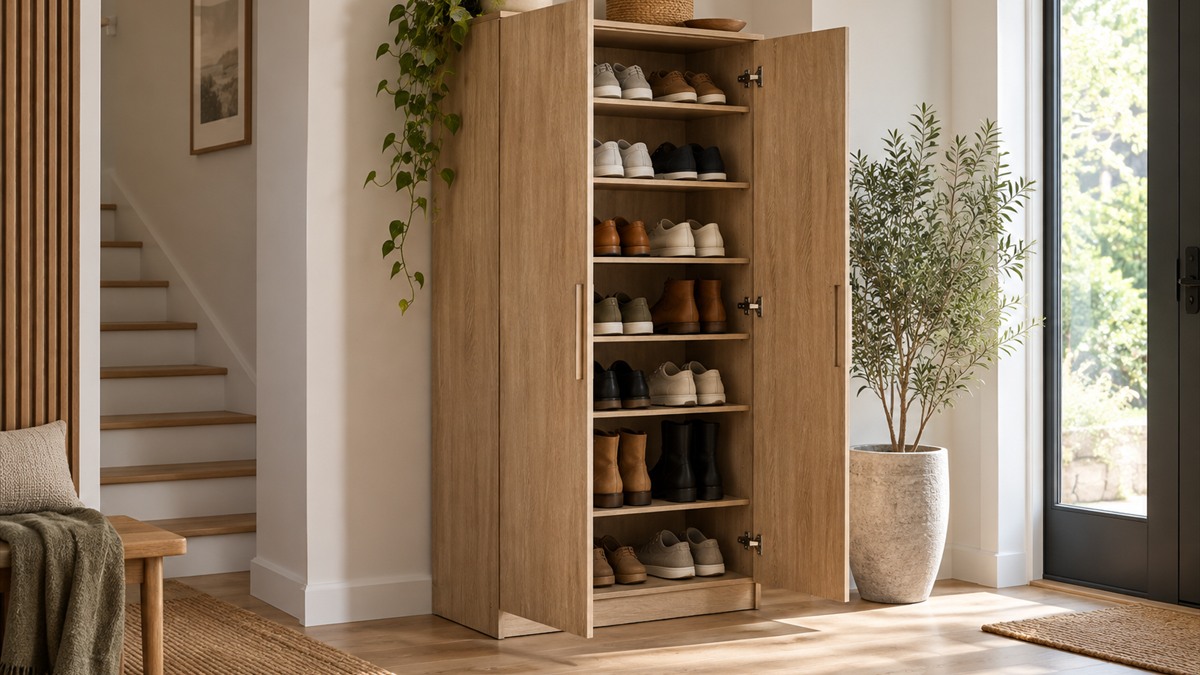
A tall cabinet for shoes is a piece of furniture the U.S. Consumer Product Safety Commission treats as a tip-over risk, and the question is how to hold it to the wall. The answer depends on where the anchor goes. The CPSC report on anchoring furniture says a stud is the usual point for the screw, and the maker sheets for two toggle anchors give a planning rule for loads. This guide explains those rules and what they do not cover for shoe cabinets.
Updated 19 October 2026
Author: Editorial team, home-shelving-guide.com
Quick answer
- The CPSC report describes a standard for clothing storage units taller than 30 inches. A tall shoe cabinet is not named in it, so check the maker’s sheet for the cabinet’s own stability rating.
- The tip-restraint strap must hold 50 lbs, but the wall anchor at the other end has no strength requirement under that standard.
- The report says a wood screw is usually the fixing and must go into a stud. Drywall alone is not the usual answer.
- For a toggle anchor, the maker says to use one quarter of the ultimate value as the maximum load per anchor. For one bolt in 1/2 inch drywall, that is 238 / 4 = 59.5 lb.
- Load near the wall, not at the far end. The maker says moving the load away from the wall greatly reduces the allowable load on an anchor.
Why a tall cabinet is a tip-over question
The CPSC report frames the problem around children, and it gives the number used in the standard: “Fifty pounds represents the weight of a 95th percentile 5-year-old child.” The report’s dresser test imitated a child climbing up an open drawer, so the standard asks for a stability check with one drawer or door loaded.
The standard in the report is ASTM F2057-14, which covers chest-type furniture and other clothing storage units taller than 30 inches. A tall shoe cabinet is not named, but its doors and drawers are the same kind of open part the standard’s test loads. This guide does not claim that any shoe cabinet meets the standard. The maker’s sheet is the place to check that.
The report describes two layers of protection. The first is the unit itself, which should not tip with its drawers or doors open and loaded. The second is a tip-restraint system, usually a strap and two screws, that holds the top of the unit to the wall. The report describes the typical system this way: “the typical anchoring system consists of screws and fabric straps that affix the furniture to the wall.” A shoe cabinet with doors and no restraint in the box is not safe to assume, so the restraint question should be settled before the cabinet is loaded.
What the standard asks for at the point of sale
The report says the standard requires more than a strap. It notes that a tip-restraint system must come with installation instructions, and that those instructions must be provided at the point of sale of the furniture. That matters for a tall cabinet bought online or from a store, because the instructions are the first document that should tell you where the anchor goes.
The report also says that these systems are not usually installed by consumers. In its words, “One of the problems is that such restraint systems are not usually installed by consumers.” The report links that to the tip-over incidents it reviewed. For a shoe cabinet, the practical step is to treat the restraint as a required part of the install, not an optional extra, and to read the instruction sheet before the first pair of shoes goes inside.
| Requirement or point | What the source says | What it means for a shoe cabinet |
|---|---|---|
| Unit size that falls under the standard | Units taller than 30 inches | A tall cabinet with doors or drawers should be checked against this height |
| Test load | 50 lb on one open drawer or door (paraphrase of the standard) | A door is a test case, not only a drawer |
| Restraint strength | A strap must hold 50 lb | The strap must be installed so the 50 lb load is carried |
| Wall anchor | The drywall anchor has no strength requirement under the standard | The wall end needs a separate check |
| Point of sale | Restraint and installation instructions must be provided | Read the instructions before loading the cabinet |
The wall end is the weak point
The report makes its most important point about the wall anchor. It says: “the strap securing a piece of furniture must be able to hold 50 lbs., but the drywall anchor that holds the strap to the wall has no strength requirement.” In plain terms, the standard checks the strap, but a plastic or drywall anchor at the wall end can still be the weakest part.
The report also explains how a drywall anchor carries load. It says, “Drywall anchors are strongest when pulled at an angle parallel to the wall (a shearing force).” A tip-restraint strap pulls the furniture toward the wall, and for a strap that runs nearly level, the anchor sees a pull that is close to straight out from the wall. The report describes that direction as the most difficult one for drywall anchors to resist.
For that reason the report gives a clear preference: “Rather, a wood screw is usually provided and must be installed in a stud.” It also says what finding that stud takes. In the report’s words, “This means that consumers will need a stud finder (or need to poke holes in the wall to determine the stud’s location), a drill, a screwdriver, and several minutes of time.” A stud finder is the quicker of the two methods the report names.
The report’s demonstration wall had pine studs spaced 16 inches apart on centre, but that is a laboratory wall, not a statement about typical homes. The sources we opened do not give a stud spacing for ordinary houses, so measure the wall you have.
What the dresser test measured
CPSC staff put a secondhand five-drawer dresser on a demonstration floor and attached a tether to a single drywall anchor on the wall. The report gives the dresser size as 49 inches tall, 36 inches wide and 18 inches deep. The anchor was set 18 inches from the floor. The staff then loaded the bottom drawer and measured the tension on the tether when the dresser tipped.
The results are short enough to set in a table:
| Setup | Weight in bottom drawer | Tension on tether reported | Share of the 50 lb standard figure |
|---|---|---|---|
| Bare floor | 100 lb | about 8 lb | 8 / 50 = 0.16, or 16 percent |
| Carpet squares and pads under each leg | 100 lb | about 10 lb | 10 / 50 = 0.20, or 20 percent |
The report also notes that the standard for furniture, ASTM F3096, requires that anchors provided with dressers hold a minimum of 50 lbs of force. The measured tension in this one setup was well under that figure. The result does not give a rating for your cabinet, and it does not measure a drawer or door pulled open by a child. What it does show is how the tether load rises as the furniture starts to tip, which is why the tether needs to be tight. The report says a slack tether lets the unit wobble before it tips, and that the impulse force on a slack tether can exceed its rated load.
For a tall shoe cabinet, the lesson is about the tether, not about shoes. Keep the strap or cord short and tight, and check it again after the cabinet has been moved, because the report treats slack as a real problem.
Anchor types and the planning rule
The report covers strap restraints. Toggle anchors are a different product, and two manufacturer sheets give numbers for them. Both come from one maker, so read them as the maker’s own data.
The plastic toggle sheet says: “Industry safety standards recommend using only 1/4 of ultimate tensile and shear values as the maximum load per anchor.” The SNAPTOGGLE sheet says: “Industry standards recommend 1/4 of ultimate test load.” The maker’s FAQ repeats the rule and adds that the ultimate figure “is for objects held closely to the wall.”
The SNAPTOGGLE sheet gives an ultimate tensile pull-out figure for several sizes in 1/2 inch drywall. Applying the one-quarter rule to each figure gives a planning number:
| Bolt size (SNAPTOGGLE sheet) | Ultimate tensile pull-out in 1/2 inch drywall | Planning figure at one quarter |
|---|---|---|
| BA | 238 lb | 238 / 4 = 59.5 lb |
| BB | 265 lb | 265 / 4 = 66.25 lb |
| BE | 270 lb | 270 / 4 = 67.5 lb |
| BC | 275 lb | 275 / 4 = 68.75 lb |
| BD | 275 lb | 275 / 4 = 68.75 lb |
These are planning figures, not ratings for a shoe cabinet. The sheet says the values “should be used as guides only and cannot be guaranteed.” The FAQ adds a second caution that matters for a tall cabinet: “Moving objects away from the wall (e.g., the far end of a shelf or using a TV mount that swings away from the wall) significantly increases the effective weight of that object, greatly reducing the allowable load of that anchor.” Shoes stored at the top or the front of a cabinet are away from the wall, so for those loads the planning figure may be too high.
A toggle bolt is also not a tip-restraint strap. It can form part of a wall end only if the cabinet’s own instructions allow it. Follow the fixing named there first.
Where the cabinet should go
Use the report’s order of steps. Find a stud and mark it. Choose a screw that the instructions allow for that wall. Install the strap or restraint so it is taut from start to finish. Keep the load close to the wall, because the maker’s FAQ says that moving objects away from the wall greatly reduces the allowable load of an anchor.
Think about the wall type too. The maker’s plastic toggle sheet says that the holding strength “varies directly with the strength and condition of the substrate.” That means the condition of the wall is part of the load plan, so check the wall before drilling. If the wall is plaster, the sources we opened do not give a figure, so do not carry the drywall numbers over to plaster.
Mistakes that weaken a tall cabinet
- Treating the one-quarter figure as the ultimate value. The maker’s figure is the ultimate load; the planning figure is one quarter of it.
- Using a drywall-only anchor for a pulling strap, since the report says the drywall anchor has no strength requirement under the standard.
- Leaving slack in the strap. The report says a slack tether lets the unit wobble before it tips.
- Storing the heaviest shoes at the top or the far end, away from the wall.
- Assuming the restraint is in the box. The standard requires instructions at the point of sale, so the instruction sheet is the document to read first.
How we chose
We used the sources that cover tip-over restraints and wall anchors: the 2015 CPSC report on anchoring furniture and televisions, the plastic toggle and SNAPTOGGLE sheets from the same maker, and the maker’s FAQ. We downloaded each page, converted it to text and checked each quoted sentence against that text. The report covers dressers and TV stands rather than shoe cabinets, so we applied its rules to a tall cabinet and say where that step is an inference. We did not use prices, ratings or product listings to choose any of the advice here.
What we could not verify
No source we opened gives a load rating for a shoe cabinet, for its doors or for its shelves. The 50 lb figure is a test load for a drawer or door in the standard, not a limit for shoes.
The sources do not give a stud spacing for typical houses, and they do not give a figure for an anchor in plaster. The report’s demonstration wall is a laboratory wall with studs 16 inches on centre.
The sources do not say how much a pair of shoes weighs, so this guide does not add up a shoe load. Add up your own items before you decide how heavy the cabinet will get.
FAQ
Does a tall shoe cabinet need to be anchored?
The CPSC report treats tall clothing storage units as a tip-over hazard, and it describes a strap and a fixing into a stud as the usual answer. If the cabinet is taller than 30 inches, the standard the report describes applies to units of that height. The cabinet’s own instructions should say what to fix and where.
What does the 50 lb figure mean for a cabinet?
It is the test load in the standard, based on the weight of a 95th percentile 5-year-old child. The standard asks a unit not to tip when one open drawer or door carries that load, and it asks the tip-restraint strap to hold 50 lb. It is not a shelf rating, and it does not tell you how much a shoe cabinet can hold on its shelves.
Can I use a toggle bolt instead of a stud?
A toggle bolt is a fixing for hollow walls. The maker’s sheet gives a one-quarter planning figure for the BA size in 1/2 inch drywall, which is 59.5 lb. That figure is for a load held close to the wall, and it does not replace the stud the report describes. If your cabinet’s instructions name a specific fixing, use that.
Why does the wall end matter more than the strap?
The standard checks the strap for 50 lb, but it puts no strength requirement on the drywall anchor at the wall end. The report says a drywall anchor is strongest in shear and weakest when pulled straight out, which is the direction a tip restraint pulls. A wood screw in a stud is the fixing the report calls usual.
What if my wall is plaster?
The sources we opened give no figure for an anchor in plaster. Do not use the drywall numbers. Find a stud, or ask the cabinet maker for the fixing it recommends for your wall type.
Bottom line
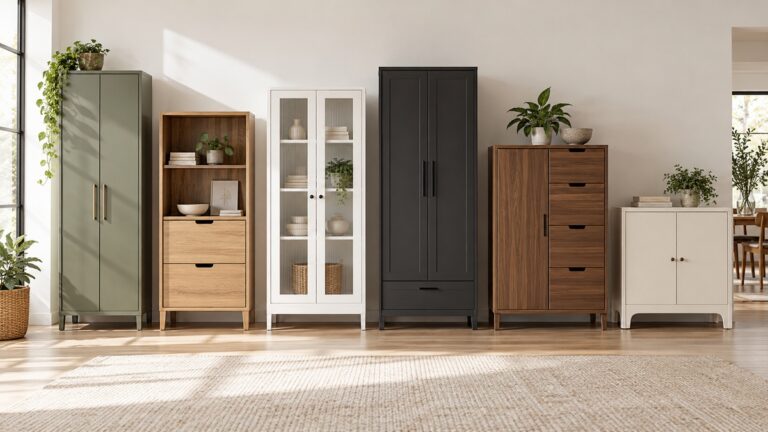
If you are still choosing a cabinet, compare the tall narrow shoe cabinets with doors first, then read the shoe shelving units notes before deciding where it goes.
A tall cabinet for shoes should be held to the wall with the restraint its instructions call for, with the screw in a stud where you can reach one. Use the maker’s one-quarter rule only as a planning figure, keep the tether tight and keep the heaviest load low and close to the wall.
Sources
- U.S. Consumer Product Safety Commission, anchoring furniture report (2015): the standard scope (units taller than 30 inches), the 50 lb test, the strap and drywall anchor point, the stud recommendation and the dresser tether test
- TOGGLER, Plastic Toggle Anchors sheet (PDF, manufacturer): the one-quarter rule and the substrate condition
- TOGGLER, SNAPTOGGLE Heavy-Duty Toggle Bolts sheet (PDF, manufacturer): the BA to BD ultimate pull-out figures in 1/2 inch drywall and the guidance that they cannot be guaranteed
- TOGGLER, frequently asked questions (manufacturer): the far-end and close-to-wall loading note and the one-quarter working load