Magnetic Spice Rack: Where It Should Go and What to Check
As an Amazon Associate we earn from qualifying purchases. Details
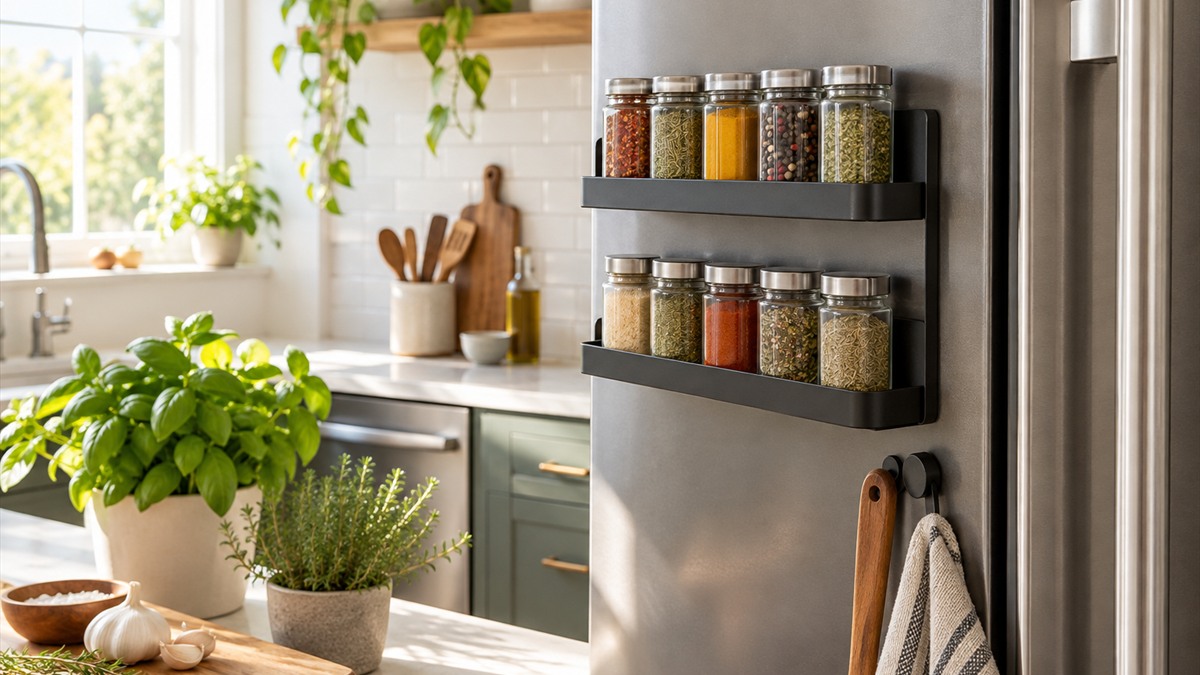
A magnetic spice rack is a simple way to hold jars at hand, but the spot it sits in matters more than the magnet. Extension sources on spice storage agree on the conditions that keep spices good: dry places, away from light and heat, in airtight containers. Washington State names the refrigerator among the places to avoid storing spices above. The sources do not mention magnets, metal panels or the side of a fridge, so this guide separates what they say about storage from what they leave open for a magnetic mount.
Updated 19 October 2026
Author: Editorial team, home-shelving-guide.com
Quick answer
- The sources ask for airtight containers, kept dry and away from sunlight and heat. A magnetic rack has to meet the same rule as any shelf.
- Washington State lists the stove, dishwasher, microwave, refrigerator, sink and heating vents as places to avoid storing spices above. A rack on a fridge is close to that list.
- The sources do not cover magnet strength, metal surfaces, or the weight a magnetic mount can hold. Check the rack’s own instructions for those.
- Plan for a shorter life on a spot that is warm and bright. The sources give six months as a check point for ground spices, and one year for ground spices under their storage conditions.
- Smell each jar on a schedule. Penn State says to replace a spice once its aroma has faded.
What the storage sources say about the spot
The Washington State guide, “Cleaning Out the Kitchen Cupboard,” gives the main rule. It says spices “should be kept away from the heat, light and humidity to prevent flavor and color loss.” It then gives the list of places to avoid: “Avoid storing them above the stove, dishwasher, microwave, refrigerator, sink or a heating vent.” The list is built around the working parts of a kitchen, which produce heat and moisture.
Penn State’s guide, “Storing Staple Ingredients in the Kitchen,” agrees on the conditions and adds a warning about warmth: “Avoid warm temperatures and moisture.” Its spice rule is “Spices and herbs should be stored in airtight containers in dry places away from sunlight and heat.” A magnetic rack that holds open jars in a bright, warm spot does not meet that rule, however good the magnet.
Purdue Extension’s cupboard guide gives a general placement rule. It advises keeping foods in the coolest cabinets, away from appliances that produce heat. The guide is about cupboards, but the principle is the same one the spice sources state: keep the spices away from the parts of the kitchen that run hot.
Where a magnetic rack usually goes
A magnetic rack needs a metal surface, and in most kitchens that means the refrigerator or a metal range hood or panel. The sources do not discuss those surfaces. They name the refrigerator as a place to avoid storing spices above, and they do not say whether the side of a refrigerator, the front, or a metal panel on the wall is acceptable.
The difference matters. Washington State’s word is “above,” which describes the spot over the appliance. A jar on the side of a fridge is not above it in the plain sense, but the sources do not say that a side position is safe. The honest reading is that the sources do not settle the question, and a reader should choose the spot with the same test the sources use: dry, out of direct light and away from the appliances the list names.
A simple check helps. Hold a hand near the surface where the rack would sit, and see whether the spot is warm or bright at the times you cook. The sources do not give a temperature for that test, so the check is a reader’s judgment, not a measurement. If the spot is warm, the Penn State warning about warm temperatures applies to it.
The shelf-life figures to plan around
Shelf life is where the storage rules become a calendar. The extension figures do not agree, so the table below shows each one as stated.
| Source | Spice form | Stated figure |
|---|---|---|
| Washington State (2016) | Ground spices | 1 year |
| Washington State (2016) | Whole spices | 2 years |
| Purdue CFS-423-W | Ground spices | 6 months |
| Purdue CFS-423-W | Whole spices | 1 to 2 years |
| Iowa State (2019 blog) | Typical spices | 2 to 3 years |
| Penn State | Ground spices and all herbs | Evaluate freshness after six months |
Use the shortest figure that applies to the spot. A magnetic rack on a warm side of the kitchen is a spot where a ground spice may need to be replaced sooner than the Washington State one-year figure, but the sources give no number for that. The calculation for a planning date is simple. If a jar is opened on 1 March and is ground, the Purdue figure of 6 months gives 1 March plus 6 months, which is 1 September. The Washington State figure of 1 year gives 1 March of the next year. Use the earlier date.
Whole spices give more room. Washington State gives whole spices two years, twice the one-year ground figure: 2 / 1 = 2. Purdue gives whole spices one to two years. A reader who buys whole spices and grinds them as needed has a longer window, but the sources do not discuss grinding at home, so do not apply the ground figures to freshly ground spice.
A freshness routine for a magnetic rack
Set the routine so it does not depend on the calendar alone. Write the open date on the lid or on a label. At six months, which is Penn State’s check point for ground spices and all herbs, smell every jar on the rack. Iowa State suggests a smell check first, then taste and colour, and it says a good spice has a strong aroma, potent flavor and vibrant colour.
Penn State’s rule is short: “If the characteristic aroma of the spice or herb has faded, replace it.” That rule applies to a magnetic rack as much as to a drawer, so a jar that has lost its smell should go, even if the date on the label looks fine.
A rack that is in a warm or bright spot should be checked more often. The sources do not give a number, so set the interval by the aroma test rather than by a fixed count of weeks.
Container choice for a magnet rack
Penn State says spices should be stored “in airtight containers.” A magnetic rack often holds small jars with clip lids or screw lids, so the lid is the thing to check. A jar that does not seal leaves the spice open to air and moisture, which the sources name as causes of lost quality.
The sources do not rank glass, metal or plastic jars, and they do not say whether clear jars are better or worse than opaque ones. The light rule is stated for the spot the spices sit in, so the post does not turn it into a jar rule.
Weight, grip and mounting
The sources do not cover the things most buyers ask about first: how strong a magnet is, how much weight a rack can hold on a fridge or a metal panel, or whether a rack scratches paint. These are questions for the rack’s own instructions. This guide does not give a magnet strength, a weight limit or a grip figure, because none appears in any source we opened.
A reader can still plan. Add up the weight of the jars and the rack when full, and check that total against the rack’s stated capacity in its instructions. Do not use a weight figure from a different product, and do not assume a magnetic mount holds what a wall anchor holds.
Mistakes with a magnetic spice rack
- Putting the rack on a surface that is warm or bright, where the Penn State warning on warm temperatures and the light rule both apply.
- Using a jar with a loose lid, which leaves the spice open to air and moisture.
- Filling the rack and forgetting it, since the sources give a check point of six months and an aroma test.
- Treating the fridge side as safe because the list names the refrigerator, not its side. The sources do not settle that case.
- Assuming a magnet rack has a load rating the sources give. They do not.
A calendar for a rack of jars
A magnetic rack usually holds several jars that were opened at different times, so one date per rack is not enough. Give each jar its own open date and set the checks from it. The table shows the checks for a jar opened on 1 March, using the figures in the sources. For a jar opened on another day, add the same intervals to that date.
| Check | Interval from opening | Date for a jar opened on 1 March | Source |
|---|---|---|---|
| First aroma check, ground spice or herb | 6 months | 1 September | Penn State; Purdue for ground spices |
| Ground spice, end of the stated life | 1 year | 1 March, next year | Washington State |
| Whole spice, end of the stated life | 2 years | 1 March, two years later | Washington State |
| Typical spice, upper end of the range | 3 years | 1 March, three years later | Iowa State, typical spices |
Two lines of arithmetic set the pace. Washington State’s whole-spice figure is twice its ground figure, so 2 / 1 = 2. Six months is half of one year, so the first check comes at half the ground-spice life, 6 / 12 = 0.5. A reader who checks at six months and again at one year covers both sources’ ground-spice points.
A rack that stands in a warm or bright spot should be checked on the earlier of the dates. The sources do not give a figure for how much earlier, so this is a judgment. The rule the sources do give is the aroma test: if the characteristic aroma has faded, replace the spice. A calendar tells a reader when to smell, not when to throw a jar away.
How we chose
We used four extension pages: Washington State University Extension’s “Cleaning Out the Kitchen Cupboard,” Penn State Extension’s “Storing Staple Ingredients in the Kitchen,” Iowa State University Extension’s spice expiration blog and Purdue Extension’s “Spotlight on Cupboard Storage.” We downloaded each page, converted it to text and checked each quoted sentence against the saved text. We did not use any product listing, price, rating or brand to choose the advice. The sources do not cover magnetic racks, so the post applies their storage rules to that case and says where the step is ours.
What we could not verify
The sources we opened do not mention magnets, metal panels, magnet strength, grip, or the weight a magnetic rack can hold.
The sources do not say whether the side of a refrigerator is a safe place for spices. Washington State’s list names the refrigerator, but the list uses the word above.
The sources do not give a temperature or a light level for a safe spot, so the warm-and-bright check in this post is a judgment.
FAQ
Is a magnetic spice rack on the fridge a good idea?
The sources do not give a clear answer for the side of a fridge. They name the refrigerator among places to avoid storing spices above, and they require a dry spot away from heat and light. If the spot is warm or bright, the sources’ rules point against it.
How strong should the magnet be?
The sources do not say, so this guide does not give a figure. Use the rack’s own instructions for its weight limit and mounting.
How long will spices last on a magnetic rack?
No source gives a figure for a magnetic rack. Use Penn State’s six-month check for ground spices and all herbs, Washington State’s one-year figure for ground spices and two years for whole spices, and the aroma test before you trust a jar.
Do the jars need to be airtight?
Yes, according to Penn State, which says spices should be stored in airtight containers. A rack does not change that rule, so check each lid.
What should I do with a jar that smells weak?
Penn State says to replace a spice when its characteristic aroma has faded. Iowa State adds taste and colour checks. A weak smell is the signal the sources use.
Bottom line
A magnetic spice rack can work if it sits in a dry spot, away from direct light and heat, with airtight jars and a monthly or six-monthly smell check. The sources do not cover magnets or metal surfaces, so check the rack’s own instructions for those, and do not assume a magnet stands in for a dry, cool spot.
For other spice placements, see the spice shelves on a wall guide and the spice drawer organizer guide.
Sources
- Washington State University Extension, Cleaning Out the Kitchen Cupboard (April 29, 2016): heat, light and humidity, the list of places to avoid including the refrigerator, and the one-year and two-year figures
- Penn State Extension, Storing Staple Ingredients in the Kitchen: airtight containers in dry places, the warm and moist warning, the six-month check and the aroma rule
- Iowa State University Extension, Herbs and Spices Have an Expiration Date (2019): the smell, taste and colour checks and the shelf-life table
- Purdue Extension, Spotlight on Cupboard Storage, CFS-423-W: the cool-cabinet rule and the whole and ground spice figures