Wooden Portable Closet for Hanging Clothes: Stability and Damp
As an Amazon Associate we earn from qualifying purchases. Details
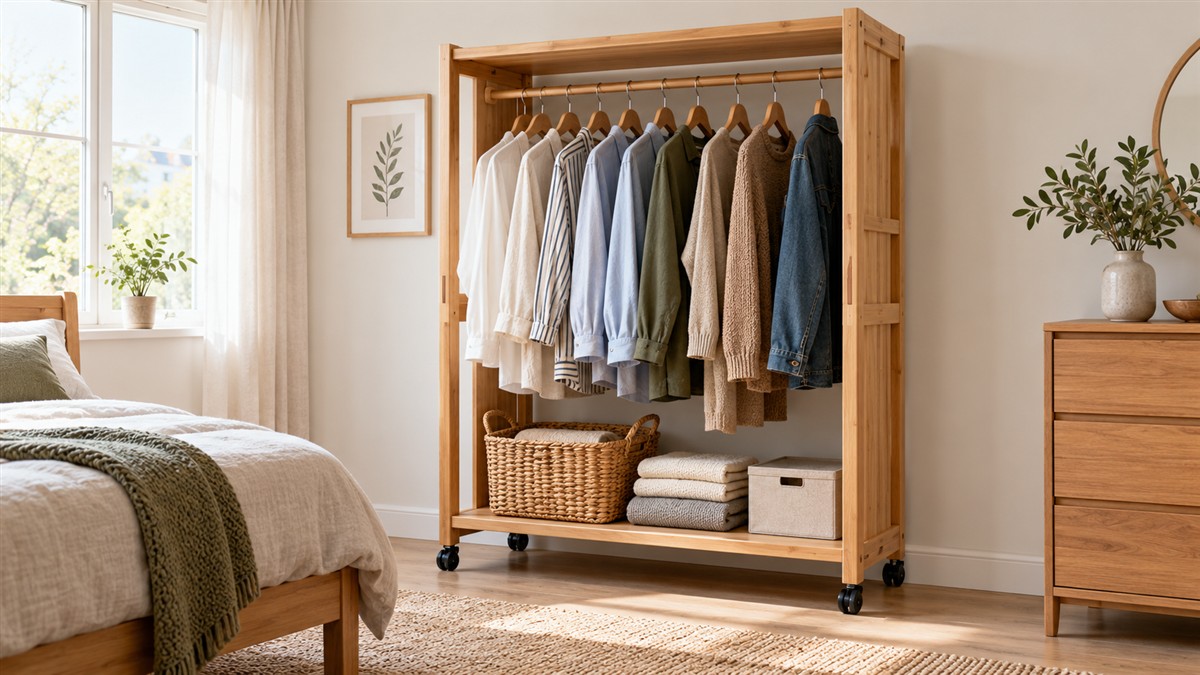
A wooden portable closet for hanging clothes is a freestanding wardrobe, so the questions are stability and air. The U.S. Consumer Product Safety Commission’s 2015 report on anchoring furniture covers clothing storage units, which is the category a portable closet falls into when it is taller than 30 inches. The EPA gives humidity limits for the home, and the University of Missouri textile guides say wood can release acids that yellow fabric. This guide sets out what those sources say about tip-over, humidity and contact with wood, and where the sources do not reach a portable closet.
Updated 19 October 2026
Author: Editorial team, home-shelving-guide.com
Quick answer
- The CPSC report covers clothing storage units taller than 30 inches. A portable closet of that height is in the same category, though the report does not name it.
- The report measured dressers and a media cabinet, not a hanging wardrobe, so it gives no tip figure for a closet with a rod and no drawers.
- Plan the room air. The EPA says to keep indoor humidity below 60 percent, and ideally between 30 and 50 percent.
- Line the wood. The Missouri guide says wood releases acidic oils that can yellow and weaken textiles in direct contact.
- Do not treat a portable closet as a sealed box. The Missouri guide says airtight plastic can trap moisture, and it advises a lined, breathable container for textiles.
Is a portable closet a clothing storage unit?
The CPSC report uses a wide definition. It says that “furniture” in the report means “any type of clothing storage unit, bookcase, electronics, and appliances.” A freestanding wooden closet with a hanging rod is a clothing storage unit in that sense. The standard the report describes, ASTM F2057-14, covers chest-type furniture and other clothing storage units taller than 30 inches, so a closet taller than that height is in the category the standard addresses.
The report does not test a closet, and the standard’s logic was written around drawers and doors. A closet with a rod and no drawers may have very different tip behaviour, and the report does not say how that difference changes the picture. The honest reading is that the report’s principle applies, and its numbers do not.
Check the closet’s height first, then its design. If it is taller than 30 inches, plan for tip-over. If it has drawers or doors, the report’s logic of loading one open part applies as well. The maker’s instructions should say whether a tether, a strap or an anchor is included.
What the dresser test does and does not tell a closet owner
The report’s measured figures come from a secondhand five-drawer dresser and a television cabinet. The dresser stood 49 inches tall, 36 inches wide and 18 inches deep. Without a tether, the report says both the dresser and the media cabinet needed between 13 lb and 18 lb of pull to tip. A portable closet has a different shape and no drawers, so its figure is not in the report.
The report’s tether test loaded the bottom drawer of the dresser, and the tether tension was about 8 lb with 100 lb in the drawer, and about 10 lb with carpet pads. The report says that the standard for furniture, ASTM F3096, “requires that anchors provided with dressers hold a minimum of 50 lbs. of force.” A closet owner can read that as the 50 lb anchor figure the standard sets for dressers. The closet’s own instructions should say which figure applies to it.
The report also explains the wall end. It says a drywall anchor is strongest when pulled parallel to the wall, and the pull from a tipping closet is closer to straight out. The report’s usual answer is a wood screw in a stud, and it says that finding the stud takes a stud finder or poking holes in the wall.
Humidity inside a wooden closet
The EPA guide makes the humidity point for the home. It says: “If possible, keep indoor humidity below 60 percent (ideally between 30 and 50 percent) relative humidity.” A wooden closet is inside the home, so the EPA figure is the one to use for the room the closet stands in. The closet itself does not have its own humidity limit in the sources.
The EPA also sets the rule for anything that gets wet: “It is important to dry water-damaged areas and items within 24-48 hours to prevent mold growth.” A garment that was wet should be dried fully before it hangs in a closet.
The Missouri textile guide gives a tighter band for heirloom textiles, 45 to 55 percent relative humidity, with a temperature of 62 to 72 degrees F. It also warns about the place the closet stands, and it lists attics, basements, kitchens, laundry rooms and unheated spaces as rooms to avoid for textile storage. A portable closet in one of those rooms is in the wrong place by the Missouri guide’s rule.
The arithmetic between the two humidity figures is short. The EPA upper limit of 60 percent sits 60 – 55 = 5 points above the top of the Missouri textile band. The Missouri band is 55 – 45 = 10 points wide. A closet that holds clothes near the Missouri top is inside the EPA limit with a 5-point margin.
Wood and the fabric inside
The Missouri guide makes a point about wood that matters for a wooden closet. It says woods of any type release volatile, acidic oils that yellow and weaken textiles if the items touch them directly. Its remedy is a barrier of washed cotton sheeting, muslin or acid-free tissue between the wood and the fabric. A garment that rests against bare wood, such as a shirt on a wooden back panel, is the case the guide describes.
The guide’s point is about textiles in general. It is not a claim about every clothes closet, and the sources do not say how much a cotton shirt on a hanger is affected by a wooden back. The safe reading is to keep fabric off bare wood where you can, use a fabric liner or a cloth cover, and check the garments from time to time.
Moths, cedar and the wooden closet
Many wooden closets are sold with a suggestion of cedar. The Missouri guide is clear on what cedar does: “Cedar chests and closets may have almost no value as moth or carpet beetle repellents.” It adds that the value of a cedar chest lies in keeping it tightly closed, which keeps out insects. A closet with cedar panels is not a substitute for a closed, dry space and regular checks.
The same guide says the insects that attack textiles are attracted to wool, silk and similar fibres. A wool coat in a wooden closet is therefore a case where the closet’s own protection is limited, and inspection is the protection the sources describe.
Choosing a spot for a portable closet
Put the closet in a heated room that is in regular use. The Missouri guide’s rule about rooms to avoid applies here: attics, basements, kitchens, laundry rooms and unheated spaces are the wrong places for clothes or textiles. A bedroom or a dressing room with steady air is closer to the guide’s advice.
Keep the closet out of damp rooms, since the EPA’s humidity figure is for the room air. The sources do not give a distance from a bathroom or a kitchen, so the reader has to judge the spot. A closet that stands in a room where you dry towels or wet coats is a closet in a damp room.
Check the stability before loading it. A portable closet should be level, should not rock when you open the door, and should be checked again after it is moved. The CPSC report treats tether slack as a problem, because a slack tether lets the unit wobble before it tips, so a loose closet is a problem before it is loaded.
Mistakes with a wooden portable closet
- Assuming the report’s dresser figures apply to a closet with a rod and no drawers.
- Hanging fabric against bare wood for long periods, since the Missouri guide names wood’s acidic oils as a risk to textiles.
- Storing a damp garment because the closet is closed and looks dry.
- Relying on cedar panels to stop moths, since the Missouri guide says cedar may have almost no value for that purpose.
- Standing a tall closet in a room the guide lists as a poor place for textiles.
What the listings state
Three portable closet listings from the research file show what sellers state about height, load and stability. The table uses only the listing’s own words and figures. Where a listing is silent, the table says so.
| Listing | Height stated | Width and depth stated | Load or weight stated | Stability wording |
|---|---|---|---|---|
| 67-inch wide wardrobe with cover | 65.7 inches | 66.9 inches long, 17.7 inches wide in one field | Item weight 8.6 lb; hanging rail holds up to 33 lb; each shelf 15 lb | Calls itself a stand-alone closet; no anti-tip hardware mentioned |
| Steel-pipe wardrobe, 51.7 x 18.2 x 70.6 inches | 70.6 inches | 51.7 inches long, 18.2 inches wide | Item weight 14.5 lb; no load figure | Says the pipe thickness “ensuring the stability of the wardrobe”; no anti-tip hardware mentioned |
| Four-tier metal wardrobe with hanging rod | 62.2 inches | 45.66 inches wide, 11.81 inches deep | Two load figures: 60 lb in one field and 600 lb in another | Says adjustable balancing feet enhance stability; no anti-tip hardware mentioned |
1. VTRIN Portable Closet for Hanging Clothes 67 Inch Wide Large Capacity Portable Wardrobe Closet (Covered wardrobe with a stated rail figure)
Pros
- The listing states 33 lb for the hanging rail and 15 lb per shelf.
- The listing gives a 65.7-inch height and a hanging area of 49.3 inches.
Cons
- The listing mentions no anti-tip hardware.
- The listing says it can be placed anywhere in the room, which does not address fixing to a wall.
Best for: a covered wardrobe for a bedroom with a clear wall space and a stated rail load
Skip if: the unit must be fixed to the wall and the listing offers no fixing
View on Amazon (affiliate link)
2. LOKEME Wardrobe Closet,Steel Pipe Diameter 19mm,Portable Closet for Bedroom (Tallest listed wardrobe with a shelf-count conflict)
Pros
- The listing gives 70.6 inches of height, the tallest of the three.
- The listing says the pipe thickness is intended to keep the wardrobe stable.
Cons
- A bullet says 6 storage racks, while the specification field says 1 shelf.
- The listing gives no load figure for the rail or the shelves.
Best for: a tall wardrobe where the shelf layout can be confirmed on arrival
Skip if: you need the shelf count or a load figure before you buy
View on Amazon (affiliate link)
3. HOMIDEC Wardrobe Closet,Portable Clothes Rack with 4 Tiers Shelves (Four-tier metal wardrobe with two load figures)
Pros
- The listing states adjustable balancing feet for stability on uneven floors.
- The listing gives 45.66 inches of width, which is wider than the other two.
Cons
- The listing gives 60 lb in one field and 600 lb in another.
Best for: an open-front wardrobe where the load figure can be confirmed with the seller first
Skip if: you cannot settle the load figure, or you plan to load the top shelves with heavy items
View on Amazon (affiliate link)
The first calculation compares each height with the 30-inch line that the CPSC standard uses for clothing storage units. Each listed height divided by 30 gives the multiple of that line:
- 65.7 / 30 = 2.19, so the first wardrobe is about 2.2 times the 30-inch line.
- 70.6 / 30 = 2.35, so the second is about 2.4 times the line.
- 62.2 / 30 = 2.07, so the third is about 2.1 times the line.
Every listing is well over the 30-inch line, so the report’s logic applies to each of them. The listings do not say a tip restraint is included, and none of the three mentions anti-tip hardware in the bullets we read. A reader should check the box contents before assembly and before loading the unit.
The second calculation compares the stated weights. The first listing gives 8.6 lb for the empty unit and 33 lb for the rail, so the rail is 33 / 8.6 = 3.8 times the unit’s own weight. That ratio says little about tip-over, since the report measured a different unit, but it shows that the rail figure is a load figure, separate from the weight of the closet.
The third listing gives two load figures, 60 lb in one field and 600 lb in another. The two cannot both be the unit’s limit, and the listing does not say which applies. The gap is 600 / 60 = 10 times, which is a reason to use the lower figure until the seller clears it up.
The second listing states a height that is the largest of the three, at 70.6 inches, and it states 14.5 lb for the empty unit. It also lists “6 storage racks” in a bullet while its specification field gives “Number of Shelves: 1″. That conflict is a reason to read the box and check the shelves before loading.
The first listing’s figures can be added into a plan, though the listing does not add them for you. It gives 33 lb for the hanging rail, and 15 lb for each shelf. The bullets say the unit has four storage shelves. Four shelves at 15 lb give 4 x 15 = 60 lb, and the rail and shelves together come to 33 + 60 = 93 lb. That 93 lb figure is our arithmetic on two separate listing figures, not a stated limit for the closet, and it assumes each part carries its own figure at the same time.
The reader can apply the same method to any listing. Write down each stated figure, multiply the per-part figures by the number of parts, add the totals, and keep the result in view when deciding what goes where. Where a listing gives one figure and no count of parts, the arithmetic cannot be done, and the reader should ask the seller for the missing figure before buying.
None of the listings states a load for the whole closet with clothes in it. The sources we opened give no weight limit for a freestanding wardrobe, so the post does not add one.
How we chose
We used four sources: the 2015 CPSC report on anchoring furniture and televisions, the EPA’s brief guide to mold and moisture, and two University of Missouri guides on textiles, “To Protect and Preserve” and “Caring for Your Treasures.” We downloaded each source, converted it to text and checked the quoted sentences against that text. We did not use any product listing, price, rating or brand. The closet is a freestanding unit, and the report did not measure one, so the post says where the principle carries over and where it does not.
What we could not verify
The sources we opened do not measure a portable closet, a hanging rod, or the tip behaviour of a closet without drawers. They give no weight limit for a rod or for the garments on it.
The sources do not give a humidity figure for the inside of a closet, only for the room, and they do not describe how a wooden closet’s own panels affect the air.
The sources do not say whether a particular wood type, finish or panel is better for clothes, and they do not describe a tether or anchor for a portable closet.
FAQ
Does a wooden portable closet need to be anchored?
The sources do not say for a closet of this kind. The CPSC report covers clothing storage units taller than 30 inches, and it describes a tip-restraint system for them. If the closet is taller than 30 inches, check its instructions for a restraint, and anchor it as they say.
What humidity should the room have?
Use the EPA’s 60 percent figure as the ceiling, and its 30-to-50 percent range as the ideal. The Missouri textile guide gives 45 to 55 percent for heirloom textiles. Use the lower band if the clothes are valuable.
Can clothes touch the wooden back of the closet?
The Missouri guide says wood releases acidic oils that can yellow and weaken textiles in direct contact, and it recommends a barrier. Use a fabric liner or a cloth cover, and check the garments from time to time.
Do cedar panels keep moths out?
The Missouri guide says cedar closets and chests may have almost no value as moth or carpet beetle repellents. The value of a cedar chest is that it is tightly closed. Do not rely on cedar alone.
What if the closet gets wet?
The EPA says to dry water-damaged items within 24 to 48 hours to prevent mold growth. Dry the garments fully before they go back in the closet, and check the closet for moisture.
Bottom line
Treat a wooden portable closet as a freestanding unit: check its height, anchor it if the instructions allow, and keep it level and steady. Keep the room dry, keep fabric off bare wood, and do not rely on cedar to keep moths out.
For more options, see the rod to hang clothes in a closet guide and the small clothes rack for a bedroom guide.
Sources
- U.S. Consumer Product Safety Commission, anchoring furniture and televisions report (2015): the definition of furniture, the clothing storage standard scope, the freestanding pull figures and the anchor figure of 50 lb
- U.S. Environmental Protection Agency, A Brief Guide to Mold, Moisture and Your Home: the indoor humidity limit and the 24-to-48-hour drying rule
- University of Missouri, To Protect and Preserve: quilts and textile heirlooms (PDF): the 45-to-55 percent band, the wood contact rule, the cedar point and the rooms to avoid
- University of Missouri, Caring for Your Treasures (PDF): the mold and mildew point and the unfinished attics and basements warning