How Deep Should Laundry Room Shelves Be
As an Amazon Associate we earn from qualifying purchases.
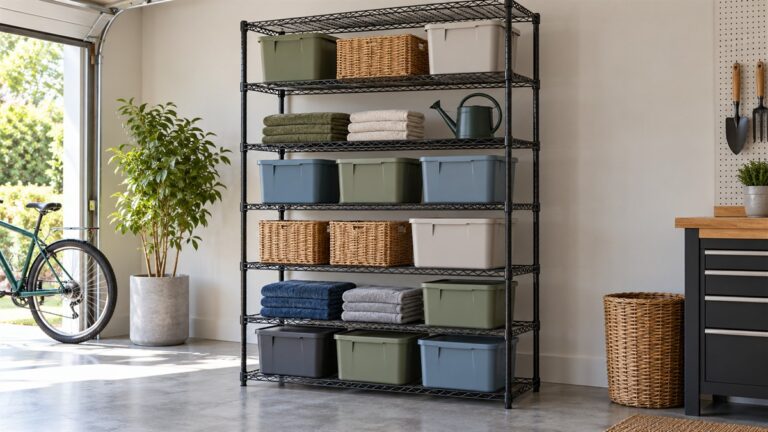
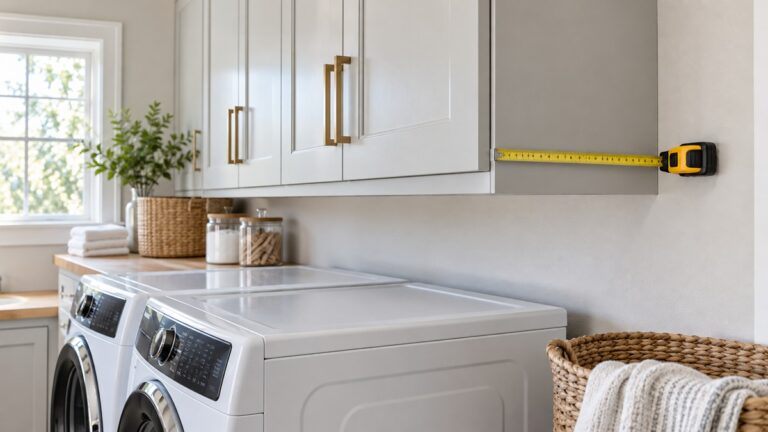
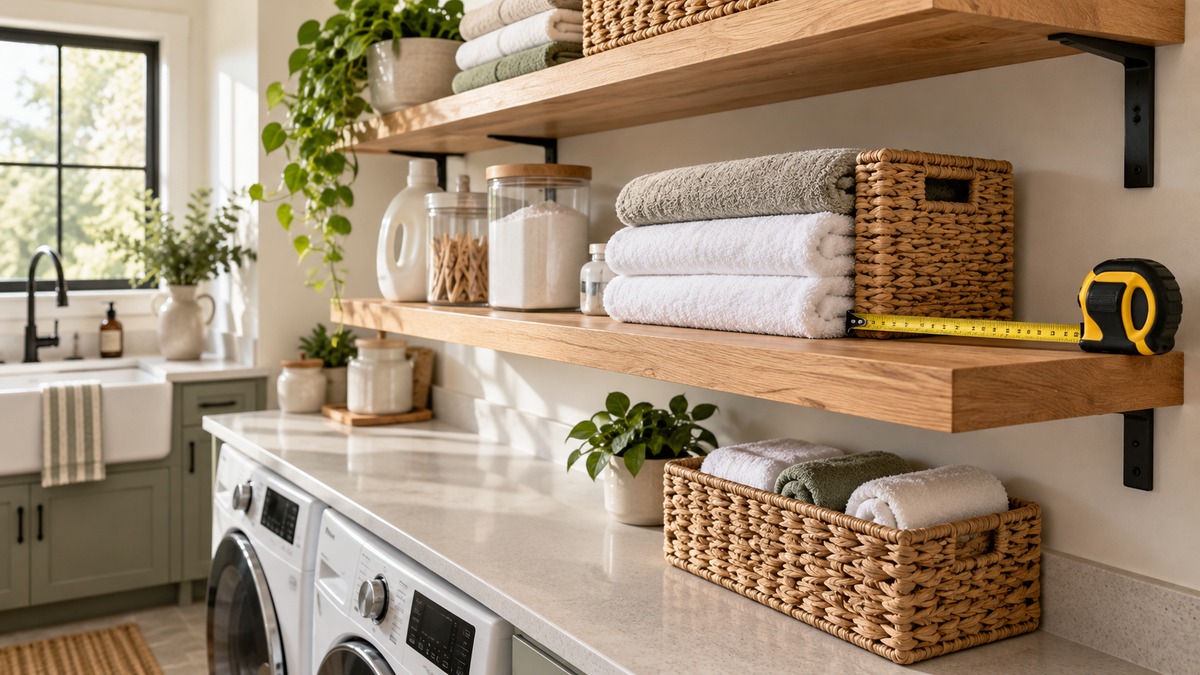
How deep should laundry room shelves be? The depths the makers list cluster at 12 and 16 inches for wire shelving, 11.8 and 15.7 inches (30 and 40 centimeters) in Elfa’s laundry guidance, 6 and 12 inches for IKEA wall frames, and 15¾ to 20⅛ inches for IKEA’s laundry systems. No source we opened names one right depth for a laundry room. This guide lines the numbers up, converts them, tests them against real basket sizes, and shows what shelf depth does to reach and to a walkway.
Quick answer
- ClosetMaid lists wire shelving in depths of 6, 9, 10, 12, 16 and 20 inches, and says Shelf & Rod shelving is used where storage and hanging are both needed, such as in a closet or laundry room. Its brackets match the shelf depth, except that Shelf & Rod always takes a 12 inch bracket.
- Elfa’s laundry page suggests wire shelves in depths such as 30 and 40 centimeters, shallower for smaller items and deeper for boxes and towels.
- A 12 inch shelf cannot hold any of the six IKEA bins and baskets we compared, while a 20 inch shelf holds all six. The 16 inch shelf holds two.
- Over a counter, a reach deeper than 20 inches lowers the ADA high reach from 48 to 44 inches. Kitchen guidance asks for pull-outs past 18 inches.
Depths the makers list
The table gathers the depths from the pages we opened. ClosetMaid’s figures come from its 2016 fixed-mount specification sheet and its how-to guide. Elfa’s come from its laundry page, its Sparring planning guide and a ready laundry unit. IKEA’s come from its laundry guide. We convert centimeters to inches with 1 centimeter = 0.3937 inch, and millimeters with 25.4 per inch.
| System | Depths listed (inches) | Source |
|---|---|---|
| ClosetMaid SuperSlide | 12, 16 | How-to guide |
| ClosetMaid Shelf & Rod (wardrobe) | 10, 12, 16; the 16 inch size is also sold with a 10 inch hang section | Specification sheet |
| ClosetMaid Close Mesh | 9, 12, 16, 20 | Specification sheet |
| ClosetMaid Linen | 6, 9, 20 | Specification sheet |
| ClosetMaid TotalSlide and Heavy Duty | 12, 16 | Specification sheet |
| Elfa, laundry guidance | 30 and 40 cm = 11.8 and 15.7 | Laundry page |
| Elfa Sparring solid shelves | 25, 30, 40, 50 cm = 9.8, 11.8, 15.7, 19.7 | Sparring planning guide |
| Elfa laundry unit with drying shelves | 625 mm overall = 24.6 | Product page |
| IKEA ENHET wall frames with shelves | 6, 12 | Laundry guide |
| IKEA BOAXEL wall system shelves | 15¾ | Laundry guide |
| IKEA JONAXEL top shelf for frame | 20⅛ (listed as 19⅝ × 20⅛; we read the second figure as depth) | Laundry guide |
| Wall cabinet box (NKBA drafting text) | Generally 12 | Cabinet chapter |
Two things stand out. The common wire depths are 12 and 16 inches across ClosetMaid’s lines, with 20 inches for mesh and linen shelving. The laundry-specific sources sit near the same numbers from another angle: Elfa’s 30 and 40 centimeters are within 0.2 and 0.3 inch of 12 and 16 inches, and IKEA’s two open-frame depths are 6 and 12. The 24.6 inch figure for the Elfa unit is the overall depth of a unit with fold-down drying shelves, not a shelf depth, so we leave it out of the comparisons below.
What the sources say each depth suits
Few pages tie a depth to a use. The ones that do are short. The Elfa laundry page says wire shelves in different depths, “30 and 40 cm,” can adapt to your needs, with the shallower shelves “perfect for smaller items” and the deeper shelves for larger storage boxes and towels. The page names laundry detergent as an example of a smaller item. The Sparring planning guide gives a ladder of recommended solid-shelf depths: 25 centimeters for a smaller sideboard and decoration, 30 for a bookcase, 40 for storage and 50 for a desk. A laundry shelf for boxes would sit on the 40 centimeter rung by that ladder, which is our reading, not Elfa’s statement.
ClosetMaid’s how-to guide describes Close Mesh shelving in 16 and 20 inch depths as “perfect for pantry storage or for anywhere small items are stored,” and says SuperSlide shelving with standard hardware can serve storage uses such as linen closets. A North Carolina Agricultural Extension Service publication from 1965, written about clothing closets, says “A 12-inch shelf will hold most hats, folded garments, shoes, and clothing accessories.” The publication does not mention towels or sheets, so treat the 12 inch figure as a starting point for folded stacks.
An Oregon State University Extension circular from 1967 on clothes closets gives planning rules in a list: “Store frequently used items within easy reach,” and “Out-of-season and seldom used articles can be kept on the higher shelves.” It also calls the closet door “a handy place for shallow racks or bins.” Those rules apply to any shelf, and they decide which depth goes where: deeper shelves where you reach into them less often, and shallow ones at the height you use every day.
A fit test with real basket sizes
IKEA’s laundry guide lists dimensions for several baskets and bins, and the two IKEA systems pair a bin with a shelf of nearly the same depth. The BOAXEL mesh basket is 15¾ inches deep for a BOAXEL shelf 15¾ inches deep. The JONAXEL mesh basket is 19⅝ inches deep for a top shelf 20⅛ inches deep. The slack in those pairings is 0 and 0.5 inch.
The test is simple: slack = shelf depth − item depth, and a negative number means the item overhangs the front or does not fit. The shelf depths are the three ClosetMaid sizes that recur, 12, 16 and 20 inches. The items are six IKEA listings, using the depth, length or diameter given for each.
| Item (IKEA listing) | Depth or diameter (inches) | 12 inch shelf | 16 inch shelf | 20 inch shelf |
|---|---|---|---|---|
| TORKIS flexible laundry basket | 15 | 12 − 15 = −3 | 16 − 15 = 1 | 20 − 15 = 5 |
| BOAXEL mesh basket | 15¾ | −3.75 | 0.25 | 4.25 |
| JÄLL laundry bag with stand | 16½ (length) | −4.5 | −0.5 | 3.5 |
| FYLLEN laundry basket | 17¾ (diameter) | −5.75 | −1.75 | 2.25 |
| TORKIS two-compartment basket | 18½ | −6.5 | −2.5 | 1.5 |
| JONAXEL mesh basket | 19⅝ | −7.625 | −3.625 | 0.375 |
Read across: no basket in the list fits a 12 inch shelf, the 16 inch shelf takes the 15 and 15¾ inch ones, and only the 20 inch shelf takes all six. The match between depth and item is a shape question and a reach question as well, and the table cannot answer either, since a 20 inch shelf holding a 15 inch basket has 5 inches of dead space behind it. IKEA’s own pairings put the slack at 0 to 0.5 inch, which suggests makers size a bin to its shelf. If your containers differ, measure the deepest one and compare it with the table’s formula.
Depth, reach and the walkway
Depth changes how far a hand travels. The ADA standards set a high forward reach of 48 inches over an obstruction when the reach depth is 20 inches or less, and 44 inches when it is greater, with a maximum reach depth of 25 inches. A shelf above a folding counter makes the counter an obstruction. The Elfa Sparring guide also sells a shallow bracket that “fits well in a narrower passage,” and a deep bracket that is “reinforced to withstand the extra weight.”
The kitchen chapter of the UD Project’s residential specification says pull-out shelving or drawers should be used in storage areas deeper than 18 inches. A North Dakota housing standard says the same for kitchens. The HUD Fair Housing Act Design Manual drawing of a “Small Shallow Storage Closet” carries the label “shelves at all reach heights” and a recommended maximum of 18 inches, among notes the manual calls “recommendations only.” We read the 18 as a depth, though the drawing does not spell that out. None of these pages is about laundry shelves, but all of them point to 18 inches as the point past which reach becomes a problem.
Open shelves also stick out into the room. The ADA standards limit objects whose leading edges are between 27 and 80 inches above the floor to a protrusion of 4 inches into a circulation path, and set a minimum walking width of 36 inches. Both are references for public buildings. The table subtracts each shelf depth from three passage widths of our own choosing.
| Passage width (inches) | 6 inch shelf | 12 inch shelf | 16 inch shelf | 20 inch shelf |
|---|---|---|---|---|
| 42 | 42 − 6 = 36 | 42 − 12 = 30 | 42 − 16 = 26 | 42 − 20 = 22 |
| 48 | 48 − 6 = 42 | 48 − 12 = 36 | 48 − 16 = 32 | 48 − 20 = 28 |
| 60 | 60 − 6 = 54 | 60 − 12 = 48 | 60 − 16 = 44 | 60 − 20 = 40 |
Against the 36 inch walking width, a 42 inch passage works only with the 6 inch shelf, a 48 inch passage works with 6 and 12, and a 60 inch passage works with all four. Every depth in the table exceeds the 4 inch protrusion limit, by 2, 8, 12 and 16 inches. The limit applies only where a shelf sits along a path of travel, and it was written for public buildings. A shelf above a counter or machine, where no one walks, is outside that rule, which is why the table is a planning aid and not a requirement.
Brackets, spacing and load
Depth also decides hardware. ClosetMaid’s installation guide says to “always match bracket size to shelving depth,” except that Shelf & Rod shelving always uses 12 inch brackets. The wire shelving specification sheet repeats the rule, listing brackets in 12, 16 and 20 inch sizes, and adds that standards should be spaced no more than 24 inches apart and no more than 4 inches from each end of a shelf. The guide recommends stud installation whenever possible for the strongest installation.
The pages do not tie a load limit to depth. Elfa gives a maximum of 200 kilograms per section for its Classic click-in system and asks owners to distribute weight evenly, and for Sparring it recommends a maximum weight spaced evenly across the system of 40 kilograms for the 45 width, 30 for the 60 width and 20 for the 90 width. Those figures depend on the width between wallbands and not on shelf depth. Our guide to the ClosetMaid wire shelf weight limit covers the load side, and our guide to wire closet shelving with a clothes rod covers the Shelf & Rod style.
How to decide your depth
- List the containers, boxes and folded stacks that will sit on the shelf, and measure the deepest one.
- Choose the nearest stock depth at or above it, from 12, 16 or 20 for wire shelving, or from the Elfa and IKEA sizes if you use those systems.
- Check the slack against the table’s formula, shelf depth minus item depth.
- Put the deeper shelves higher or lower, where you reach in less often, and the shallow ones at the height you use daily.
- Match the brackets to the shelf depth, using 12 inch brackets for Shelf & Rod.
- If the shelf is along a path of travel, subtract its depth from the passage width and compare the result with 36 inches. For more on a related depth question, see our guide to the best depth for floating shelves in a bedroom.
How we chose
We read the pages listed below on 2026-10-21: the ClosetMaid how-to guide and two specification sheets, three Elfa pages, the IKEA laundry guide, a 1965 North Carolina extension publication and a 1967 Oregon State circular, the HUD Fair Housing Act Design Manual, the ADA text and the NKBA cabinet chapter. We kept the depths and rules that each page states in plain words and quoted only sentences that we matched against the page text. We used makers’ own dimension lists for the fit test. The tables use our own arithmetic, and the passage widths are examples of our own.
What we could not verify: what the sources do not say
The pages we opened give no laundry-room shelf depth from the NKBA or from a current extension publication. The two extension documents are old and cover clothing closets. The sources do not rank depths for a laundry room, and they do not state a load limit by depth. A South Dakota State University Extension page on laundry room design could not be opened. The HUD drawing does not label its 18 inch figure as a depth in words, so that is our reading. The ADA reach, protrusion and walking-width figures apply to public buildings, not to a private room. The IKEA listings are product catalog sizes, and the fit test takes only the dimensions they list.
Frequently asked questions
What is the most common depth for laundry room shelves?
ClosetMaid lists its wire shelving most often at 12 and 16 inches. Elfa’s laundry guidance gives 30 and 40 centimeters, which are 11.8 and 15.7 inches. Neither maker calls one depth the right one for every laundry room.
Is a 12 inch shelf deep enough for laundry baskets?
Not for the six IKEA baskets and bins we compared, which run from 15 to 19⅝ inches deep or across. A 12 inch shelf suits smaller items and folded stacks, as the 1965 North Carolina extension publication describes for folded garments.
Do deeper shelves need different brackets?
Yes. ClosetMaid says to match bracket size to shelf depth, with one exception: Shelf & Rod shelving always uses 12 inch brackets.
How deep can a shelf be before reaching gets hard?
The UD Project and a North Dakota housing standard say pull-out shelving or drawers should be used in storage deeper than 18 inches in a kitchen. The ADA lowers the high forward reach from 48 to 44 inches when the reach depth passes 20 inches.
Can I use shallow shelves in a narrow laundry closet?
Elfa describes a shallow bracket that fits a narrower passage, and IKEA lists wall frames with shelves 6 inches deep. A 6 inch shelf leaves 36 inches in a 42 inch passage by our arithmetic.
Bottom line
Measure the deepest thing that will sit on the shelf, pick the nearest stock depth above it, and match the brackets to that depth.
Sources
- https://homedepot.closetmaid.com/en-US/Installation/Pages/how-to-guides.aspx (opened 2026-10-21)
- https://design.closetmaid.com/en-us/Documents/105723.14cmR6_ClosetMaidFixedWire.pdf (opened 2026-10-21)
- https://design.closetmaid.com/en-us/Documents/Wire%20Shelving%20Specifications%20rev_6_12_English_HQ.pdf (opened 2026-10-21)
- https://elfa.com/en/inspiration/room/laundry-and-cleaning (opened 2026-10-21)
- https://elfa.com/en/measure-and-plan/planning-guide-sparring (opened 2026-10-21)
- https://elfa.com/en-gb/products/classic-by-elfa/top-hang/ready-solutions/9800252laundrysolutionclassicwhiteopt2-rs (opened 2026-10-21)
- https://www.ikea.com/us/en/files/pdf/b3/25/b3253a3b/laundry_oct_23.pdf (opened 2026-10-21)
- https://ocr.lib.ncsu.edu/ocr/ua/ua102_200-001-bx0004-004-005/ua102_200-001-bx0004-004-005.pdf (opened 2026-10-21)
- https://ir.library.oregonstate.edu/xmlui/bitstream/1957/24327/1/ECNO691.pdf (opened 2026-10-21)
- https://www.huduser.gov/portal/sites/default/files/publications/pdf/fairhousing/fairfull.pdf (opened 2026-10-21)
- https://www.access-board.gov/ada/ (opened 2026-10-21)
- https://elearning.nkba.org/wp-content/uploads/2023/11/Chapter-6-Illustrating-CabinetryCasework.pdf (opened 2026-10-21)
Disclosure: As an Amazon Associate we earn from qualifying purchases.