How Far Apart Should Laundry Room Shelves Be
As an Amazon Associate we earn from qualifying purchases.
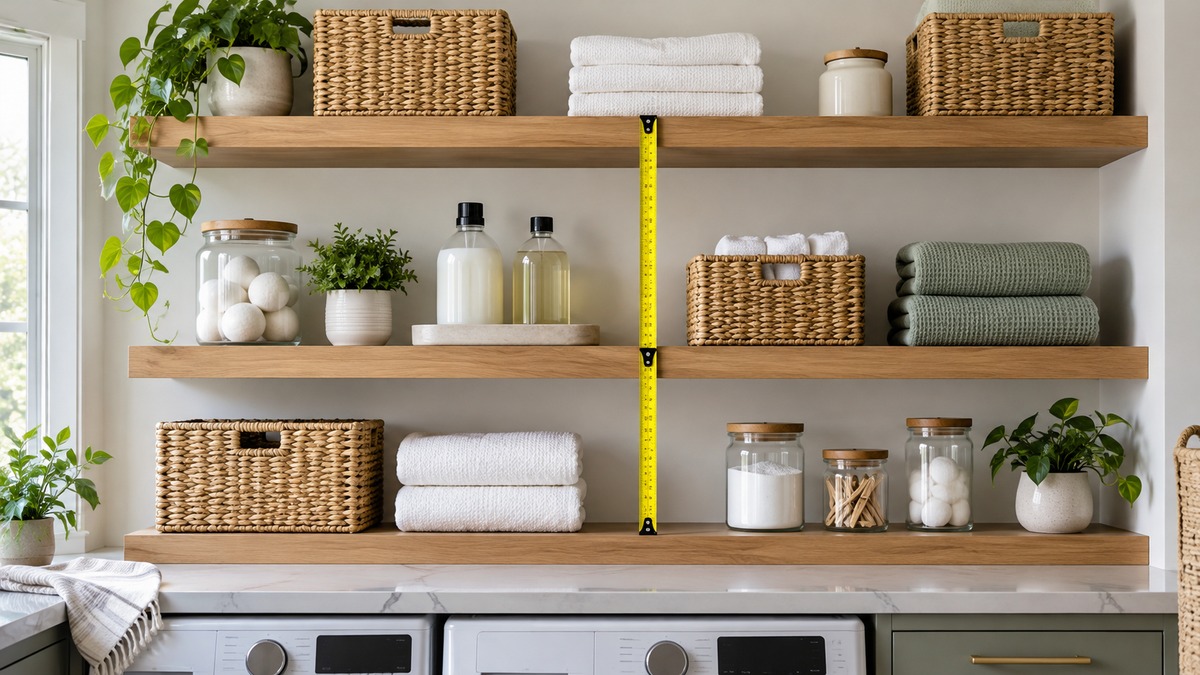
How far apart should laundry room shelves be? No page we opened sets one number. The gap between two shelves is the height of the tallest thing you will store on the lower one, plus a little room to lift it out. Three limits then cap the stack: the clearance a top-loading washer needs for its lid, the height a person can reach, and the advice to keep laundry products away from children. This guide turns those limits into a worksheet you can fill in with your own measurements.
Quick answer
- Set each gap to the tallest item on the shelf below it, plus clearance for your hand. The pages we opened give no fixed gap for laundry shelves.
- Over a top-loading washer, the lowest shelf must clear the lid. LG’s checklist for its top-loaders calls for 15.7 inches above the washer.
- The U.S. Access Board standards put the high forward reach at 48 inches. A shelf over a top-loader that reaches 36 inches already starts above that line.
- Keep laundry products in a high, locked cabinet, as the American Academy of Pediatrics advises, rather than on an open shelf at child height.
Why the answer is a formula and not a number
People often look for a standard spacing such as 12 inches between shelves. In the pages we opened, none states one for a laundry room. What the pages do provide are limits that act on the whole stack. The first limit is the machine. The second is the reach of the person using the shelf. The third is what the shelf holds, and who else in the home can get to it.
That is why the useful question is not a single distance but a short calculation. The calculation has three parts. First, find the height of the tallest item on each shelf. Second, add a clearance so you can slide the item out without catching it on the board above. Third, add the thickness of the shelf board to get the repeat distance from one shelf to the next. We call that repeat distance the pitch. The pitch, not the gap alone, decides how many shelves fit in the wall space you have.
The clearance is our own assumption, set at 2 inches in every table below. None of the pages we opened specifies it. Use a bigger number if you have large hands, wear gloves, or lift heavy jugs by the handle, and use a smaller number if your items are slim and light.
How we chose
This is an explanation of a method, not a product list. We read the pages on 2026-10-21 and kept only facts that a page states in plain words. The sources fall into four groups. Federal pages give reach ranges and the height rule for accessible washers. A manufacturer page gives the lid clearance for one brand of top-loader. Pediatric, poison-control and fire-safety pages give the storage and dryer advice. Closet-system makers give planning heights for folded laundry and the support spacing for their own hardware.
We did not use blog posts or retail pages to support any gap, and a few pages could not be read: the South Dakota State University extension laundry page and two appliance-maker dimension guides returned access-denied responses. Every quotation in this guide was matched against the text of the page it came from. The tables are our own arithmetic, and each input is labeled as a source figure or as an assumption.
Step 1: Find the top of the machines
Everything above a washer starts with the height of the machine itself. The Access Board guide to washers and dryers says that the height of top-loading machines must be 36 inches maximum above the finish floor. That rule is written for facilities the ADA covers, and the guide does not say it applies to a private laundry room, so treat it only as a public reference number for a top-loader. Use it as a stand-in until you measure your own machine.
Measure from the floor to the top of the machine with the lid closed. If the machine sits on a pedestal or a drain pan, include that in the number. Write down the result, because the next step adds a clearance to it.
Step 2: Add the lid clearance for a top-loader
A top-loading washer opens upward, so the first shelf above it has to leave room. LG’s pre-purchase and installation checklist for its top-loaders says to allow 15.7 inches (40 cm) above the washer, “accounting for lid clearance.” The same checklist asks for at least 1 inch on each side and 4 inches behind the washer, measured from the water supply.
That figure belongs to LG’s own top-loaders. The pages we opened give no lid clearance for other brands, and none gives a figure for front-loading machines, whose doors open to the side. For any other machine, the installation manual for the exact model is the page to check. The table shows what the LG figure does to the height of the lowest shelf for three machine heights. The 36-inch row uses the Access Board maximum, and the 34-inch and 38-inch rows are our assumptions.
| Machine top (inches) | Plus lid clearance (inches) | Bottom of lowest shelf (inches) | Above the 48-inch high reach by (inches) |
|---|---|---|---|
| 34 (our assumption) | 15.7 | 34 + 15.7 = 49.7 | 49.7 – 48 = 1.7 |
| 36 (Access Board maximum) | 15.7 | 36 + 15.7 = 51.7 | 51.7 – 48 = 3.7 |
| 38 (our assumption) | 15.7 | 38 + 15.7 = 53.7 | 53.7 – 48 = 5.7 |
The last column is the useful one. The U.S. Access Board’s ADA Standards, in section 308.2.1, set the high forward reach at 48 inches maximum and the low forward reach at 15 inches minimum when the reach is unobstructed. Every row in the table is above 48 inches. A shelf that clears the lid of a top-loader is therefore a stretch shelf for anyone who relies on that reach range. It can still be a good place for items you use a few times a year.
Step 3: Choose the gap from the items
The next job is to decide what goes on each shelf. IKEA’s wardrobe planning guide gives three planning heights that are close to what laundry shelves hold: 21 cm for SKUBB storage boxes, about 25 cm for 10 folded t-shirts, and about 30 cm for 10 pairs of folded sweaters. These are closet figures, so treat them as stand-ins for stacks of folded laundry and baskets. Convert each to inches by dividing by 2.54, then add the 2-inch clearance to get the gap.
Detergent jugs, softener bottles and spray bottles are the other tall items. The pages we opened give no height for those products, so measure the tallest one you own and use that number in place of the planning figure.
| Item (planning height from IKEA) | Height (inches) | Gap with 2 inches clearance | Pitch with a 1-inch board |
|---|---|---|---|
| SKUBB-size box, 21 cm | 21 ÷ 2.54 = 8.3 | 8.3 + 2 = 10.3 | 10.3 + 1 = 11.3 |
| 10 folded t-shirts, 25 cm | 25 ÷ 2.54 = 9.8 | 9.8 + 2 = 11.8 | 11.8 + 1 = 12.8 |
| 10 folded sweaters, 30 cm | 30 ÷ 2.54 = 11.8 | 11.8 + 2 = 13.8 | 13.8 + 1 = 14.8 |
The 1-inch board thickness is also our assumption. A thin wire shelf takes less, and a thick wooden board takes more. If you are shopping for adjustable hardware so you can change the gap later, see our guide to adjustable-height shelves.
A mixed shelf follows its tallest item. If a shelf holds folded towels and one tall bottle, the bottle sets the gap. One way around that is to give the tall items their own shelf, which lets the other shelves sit closer together. Elfa’s laundry room page makes a similar point about layout: it says to adapt storage to the unique conditions of the room, and it suggests that cleaning tools are best stored at a height where they are easy to reach.
Step 4: Count the shelves that fit
With the pitch in hand, count the shelves for each zone of wall. Divide the height of the zone by the pitch and round down. The table below runs the calculation for three zones with the pitches from the last table. The first zone is the wall above a top-loader whose top is at 36 inches, which starts at the 51.7-inch figure from Step 2 and runs to an assumed 96-inch ceiling. That leaves 96 – 51.7 = 44.3 inches. The second zone is the 15-to-48-inch adult reach band beside the machines, which is 33 inches tall. The third is the 18-to-40-inch band that the ADA advisory table gives for children aged 5 through 8, which is 22 inches tall.
| Pitch (inches) | Shelves above the washer (44.3 ÷ pitch) | Shelves in the adult band (33 ÷ pitch) | Shelves in the 5-to-8 band (22 ÷ pitch) |
|---|---|---|---|
| 11.3 | 44.3 ÷ 11.3 = 3.9, so 3 | 33 ÷ 11.3 = 2.9, so 2 | 22 ÷ 11.3 = 1.9, so 1 |
| 12.8 | 44.3 ÷ 12.8 = 3.5, so 3 | 33 ÷ 12.8 = 2.6, so 2 | 22 ÷ 12.8 = 1.7, so 1 |
| 14.8 | 44.3 ÷ 14.8 = 2.99, so 2 | 33 ÷ 14.8 = 2.2, so 2 | 22 ÷ 14.8 = 1.5, so 1 |
The last row of the first column is worth a second look. Dividing 44.3 by 14.8 gives 2.99, which is just short of 3, because three shelves at that pitch need 44.4 inches. Check your own arithmetic the same way, using the unrounded numbers.
The table also shows why the wall beside the machines matters. Two shelves fit in the adult reach band at every pitch, but only one fits in the band for a child aged 5 through 8. The ADA children’s table is an advisory table for elements designed for children, and a laundry shelf is not one. It serves here only as a reference for what a child can reach, because the American Academy of Pediatrics warns that young children can often reach higher than you expect.
Step 5: Decide what goes where
The pitch answers how many shelves fit, and the limits answer what belongs on each one. The Louisiana State University AgCenter guide to accessible laundry rooms says that, for a family member with limited reach, shelves, racks and cabinets need to be “positioned lower to the ground and be shallower.” Put the items you use every wash on the shelves that sit inside the reach band, and put seasonal items above it.
Laundry products need a separate decision, because the safety advice is specific. The American Academy of Pediatrics says to put products away out of sight and reach of children and pets, and that “A high, locked cabinet is best.” It also says not to store products on top of the washer and dryer or in storage drawers under laundry machines. An open shelf at a child’s reach height is the opposite of that advice, so the shelves in the lowest zone should hold items such as dry towels, not detergent.
The same page says children can get hold of detergent packets when they are placed in the laundry basket, on top of the washer or dryer, or on a counter before use. That is a reason to plan a place for the product that is not on the machines themselves. The pages we opened do not say whether an open shelf above the machines is high enough, because the answer depends on the child and the room.
Keep the dryer area open
The dryer needs a different kind of clearance. The National Fire Protection Association tip sheet, hosted by the U.S. Department of Energy, says to keep the dryer area “clear of things that can burn, such as boxes or clothing.” The U.S. Fire Administration flyer adds two points about access: clean the back of the dryer where lint can build up, and check that the venting behind it is not damaged, crushed or restricted.
Neither page defines the dryer area in inches. For shelf planning, that leaves you with a principle but not a number. Do not wall in the back of the dryer with a fixed unit that blocks access to the vent, and do not stack cardboard boxes or piles of clothing next to or on the machine. If you are unsure how close a shelf can sit to a dryer, the installation manual for your dryer is the place to look.
Horizontal spacing of the supports
Shelf-to-shelf distance is only one meaning of the question. Some readers also want to know how far apart the brackets or standards should be. The pages we opened answer that only for one maker’s hardware. The ClosetMaid installation guide for its ShelfTrack system says standards should be spaced no more than 24 inches apart and no more than 4 inches from the end of the shelf. A ClosetMaid hardware sheet for wire shelves says never to install wall clips more than 12 inches apart, and to space support brackets no more than 36 inches apart.
Those numbers are instructions for ClosetMaid products and do not carry over to other brands. Follow the sheet that comes with the shelf you buy. For wire shelf load figures, see our post on the ClosetMaid wire shelf weight limit. For a rod-and-shelf layout on one wall, see wire closet shelving with a clothes rod.
A worked layout for one wall
Put the steps together for a wall above a top-loader with a 36-inch top. The lowest shelf bottom is at 51.7 inches. Say the top-loader’s owner stores folded t-shirts and towels, which we model at the 25 cm planning height. The pitch is 12.8 inches, so three boards fit between 51.7 inches and a 96-inch ceiling, with 5.8 inches left over. The first board’s top sits at 52.7 inches, the second at 65.5 inches, and the third at 78.3 inches.
The result is a wall of storage that suits a tall adult and almost nothing else. Everything on it is above the 48-inch reach line. A better plan for a mixed household moves the daily items to the open wall beside the machines. Two shelves fit in the 15-to-48-inch band at a 12.8-inch pitch, which leaves the wall above the washer for bulk and seasonal items. If the room has a rolling hamper, a sorter or a rack, see laundry sorters with a hanging bar and shelf for ideas that need no wall space.
Mistakes to avoid
- Setting the first shelf at lid height. LG’s checklist asks for 15.7 inches above the washer for its top-loaders, so a shelf placed lower than that leaves no room for the lid.
- Using one gap for every shelf. A gap sized for sweaters wastes space above a shelf of dryer sheets and wastes reach in the band you can use every day.
- Counting only the wall above the washer. That wall begins above the 48-inch reach line, as the Step 2 table shows.
- Storing detergent where children can reach it. The American Academy of Pediatrics advises a high, locked cabinet.
- Stacking boxes against the dryer. The fire-protection tip sheet says to keep the area clear of things that can burn.
- Copying one maker’s support spacing onto another brand. The 24-inch and 12-inch figures belong to ClosetMaid hardware.
What we could not verify
The sources we opened do not give a standard distance between laundry room shelves, a lid clearance for any brand other than LG, a clearance figure for front-loading machines, or the height of a detergent jug. They do not define how close a shelf may sit to a dryer, and they do not say how deep a machine is. The ADA rule for reaching over an obstruction covers a reach depth of up to 25 inches, and the pages we opened give no machine depth to compare against that limit. The 1-inch board, the 2-inch clearance, the 34-inch and 38-inch machine tops and the 96-inch ceiling are our assumptions, and the IKEA heights come from a closet guide and not a laundry guide. Nothing here is a product claim, and no shelf model is rated or ranked.
Frequently asked questions
How far apart should laundry room shelves be?
Match each gap to the tallest item on the shelf below, then add clearance for your hand. The pages we opened set no fixed distance, so the worksheet in Steps 3 and 4 is the answer. With the 2-inch clearance we assumed, planning heights of 21, 25 and 30 cm give gaps of 10.3, 11.8 and 13.8 inches.
How high above a washer should the first shelf be?
For an LG top-loader, 15.7 inches above the washer, according to LG’s installation checklist. For any other machine, read the installation manual for that model, because the pages we opened give no figure for other brands.
Do front-loading washers need the same gap?
The LG figure describes lid clearance on a top-loader, and a front-loader opens at the front. We found no clearance figure for front-loaders in the pages we opened, so check the manual for your model before you fix a shelf above one.
Can I keep detergent on a shelf over the washer?
The American Academy of Pediatrics says a high, locked cabinet is best and says not to store products on top of the washer and dryer. It does not rule on an open shelf above the machines, so the safer plan is a locked cabinet if children visit or live in the home.
How far apart should the shelf supports be?
It depends on the hardware. ClosetMaid’s ShelfTrack guide says standards no more than 24 inches apart, and its wire shelf hardware sheet says wall clips no more than 12 inches apart. Use the spacing printed on the instructions that come with your shelf.
Bottom line
Size every gap to the tallest item plus clearance, start a top-loader’s first shelf at its lid clearance, and keep the daily items and the laundry products out of the zone a child can reach.
Sources
- https://www.lg.com/ae/support/product-help/CT20076046-20155028331617 (opened 2026-10-21)
- https://www.access-board.gov/ada/ (opened 2026-10-21)
- https://www.access-board.gov/ada/guides/chapter-6-washers/ (opened 2026-10-21)
- https://www.lsuagcenter.com/topics/family_home/home/design_construction/design/planning%20interior%20spaces/accessible%20design/accessible-laundry-rooms (opened 2026-10-21)
- https://www.healthychildren.org/English/safety-prevention/at-home/Pages/Laundry-Room-and-Detergent-Safety.aspx (opened 2026-10-21)
- https://www.energy.gov/sites/prod/files/2016/06/f32/NFPA_DryerWasherSafetyTips.pdf (opened 2026-10-21)
- https://www.usfa.fema.gov/downloads/pdf/publications/clothes_dryer_fire_safety_flyer.pdf (opened 2026-10-21)
- https://homedepot.closetmaid.com/en-US/Installation/Pages/how-to-guides.aspx (opened 2026-10-21)
- https://pdf.lowes.com/productdocuments/93a1959a-e794-4321-93c0-c1fbc834dcd9/44005886.pdf (opened 2026-10-21)
- https://www.ikea.com/ie/en/files/pdf/69/0a/690a180e/pax__komplement.pdf (opened 2026-10-21)
- https://elfa.com/en/inspiration/room/laundry-and-cleaning (opened 2026-10-21)
As an Amazon Associate we earn from qualifying purchases.