Best Shelves for Toy Storage: Six Toy Bookshelves Compared by Size, Bins and Shelves
As an Amazon Associate we earn from qualifying purchases. Details
The person typing best shelves for toy storage wants shelving that holds books and toys together without becoming a tip-over hazard in a playroom or bedroom. This guide compares six bookcases and toy shelves whose Amazon listings state sizes, bin counts, shelf counts and wood types. The safety advice comes from a federal commission report and a university safety bulletin, and the clutter advice comes from a university extension program. Start with the anchoring question, then choose the width and bin count your room can take.
Quick answer
- Plan the fixing before anything else. The University of Kansas bulletin says children are too short to reach the tops of tall furniture, and it says “You can’t always stop your young child from climbing.” Five of the six stated heights fall between 30.7 and 31.7 inches, so each unit needs a wall fixing or an anti-tip device.
- Choose the width by the wall you have. The stated widths run from 52.0 inches to 74 inches, and SpaceAid’s 74 inch unit is the widest in the group.
- Pick open shelves when books share the unit. Three listings state six shelves: EXPERLAM’s dual bookshelf, Dclavy and ZJFGPOT.
- Count the bins against the toys you own. Five of the six listings state 12 or more bins, and one states nine.
What toy shelving has to do
Toy storage combines three jobs. The unit holds books, bins and loose toys at a height a child can reach, it stays upright when a child climbs or pulls out a bin, and it gives the room an orderly look that adults can keep up. The listings in this group describe the bins and shelves in detail and give sizes for most of them. They describe stability with phrases such as “extended base” and “anti-tipping device” more often than with a number.
This guide takes the safety question first, because it is the one that cannot be fixed after purchase. The sizes and bin counts come next, then the sorting trade-off between open shelves and bins. The listing claims about wood come last, since the sources here do not check them.
Tip-over comes first
The U.S. Consumer Product Safety Commission report on anchoring furniture defines the term broadly. It says that the terms “falling furniture” or “furniture” cover “any type of clothing storage unit, bookcase, electronics, and appliances.” A toy bookcase is therefore furniture in the sense that matters for tip-over, whatever the listing calls it.
The University of Kansas Environment, Health and Safety office explains why children are involved. It says that “Unfortunately, tip-over incidents happen more than many of us realize.” It also notes that young children are “too short to reach the tops of tall pieces of furniture where irresistible items like TVs, tablets, and toys may reside.” Its advice is to stabilize the furniture, since “You can’t always stop your young child from climbing. But you can stabilize the furniture that could hurt them.”
The heights in the listings are close to one another. Five units state heights between 30.7 and 31.7 inches, so their top shelves sit at about the same level. None of the listings gives a reach figure, and the sources we opened do not give one either. The practical rule that the KU bulletin supports is to keep the tops clear, because the bulletin ties the tops of furniture to the items children want.
For a toy unit, that advice has two practical parts. Fix the unit to the wall where the maker’s instructions allow, and keep the toys that draw a child upward off the top of the unit. A shelf that is well fixed but holds a favorite toy on top still invites a climb. For wall-free options or smaller units, our small wood bookcase guide compares narrower models, and the children’s small bookcase guide lists models sized for kids.
Sizes, bins and footprints
Table 1 sets the listed dimensions side by side. A footprint here is width times depth, and it appears only where the listing gives both. A blank cell means the listing does not state the figure in the bullets or detail rows we read.
| Listing | Bins (listing) | Shelves (listing) | Dimensions (listing, inches) | Footprint (square inches) |
|---|---|---|---|---|
| SpaceAid | 24 (8 large, 16 small) | 3 | 74 W x 13.6 D x 31.5 H | 1006.4 |
| EXPERLAM, dual bookshelf | 12 (4 large, 8 small) | 6 open shelves | 52.0 W x 11.0 D x 31.7 H | 572 |
| Dclavy | 12 removable | 6 open shelves | 52.3 W x 13.6 D x 31.5 H | 711.28 |
| mirolam | 12 removable (4 large, 8 small) | 3 | 55.1 W x 14.6 D x 30.7 H | 804.46 |
| ZJFGPOT | 12 removable (4 large, 8 small) | 6 | 53.9 W x 11 D x 31.5 H | 592.9 |
| EXPERLAM, top rack | 9 removable | 3 in the spec row, 6 side shelves in the bullets | not stated | not stated |
Four calculations follow from these figures. The first checks the bin counts against the listed sizes. SpaceAid’s 8 large and 16 small bins give 8 + 16 = 24, and mirolam’s 4 large and 8 small give 4 + 8 = 12, which matches its title.
The second turns width into wall length. SpaceAid’s 74 inches is 74 divided by 12 = 6.17 feet, so its wall needs more than six feet of clear length. The narrowest stated unit, EXPERLAM’s dual bookshelf at 52.0 inches, is 52 divided by 12 = 4.33 feet.
The third compares footprints. mirolam’s 55.1 by 14.6 inches gives 55.1 x 14.6 = 804.46 square inches, and EXPERLAM’s dual bookshelf gives 52.0 x 11.0 = 572 square inches. The difference is 804.46 minus 572 = 232.46 square inches, which comes from the extra depth of the mirolam unit.
The fourth checks the top-rack unit’s missing width. Its listing states no overall width, so the wall length cannot be calculated from the listing. Measure the wall before you consider that unit.
Bin counts can also be divided by shelves to estimate how the bins sit. SpaceAid’s 24 bins across three shelves give 24 divided by 3 = 8 bins per shelf on average, and EXPERLAM’s dual bookshelf gives 12 divided by 6 = 2 bins per shelf. Those averages assume an even split, which the listings do not state, so treat them as planning figures and not as a layout.
The same division helps with a room’s inventory. Suppose a room has 36 small toy sets, each of which needs its own bin. SpaceAid’s 16 small bins would then hold them at 36 divided by 16 = 2.25 sets per bin on average, so every small bin would hold more than two sets. That example is made up to show the arithmetic and does not describe any particular family. A room with fewer sets, or with sets that can share a bin, needs less.
Open shelves and bins: the sorting trade-off
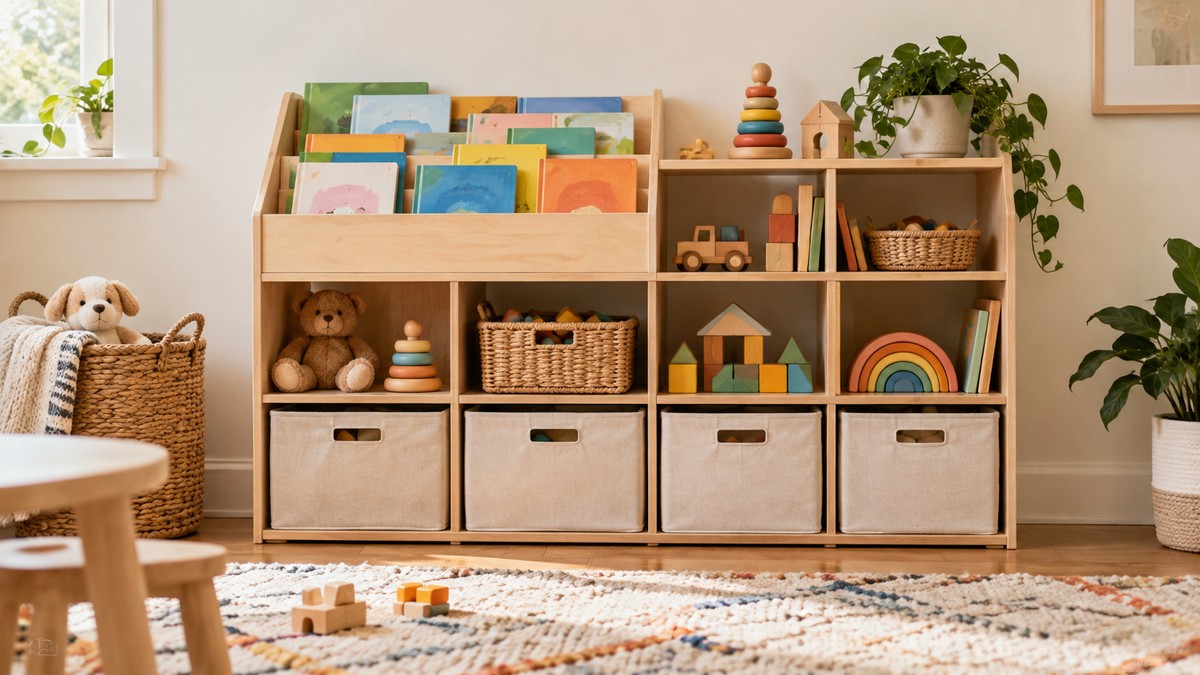
A toy box or a set of bins alone would not answer the question this guide is about, so every listing here combines bins with shelves. The two parts do different jobs. A bin holds loose pieces, so a child can pull out one bin and return it. A shelf holds books and larger toys in view.
The Penn State Extension article on clutter makes the case for sorting: “Cluttered spaces can reduce efficiency and create an environment where children and adults feel stressed and overwhelmed with visual and informational overload.” The same article says that “Children can get involved in the process as well.” A unit with clear sorting, such as bins for small pieces and shelves for books, gives a child a job that a jumbled pile does not. The listings describe that split. Dclavy’s bullets call its bins removable, and the EXPERLAM top-rack unit says its bins are for smaller toys and loose pieces.
The number of bins matters as much as their size. SpaceAid’s 24 bins give the most separate spaces in this group, while the 12-bin units give fewer, larger ones. The listings do not say how many sets a room needs, so the count should follow the toys you already own.
Materials and finish claims
Four listings describe solid pine, and two describe FSC-certified wood. The bullets make several claims about the wood: that it is not MDF, that it is non-toxic, that it has rounded edges, and that it is safe for everyday family use. Rounded edges and a wide base are design features the bullets describe. The safety and non-toxic wording is a listing claim, and the sources we opened do not confirm it for any product here. Treat those words as the maker’s description, and check the finish on the unit that arrives.
Placement follows from the same reasoning. Set the unit against a wall that can take a fixing, and keep the top free of toys. A listing with an anti-tipping device still needs the device fixed according to its instructions. The Dclavy spec row names an anti-tipping device, but its bullets do not say how it is installed, so read the instructions before you rely on it.
Where each listing fits
SpaceAid: the bin-heavy unit
SpaceAid’s unit is the widest stated in this group, at 74 inches, and it holds the most bins, 24 in total. Its bullets describe a tiered shelf with three shelves and a front base that extends to resist tipping. It suits a playroom wall where many small pieces each need a bin, and a family with enough wall for the full width.
EXPERLAM dual bookshelf: side racks at three heights
EXPERLAM’s dual bookshelf has six open shelves and side racks, and its bullets say the racks adjust to three heights of 28, 34 and 40 centimeters. The title and bullets give 12 bins, four large and eight small. It fits a family with books and plush toys, since the open shelves hold the books and the racks hold the bins.
Dclavy: removable bins and an anti-tipping device
Dclavy’s bookcase is 52.3 inches wide and 31.5 inches tall, with six open shelves and 12 removable bins. Its bullets describe a solid pine frame that is not MDF, melamine or fabric, and the spec rows include an anti-tipping device. The bullets also call the layout Montessori-inspired, which is a description and not a certification. It suits a nursery or bedroom where books and bins share one unit.
mirolam: a bookshelf with twelve bins
mirolam’s bookshelf is the deepest stated in this group, at 14.6 inches, and 55.1 inches wide, with three shelves and twelve bins. The bullets say its wood is FSC certified and that its extended base improves stability. They also say the hardware is included in the box. It fits a playroom where the bins matter more than the number of shelves.
ZJFGPOT: six shelves and a stated weight
ZJFGPOT’s organizer has six shelves and twelve removable bins, in four large and eight smaller sizes. Its product dimensions are 53.9 by 11 by 31.5 inches, and its item weight is 26.3 pounds. The weight matters to anyone who cleans behind a unit or moves it between rooms.
EXPERLAM top rack: a grab-and-go area
EXPERLAM’s second unit has a raised top rack, six side shelves and nine removable bins, with an FSC-certified solid wood frame. Its bullets give no overall dimensions, and its spec row lists three shelves, which does not match the six side shelves in the bullets. Measure the space before you choose it, and treat the shelf count as unsettled until you read the product page.
What to check on the listing
- Measure the wall first. Stated widths run from 52.0 to 74 inches, and the EXPERLAM top-rack unit gives no width.
- Count the bins the room needs. Five listings state 12 or more, and the top-rack unit states nine.
- Decide how many shelves the books need, since three listings state six.
- Plan the fixing before the unit arrives, following the maker’s instructions.
- Check the finish and wood on the unit you receive, because the claims in the bullets are not confirmed by the sources.
How we chose
We searched Amazon.com for “best shelves for toy storage” in Chrome on 21 October 2026 and read the first twelve listings on the results page. We kept units that combine shelves with bins. We dropped bins sold alone, toy boxes with no shelves, and a generic rolling shelf whose title does not mention toys. We then took one listing per brand, which gave five brands, and we added a second listing from EXPERLAM so the set reached six. That second listing is the top-rack unit, which differs from the dual bookshelf. For each listing we read the title, the first five feature bullets and the detail rows where the page gave them.
We did not use prices, ratings, sales rank or availability, because the browser gave no reliable values for them. Where a bullet gives a figure, we report it as the listing’s own statement.
What we could not verify
- How the listed weight limits and anti-tipping devices work in practice. No listing in this set states a load figure in its bullets, and the Dclavy spec row names a device without an installation step.
- Whether the wood is non-toxic or has the finish the bullets describe, and whether the FSC claim covers the unit you receive. The sources we opened do not cover these points.
- Whether the rounded edges and extended bases stop tipping in use. The bullets describe them as design features, and the sources do not measure them.
- The overall width of the EXPERLAM top-rack unit, and the shelf count on which its spec row and bullets disagree.
- What the Dclavy “Montessori-inspired” wording means beyond the layout the bullets describe.
- Anything beyond the first five bullets of each listing.
1. SpaceAid Large Toy Storage Organizer with 24 Bins and 3 Shelves, Toy Organizers Storage Bookshelf (Three-shelf pine organizer with 24 bins)
Specs from the listing (checked ):
- Shelf Type: Tiered Shelf
- Number Of Shelves: 3
Pros
- The bullets give a shelf size of 74 by 13.6 by 31.5 inches
- The bullets count 8 large bins and 16 small bins in the set
Cons
- The bullets do not say whether the bins lift out
- At 74 inches wide the unit needs a long wall section
Best for: A playroom wall that needs many small bins in one unit
Skip if: You have less than 74 inches of wall space
View on Amazon (affiliate link)
2. Extra Large Toy Storage Organizer, Dual Bookshelves, 12 Bins (Dual bookshelf with side racks at three heights)
Specs from the listing (checked ):
- Number Of Shelves: 6
- Shape: Rectangular
Pros
- The bullets describe side racks with three heights of 28, 34 and 40 centimeters
- The bullets give a 52.0 inch width with six open shelves
Cons
- The bullets describe an unfinished wood surface and do not say what finish is applied
- The non-toxic wording is a listing claim that no source we opened covers
Best for: A family with books and plush toys that wants open shelves
Skip if: You want a finished surface out of the box
View on Amazon (affiliate link)
3. Toy Organizers and Storage with Kids Bookshelf/Bookcase, 52.3″ W (Kids bookcase with twelve removable bins)
Specs from the listing (checked ):
- Additional Features: Anti-Tipping Device
- Number Of Shelves: 6
Pros
- The bullets say the 12 bins lift out and can be rearranged
- The spec rows list an anti-tipping device
Cons
- The bullets say the wood is solid pine but do not describe the finish
- The Montessori-inspired wording describes the layout, not a certification
Best for: A nursery or bedroom that needs books and bins in one bookcase
Skip if: You need the bins fixed in place
View on Amazon (affiliate link)
4. Toy Storage Organizer with Bookshelf and Stuffed Animal Storage – Kids Playroom Organization with 3 (Three-shelf bookshelf with twelve bins and FSC-certified wood)
Specs from the listing (checked ):
- Brand: mirolam
- Model Number: TSWB-White
Pros
- The bullets say the wood is FSC certified
- The bullets say the hardware is included and give an overall size of 55.1 by 14.6 by 30.7 inches
Cons
- The bullets describe an extended base for stability and no anchoring kit
- The bullets give bin sizes but no load figure
Best for: A playroom that needs sorting bins and a bookshelf
Skip if: You need six shelves for a large book collection
View on Amazon (affiliate link)
5. Toy Storage Organizer with 6 Shelves and 12 Bins, Toy Organizers and Storage Shelf with Bookshelf (Six-shelf pine organizer with twelve bins)
Specs from the listing (checked ):
- Product Dimensions: 53.9 x 11 x 31.5 inches
- Item Weight: 26.3 pounds
Pros
- The bullets describe six shelves and twelve removable bins in two sizes
- The spec row gives a product size of 53.9 by 11 by 31.5 inches
Cons
- The bullets describe an extended front base but no anchoring kit
- The listed item weight of 26.3 pounds makes the unit harder to move
Best for: A bedroom or nursery that needs many shelves and bins in one unit
Skip if: You plan to move the unit often
View on Amazon (affiliate link)
6. Large Toy Storage Organizer, Top Rack, 6 Side Shelves, 9 Bins (Top rack with six side shelves and nine removable bins)
Specs from the listing (checked ):
- Number Of Shelves: 3
- Additional Features: 3-in-1 Desgin, 9 Storage Bins, Durable, Space Saving, Top Rack
Pros
- The bullets say the nine bins are removable for sorting
- The bullets describe an FSC-certified solid wood frame
Cons
- The bullets give no overall dimensions, so the fit must be measured
- The spec row lists three shelves while the bullets describe six side shelves
Best for: A kids room that needs open display and bin sorting in one unit
Skip if: You need a stated size before you order
View on Amazon (affiliate link)
FAQ
Is a toy storage shelf safe for a toddler?
It is only as safe as its fixing. The University of Kansas bulletin says “You can’t always stop your young child from climbing. But you can stabilize the furniture that could hurt them.” The bullets describe stability through a wide base. Only the Dclavy spec row names an anti-tipping device. Follow the maker’s instructions and fix the unit to the wall before it holds toys.
How many shelves does a toy bookshelf need?
It depends on the books. The six-shelf units here are EXPERLAM’s dual bookshelf, Dclavy and ZJFGPOT, while mirolam and SpaceAid have three. Count the books first, then match the shelves, and remember that bins take their own share of each shelf.
Should I buy a bin unit or a bookshelf unit?
Buy the combined unit when books and toys share a room. These listings combine both, and a bin alone does not provide the bookshelf space that they add. If you only need a place for loose toys, a bin box may be enough, but that product is not covered here.
Does a wider unit hold more toys?
Width adds room, but depth changes the footprint too. The mirolam listing is 55.1 by 14.6 inches, a footprint of 804.46 square inches, while EXPERLAM’s dual bookshelf is 52.0 by 11.0 inches, a footprint of 572 square inches. Compare the footprint with the floor space, not the width alone.
Bottom line
Start with the wall and the fixing, then choose the width and bin count the room can take. Use open shelves where books share the unit, and keep the top free of toys. Treat the wood and finish claims as the maker’s description until you see the unit.
Sources
- U.S. Consumer Product Safety Commission, Preliminary Evaluation of Anchoring Furniture and Televisions Without Tools (2015 report; opened 2026-10-21): https://www.cpsc.gov/s3fs-public/pdfs/Tipover-Prevention-Project-Anchors-without-Tools.pdf
- University of Kansas Environment, Health and Safety, KU EHS April Safety Tip: Preventing Furniture and TV Tip-Overs (opened 2026-10-21): https://ehs.ku.edu/news/article/ku-ehs-april-safety-tip-preventing-furniture-and-tv-tip-overs
- Penn State Extension, Better Kid Care, Clean, uncluttered space (opened 2026-10-21): https://extension.psu.edu/programs/betterkidcare/news/clean-uncluttered-space