Best Way to Store Blankets in a Closet Without Mildew
As an Amazon Associate we earn from qualifying purchases. Details
The best way to store blankets in closet space is to keep them dry, flat and in air that does not stay damp. The University of Missouri guidance on textiles says that mold and mildew grow where “Warm and moist air coupled with a lack of air circulation” builds up, and it names the closet as a space to check, not a safe default. The EPA adds a humidity target for the home and a drying rule for anything that gets wet. This guide shows what the sources say about humidity, where blankets should not go, how to fold and line them, and what the sources leave open for a closet.
Updated 19 October 2026
Author: Editorial team, home-shelving-guide.com
Quick answer
- Store blankets flat when you can. If they must be folded, use acid-free tissue or muslin to cushion the folds, and refold them from time to time.
- Keep the storage space in the living area. The Missouri guide says to avoid attics, basements, kitchens, laundry rooms and unheated spaces.
- Aim for indoor humidity that the sources name. The EPA says to keep it below 60 percent and ideally between 30 and 50 percent. The Missouri textile guide gives 45 to 55 percent for heirloom textiles.
- Dry any damp blanket within 24 to 48 hours, according to the EPA, before it goes into storage.
- Do not rely on cedar. The Missouri guide says cedar closets may have almost no value as moth repellents.
Why the closet is not a neutral choice
A closet is an enclosed space, so it can trap moisture as easily as it keeps dust off. The Missouri guide on quilts and heirloom textiles is direct about the risk. It says: “Warm and moist air coupled with a lack of air circulation encourage mold and mildew growth that can stain fibers and cause deterioration.” A closet packed with blankets has little air circulation, so the air around the blankets has to be dry before they go in.
The same guide sets the place to store textiles. It points to the cool, dry parts of the home that stay that way all year, which are generally the rooms where the family lives. It adds a list of places to avoid: “Avoid attics, basements, kitchens, laundry rooms and unheated spaces.” An interior closet in a room that is heated and lived in is closer to that rule than a closet in a garage, a basement or a utility room. The sources do not say how to tell whether a closet meets the rule, so the check is practical: is the room warm, dry and used?
The companion guide, Caring for Your Treasures, lists mold and mildew among the causes of damage to textiles, alongside light, pests and handling. A closet choice is therefore a humidity choice first.
The humidity figures the sources give
The sources give two humidity targets, and they do not match. The table shows both, and the calculations show how far apart they are.
| Source | Guidance | Figure as stated |
|---|---|---|
| EPA, A Short Guide to Mold, Moisture and Your Home | Upper limit for indoor humidity | Below 60 percent |
| EPA, same guide | Ideal indoor range | Between 30 and 50 percent |
| University of Missouri, To Protect and Preserve (textiles) | Relative humidity for heirloom textiles | 45 to 55 percent |
| University of Missouri, same guide | Temperature | 62 to 72 degrees F |
Two calculations show the gap. The EPA upper limit of 60 percent is 60 – 55 = 5 points above the top of the Missouri band. The Missouri band runs from 45 to 55, so its width is 55 – 45 = 10 points. The EPA ideal range from 30 to 50 is 50 – 30 = 20 points wide.
For a reader, the practical reading is simple. A closet that stays between 45 and 55 percent meets the textile guide. A closet that stays at or under 50 percent meets the EPA’s ideal range. Any closet kept under 60 percent meets the EPA upper limit. The sources do not say how a reader should measure humidity in a closet, so a cheap hygrometer is the only way to check the figure, and the sources do not name one.
The Missouri guide’s emphasis on air circulation points the same way. A closet in a room with stable, dry air is the better choice than a closet in a space that swings between damp and dry.
Fold, line and stack the blankets
The Missouri guide has a clear order for folded textiles. It says: “Store textile items flat if possible.” If the blanket must be folded, the guide says: “If items must be folded, use acid-free tissue or muslin to cushion folds. Refold periodically to minimize the chance of permanent creases and fold lines.” A blanket left folded in one place for years can crease, and the guide’s advice is to change the folds from time to time.
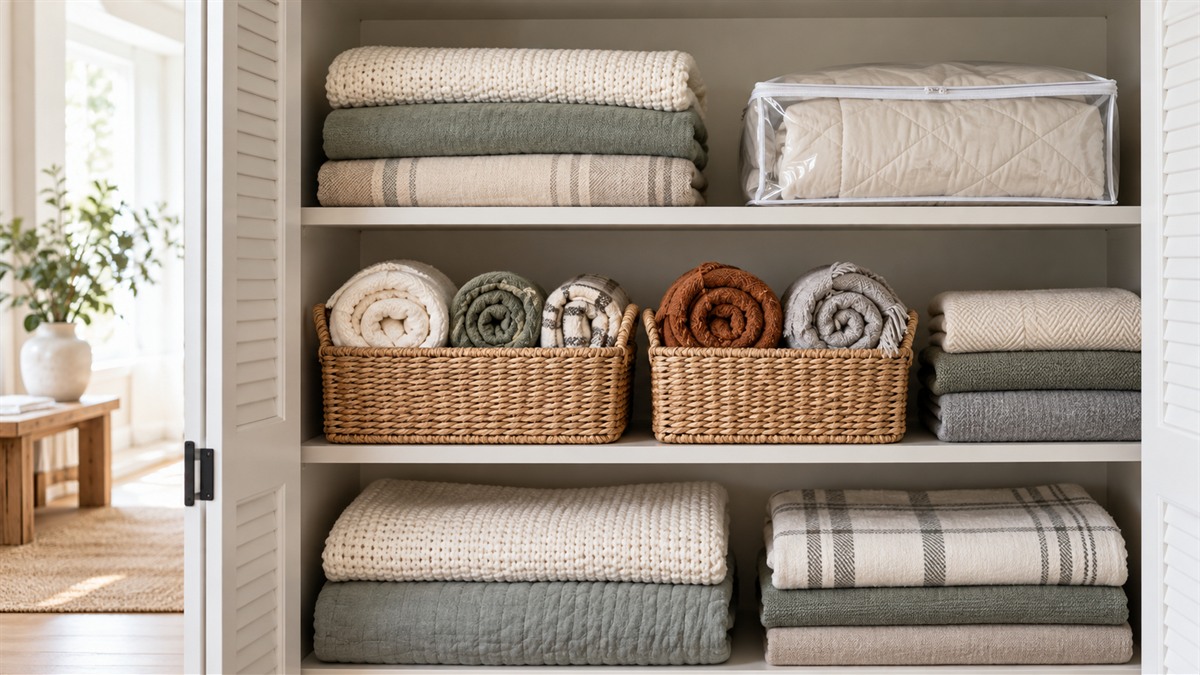
The guide also warns about the shelf and the box. It says ordinary cardboard and wood give off acids that deteriorate and yellow textiles over time. A bare wood shelf or a cardboard box on a shelf can therefore damage a blanket that sits against it. The guide’s answer is to line the shelf or box with archival tissue or washed cotton sheeting or muslin.
Plastic is treated differently. The guide says a container of new plastic can be used for textiles if it is lined, but the sources we opened do not rank plastic against cotton bags for blankets. Choose a breathable, lined choice, and do not seal a damp blanket in a bag. The EPA’s drying rule applies to anything that gets wet, so a blanket must be dry before it goes into any container.
Stacking matters too, because the mildew condition the Missouri guide describes needs a lack of air circulation. A closet packed to the top shelf leaves the air little room to move, so the stacks should be loose enough for air to pass between them. The sources do not give a spacing, so judge it by eye.
Drying a blanket that has been wet
The EPA guide makes the rule on wet items direct. It says: “It is important to dry water-damaged areas and items within 24-48 hours to prevent mold growth.” A blanket that was rained on, soaked in a spill or left damp after washing falls under that rule, so it should be dried before it goes into the closet.
The EPA’s mold guidance starts from one principle that applies to this case. Mold control depends on controlling moisture, so for a closet the blanket should be dry, the air should be dry and the closet should have air moving around the stack.
Pests and cedar
Storage is also about insects. The Missouri guide says the insects that attack textiles are attracted to wool, silk and similar fibers. Its sentence on cedar is clear: “Cedar chests and closets may have almost no value as moth or carpet beetle repellents.” The guide does not recommend a particular pest product. Open the stored blankets from time to time and check the folds, since regular checks are the only protection the sources describe.
A reader who has been using cedar blocks or sachets should therefore not treat them as a full protection plan. The sources do not give a chemical or pest method, so this post does not recommend one.
A practical storage routine
- Wash or air out each blanket, and dry it fully before it goes into storage. The EPA’s 24-to-48-hour rule applies to anything that got wet.
- Choose an interior closet in a room that is heated and in use, not an attic, basement, kitchen, laundry room or unheated space.
- Keep the blankets flat on a lined shelf if the space allows. If folding is needed, cushion the folds with tissue or muslin.
- Leave air gaps between stacks, so air can move through the closet.
- Check the humidity with a hygrometer, and compare it with the 45-to-55 percent textile band and the EPA’s ideal 30-to-50 percent range.
- Open and inspect the stack every few months, and refold the blankets so the creases move.
Mistakes that cause blanket damage
- Storing a damp blanket because it feels dry on the outside.
- Putting blankets on a bare wood shelf or in a cardboard box without a lining, since the Missouri guide names both as sources of acids.
- Sealing a blanket in a plastic bag or box without drying it first.
- Relying on cedar as the only pest defence, since the guide calls its value almost none for moths and beetles.
- Packing the closet so tightly that the air cannot move around the stack.
A closet check you can repeat
The sources describe a few conditions that a closet can be checked against, and a reader can turn them into a short routine that takes a few minutes. Each check below comes from a source named in this post.
- Check the room, not just the closet. The Missouri guide’s rooms to avoid are attics, basements, kitchens, laundry rooms and unheated spaces, so a closet in one of those rooms fails the first check.
- Check the humidity reading against the two bands. The EPA ceiling is 60 percent, and the textile band in the Missouri guide is 45 to 55 percent. A reading inside the textile band also sits below the EPA ceiling, with 60 – 55 = 5 points to spare at the top.
- Check each blanket for dampness. The EPA drying rule is 24 to 48 hours for any item that got wet, so a blanket that was wet on a Monday should be dry by Wednesday before it goes back in.
- Check the shelf. Wood releases acidic oils that can yellow textiles, and the Missouri guide asks for a barrier of cotton sheeting, muslin or acid-free tissue between the wood and the fabric.
- Check the stack. Lack of air circulation is one of the conditions the Missouri guide names alongside warm, moist air, so a stack with air gaps removes one of them.
The routine is only as good as its readings. A cheap hygrometer gives a number, but the sources do not name one or give its accuracy, so compare two readings in different places before trusting either. Record the readings with the date, and keep the record with the closet.
How we chose
We used three sources: the University of Missouri’s “To Protect and Preserve” guide on quilts and textile heirlooms, the same university’s “Caring for Your Treasures” guide, and the EPA’s short guide to mold and moisture. We downloaded each page or PDF, converted it to text and checked every quoted sentence against that text. We did not use any product listing, price or rating. The textile guides are written for heirloom quilts and collections, so we apply their rules to household blankets and say where that reading is a step.
What we could not verify
The sources do not describe the closet itself: its size, whether it has an outside wall, or how much air it gets. They do not give a humidity reading for a specific closet.
The sources do not give a figure for how long a damp blanket takes to dry. The EPA gives 24 to 48 hours for water-damaged items, but that is a drying rule, not a drying time for a blanket.
The sources do not compare pest products, and they do not say how often a stored blanket should be opened or inspected.
FAQ
What is the best way to store blankets in a closet?
Dry them fully, store them flat if you can, and line the shelf. Keep the closet in a heated, lived-in part of the home, and keep the air dry. The sources give humidity targets of 45 to 55 percent for textiles and under 60 percent for the home as a whole.
Can blankets go in a plastic bin?
The Missouri guide says new plastic can be used for textiles if it is lined, and it warns against sealing damp items in plastic. Dry the blanket first, and choose a breathable or lined choice.
Is a cedar closet enough to protect blankets from moths?
No. The Missouri guide says cedar closets and chests may have almost no value as moth or carpet beetle repellents, and it recommends opening and inspecting stored items often.
What humidity should a blanket closet have?
The Missouri textile guide gives 45 to 55 percent relative humidity for heirloom textiles. The EPA gives below 60 percent as the upper limit for indoor humidity, and 30 to 50 percent as the ideal range. Use the lower figure if your blankets are valuable.
What do I do if a blanket gets wet?
The EPA says to dry water-damaged items within 24 to 48 hours to prevent mold growth. Dry the blanket fully before it goes back into the closet.
Bottom line
Store blankets dry, flat if you can, on a lined shelf, in a heated room that stays dry and has air moving around the stack. Keep the humidity under the EPA’s 60 percent limit at the least, and check the blankets from time to time, since the sources do not offer a shortcut for either.
For more on closet space, see the towels in a closet guide and the closet organizing ideas for small spaces guide.
Sources
- University of Missouri, To Protect and Preserve: quilts and textile heirlooms (PDF): the 45-to-55 percent humidity band, the room types to avoid, the folding and tissue advice, the acid note and the cedar point
- University of Missouri, Caring for Your Treasures (PDF): mold and mildew from high relative humidity, and the unfinished attics and basements warning
- U.S. Environmental Protection Agency, A Short Guide to Mold, Moisture and Your Home: the moisture-control principle, the below-60-percent and 30-to-50-percent humidity guidance and the 24-to-48-hour drying rule