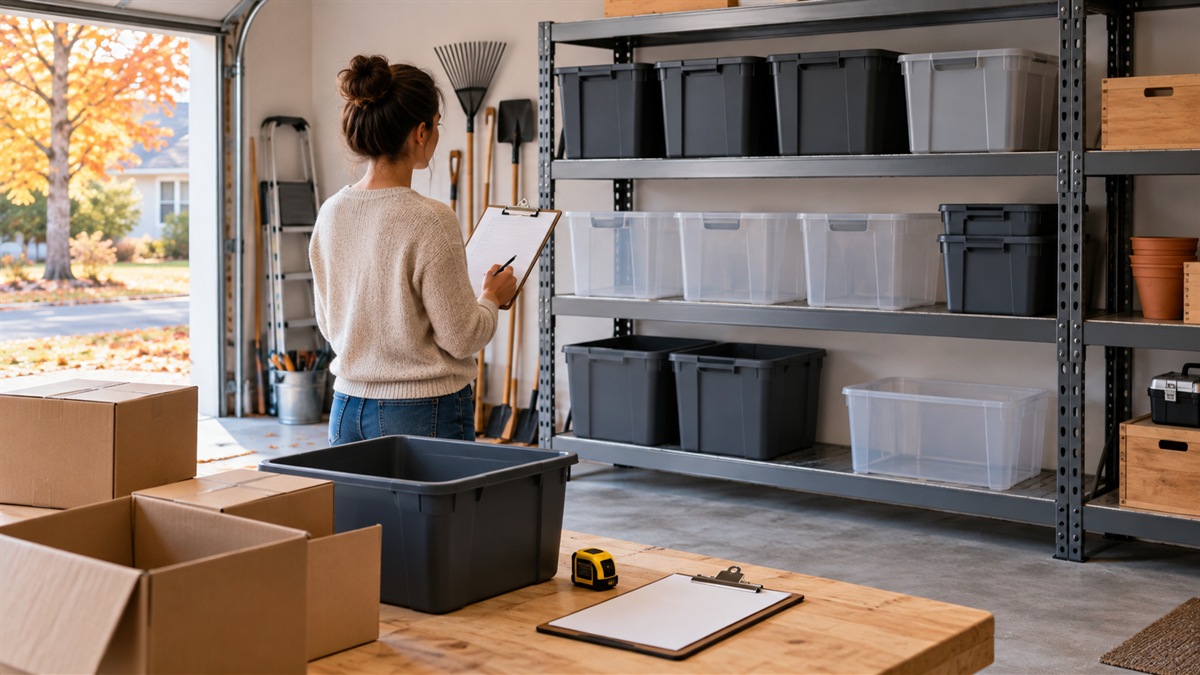
Black Friday Shelving Checklist: 5 Checks Before You Buy
As an Amazon Associate we earn from qualifying purchases.
This black friday shelving checklist is for anyone who plans to buy a shelf, bookcase or storage rack during the Black Friday season. Thanksgiving falls on November 26, 2026, which makes Black Friday November 27. The checks below cover the wall, the weight figures, tip-over hardware, dimensions and assembly. Several of them are questions the listings we read leave unanswered, so finish them before anything goes into your cart.
Quick answer
- Check the wall and the fasteners first. The fasteners you can use depend on whether a stud is there.
- Read every weight figure for what it measures: per shelf or total, with wheels or without, and whether the listing gives one at all.
- For a tall or top-heavy unit, confirm that an anti-tip item is in the parts list, and plan to attach it to the wall.
- Confirm height and depth from the dimension fields, since a title can disagree with them.
Timing: finish the checks before the weekend
Black Friday falls on November 27, 2026, and Cyber Monday falls on November 30. This guide goes live on November 16, which gives you eleven days before Black Friday. That is enough time for the checks, but only if you start them early. Finding studs, measuring a wall and comparing two weight figures takes longer than a single browsing session.
The listing data behind this guide was saved between October 10 and October 13, 2026. Listings change. A dimension can be corrected, a weight figure can be dropped, and an included part can be swapped out. Before you buy, reread the live listing and confirm each figure in this post against it.
Timing also matters for returns. The fields we read for these listings do not include return terms or warranty terms, so the seller’s return window is something you have to read on the live page. If a unit fails your wall check, you need enough days left to send it back, which is one more reason to finish the checks well before November 27.
Run the checks in this order: wall, weight, tip-over hardware, then dimensions and assembly. The wall comes first because the hardware you should use depends on the wall. IKEA’s US wall anchoring guide puts it this way: the hardware depends on both the type of furniture and the wall material.
Check 1: The wall and the fasteners
Start with the wall, because a shelf is only as secure as what it is fixed to. IKEA’s US wall anchoring guide, written for its Hensvik wardrobe, says that the hardware you should use to secure furniture to the wall depends on both the type of furniture you have and your wall material. It then separates walls into cases. For drywall or plaster with a wood stud, it says to drill a pilot hole of 3mm into the stud. For drywall without a stud, it calls for 8mm holes and plastic plugs: drill 5/16-inch (8mm) diameter hole(s) through the wall, then drive the plugs. For masonry, it calls for the same 8mm holes, drilled 2 and 3/4-inches (70mm) deep into the wall.
That guide covers a wardrobe, not a shelf, so draw on it for the wall method only. It does not give a load figure for any plug or screw, and the listings we read do not give one either. Its plug step ends with a warning: Do not over-tighten.
Stud spacing is the other half of the wall check. The FLEXIMOUNTS 1×6 ft wall shelf listing says it is “Suitable for wood stud spacing of 16″, 18″ or 24″.” It adds that the shelves “can only be installed separately for 24″ studs” and that the unit “Can NOT be mounted to metal wall.” If your wall is metal, or your studs sit at some other spacing, that listing does not fit the wall, however good the shelf looks.
The IKEA BILLY bookcase assembly sheet is a clear example of a wall-fixing warning. Its English text reads: “To prevent tip over this furniture must be used with the wall attachment device(s) provided.” The sheet then adds: “Screw(s) and plug(s) for the wall are not included.” and “Use screw(s) and plug(s) suitable for your walls.” That wording shows what a manufacturer warning looks like. It says nothing about any product in the cards below.
End the wall check with a short list: the wall material, where the studs are, the fasteners in the box, and the fasteners you still need to buy. If you are weighing wall shelves against a freestanding unit, see our roundup of floating shelves that can hold weight. For a smaller wall shelf, see our guide to small wall shelves for a living room.
Check 2: Read every weight figure for what it measures
Weight is where the listings we read were least consistent, and where one number can mean three different things. A unit can carry a per-shelf figure, a total figure, or both. Some listings give different figures for the wheels stopped, the wheels moving, or the leveling feet in place. Before you compare two units, write down which number each listing gives and what it measures.
The Amazon Basics 5-shelf wire rack shows the problem. Its bullet gives three per-shelf figures: “weight capacity per shelf: 300 pounds with leveling feet, 132 pounds with wheels not in motion, and 88 pounds with wheels in motion.” It gives matching totals of 1500, 661 and 441 pounds, “based on evenly distributed weight.” Its spec field, labelled “Weight Capacity Maximum”, reads 1250 pounds, which matches none of those totals.
Check the figures with one formula: per-shelf figure times number of shelves should equal the stated total, give or take rounding. Applied to the listings in the cards below, it gives these results.
- Amazon Basics: 300 × 5 = 1,500, which matches the bullet total. 132 × 5 = 660 and 88 × 5 = 440, each within one pound of the bullet totals of 661 and 441.
- VASAGLE: 22 × 6 = 132 pounds, against a spec field value of 154 pounds, a gap of 22 pounds.
- Tujurich: 120 × 5 = 600 pounds, against a spec field value of 750 pounds, a gap of 150 pounds.
- FLEXIMOUNTS: no per-shelf figure, so the formula cannot run. The bullet gives 900 pounds total, and the spec field gives 300 pounds minimum.
- TUTOTAK: no figure of either kind, so there is nothing to check.
Table 1. Figures as each listing states them.
| Listing | Per-shelf figure (as stated) | Total or maximum (as stated) | Shelves (as stated) | Anti-tip or wall item (as stated) |
|---|---|---|---|---|
| Amazon Basics 5-shelf wire rack | 300 lb with leveling feet; 132 lb with wheels not in motion; 88 lb with wheels in motion | 1,500 / 661 / 441 lb (bullet); 1,250 lb (spec field) | 5 | Not stated; parts are casters and leveling feet |
| VASAGLE 6-tier bookcase | 22 lb per tier (bullet) | 154 lb (spec field, “Weight Capacity Maximum”) | 6 | Anti-tip kit included |
| Tujurich 5-tier metal rack | 120 lb per shelf (title) | 750 lb maximum (spec field) | 5 | Wall anchor kit (bullet); parts field lists hardware and rod |
| FLEXIMOUNTS 1×6 ft wall shelf | Not stated | 900 lb total (bullet); 300 lb minimum (spec field) | 2 | Hardware included; studs at 16, 18 or 24 inches |
| TUTOTAK 6-tier bookshelf | Not stated | Not stated | 6 | Anti-tilting tool to install (bullet); not named in parts field |
The VASAGLE bookcase raises a different question. Its bullet says the unit “can support up to 22 lb per tier”, while its spec field reads 154 pounds under “Weight Capacity Maximum”. Six tiers at 22 pounds would be 132 pounds, so the field figure does not follow from the bullet. The listing does not explain the gap. Until the seller does, plan around the lower figure.
Read the field labels too. A label such as “Minimum weight” next to a capacity-sounding number does not tell you whether the number is a limit or a floor. The FLEXIMOUNTS and FOSTOKO spec fields both use “Minimum weight” for figures that read like capacity. Use the bullet text to decide what the figure measures, and if the bullet is silent, ask the seller.
Wheels deserve their own line on the checklist. Health Canada’s advisory says: “Models with legs or wheels are more likely to tip-over.” The Amazon Basics bullet shows the same effect in its numbers, since 300 pounds per shelf with leveling feet falls to 88 pounds with the wheels in motion. For wire shelving in particular, see our ClosetMaid wire shelf weight limit guide. For metal racks, see Best Hyper Tough 5 Shelf Metal Storage Rack Options, and for a second metal rack comparison, see AceMining vs reliahom: Storage Racks Compared.
Check 3: Tip-over and anti-tip hardware
This is the check with the most at stake, and the sources agree on the basic step. The National Safety Council’s Safety + Health article, which reports CPSC guidance and is dated December 6, 2022, says: “The agency recommends anchoring TVs and furniture such as bookcases and dressers securely to a wall.” The same article cites a CPSC report that found “an estimated 472 children were killed in TV and furniture tip-over incidents” between 2000 and 2020.
We could not open the CPSC’s own pages, which returned an error to our requests. The CPSC wording in this post therefore comes through the trade article, and we say so here rather than quote the agency directly.
Health Canada’s archived advisory, dated February 5, 2013, gives plainer steps. It says to “Choose storage furniture, such as bookcases, cabinets, television stands, and dressers, with a wide and stable base that sits directly on the floor.” It also says “Models with legs or wheels are more likely to tip-over,” and that you should “Attach furniture to the wall or dry-wall stud if possible, using the appropriate angle braces, anchors or safety straps.”
Those lines turn into three questions for any listing. First, does the unit sit on a flat base, or on casters or legs? The Amazon Basics rack has casters, and its parts field names casters and leveling feet. Second, does the parts list include an anti-tip item? The VASAGLE bookcase’s list includes an Anti-Tip Kit, and its bullet says “the included anti-tip kit ensures safety.” The Tujurich rack’s bullet mentions an “included wall anchor kit,” but its parts field lists only hardware and a rod, so confirm what is in the box.
Third, does the listing say how to fix the unit to the wall? The TUTOTAK bookshelf’s bullet says “Please remember to install the anti-tilting tool on the wall for better stability.” Its parts field lists only an instruction manual. The listing does not name the tool or say whether it is included, which is the gap to close before you buy.
A tip-over restraint is not a weight figure. A unit can have a strong per-shelf figure and still need a wall fixing, which is why this check sits apart from the weight check above. If you are looking at a tall six-shelf bookcase, our Furinno vs VASAGLE bookcase comparison and our Nathan James Theo 6 shelf bookcase alternatives both cover tall open units.
Check 4: Dimensions from the fields, not the title
Dimensions are another place where titles and fields disagree. The FOSTOKO garage shelving title reads “72″ H”, but its product dimensions field reads “15.8″D x 35.4″W x 31.5″H”. Those numbers cannot both describe the height of the same unit. The listing does not explain which one is right, so measure the space you have and ask before you order.
Tujurich shows a smaller gap. Its title reads “24″ x 12.2″ x 61.1″”, while its item dimension field reads 11.8 x 24 x 61 inches. The depth differs by 0.4 inch. That is small, but it is a reason to record one number per dimension and note where it came from.
Depth decides what fits on each shelf, so compare the depth figures first. The listed depths in this guide are 9.4 inches for the VASAGLE bookcase, 14.02 inches for the Amazon Basics rack, 12 inches for the FLEXIMOUNTS wall shelf and 10.7 inches for the TUTOTAK bookshelf. Put those numbers next to the depth of what you plan to store, and leave room to reach each item.
Adjustable tiers need the same care. The VASAGLE listing says its tiers are “adjustable to 3 heights (up or down 1.2″)”. That describes a small up-or-down movement. It does not list the three heights, so measure the tallest item you plan to store before you assume it will fit.
Shelf clearance is stated in only one listing here. The Tujurich bullet gives it: 13 inches of clearance on the upper shelves, and an extra-tall 17.7-inch bottom shelf. For the rest, the listing gives overall dimensions only, so ask the seller for the clearance you need.
Check 5: Assembly, tools and the parts list
Assembly claims are easy to read and hard to verify before the unit arrives. Start with the parts list. The Amazon Basics bullet says “Assembles quickly and easily; no tools needed”, and its parts field names only casters and leveling feet. Read those as two separate facts: the listing says no tools are needed, and the box includes casters and leveling feet.
Other listings describe their tools differently. The Tujurich bullet says the rack includes “all required assembly tools”. The TUTOTAK bookshelf says “no other special tools are required”. The FOSTOKO garage shelving bullet says the unit comes “with a pair of gloves and a small hammer”, which is a more specific parts claim than most of the others make.
Wall-mounted units need a different check. The FLEXIMOUNTS bullet describes “Easy one-person installation with all hardware included”, and the listing names an installation template and a bubble level. Those are the seller’s claims, and the listing gives no installation time.
Hardware in the box is the question that matters most for a wall unit. The BILLY sheet is clear that wall screws and plugs are not supplied with that bookcase. The same logic applies to any wall unit: a fixing kit in the box is one thing, and the fasteners for your wall type are another. Count both before you order. If you are deciding between two standing shelf units, our Amazon Basics vs Plano standing shelf units comparison is a place to start.
Mistakes to avoid
- Trusting the title for size. The FOSTOKO title reads 72 inches tall, while its product dimensions field gives 31.5 inches for the third number. Check the field, then ask.
- Adding a per-shelf figure to get a total without checking. The Tujurich rack’s 120 pounds per shelf times five shelves is 600 pounds, not the 750 pounds in its spec field. Do the arithmetic, then ask which figure applies.
- Counting casters as anchoring. Health Canada says models with legs or wheels are more likely to tip over, and the Amazon Basics per-shelf figure falls to 88 pounds with the wheels in motion.
- Assuming wall hardware is in the box. The BILLY sheet says screws and plugs for the wall are not included. Check the parts list for each unit.
- Ignoring the wall material. The FLEXIMOUNTS listing says it cannot be mounted to a metal wall, and it names stud spacings of 16, 18 or 24 inches.
- Filling a gap with another listing’s number. The TUTOTAK listing states no weight figure. Do not borrow one from a different unit.
How we chose
The units in this guide come from listing data saved for this site between October 10 and October 13, 2026, across ten research pages. Seven of those pages, on shelf weight, wall fixings and metal racks, hold 65 entries covering 63 different products, since a few products appear on more than one page. We did not rank them.
We kept entries that were shelving units and that state at least one dimension, weight figure or parts detail. We left out entries that were not shelving, such as a bamboo spice rack and a shower caddy. From what remained, we picked five listings that each show a different check: a wire rack with casters, a tall bookcase with an anti-tip kit, a tall metal rack, a wall shelf, and an open bookshelf with no weight figure.
The five cards are not a ranking. Each one is there to show a different check. They do not cover every shelf type, and the list is a snapshot, not a guide to what is in stock.
What we could not verify
- The CPSC’s own pages could not be opened from our requests. Their guidance here comes through a National Safety Council article dated December 6, 2022.
- The Health Canada advisory is archived and dated February 5, 2013. It is useful for the basic steps, but it is not a current consumer page.
- The IKEA guides cover a wardrobe and a bookcase, and the Hensvik PDF’s metadata dates it to March 2017. We draw on them for wall methods and warning wording only, not to describe any product in the cards.
- The sources we opened do not give load figures for plugs or screws in drywall or masonry, so this post cannot say how much a given fixing holds in your wall.
- The listing data does not state return terms, warranty terms or assembly time for these units.
- Listing data is a snapshot from October 10 to 13, 2026. Dimensions, weight figures and parts can change before November 16 or later.
Five listings to check against this list
Each card uses the listing data we saved, and each one shows one check from the list above.
Amazon Basics 5-Shelf Adjustable Wire Shelving Unit, Chrome
Listing details: Five shelves, 14.02 inches deep, 30 inches wide and 64.76 inches tall. Alloy steel with a chrome finish, with casters and leveling feet included. The listing says it needs no tools to assemble.
Good for: a movable wire rack in a garage, laundry room or kitchen, which are the uses the listing names.
Skip if: you need the unit fixed to a wall, since its included parts are casters and leveling feet only.
Limitation: the per-shelf figure falls to 88 pounds when the wheels are in motion.
VASAGLE 6-Tier Open Bookcase, Cloud White
Listing details: Six tiers, 9.4 inches deep, 23.6 inches wide and 63.3 inches tall. The bullet describes particleboard and MDF, and the parts list includes an accessory kit and an Anti-Tip Kit. Item weight is 45.1 pounds.
Good for: a tall open bookcase where you want the anti-tip hardware in the same box.
Skip if: you plan to load heavy books on every tier, since 22 pounds per tier is the lower of the two figures.
Limitation: the bullet says 22 pounds per tier and the spec field says 154 pounds maximum, and the listing does not explain the difference.
Tujurich 5-Tier Metal Shelving Unit, Black
Listing details: Five shelves, 11.8 inches deep, 24 inches wide and 61 inches tall. Iron and metal, with four adjustable leveling feet. The bullet says the box includes all required assembly tools and a wall anchor kit.
Good for: a garage or pantry rack where leveling feet and in-box tools matter most.
Skip if: you need the anti-tip hardware confirmed by the parts list, because that list names only hardware and a rod.
Limitation: 120 pounds per shelf across five shelves is 600 pounds, while the spec field reads 750 pounds maximum.
FLEXIMOUNTS 1×6 Ft Wall Shelf, 2-Pack, Black
Listing details: Two shelves, 12 inches deep, 72 inches wide and 6.1 inches tall, weighing 26.4 pounds. Heavy gauge steel, with hardware, an installation template and a bubble level included. The listing says the shelves can only be installed separately on 24-inch studs.
Good for: a long garage or pantry wall shelf on wood studs at 16, 18 or 24 inches.
Skip if: the wall is metal, since the listing says the unit cannot be mounted to a metal wall.
Limitation: the listing gives 900 pounds total in a bullet and 300 pounds minimum in its spec field, with no per-shelf figure to check against.
TUTOTAK 6-Tier Tall Narrow Bookshelf
Listing details: Six shelves, 10.7 inches deep, 14.5 inches wide and 65.3 inches tall, in engineered wood, weighing 17.4 pounds. Freestanding, with four adjustable feet. The bullet calls it compact and lightweight.
Good for: books, crafts and photo albums on a tall, narrow open shelf, the uses the bullet names.
Skip if: you need a stated weight figure before you load the shelves, since the listing gives none.
Limitation: the bullet says to install an anti-tilting tool on the wall, and the parts field names only an instruction manual.
Bottom line
Do not order a unit until you can name the weight figure it states, what that figure measures, and the item that fixes it to your wall. If the listing leaves any of those out, ask the seller or manufacturer rather than filling the gap with a guess.
FAQ
Do I need to anchor a short bookcase?
The sources we opened do not set a height cutoff. The CPSC guidance, as reported by the National Safety Council, recommends anchoring bookcases and dressers to a wall, and Health Canada says to attach furniture to the wall or a drywall stud “if possible”. If the box has no anti-tip item, the sources do not say the unit is safe without one.
Does a minimum weight figure tell me the shelf capacity?
Not on its own. The FLEXIMOUNTS and FOSTOKO spec fields both use the label “Minimum weight” for numbers that could be read as capacity. Read the bullet to see what the figure measures, check whether it is per shelf or total, and ask the seller if the listing does not say.
Can I mount a wall shelf on drywall without finding a stud?
The IKEA Hensvik guide describes a drywall method without a stud: drill 8mm holes, drive plastic plugs, then tighten the screws into them. The guide is for a wardrobe, and it gives no load figure. It also warns: “Do not over-tighten.” The FLEXIMOUNTS listing names wood stud spacings of 16, 18 or 24 inches and does not describe a no-stud install.
Do casters count as anchoring?
No source we opened treats casters as a restraint. Health Canada says models with legs or wheels are more likely to tip over. The Amazon Basics bullet shows its per-shelf figure falling to 88 pounds with the wheels in motion, and its parts field lists casters and leveling feet only.
What should I do if the listing gives no weight figure?
Ask the seller or the manufacturer for the stated figure, what it measures, and whether it assumes a wall fixing, and get the answer in writing before you buy. The TUTOTAK listing states no weight figure, and its bullet asks you to install an anti-tilting tool on the wall. Do not fill the gap with a number from another listing.
Does the Black Friday date change the checks?
No. The checks are the same on any day. The date changes when you need to finish them: Black Friday falls on November 27, 2026, and the seller’s return terms, which the listing data here does not include, decide how long you have to send a unit back. This guide goes live on November 16, so start there.
Disclosure: the Amazon links in this post are affiliate links. We earn from qualifying purchases.
Sources
- Health Canada, “Health Canada reminds Canadians of the dangers related to furniture tip-overs” (archived advisory, dated February 5, 2013). https://recalls-rappels.canada.ca/en/alert-recall/health-canada-reminds-canadians-dangers-related-furniture-tip-overs (opened October 20, 2026)
- National Safety Council, Safety + Health, “CPSC to shoppers: Anchoring new TVs and furniture can save lives” (dated December 6, 2022). https://safetyandhealthmagazine.com/articles/23324-cpsc-to-shoppers-anchoring-new-tvs-and-furniture-can-save-a-life (opened October 20, 2026)
- IKEA US, BILLY bookcase assembly instructions (PDF). https://www.ikea.com/us/en/assembly_instructions/billy-bookcase-white__AA-2289108-3-100.pdf (opened October 20, 2026)
- IKEA US, Hensvik wall anchoring guide (PDF). https://www.ikea.com/us/en/manuals/hensvik-wardrobe__AA-2015724-2_pub.pdf (opened October 20, 2026)