Best Under Cabinet Mounted Spice Rack: How to Choose
As an Amazon Associate we earn from qualifying purchases. Details
An under cabinet mounted spice rack moves jars off the countertop and into space you already own. The phrase covers more than one product, so shoppers often compare racks that mount in completely different ways. This guide sorts those styles, explains which listing details decide fit, and walks through measuring your cabinet before you order. Read the mounting method first, because it decides which measurements matter most. Most mistakes happen when a shopper compares the wrong numbers. Then compare the listing figures with the cabinet you actually have.
Quick answer
Choose an in-cabinet pull-out if you want to reach spices inside a base cabinet. Choose a rack fixed under an upper cabinet only if the listing states that mounting method and you can fasten it to a stud or a rated anchor. Magnetic racks are a different product. They hold to steel surfaces such as a refrigerator side, so they do not solve an under-cabinet storage problem. Only one rack in this comparison is a cabinet-mounted spice organizer, and it is the SpaceAid pull-out below. Its listing states “In Cabinet” mounting, a 7.6-inch width and a 10.6-inch depth, but it also conflicts on tier count. Measure before you buy.
Three products sit under one search phrase
The phrase is used for three different product types. Start by sorting them by how they attach.
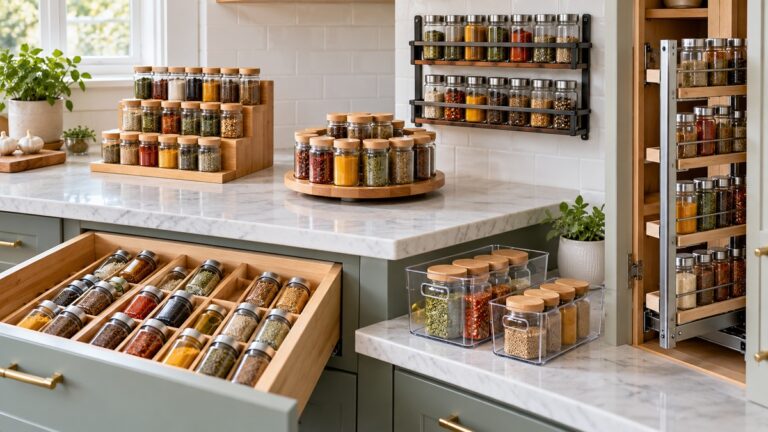
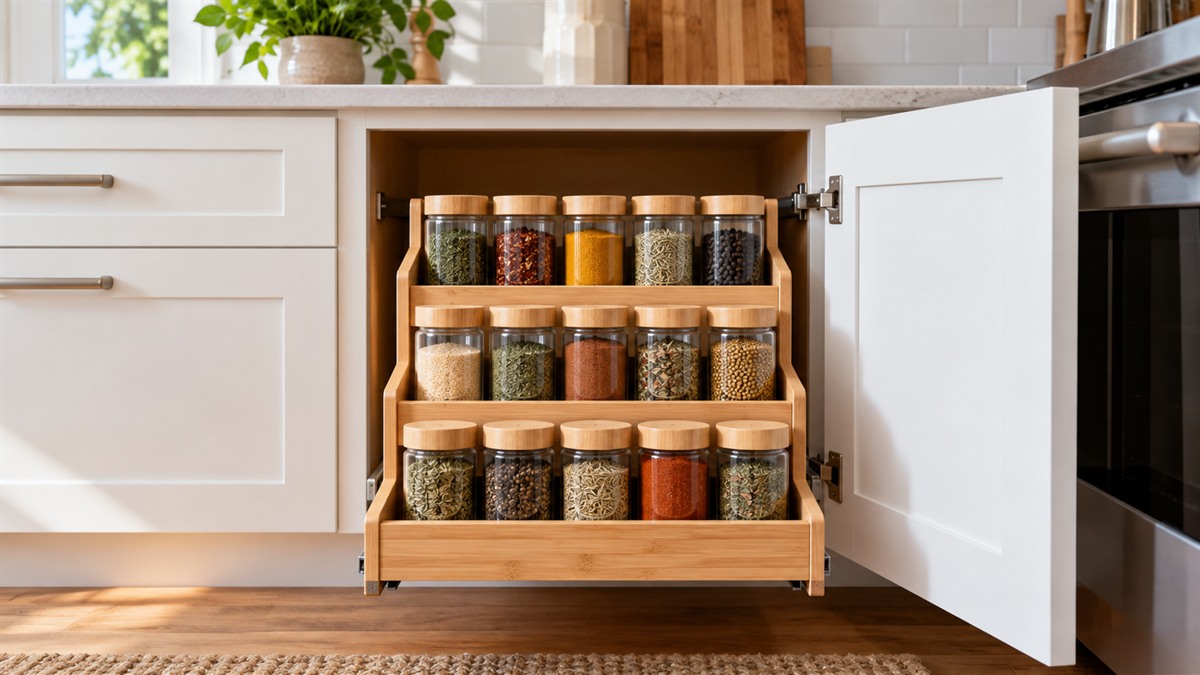
An in-cabinet pull-out sits inside a base cabinet. It slides out on rails so you can see every jar at once. A pull-out rack works much like a drawer. A drawer is a box-shaped container inside a piece of furniture that can be pulled out horizontally to access its contents. Because the rack lives inside the cabinet, the interior dimensions matter more than the wall behind it.
A rack fixed under an upper cabinet is a different job. The countertop sits below it. A countertop is usually installed upon and supported by cabinets, at a working height. A fixed rack carries its load through its fasteners, so the wall behind it matters. Drywall is a panel with paper facers, and it is common in interior walls. That means you need to know what is behind the surface before you drill.
Magnetic racks stick to steel. Their listings describe refrigerator sides, washing machines and other iron surfaces. That is a different job from a cabinet-mounted rack. A magnetic rack can be useful, but it does not answer the question of how to store spices under an upper cabinet. If you want a hanging option instead, see hanging seasoning racks.
Reading the listing before you buy
Listings for these racks repeat dimensions in several places. Compare them before you trust any single number.
The mounting field tells you the basic type. The SpaceAid lists “In Cabinet” in its mounting field and “Sliding Shelf” in its shelf type. If the field says magnetic or wall mount, the rack belongs to another group in this guide.
The product dimensions field and the overall size bullet should match. For the SpaceAid, the field gives 10.6 inches deep, 7.6 inches wide and 9.6 inches high, and the bullet repeats the same overall size. Those are the outside measurements of the rack, not the space you need inside your cabinet.
The recommended cabinet size is a separate figure. The first bullet says the SpaceAid is recommended for cabinets that are 12 inches tall and 10.60 inches deep. Read that as the maker’s recommendation. It does not guarantee a fit in your cabinet, especially if your cabinet has a face frame, a fixed divider or a shallow back panel.
Shelf count is where the SpaceAid listing conflicts with itself. One bullet describes a 2-Tier version, while the specification field lists 3 shelves. The listing does not settle which is correct, so rely on neither number until you check the product page or the manual.
Weight is also unclear. The SpaceAid listing does not state a shelf weight capacity. Do not load it with heavy glass jars until you have confirmed a limit with the maker.
Material and finish come from the listing. The SpaceAid listing states bamboo and a natural color. It does not list a finish type, so ask the seller or check the product page if the finish matters to you.
Assembly is required. The listing says the rack goes together at home, and it states that the package includes the hardware and a screwdriver. Whether you need any other tool depends on your cabinet, and the listing does not say.
The bottom panel is described as clearing a cabinet lip. That is useful if your cabinet has a lip at the front, but you still need to measure that lip yourself.
One bullet mentions kitchen upper cabinets, while the mounting field says In Cabinet. The listing does not say whether the rack is meant for the inside of an upper cabinet or a base cabinet. If your target cabinet is an upper one, check that point with the seller before you order.
Measuring your cabinet
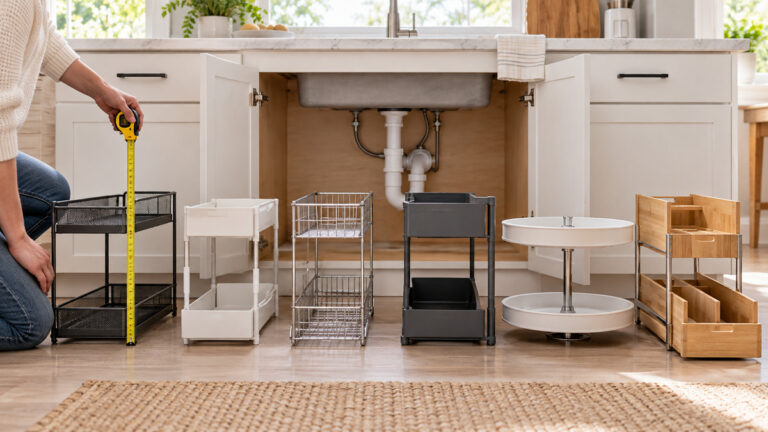
Measure the interior, not the door opening. Take three readings for each dimension: at the front, at the middle and at the back. Cabinets are not always square, and a rack that fits at the front can bind at the back.
Measure the height from the bottom of the cabinet to the underside of the shelf above, if there is one. Check whether a fixed shelf, a drawer front or a hinge blocks the path the rack needs when it slides out.
Measure the depth from the inside of the door to the back panel. Compare that figure with the recommended depth in the listing, and leave room for the door to close.
Note the lip. If the cabinet floor has a raised edge, the rack’s bottom panel needs to clear it. The listing says the SpaceAid is designed to do this, but only your cabinet can confirm it.
Check for pipes, wiring or a sink trap if you are looking at a base cabinet near the sink. Those parts can stop a pull-out from opening fully, and no spice listing can tell you about them.
Write the figures down before you compare racks. Put them next to the listing numbers, not next to your memory of the store shelf.
How to choose
Choose an in-cabinet pull-out if:
- your base cabinet has open space and a front opening you can use
- you want to see every jar when the door opens
- your measured interior matches the listing’s recommendation or leaves room to spare
Choose a rack fixed under an upper cabinet if:
- the listing describes a fixed mount, not a pull-out or a magnet
- you can locate studs or install rated anchors
- you can read the maker’s hardware notes before you drill
Choose a magnetic rack if:
- you have an iron or steel surface you are willing to use
- the items you store are light
- you check the load figure on that product’s listing before loading it
You may not need this type of rack at all if your cabinet is shallower than the recommendation and nothing else on your shelves needs to move out. In that case, a countertop organizer or a plain shelf may serve you better. If you want other layouts for the same kitchen space, compare pull-out spice shelves and sliding spice cabinets before you decide.
1. SpaceAid Bamboo Pull Out Spice Rack Organizer for Cabinet, Heavy Duty Slide Out Seasoning Kitchen (In-cabinet pull-out)
Specs from the listing (checked 2026-10-11):
- Mounting Type: In Cabinet
- Product Dimensions: 10.6″D x 7.6″W x 9.6″H
- Material: Bamboo
- Number of Shelves: 3
- Item Weight: 2.96 kg
Pros
- The listing states bamboo material and a natural color, with a sliding shelf type
- Smooth ball bearing glides and full extension rails let the shelves come out far enough to reach the back
- The listing states the bottom panel clears any cabinet lip, which helps with a front lip
- The listing says the hardware and a screwdriver are included in the package
Cons
- The listing gives two shelf counts: a 2-Tier bullet and 3 shelves in the specifications
- The listing does not state a shelf weight capacity, so heavy jars need a check with the maker
- One bullet mentions kitchen upper cabinets while the mounting field says In Cabinet
- The recommended cabinet size of 12 inches tall and 10.60 inches deep is a recommendation, not a guarantee of fit
Best for: A reader with an open base cabinet who wants to pull spices out rather than reach over them.
Skip if: Skip it if you need a rack fixed under an upper cabinet, or if your measured cabinet is shorter or shallower than the recommended size.
View on Amazon (affiliate link)
What to verify before ordering the SpaceAid
The SpaceAid is the only cabinet-mounted option in this comparison. It is a bamboo, natural-color rack that the listing describes as a sliding organizer for kitchen cabinets. The bullets say the rails use smooth ball bearing glides and full extension, so the shelves come out far enough to reach the back of the cabinet. That matters if you keep spices toward the rear of a deep cabinet.
Buy it if your goal is a base cabinet with open space, and your own measurements fit the recommendation. It suits a reader who wants to pull spices out rather than reach over them.
Skip it if you need a rack fixed under an upper cabinet. The mounting field says In Cabinet, and the bullet about upper cabinets does not change that field. Skip it also if your cabinet is shallower or shorter than the recommended size, because the listing does not describe a smaller version.
Before you order, confirm three things with the listing: the shelf count, the weight limit and the cabinet type it was designed for. The listing leaves all three open.
A narrow base cabinet
Take a base cabinet that is 18 inches wide inside. The SpaceAid listing states a width of 7.6 inches.
Step 1: 18 – 7.6 = 10.4 inches of width is left over.
Step 2: if you split that leftover space evenly between the two sides, each side gets 10.4 ÷ 2 = 5.2 inches.
Check: 5.2 + 5.2 = 10.4, so the split adds back to the leftover width.
Real cabinets rarely give you an even split. Hinges, side panels and a fixed divider take space too. Measure your own interior, then repeat the same subtraction with your figures.
Mistakes to avoid
Measuring only the door opening is the most common error. The opening is smaller than the interior in many cabinets, and the rack has to pass through it.
Treating the recommended cabinet size as a guarantee is the second error. A recommendation tells you what the maker expects. Your cabinet may differ.
Trusting one shelf count when two fields disagree is the third error. The SpaceAid listing gives two counts. Check before you order.
Loading heavy jars without a stated limit is the fourth error. The SpaceAid listing does not state a weight capacity.
Buying a magnetic rack for a cabinet with no steel surface is the fifth error. Magnetic racks need an iron or steel surface, as their listings state.
Ignoring obstacles such as a fixed divider, a hinge or a pipe is the last error. Each one can block the path of a pull-out, and each one is easy to see before you buy.
FAQ
Is an under cabinet mounted spice rack the same as a pull-out?
Not always. A pull-out sits inside a base cabinet and slides out. A rack mounted under an upper cabinet is fixed, and it depends on its fasteners and the wall behind it. Check the mounting field before you compare sizes.
Does the SpaceAid fit a cabinet that is 12 inches tall and 10.60 inches deep?
The listing recommends that size. Measure your own interior at the front, middle and back. If your cabinet is smaller in either direction, the recommendation does not apply to your kitchen.
How much weight can the SpaceAid hold?
The listing does not state a shelf weight capacity for it. Ask the seller or check the maker’s manual before you store heavy glass jars or large containers.
Can I mount a rack under an upper cabinet without finding studs?
Look for studs first, using a stud finder. Stud finders locate framing behind walls. Magnetic models detect the metal fasteners that hold wallboard to studs, and electronic models sense changes in wall density. If studs are not where you need them, use rated anchors, and follow the maker’s mounting instructions. Do not assume a generic anchor will hold a set load.
Are magnetic spice racks useful under a cabinet?
Only if the cabinet has a steel or iron surface that the rack can grip. The listings for magnetic racks describe refrigerator sides, washers and other metal surfaces. A wooden cabinet is not that kind of surface.
Why do the listing numbers disagree?
Listings are written by sellers, and they sometimes repeat or label the same figure in different ways. The SpaceAid gives two tier counts. Rely on the measurement you take yourself, and check the product page or manual for the rest.
Do I need tools to install the SpaceAid?
The listing says the rack is easy to assemble, and it includes the hardware and a screwdriver. Whether you need more tools depends on how you fasten it in your cabinet. The listing does not describe the installation step in detail, so read the manual before you start.
Bottom line
If your spices sit in a base cabinet and your measured interior matches the listing, choose the in-cabinet pull-out. If you need a fixed rack under an upper cabinet, shop only among fixed mounts and confirm the wall type before you drill. If your only steel surface is a refrigerator side, choose a magnetic rack and skip the cabinet altogether. Measure first, and check the shelf count and weight limit on the listing before you buy.
Sources
- Stud finder (Wikipedia): explains that stud finders locate framing behind walls and how magnetic and electronic models differ.
- Drawer (Wikipedia): defines a box-shaped container that pulls out horizontally, used to describe a pull-out rack.
- Countertop (Wikipedia): explains that countertops are usually installed upon and supported by cabinets.