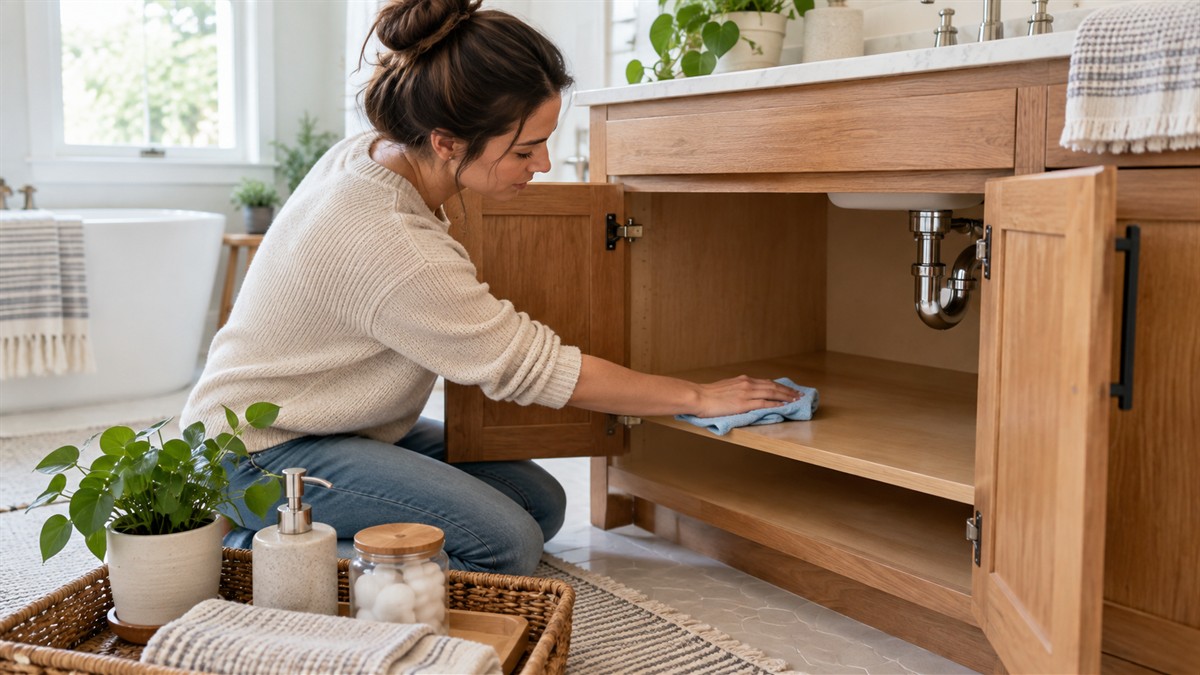
How to Clean Bathroom Cabinets
As an Amazon Associate we earn from qualifying purchases.
How to clean bathroom cabinets comes down to three habits: wipe with a soft, damp cloth and mild soap, rinse, and dry every surface at once. Two furniture makers whose manuals we opened rule out bleach, ammonia and abrasive cleaners, and a third advises avoiding chemicals, household cleaners and abrasives that may damage the finish. Under the sink, the EPA says to fix plumbing leaks promptly and to scrub mold off hard surfaces with detergent and water. This guide sets out the steps, a mold-area calculation and a short routine.
Quick answer
- Read the care section for your cabinet first. The manuals we opened differ in how strict they are, and the maker of your cabinet decides what is safe for its finish.
- The common method is a soft, damp cloth with mild soap or detergent, a rinse with clean water, and a dry cloth.
- Skip bleach, ammonia, alcohol and abrasives on finished surfaces unless your cabinet’s manual allows them.
- Ventilate the room, wear gloves, and never mix cleaning products.
- Look inside the base cabinet for leaks and mold. Scrub mold off hard surfaces with detergent and water, and dry completely.
- Put cleaners back in a place with a child-resistant latch, not in an unlocked low cabinet.
Start with the maker’s care instructions
Bathroom cabinets are made of wood, laminate, foil-wrapped board and stone tops, and the cleaning rules differ. The table sets out what four care sections say. Three are vanity manuals hosted by Lowe’s, and one is an IKEA assembly manual. The IKEA buying guide for the same series gives a matching instruction: wipe the furniture with a cloth damp with water or non-abrasive detergent, then wipe dry with a clean cloth.
| Document | Everyday cleaning | Ruled out or limited | Drying and moisture |
|---|---|---|---|
| IKEA GODMORGON washstand manual | Soft, damp cloth and a little mild detergent if necessary | Ammonia, alcohol, bleach, abrasives | Rinse with clean water, then dry with a clean, dry cloth. Dry splashes quickly. Do not leave in pools of water. |
| Teamson vanity use and care manual | Soft, damp cloth, mild soap and water | Bleach, ammonia, abrasive cleaners | Wipe surfaces dry to prevent water spots, warping or swelling |
| Windwood 42 inch vanity manual | Dust with a soft, dry cloth; mild non-abrasive soap and water for the stone top | All chemicals, household cleaners and abrasives that may damage the finish | Do not let liquid sit on stone overnight; blot oil and acid spills |
| Unbranded vanity instruction manual (the pages we opened show no maker) | Soft, damp cloth, then some cleaner, then dry at once with another cloth | Nylon brush, toilet cleaner, hydrochloric acid cleaner | Dry the cabinet immediately when it meets water |
Counting the four documents gives a simple tally. Three of the four rule out abrasives in some form, two rule out bleach, two rule out ammonia, and three say to dry the surface after cleaning or after water contact. The Windwood text names no product to avoid. It asks only that you avoid whatever may damage the finish, and it tells you to wipe up spills rather than leave liquid standing. When documents disagree, follow the one that came with your cabinet.
Step 1: Empty the cabinet and ventilate the room
Remove everything from the cabinet and set it aside. Then open the window or run the exhaust fan before you pick up a cleaner. Poison Control advises ventilating the work area well, especially small spaces such as bathrooms, by opening a window or door and running an exhaust fan. The NMSU Cooperative Extension guide to home cleaning products gives the same instruction for bathrooms.
Protect your hands and eyes. Virginia Cooperative Extension advises wearing disposable gloves and glasses when you use household chemical solutions, and discarding the gloves when you finish. The EPA says ordinary household rubber gloves may be used when you work with water and a mild detergent, and it names natural rubber, neoprene, nitrile, polyurethane or PVC gloves for disinfectants, bleach or strong cleaning solutions.
Step 2: Dust, then wipe with soap and water
Dust first. Teamson’s manual says to dust weekly with a microfiber cloth for laminate and wood finishes, and Windwood’s says to dust regularly with a soft, dry cloth. Then follow the order that Virginia Cooperative Extension gives for household surfaces: wash with water and a soap or detergent solution, then rinse thoroughly with clean water.
For finished wood, a University Apartments move-out guide hosted on housing.wisc.edu tells residents to clean kitchen wood cabinets with mild dish soap or a soap made for wood. That guide is written for apartment turnover and not for a particular finish, so it supports the soap-and-water method without settling which soap is best. For a stone top, follow the maker: Windwood’s manual says to clean stone with a mild non-abrasive soap and water, and to rinse the vanity top with clean, hot water frequently.
Step 3: Rinse and dry every surface
Drying is the step that three of the four manuals share, and it matters because the cabinet sits in a damp room. IKEA’s manual says that its furnishings are made of moisture-resistant materials but should not be left to stand in pools of water or exposed to extremely high humidity, and that splashes should be dried as quickly as possible to stop moisture from penetrating the surface. Teamson warns that surfaces left damp can show water spots, warping or swelling over time. The unbranded manual says to keep the cabinet away from water, which will cause deformation and damage.
Use a second, dry cloth for the final pass, as the unbranded manual describes. Our suggestion is to leave the doors and drawers open for a while so the inside dries too. The EPA’s guidance on mold has the same core rule for any item that gets wet: dry it completely. It adds that it is important to dry water-damaged areas and items within 24 to 48 hours to prevent mold growth.
Step 4: Check the base cabinet for leaks and mold
The cabinet under the sink is where a slow leak hides. The unbranded manual says that the water supply pipes, the drainage pipes and the connection parts are prone to water leakage and should be checked regularly. Teamson’s text says to make sure plumbing connections are sealed properly to avoid leaks that could damage the vanity base. The EPA’s rule is blunt: fix plumbing leaks and other water problems as soon as possible, because cleaning mold without fixing the water problem means the mold will most likely come back.
If you find mold, the EPA says that in most cases you can handle a patch smaller than about 10 square feet yourself, and that larger areas call for its separate remediation guidance. For hard surfaces, the EPA says to scrub mold off with detergent and water and dry completely. It says that absorbent or porous materials may have to be thrown away if they become moldy, because mold can fill the crevices and be difficult or impossible to remove. The EPA does not recommend chlorine bleach as a routine practice during mold cleanup.
The table turns the 10 square foot figure into cabinet terms. It uses the Luxxe Cabinetry specification guide hosted by Lowe’s, which lists a standard vanity base cabinet as 21 inches deep and 34½ inches high. Those are outside dimensions, so the real interior panels are somewhat smaller and the areas are upper bounds. The formula is: area in square feet = width × height (or width × depth) in inches ÷ 144. The 24 inch width is our assumption for a two-door base, one of the widths in the same guide.
| Surface of a 24 inch wide base cabinet | Size in inches | Area in square feet | Share of the EPA’s 10 square foot figure |
|---|---|---|---|
| One side panel | 21 × 34.5 = 724.5 | 724.5 ÷ 144 = 5.03 | 50.3 percent |
| Back panel | 24 × 34.5 = 828 | 828 ÷ 144 = 5.75 | 57.5 percent |
| Cabinet floor | 24 × 21 = 504 | 504 ÷ 144 = 3.50 | 35.0 percent |
Read the table as a warning about scale. A single side panel plus the back panel adds up to 10.78 square feet, which is already past the EPA’s figure. Mold that looks small on the floor of the cabinet can still be part of a larger patch that continues up the walls, so measure the actual patch before you decide who should clean it. If you have health concerns, the EPA says to consult a health professional before starting cleanup.
Step 5: Handle soap scum, stains and hardware
Soap scum and hard water marks tempt people to reach for stronger products. Check the cabinet’s manual first. The IKEA manual rules out abrasives, and the NMSU guide says that all abrasives can leave scratch marks on some surfaces, so it advises checking the manufacturer’s directions before using one on any surface. NMSU does say that mild abrasives suit surfaces such as laminate, countertops, tile and sinks, and that coarse abrasives damage many surfaces. The unbranded manual adds that acid and alkaline solutions poured into the basin can cause discoloration, leaks or damage.
Vinegar sits in a gray area. The NMSU guide describes acetic acid as a natural all-purpose cleaning agent that is best for surfaces that can tolerate a strong, acidic product, and it notes that vinegar removes hard water deposits from glassware and rust stains from sinks. None of the cabinet manuals we opened mention vinegar, so for a finished cabinet the safest reading is to follow the maker’s list and skip it unless the manual allows it.
Hardware needs its own pass. Teamson’s manual says to keep drawer tracks clean and free of debris, to apply a small amount of silicone-based lubricant if movement becomes stiff, and to check and tighten handles regularly. Virginia Cooperative Extension lists handles on sinks, cabinets and drawers among hard, non-porous surfaces suited to sanitizer or disinfectant, with the caveat that the product label decides where it can be used. If you disinfect handles, read the label for contact time and keep the solution off finishes that the cabinet’s maker restricts.
Never mix cleaners
Poison Control says that mixing household cleaning products can result in poisonous fumes and serious breathing problems. The NMSU guide is more specific: never mix a toilet bowl cleaner with any other household or cleaning product, and never mix ammonia with chlorine or bleach products, because this can release a highly toxic gas. Virginia Cooperative Extension makes the same point about bleach and ammonia and says they do not make each other stronger. Because the cabinet manuals above also rule out bleach and ammonia on finishes, a single mild soap solution is the simplest choice, and there is nothing to mix.
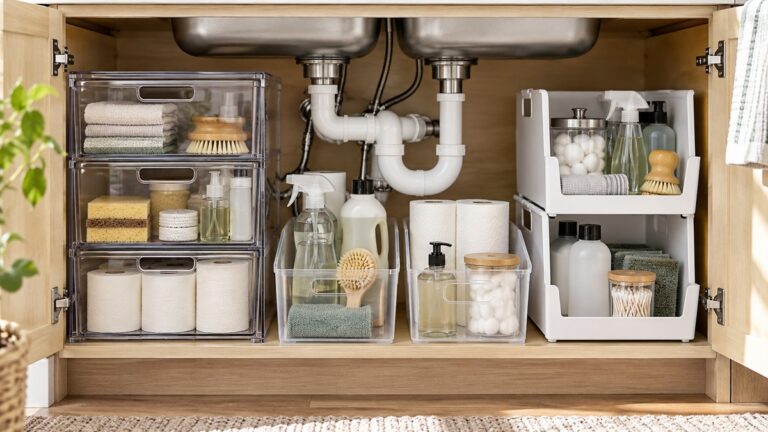
When you finish, return cleaners to a safe place. Poison Control says that one of the most dangerous places to store cleaners is an unlocked, low kitchen or bathroom cabinet. NMSU calls an unlocked cabinet under the kitchen sink the worst place to store household cleaners and advises safety latches if that is the only storage you have. For ideas on storage that keeps products organized, see our guide to a cleaning supplies organizer for under the sink our roundup of sink cabinet organizers and our guide to under-vanity organizers.
A simple routine (our suggestion)
The pages we opened set no cleaning schedule beyond the weekly dusting in Teamson’s manual, so the frequencies below are our own suggestion and not a source figure.
| Task | How often (our suggestion) | Basis in the pages we opened |
|---|---|---|
| Dust doors and fronts | Weekly | Teamson says to dust weekly for laminate and wood finishes |
| Wipe splashes and spills | The same day | IKEA says to dry splashes as quickly as possible; Teamson says to clean spills promptly |
| Wash fronts, handles and the counter edge with soap and water | Monthly | Soap-and-water method from Virginia Cooperative Extension and the manuals |
| Look at pipes and connections in the base cabinet | Monthly | The unbranded manual says to check them regularly |
| Check drawer tracks and handle screws | Every three months | Teamson says to keep tracks clean and to tighten handles regularly |
| Clean mold and fix its cause | When you see or smell it | The EPA says to clean more often if mold keeps returning in a damp bathroom, and to fix the water problem |
Cabinets that sit near a tub or shower deserve more attention. IKEA’s manual says not to place its washstand near a bathtub or shower and to make sure the bathroom is well ventilated. The EPA’s bathroom tip says that increasing ventilation by running a fan or opening a window, and cleaning more frequently, will usually prevent mold from recurring or at least keep it to a minimum.
How we chose
We read the pages listed at the end on 2026-10-21 and kept only instructions that a page states in plain words. Manufacturer care sections come from an IKEA assembly manual, an IKEA buying guide and three vanity manuals hosted by Lowe’s. The safety and mold guidance comes from two cooperative extension publications, the EPA and Poison Control. We checked each quoted phrase against the text of the page it came from. The tally and the mold-area table are our own arithmetic on stated figures, and every assumed input is labelled. We did not rank cleaning products, and this guide names no brand of cleaner.
What we could not verify: what the sources do not say
The pages we opened do not tell you which finish your cabinet has, and they do not cover thermofoil, painted or lacquered finishes by name. They give no cleaning schedule beyond weekly dusting. They do not say whether vinegar, hydrogen peroxide or a commercial disinfectant is safe on any particular cabinet finish. The EPA and extension guidance applies to household surfaces in general and not to cabinet finishes in particular, and the Lowe’s-hosted manuals describe the products they came with. The 24 inch width and the outside-dimension areas in the mold table are our assumptions, and the pages do not say how fast mold grows inside a closed base cabinet.
Frequently asked questions
Can I use bleach on bathroom cabinets?
Two of the cabinet manuals we opened, from IKEA and Teamson, rule out bleach on the cabinet. The EPA adds that chlorine bleach is not recommended as a routine practice in mold cleanup. Virginia Cooperative Extension lists bleach among common disinfectants for hard, non-porous surfaces such as handles, and says the label decides where a product may be used.
What is the safest everyday cleaner for a finished cabinet?
Mild soap or detergent in water on a soft cloth, followed by a rinse and a dry cloth, appears in both IKEA documents and in Teamson’s manual. Your own manual has the final word.
How do I clean mold off a bathroom cabinet?
For a hard surface, scrub with detergent and water, then dry completely, and fix the leak or humidity that caused it. The EPA says porous materials may have to be thrown away. If the moldy area is larger than about 10 square feet, the EPA points to its remediation guidance for larger jobs.
Why do cabinet manuals say to dry the surface?
The manuals link water left on a surface to specific damage. Teamson names water spots, warping and swelling, the unbranded manual names deformation, and IKEA says to dry splashes to stop moisture from penetrating the surface.
Do I need gloves to clean a bathroom cabinet?
Virginia Cooperative Extension advises disposable gloves and glasses when you use household chemical solutions. The EPA says ordinary household rubber gloves may be used with water and a mild detergent, and Poison Control adds rubber gloves, safety goggles and protective clothing for very strong cleaners.
Bottom line
Use a soft cloth with mild soap and water, rinse, dry everything at once, and follow your cabinet maker’s list of what to avoid.
Sources
- https://www.ikea.com/us/en/manuals/godmorgon-wash-stand-with-2-drawers__AA-2097110-1_pub.pdf (opened 2026-10-21)
- https://www.ikea.com/ca/en/files/pdf/b5/35/b5352a47/godmorgon-buying-guide-fy23-l2-en.pdf (opened 2026-10-21)
- https://pdf.lowes.com/productdocuments/568a1079-ae01-4050-9c8e-e92c4b1fd6eb/70346628.pdf (opened 2026-10-21)
- https://pdf.lowes.com/productdocuments/cd6095ca-5de2-43a3-aa04-a93ca7c4261e/72501574.pdf (opened 2026-10-21)
- https://pdf.lowes.com/productdocuments/05be4834-84c8-4e52-9a32-68e232943c6e/88492903.pdf (opened 2026-10-21)
- https://pdf.lowes.com/productdocuments/a1eb9084-5b50-46c6-8c75-617601687698/48070959.pdf (opened 2026-10-21)
- https://pubs.nmsu.edu/_g/G304.pdf (opened 2026-10-21)
- https://www.pubs.ext.vt.edu/content/dam/pubs_ext_vt_edu/FST/fst-395/FST-395.pdf (opened 2026-10-21)
- https://www.epa.gov/mold/brief-guide-mold-moisture-and-your-home (opened 2026-10-21)
- https://www.poison.org/articles/spring-cleaning (opened 2026-10-21)
- https://www.housing.wisc.edu/wp-content/uploads/sites/168/2022/11/2018-move-out-cleaning-guide-FINAL-3.pdf (opened 2026-10-21)
Disclosure: As an Amazon Associate we earn from qualifying purchases.