How to Store Canned Food After Opening
As an Amazon Associate we earn from qualifying purchases.
How to store canned food after opening comes down to a short routine: refrigerate what you do not use, put it in a covered glass or plastic container, and write the date on it. A USDA fact sheet and several state extension services agree on most of those steps. They differ on whether the original can is acceptable and on how many days opened food keeps. This guide sets out each source’s wording, shows where they disagree, and turns their day ranges into dates you can put on a label.
Quick answer
- Refrigerate unused food promptly. North Dakota State University (NDSU) Extension applies a two-hour rule to perishable food left between 40 and 140 degrees Fahrenheit.
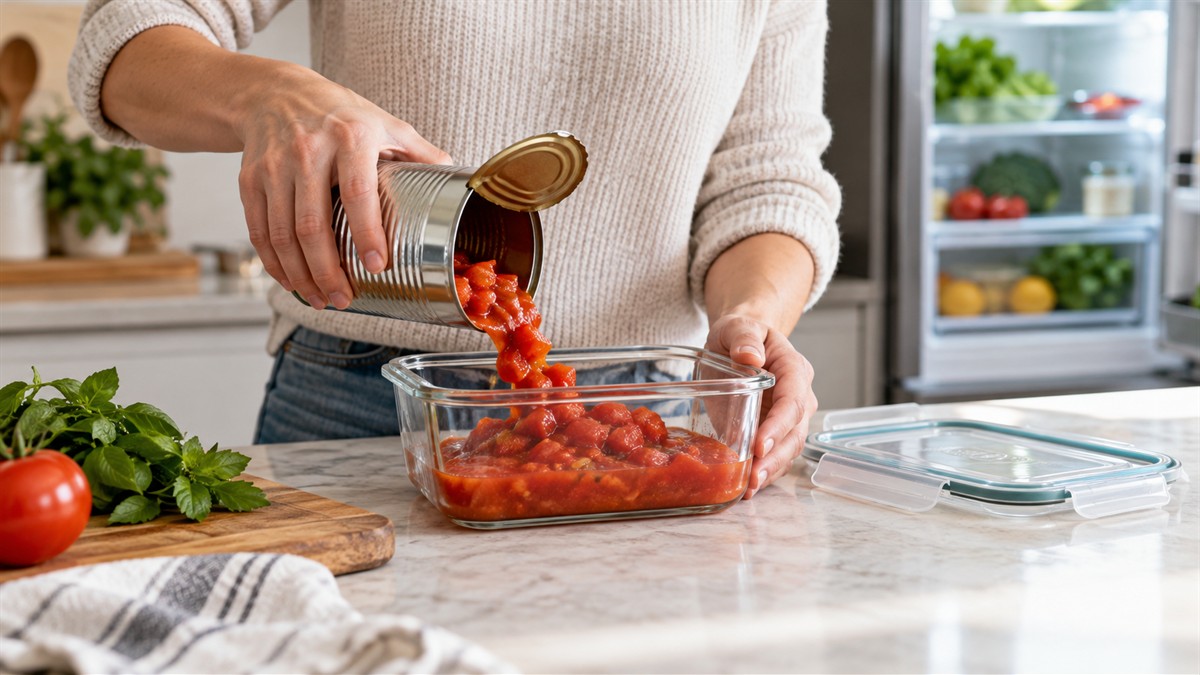
- Prefer a covered glass or plastic container. The USDA fact sheet says the can is acceptable, while NDSU says not to store food in it.
- Label the container with the date you opened the can, then use the food within the days your source gives for that food.
- Keep unopened cans in a cool, dry place, away from the stove and the sink.
Check the can before you open it
Storage after opening starts with the can on the shelf. The USDA Food Safety and Inspection Service fact sheet on shelf-stable food lists cans to avoid: “Don’t purchase bulging, rusted, leaking, or deeply dented cans.” It explains what counts as deep. A dent is deep if you can lay a finger into it, and the sheet says to discard any can with a deep dent on a seam. A small dent on an otherwise good can is a lesser concern, and the sheet says the food should be safe to eat.
New Mexico State University Extension gives a longer list of conditions under which not to eat canned food: leaking or staining, swelling, rust, badly dented or sharp-edged cans, a foul odor, and a change of color. The same guide adds a rule about tasting. You can smell food in question, but you should never taste it.
The USDA sheet also addresses what happens when a can is opened. Some cans make a hissing sound because they are vacuum-packed, and that is normal. A can that hisses loudly, or whose contents spurt out forcefully, may signal unsafe food, and the sheet says not to taste or use it. These checks come before storage because food that fails them should not be stored at all.
Not every can belongs on the shelf
The USDA sheet says that not all canned goods are shelf stable. Some canned food, such as some canned ham and seafood, is not safe at room temperature, and these products are labeled “Keep Refrigerated.” If a can carries that label, it belongs in the refrigerator before opening, as well as after. The sheet gives no list of products, so read the label on each can rather than assuming.
The two-hour clock
NDSU Extension answers the question of how long canned food can sit at room temperature after opening. Its answer is the two-hour rule: if perishable food has been left between 40 and 140 degrees Fahrenheit for more than two hours, discard it “even though it may look and smell OK.” The Ohio State University fact sheet on refrigerator storage uses a slightly different range, 41 to 135 degrees Fahrenheit, and also names two hours as the point where risk rises. The two ranges disagree at both ends, so treat the two-hour limit as the shared rule and the temperature band as approximate.
A simple calculation makes the rule usable. Write down the time you open the can, then add two hours. If you open a can at 6:15 pm, the food should be in the refrigerator by 8:15 pm. That is our own arithmetic using the NDSU rule, and the sources do not say how to count when a meal runs long. Our reading is to count from the moment the can is opened.
Can or container: where the sources differ
The question people ask most is whether food can stay in the opened can. The pages we opened give different answers, and the differences are about strictness, not about safety.
| Source | What it says about the opened can | Reason given |
|---|---|---|
| USDA fact sheet | Unused portions may be refrigerated in the can, but a glass or plastic storage container is better | To preserve optimum quality and flavor |
| NDSU Extension, question and answer page | Remove the food and put it into another covered container | For best quality |
| NDSU Extension, food storage guide | Transfer food to glass or plastic containers and do not store in the can | Off flavors of some foods may develop |
| Ohio State University Extension | Transfer opened canned fruit to a glass or plastic container | To avoid a metallic taste |
Every row gives a quality reason, and none names a safety reason. The USDA sheet also answers a worry some readers have about metal. It says the canned food industry in the United States stopped using lead-soldered cans in 1991, and that the Food and Drug Administration issued a final rule in 1995 prohibiting lead solder in all food cans. Neither the USDA sheet nor the NDSU pages tie the container choice to illness.
Our reading is that a covered glass or plastic container satisfies every source, while leaving food in the can satisfies only the USDA sheet. Choose the container if you have one free, and choose the can only when the alternative is skipping refrigeration altogether.
What the container should be
The sources agree on glass or plastic with a cover. NDSU Extension adds that all canned food should be stored tightly covered. Texas A&M AgriLife Extension has the only advice on depth that we found, in its leftovers section: refrigerate food in covered, shallow containers, less than 3 inches deep, within 2 hours after cooking. That advice is written for cooked leftovers, so it is a close fit for opened canned food rather than an exact one. It also says to leave air space around containers so cold air can circulate.
A label closes the loop. NDSU’s guide says to date food packages, and Texas A&M tells readers to label food storage containers with the date so food can be used within a safe time. New Mexico State suggests keeping a marking pen, labels or masking tape handy and writing the contents and date on refrigerated foods.
How many days in the refrigerator
Each source gives day ranges for opened canned food, and they do not match exactly. The table shows the figures for foods that both NDSU’s food storage guide and the Ohio State fact sheet cover, plus foods only one of them lists.
| Opened canned food | NDSU food storage guide | Ohio State fact sheet | How they compare |
|---|---|---|---|
| Vegetables | 2 days | 2 to 3 days | Ohio State allows one more day |
| Fruit | 5 to 7 days | 1 week | Same upper limit |
| Meats | 3 to 4 days | Canned ham, opened: 3 to 5 days | Ohio State lists canned ham only |
| Poultry | 3 to 4 days | Not listed for canned | NDSU only |
| Fish and seafood | 3 to 4 days | Not listed for canned | NDSU only |
| Tomato sauce | 5 to 7 days in one chart and 3 to 5 days in another | Not listed | NDSU disagrees with itself |
| Pickles and olives | 1 to 3 months | Not listed | NDSU only |
Where the two disagree, take the shorter range. That is our own cautious reading, not a rule from either source. Ohio State labels its times as recommended storage times for safety at 33 to 41 degrees Fahrenheit, and NDSU’s chart is for a refrigerator at 32 to 40 degrees. Both sets of figures assume a refrigerator that is cold enough, which a later section covers.
Turn the day ranges into dates
A range in days is hard to act on until it becomes a date. The method is one line: date opened plus the number of days equals the last day to eat the food. Our example assumes a can opened on a Monday evening and counts Monday as day zero. The sources do not say how to count the day of opening, so this is an assumption.
| Opened canned food | Days used (shorter source range) | Last day to eat |
|---|---|---|
| Vegetables | 2 days (NDSU) | Monday + 2 = Wednesday |
| Meats, poultry or fish | 3 to 4 days (NDSU) | Monday + 3 = Thursday, to Monday + 4 = Friday |
| Fruit | 5 to 7 days (NDSU) | Monday + 5 = Saturday, to Monday + 7 = the next Monday |
If the Ohio State range for vegetables, 2 to 3 days, is the one you follow, the last day moves from Wednesday to Thursday. Whichever range you pick, write the actual date on the label and not the range, so nobody has to do the arithmetic again at the refrigerator.
Where in the refrigerator to put it
Shelf position matters because refrigerators are not the same temperature everywhere. Ohio State Extension says the warmest area is the shelf space in the door and the coldest area is in the back. That points to the back of a shelf for an opened container, not the door.
The sources give slightly different temperature targets. Texas A&M says to keep the refrigerator at 40 degrees Fahrenheit or below. Ohio State says below 41 degrees. New Mexico State says to set it between 34 and 40 degrees and to use a thermometer placed near the door. Texas A&M adds that refrigerator temperatures only slow bacterial growth and do not prevent it, which is why the day limits above exist at all. Texas A&M and New Mexico State both warn against overloading the refrigerator because air must circulate freely.
Where the unopened cans live
The shelf matters before the can is opened, too. The USDA sheet says to store canned foods and other shelf-stable products in a cool, dry place and never above or beside the stove, under the sink, or in a damp garage or basement. It adds that temperatures below 85 degrees Fahrenheit are best and that cans should be checked every few weeks. NDSU’s question page gives a matching rule about avoiding the stove and the sink.
New Mexico State recommends first in, first out rotation: place new items at the back so the oldest dates are used first, and sort stored foods once a month so the oldest are at the front. A pantry shelf makes that practical if it has enough depth to stack by date.
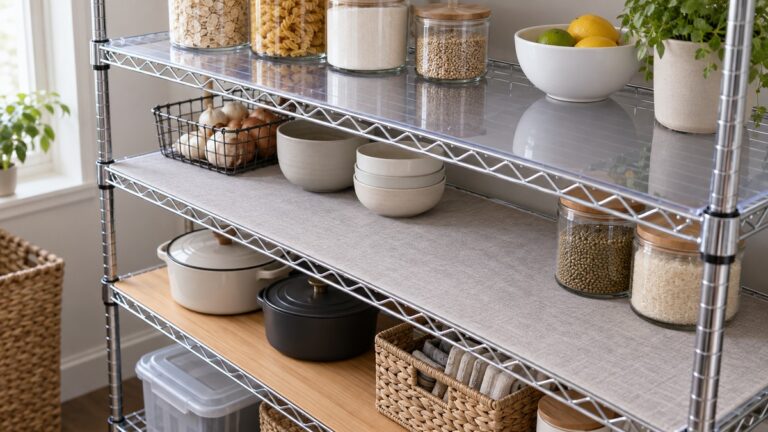
The sources give no can or shelf dimensions, so this example uses our own assumptions: a can footprint of 3 inches across, one layer of cans, and a shelf 36 inches wide and 12 inches deep. The shelf holds 36 ÷ 3 = 12 cans across and 12 ÷ 3 = 4 rows deep, which is 12 × 4 = 48 cans. If you use 6 cans a week, that is 48 ÷ 6 = 8 weeks of supply, so a monthly sort is enough to keep the front row current. Replace the figures with your own measurements before you rely on them.
For shelving ideas that suit a pantry, see our guides to small kitchen pantry shelving, pantry storage under the stairs and turning a small closet into a pantry. If your cans sit on a door, see a 12 inch wide over-the-door pantry organizer.
A short routine you can follow
- Look at the can before opening. Set aside any that is bulging, leaking, rusted or deeply dented, as the USDA sheet advises.
- Open it, serve what you need, and note the time. Plan to have the rest chilled within two hours.
- Move the rest to a covered glass or plastic container, in line with the USDA and NDSU pages.
- Write the date opened, or the last day to eat, on the container.
- Place the container toward the back of a refrigerator shelf, where Ohio State says it is coldest.
- Throw out food past its date. Texas A&M says to avoid tasting old leftovers and adds, “If in doubt, throw it out.”
How we chose
This is a food-handling guide, not a product list, and it covers commercially canned food rather than home-canned food. We opened six pages on 2026-10-21: a USDA Food Safety and Inspection Service fact sheet hosted on govinfo.gov, two NDSU Extension pages, an Ohio State University Extension fact sheet, a Texas A&M AgriLife Extension bulletin and a New Mexico State University Extension guide. We kept only points that a page states in plain words, and we checked each quoted sentence against the page text. The USDA and FoodSafety.gov web pages returned access errors when requested by script, so nothing here relies on them. The date and shelf examples are our own arithmetic, with each input marked as an assumption.
Mistakes to avoid
- Leaving opened food on the counter. NDSU’s two-hour rule applies once perishable food sits in the temperature band for more than two hours.
- Tasting to check. New Mexico State says you can smell questionable food but should never taste it.
- Using a can with a deep dent. The USDA sheet says to discard cans with a deep dent on any seam.
- Putting opened food in the door. Ohio State says the door shelf is the warmest area.
- Skipping the label. Without a date, the day ranges in the table cannot be applied.
- Storing cans above the stove or under the sink. The USDA sheet and NDSU both advise against it.
What we could not verify
The pages we opened do not give a single agreed day range for each opened canned food, and the tomato sauce figures differ even inside one NDSU guide. They do not say whether leaving food in the can raises any safety risk, only that it can affect quality. They give no storage times for opened soup, beans or other specific products beyond the groups in the table, and no freezer times for opened canned food. They do not say how to count the day of opening. The USDA fact sheet copy cited here is dated August 2014, and the Ohio State fact sheet carries a 2010 date, so newer federal guidance may be worded differently. Nothing here is a product claim or medical advice.
Frequently asked questions
Can I keep leftover canned food in the opened can?
The USDA fact sheet says unused portions may be refrigerated in the can, but it recommends a glass or plastic container for quality. NDSU Extension is stricter and says not to store food in the can. A covered container satisfies both.
How long does opened canned food last in the refrigerator?
It depends on the food. NDSU gives 2 days for vegetables, 3 to 4 days for meats, poultry and fish, and 5 to 7 days for fruit. Ohio State gives 2 to 3 days for vegetables and 1 week for fruit. Use the shorter range if the two differ.
How long can an opened can sit out?
NDSU Extension says to follow the two-hour rule for perishable food between 40 and 140 degrees Fahrenheit. Ohio State uses a 41 to 135 degree range and also names two hours.
Is a dented can safe to open?
The USDA sheet says food from a can with a small dent, but otherwise in good shape, should be safe to eat. It says to discard a deeply dented can, meaning a dent you can lay a finger into, and any can with a deep dent on a seam.
Does food from an opened can taste metallic?
It can. Ohio State advises moving opened canned fruit to glass or plastic to avoid a metallic taste, and NDSU says off flavors of some foods may develop in an opened can.
Where should unopened cans be stored?
In a cool, dry place, according to the USDA sheet. Keep them away from the stove, the sink and damp garages or basements, and check them every few weeks.
Bottom line
Chill the leftovers within two hours in a covered glass or plastic container, write the date on it, and eat it within the shorter day range your sources give.
Sources
- https://www.govinfo.gov/content/pkg/GOVPUB-A110-PURL-gpo38739/pdf/GOVPUB-A110-PURL-gpo38739.pdf (opened 2026-10-21)
- https://www.ndsu.edu/agriculture/extension/publications/questions-and-answers-about-storing-canned-and-packaged-food (opened 2026-10-21)
- https://www.ndsu.edu/agriculture/extension/publications/food-storage-guide-answers-question (opened 2026-10-21)
- https://ohioline.osu.edu/factsheet/hyg-5403 (opened 2026-10-21)
- https://agrilifeextension.tamu.edu/wp-content/uploads/2025/04/EB-5031-safe-home-food-storage.pdf (opened 2026-10-21)
- https://pubs.nmsu.edu/_e/E118/ (opened 2026-10-21)
As an Amazon Associate we earn from qualifying purchases.