How to Store Pots and Pans on Shelves
As an Amazon Associate we earn from qualifying purchases.
How to store pots and pans on shelves comes down to three habits: put each piece away dry, give it room, and keep hard surfaces from rubbing its cooking surface. Cuisinart owner’s manuals and several state extension services agree on those points. None of them prescribes a shelf layout, so this guide turns the shared rules into a plan you can apply to a shelf you already own, with a width calculation you can redo using your own cookware.
Quick answer
- Dry every pan completely before it goes on the shelf. Cuisinart says not to store pans while they are damp, and extension pages say leftover moisture rusts cast iron.
- Avoid stacking and crowding where you can. Cuisinart’s manuals say both can scratch cookware or chip enameled cast iron.
- Rub a tiny amount of oil into seasoned cast iron before storage, as NC State Extension advises.
- Do not shelve a scratched or wobbly pan as if it were fine. A University of Georgia expert says scratched cookware should be thrown away.
Start with what each pan is made of
Storage advice depends on the surface of the pan, so sort your cookware into groups before you decide where anything goes. The pages we opened cover four groups, and each one points to a slightly different habit. The table lists what each source says and which source says it. Anything not in the table, such as how to pad a stack or how to store lids, is a gap we describe near the end of this guide.
| Cookware group | Storage point from the sources | Where it comes from |
|---|---|---|
| Seasoned cast iron | Dry it thoroughly and rub in a tiny amount of oil before storing | NC State Extension (Rutherford County) |
| Enameled cast iron | Store it dry in a cupboard and avoid stacking and overcrowding | Cuisinart Chef’s Classic enameled cast iron manual |
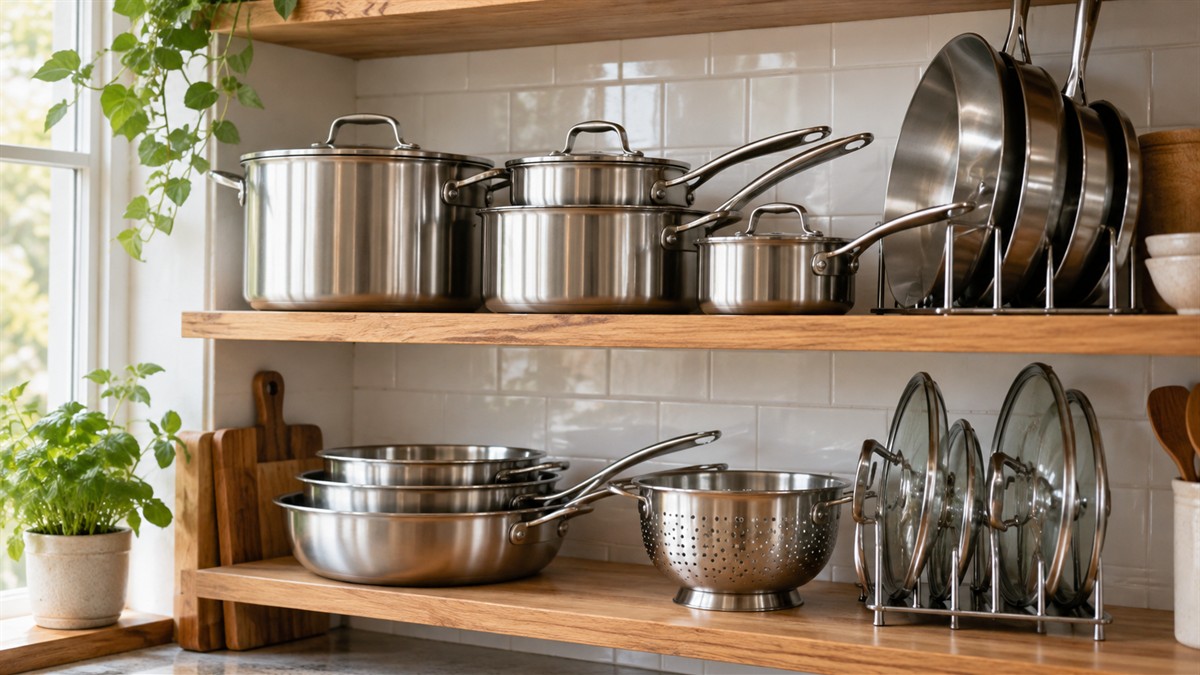
| Stainless steel | A rack or pegboard is described as convenient storage, and stacking or crowding in cabinets or drawers may scratch | Cuisinart stainless cookware manual |
| Nonstick | The coating wears with rugged use, so follow the maker’s care instructions and use non-scratching tools | Clemson extension column |
If you own a mixed set, you will have pieces in several rows. That is normal. The shelf plan later in this guide treats every piece the same, because the simplest rule from the sources, keep pans from rubbing each other, applies to all four groups.
Dry first, on every shelf
Moisture is the one storage risk that every cast iron source we opened mentions. The NC State Extension office in Rutherford County puts it plainly: “The biggest enemy to cast iron is moisture.” The same page says to dry the pan thoroughly after cleaning and to “rub just a tiny amount of oil into the surface before storing.”
A second NC State Extension page, from Brunswick County, explains the cost of skipping that step. A pan that is improperly seasoned or not fully dried before storage can quickly form a layer of rust, and the page says that layer can be hard to remove. Illinois Extension makes the same point in fewer words: “Any moisture left on the pan may cause it to rust.” Mississippi State Extension adds a habit that protects the pan before it ever reaches the shelf: “never leave cast iron submerged in water and always dry it after cleaning.”
Lodge, a cast iron maker, gives a three-step routine on its care page: wash, dry, oil. Step two reads “Dry completely with a paper towel or lint-free cloth.” The same page lists causes of rust, among them a pan “left in moisture-prone environments.” That phrase matters for shelf choice. A shelf beside a sink or dish rack is a place where air and splashes carry more moisture than a dry cupboard does. The page does not name specific rooms or shelves, so that link between the phrase and a sink-side shelf is our reading and not a rule from Lodge.
Other cookware needs the same dry start, for a different reason. Cuisinart’s enameled cast iron manual says “Do not store pans when they are still damp” and adds that pans should always go into “a dry cupboard area.” Both Cuisinart manuals also tell owners to rinse thoroughly and dry immediately. A pan that goes onto a shelf wet leaves a wet shelf, and the next pan stored there picks that moisture up.
Why stacking and crowding is the main shelf problem
Cuisinart gives the most direct storage text among the manufacturer pages we could open, and it is consistent across two product lines. The stainless manual says “Stacking and crowding in cabinets or drawers may cause scratches.” The enameled cast iron manual says to “Avoid stacking and overcrowding when storing cookware” in order to prevent scratching and chipping of the cast iron surface. Both are plain instructions, and neither depends on a particular shelf.
What those sentences imply for a shelf is straightforward. A shelf that holds each pan on its own footprint, with a little gap between neighbors, follows the manuals. A shelf where pans nest inside each other does not. Stacking gets you more cookware in less space, which is the reason people do it, but the manuals name the trade-off: the pan surface pays for the saved inches.
The manuals do not say how many pans make a stack, whether a protective layer between pans removes the problem, or which material is best for that layer. Treat any padding advice you find elsewhere as outside what these sources support. If you must stack because the shelf is short on width, our own reading is that fewer pans per stack means less rubbing, and that the pieces you use most should sit at the front of the shelf so you lift them out without dragging others.
Protect nonstick and check each pan before you shelve it
A Clemson extension column covers nonstick: “Nonstick coatings will wear away with rugged use,” and following the maker’s instructions for use and care is essential. The column also says that “Non-scoring or non-scratching utensils and cleaning aids should be used.” Storage is part of care, so a shelf layout that lets pans scrape against each other works against the same coating.
A University of Georgia expert gives the reason scratches matter. Tracey Brigman, an associate director at the National Center for Home Food Preservation, said “Scratched cookware should be thrown away for a few reasons.” The same item quotes Brigman saying that warped cookware can wobble and tip over, causing burns and spills. Both points argue for a short inspection when you put pans away: look at the cooking surface and set the pan on the shelf or counter to see if it rocks.
That inspection also settles which pans deserve shelf space. A pan you plan to discard is not worth the room, and a damaged one stored beside good cookware can scratch it. Setting aside the pans you plan to replace also frees up width before you buy any shelf.
Plan the shelf with a width calculation
The sources give no dimensions for pans or shelves, so the numbers below are our own assumptions. Replace them with measurements from your own cookware before you decide anything. The method is the part to keep: measure each pan’s footprint, add a small clearance, add up the widths, and divide by the width of one shelf.
For the example we assume a five-piece set and a 36-inch-wide shelf. We also assume each pan needs 1 inch of clearance, and that handles point the same way so they do not add width. None of those figures comes from a source.
| Piece (our assumption) | Footprint width (inches) |
|---|---|
| 10-inch skillet | 10 |
| 12-inch skillet | 12 |
| 3-quart saucepan | 8 |
| 8-quart stockpot | 11 |
| Enameled Dutch oven | 11 |
| Total footprint | 10 + 12 + 8 + 11 + 11 = 52 |
Now compare two layouts. Layout A follows the manuals: every piece sits on its own footprint. Layout B nests the two skillets into one stack, so that stack takes only the width of the larger skillet.
| Layout | Width used with 1 inch clearance per item (inches) | 36-inch shelves needed | Spare width on those shelves (inches) |
|---|---|---|---|
| A: five separate pieces | 52 + (5 × 1) = 57 | 57 ÷ 36 = 1.58, so 2 | (2 × 36) − 57 = 15 |
| B: skillets nested, four items | (12 + 8 + 11 + 11) + (4 × 1) = 46 | 46 ÷ 36 = 1.28, so 2 | (2 × 36) − 46 = 26 |
The result is useful because of what it does not show. Nesting the skillets saves 11 inches, yet both layouts still need two shelves. In this example, stacking buys you spare width but not a whole shelf, so there is no reason to accept scratches for it. If you have only one 36-inch shelf, neither layout fits: A is 21 inches over, and B is 10 inches over. That is the signal to look at a second shelf, a rack or a cabinet before you start stacking.
You can also turn the calculation around and ask how many pieces one shelf holds. Use the average footprint plus clearance: 52 ÷ 5 = 10.4 inches, plus 1 inch, gives 11.4 inches per piece. The table applies that to four common shelf widths. It is an approximation, because real pans differ in width.
| Shelf width (inches) | Pieces per shelf at 11.4 inches each | Shelves for a five-piece set |
|---|---|---|
| 24 | 24 ÷ 11.4 = 2.11, so 2 | 5 ÷ 2 = 2.5, so 3 |
| 30 | 30 ÷ 11.4 = 2.63, so 2 | 5 ÷ 2 = 2.5, so 3 |
| 36 | 36 ÷ 11.4 = 3.16, so 3 | 5 ÷ 3 = 1.67, so 2 |
| 48 | 48 ÷ 11.4 = 4.21, so 4 | 5 ÷ 4 = 1.25, so 2 |
Notice that a 30-inch shelf does no better than a 24-inch one for this set, because the extra 6 inches never adds up to a full third piece. Whole-number rounding like that is easy to miss when you shop by shelf width alone. For shelf options in a kitchen, see our guides to shelf ideas for a small kitchen and open shelves in a small kitchen.
Racks and pegboards: what the manual says and what it leaves out
The Cuisinart stainless manual describes a cookware rack or pegboard as providing “convenient, safe storage.” That is the only sentence about racks in the sources we opened, and it is a statement about convenience, not about how much a rack can carry. The manual gives no load limit, no mounting method and no spacing rule, so this guide does not either. Follow the instructions that come with any rack or pegboard you buy, and check the wall or shelf it will hang from against those instructions.
Weight is a fair worry, since Illinois Extension describes cast iron pans as heavy. For a shelf that holds a lot of cookware, the useful question is the stated capacity of that particular shelf. For a related question, see our post on the Closetmaid wire shelf weight limit, and compare a free standing wire shelf for the kitchen if you need more width.
If your cookware lives under the sink or in a cabinet, a separate organizer may suit you better than a shelf. See under-sink pot and pan organizers for that case, and small kitchen pantry shelving if the pans will share space with pantry items.
A shelf routine you can follow
- Wash each pan by hand or as its manual directs, and dry it completely. Lodge, Illinois Extension and the NC State pages all stress drying.
- For seasoned cast iron, rub in a tiny amount of oil before storing, as the Rutherford County page says.
- Look over the cooking surface. If it is scratched or the pan wobbles, set it aside, since the UGA expert says to throw away scratched cookware.
- Place each piece on its own footprint with a small gap. Keep stacks to a minimum, in line with the Cuisinart manuals.
- Put the cast iron on a shelf away from sinks and dish racks, which is our reading of the Lodge rust warning about moisture-prone places.
- Recheck the shelf every so often for damp spots, because a wet shelf can undo a dry pan.
How we chose
This is a method guide and not a product list. We opened nine pages on 2026-10-21: a Lodge care page, three extension pages on cast iron from NC State, Illinois and Mississippi State, a second NC State page, two Cuisinart owner’s manuals, a University of Georgia news item and a Clemson extension column. We kept only the points that a page states in plain words, and we checked every quoted sentence against the text of the page it came from. A second Lodge guide and a Clemson factsheet returned error codes on that date, so nothing here relies on either. The width tables are our own arithmetic, and each input is labeled as an assumption.
Mistakes to avoid
- Shelving a pan that is still damp. Cuisinart says not to store pans when they are still damp.
- Letting cast iron soak. Mississippi State Extension says never to leave it submerged in water, and Lodge lists soaking among the causes of rust.
- Nesting enameled cast iron. Cuisinart warns that stacking and overcrowding can scratch and chip the surface.
- Packing a shelf edge to edge. The width tables show that a tight set leaves no clearance, and the Cuisinart manuals warn against crowding.
- Keeping a scratched nonstick pan. The UGA expert quoted above says to throw it away.
- Hanging pans from a rack without reading its limit. The only rack sentence in the sources gives no capacity, so the rack maker’s own figure decides.
What we could not verify
The pages we opened do not say which material to place between stacked pans, whether lids should sit on or beside their pots, or how far a cast iron shelf should be from a stove or sink. They give no pan dimensions, no shelf depth or height, and no load rating for a shelf, rack or pegboard. Cuisinart’s text covers its own stainless and enameled cast iron lines, so its rules are a close fit for other brands rather than an exact one. The Clemson column is dated 2022, and the UGA item quotes one expert, so neither is a full standard. Nothing here is a product claim.
Frequently asked questions
Can I stack pots and pans on a shelf?
You can, but the manufacturer text we read advises against it. Cuisinart says stacking and crowding may scratch cookware and chip enameled cast iron. If your shelf is short on width, use the width tables above to see whether a second shelf solves the problem before you nest anything.
How should I store cast iron on a shelf?
Dry it thoroughly, rub in a tiny amount of oil, and keep it in a dry place. NC State Extension gives the drying and oil steps, and Lodge names moisture-prone environments as a rust risk.
Is it a problem to put a pan away damp?
Yes. Cuisinart tells owners not to store pans while still damp, and Illinois Extension warns that moisture left on a cast iron pan may rust it.
Can I hang pots instead of shelving them?
Cuisinart describes a cookware rack or pegboard as convenient storage for its stainless line. The manual gives no weight limit, so use the rack maker’s capacity figure and its mounting directions.
What should I do with a scratched nonstick pan?
A UGA expert says scratched cookware should be thrown away, adding that health impacts of the newer substances used in cookware are still being studied. Clemson Extension notes that nonstick coatings wear with rugged use, so replacing a worn pan beats storing it.
How many pans fit on a 36-inch shelf?
That depends on your pans. Using our assumed average of 11.4 inches per piece, including clearance, a 36-inch shelf holds three. Measure your own cookware and redo the division.
Bottom line
Put pots and pans away dry, give each piece its own footprint, and replace any pan that is scratched or wobbly instead of shelving it.
Sources
- https://www.lodgecastiron.com/pages/how-to-clean (opened 2026-10-21)
- https://rutherford.ces.ncsu.edu/news/why-cast-iron-is-worth-the-effort/ (opened 2026-10-21)
- https://brunswick.ces.ncsu.edu/news/got-a-cast-iron-skillet/ (opened 2026-10-21)
- https://extension.illinois.edu/blogs/simply-nutritious-quick-and-delicious/2024-03-15-guide-cast-iron-cookware (opened 2026-10-21)
- https://extension.msstate.edu/blogs/extension-for-real-life/how-care-for-cast-iron (opened 2026-10-21)
- https://images.homedepot-static.com/catalog/pdfImages/53/5387ec5f-76cf-473b-ab35-9f81abba7687.pdf (opened 2026-10-21)
- https://content.abt.com/documents/171526/cuisinart-cookware-set-77-10P1-owners-manual.pdf (opened 2026-10-21)
- https://news.uga.edu/columns-exclusives/clinical-associate-professor-shares-what-cookware-to-throw-away/ (opened 2026-10-21)
- https://blogs.clemson.edu/savannahvalley/homemakers-column-cookware-safety/ (opened 2026-10-21)
As an Amazon Associate we earn from qualifying purchases.