Best Wood Bookshelves: Capacity, Material and Anti-Tip
As an Amazon Associate we earn from qualifying purchases.
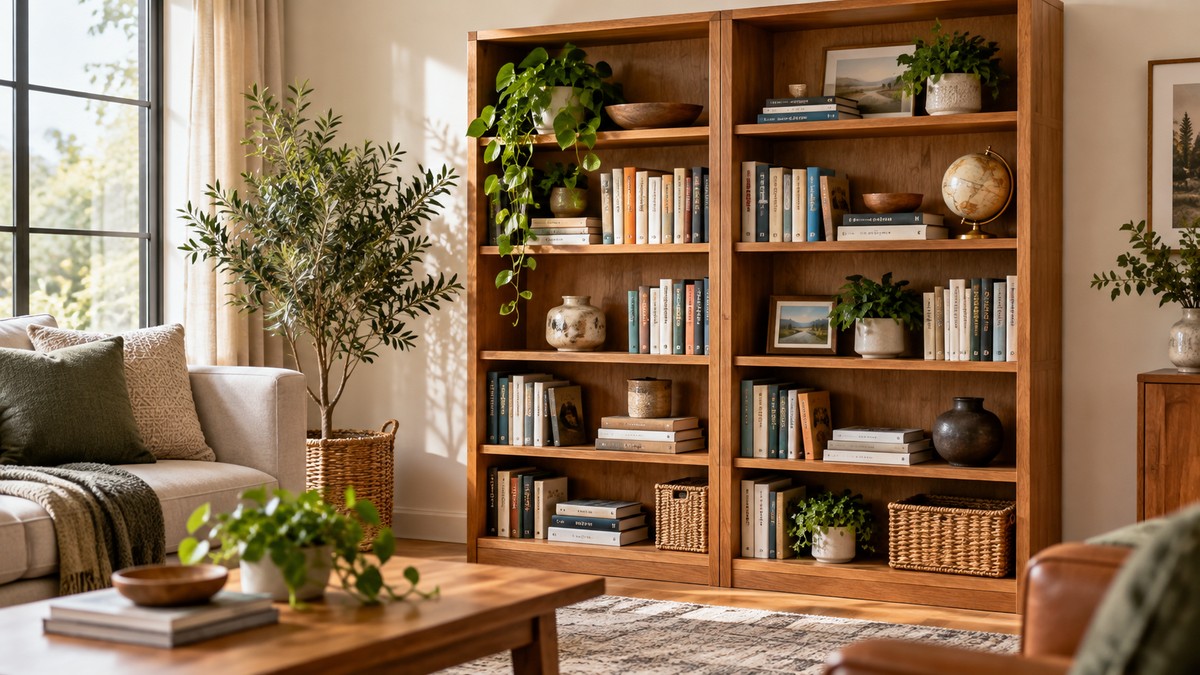
A wood bookshelf is a freestanding bookcase, usually 60 to 72 inches tall, that stores books and decor on open shelves. The five models below are the wood and wood-look bookcases that the Amazon search for “wood bookshelf” returned on 2026-10-27, after sponsored results were removed. Each listing states a different material, capacity and anchoring kit, and none of the listings says how a shelf performs when fully loaded. This guide explains what to check before you buy and how to anchor a tall unit.
Quick answer
- Choose by material first. Four of the five listings state engineered wood; only the TVU listing states solid wood as its material type.
- Capacity figures are not directly comparable. One listing states a total, others state a per-shelf or per-layer figure, and the VASAGLE listing gives two different numbers.
- Anchor any tall unit. Four listings include an anti-tip device or kit; the FOTOSOK listing describes a stability device instead. The CPSC staff report explains why a screw into a stud is the usual anchor.
Who a wood bookshelf suits, and what the listings do not state
A wood bookshelf suits a reader who wants open display for books, plants and decor in a living room, home office or bedroom, and who has a wall that can take a fixing. It is a poor choice when the room is damp, when the shelves must carry very heavy items on every tier, or when the rental agreement does not allow drilling. The listings do not state how much load each tier holds when books are spread across the whole shelf. None of them names the wall types, such as drywall, plaster or masonry, that its hardware is designed for.
Comparison table
The table includes only the fields that the listings state. Where a listing does not give a field, the cell says “not stated”.
| Product | Material (as listed) | Shelves | Overall size (as listed) | Weight capacity (as listed) | Anti-tip or stability (as listed) | Assembly (as listed) |
|---|---|---|---|---|---|---|
| VASAGLE 6-tier, Ebony Black | Engineered wood (particleboard and MDF) | 6, four adjustable | 9.4 x 23.6 x 63.3 in | Maximum 154 lb (spec table); up to 22 lb per tier (bullet) | Anti-tip kit included | Instructions included |
| HOOBRO 5-tier arched, Rustic Brown | Engineered wood; particleboard and metal | 5 | 11.8 x 16.9 x 69.3 in | Maximum 30 lb | Anti-tip kit included | Tool-free per bullet; instructions included |
| TVU 5-tier, Walnut Brown | Wood | 5 | 9.9 x 31.5 x 65 in | Maximum 250 lb (spec table) | Anti-tip device; attach to wall during assembly | Required (spec table) |
| FOTOSOK 6-tier, Light Oak | Engineered wood (particleboard) | 6 | 9.3 x 23.6 x 70.9 in | Maximum 22 lb per layer (bullet and spec table) | Stability device behind unit; fix during install | Instructions included |
| GRUSIGN 6-tier, White | Engineered wood | 6 | 9.5 x 23.6 x 70.8 in | Maximum 44 lb (spec table and bullet) | Anti-tip devices included | Instructions included |
Product notes
Each block below uses only the figures in that product’s listing. Figures are labelled as the listing says them.
VASAGLE 6-tier open bookcase, Ebony Black (ASIN B0BNJ2CF7W)
The listing says it is a 6-tier open bookcase with four adjustable tiers, built from premium particleboard and MDF. The spec table says “Maximum 154 pounds” and “Minimum weight: 132 pounds”, but the table does not say whether that figure applies per unit, per shelf or to the total. The bullets say the unit “can support up to 22 lb per tier”. The two figures are not described the same way, and the listing does not explain the difference. The listing also includes an anti-tip kit.
Skip if you need solid wood, or if you plan to load the upper tiers heavily without a wall fixing. Limitation: the two capacity figures conflict in scope, and the listing does not say whether it assumes studs.
HOOBRO 5-tier arched bookshelf, Rustic Brown (ASIN B0C5DH86H5)
The listing says the panels are particleboard and the frame is metal, with an arched top and a matte black frame over rustic brown panels. It gives an overall size of 11.8 inches deep, 16.9 inches wide and 69.3 inches tall, with 13 inches between tiers. The spec table says “Maximum 30 pounds”, and the bullets say each shelf “can hold up to 30 lb”. The listing also gives a minimum required door width of 26.6 inches. It includes an anti-tip kit.
Skip if you want a solid wood frame, since the listing describes a metal frame with particleboard panels. Limitation: the listing does not say whether 30 pounds applies per shelf or to the whole unit.
TVU 5-tier wooden bookshelf, Walnut Brown (ASIN B0DXF66267)
This is the only listing in the table that states “Wood” as its material type. The spec table gives 9.9 inches deep, 31.5 inches wide and 65 inches tall, with five shelves, a “Maximum 250 pounds” weight capacity and a “Minimum weight: 50 pounds” line. The bullets say the unit has an anti-tip device that you can secure to the wall during assembly. The listing does not say which wall fixing comes in the box or whether the device needs a stud. It also states that assembly is required.
Skip if your wall space is narrower than the 31.5-inch width, or if you need a shelf rated per tier. Limitation: the 250-pound figure is not labelled per shelf or total.
FOTOSOK 6-tier tall bookcase, Light Oak (ASIN B0CGRGFR4C)
The listing says the unit is particleboard with a light oak finish, six shelves of 0.75 inch thickness, and overall dimensions of 9.3 by 23.6 by 70.9 inches. It states a maximum bearing capacity of 22 pounds for each layer in the bullets and in the spec table, with a minimum weight of 17 pounds. It also says there is a stability device behind the unit that should be fixed during installation. The listing does not describe that device as an anti-tip kit.
Skip if you plan to place heavy reference books on every tier, since the listing states 22 pounds per layer. Limitation: the listing does not say what fixing the stability device needs or whether it assumes a stud.
GRUSIGN 6-tier bookshelf, White (ASIN B0DZ23S19S)
The listing says the unit is engineered wood with a white painted, lacquered surface. Its dimensions are 9.5 inches deep, 23.6 inches wide and 70.8 inches tall, with six tiers of 0.6 inch thickness. The bullets say each shelf supports up to 44 pounds, and the spec table gives “Maximum 44 pounds”. The listing describes anti-tip devices and a scratch- and water-resistant surface. It does not say whether the unit is suitable for a bathroom or other damp room.
Skip if you want a wood grain finish, since the listing describes a white painted surface. Limitation: the listing says “water-resistant” but gives no moisture rating for any room type.
How we chose
We read the first page of the Amazon search for “wood bookshelf” on 2026-10-27. We removed sponsored results and kept the first five non-sponsored products that are freestanding wood or wood-look bookcases. Two candidate pages opened on other products and were dropped. Several other results were children’s Montessori shelves or narrow bookcases with a different use, and they were not considered. For each product we recorded the title, brand, bullets and the spec-table fields that the listing states. We dropped every price, shipping, rating, review, rank and badge field, so the table does not rank these products by cost or by customer score.
The selection is a snapshot of one search on one day. It does not cover every wood bookshelf on Amazon or elsewhere, and the order of the search results is not a ranking.
What we could not verify
- The actual load a shelf carries under books. Each listing states a figure, but none says how the figure was measured or whether it is per shelf or total.
- Whether any unit suits a specific wall type. None of the listings names drywall, plaster or masonry as a suitable surface.
- Real-world dimensions after assembly. Listing dimensions are as stated and may differ from the assembled size.
- Durability and how the finish ages. The listings describe their finishes but give no durability information.
- The grade of the engineered wood. The listings say particleboard or MDF without a grade, so the strength of the panels cannot be compared.
Wood bookshelf capacity: per shelf or total
Capacity is the number most readers compare first, and it is the one most often misread. A maximum weight for a whole bookcase is a different number from a maximum per shelf, and a tier of hardcover books weighs far more than the same volume of paperbacks. The listings in this post use three different phrasings: a total-style figure (the TVU at 250 pounds), a per-shelf figure (GRUSIGN at 44 pounds per shelf), and a per-layer figure (FOTOSOK at 22 pounds per layer). The VASAGLE listing gives two figures that do not describe the same thing.
When you read a figure, check three things. First, whether it applies to the whole unit or to each tier. Second, whether the listing assumes the unit is fixed to a wall. Third, whether the listing gives a minimum weight that suggests how the figure was set. If a listing gives one figure with no label, treat it as unknown for planning and assume the lower number until the manufacturer confirms it.
Anchoring a tall wood bookshelf
A bookcase over about 5 feet tall can tip if its upper shelves are loaded or if a child climbs it. The US Consumer Product Safety Commission staff report on anchoring furniture describes the usual anchoring kit and why it is hard to install without tools. The report states: “Rather, a wood screw is usually provided and must be installed in a stud.” It also states: “Staff was unable to find any furniture anchors available for purchase that did not require tools for installation.” The same report found that most households in its survey had not anchored the furniture holding a television, which is a reminder that anchoring is often skipped.
Consumer Reports describes the usual kit the same way: “One bracket screws directly into the piece of furniture; the other fastens into a stud in the wall.” It also warns: “Never use a drywall anchor or toggle to anchor furniture.” Both sources point to a stud as the wall fixing for furniture of this kind, and neither recommends drywall alone.
Practical steps, drawn from those sources and from the listings:
- Find a stud with a stud finder before you drill, and mark its position. Do not guess the location from the wall surface.
- Use the anti-tip kit or stability device that the listing includes, and fix it into the stud rather than the wall board.
- If no stud is at the right spot, use a heavy-duty fixing rated for the purpose, and read the fixing’s own load rating. Do not rely on a generic plastic plug.
- Check the wall type before you buy hardware. Drywall, plaster and masonry need different fixings.
- Check the anchor again after the unit is loaded, and again after you move it.
The listings do not state a load rating for any anchor they include, so the fixing you choose decides the wall performance. Do not assume a generic anchor will hold a given weight.
Buying checklist
- Read the material line. Engineered wood, MDF and particleboard are not the same as solid wood, and four of the five listings here state engineered wood.
- Find the weight figure and check whether it is per shelf or total. If the listing gives two figures, note both and ask the seller which one applies.
- Measure the wall space and the route to it. The HOOBRO listing gives a minimum required door width of 26.6 inches, and the FOTOSOK listing gives 23.6 inches.
- Check the overall height against the ceiling and the furniture around it. The five units here range from 63.3 to 70.9 inches tall, and tall units should be anchored.
- Confirm the included hardware. Several listings say an anti-tip kit is included but do not describe the screws or anchor type.
- Check the assembly time. The listings describe assembly differently, so read the instructions before you buy.
Mistakes to avoid
- Treating two capacity figures as one. The VASAGLE listing gives 154 pounds in its spec table and 22 pounds per tier in its bullets. Plan around the lower figure until the seller clarifies.
- Assuming wood means solid wood. Four of the five listings state engineered wood, and the HOOBRO listing pairs particleboard with metal.
- Skipping the anchor. The CPSC staff report explains that the wall connection is the weak point, and an anchor only works when it is fixed into a stud.
- Placing a tall unit in a damp room. The GRUSIGN listing describes a water-resistant surface but states no moisture rating.
- Assuming a generic anchor will hold a tall unit. The listings state no anchor ratings, and the Consumer Reports guide warns against drywall anchors for furniture.
FAQ
Is a wood bookshelf the same as a solid wood bookcase?
No. In this set, only the TVU listing states solid wood as its material type. The VASAGLE, HOOBRO, FOTOSOK and GRUSIGN listings state engineered wood, particleboard or MDF. Read the material line before you assume solid wood.
How much weight does a wood bookshelf hold?
It depends on the model and on how the figure is stated. The listings in this post state 22 pounds per layer (FOTOSOK), 30 pounds (HOOBRO), 44 pounds per shelf (GRUSIGN), 154 pounds in the spec table with 22 pounds per tier in the bullets (VASAGLE), and 250 pounds (TVU). The listings do not say how each figure was measured.
Do I need to anchor a wood bookshelf to the wall?
For a tall unit, yes. The CPSC staff report describes a screw into a stud as the usual anchor. Four of the five listings include an anti-tip kit, and the FOTOSOK listing describes a stability device; in each case the hardware should be fixed to the wall.
What is the difference between a stud and a drywall anchor?
A stud is a structural wood member behind the wall surface. A drywall anchor is a fixing that grips the thin wall board. Consumer Reports states: “Never use a drywall anchor or toggle to anchor furniture.” A stud is the fixing point the sources describe for a bookcase.
Can I put a wood bookshelf in a bathroom?
The listings in this post do not state a moisture rating or say the units suit bathrooms. The GRUSIGN listing describes a water-resistant surface but does not name bathrooms as a room type, so check with the manufacturer before using any of these in a damp room.
Which wood bookshelf suits a small room?
The FOTOSOK unit has the smallest stated depth, at 9.3 inches, and the TVU is the widest at 31.5 inches. Choose by the space you can measure, then check the capacity and anchoring notes in this post.
Related guides on this site
- Best bookshelf for a small room covers narrow units for tight spaces.
- Bookcase ideas for small rooms shows layout options when floor space is limited.
- Best Lavish Home 5 tier ladder bookshelf compares a ladder-style unit with a different frame.
- Best Nathan James Theo 6 shelf bookcase covers a six-shelf option for comparison.
- Best small wall shelves for living room is useful if you want a wall-mounted alternative to a freestanding unit.
- Best decorative floating wall shelves for living room covers wall-mounted display shelves.
- Best corner wall shelf for living room is a fit for an awkward corner.
- Best floating corner shelves for living room covers corner options with a different mounting method.
Bottom line
Choose a wood bookshelf by reading the material line and the capacity label together, and fix any tall unit into a stud with the hardware the listing includes. None of the five listings states how loaded shelves perform, so plan with the lowest figure you find.
Disclosure: As an Amazon Associate we earn from qualifying purchases. Product links on this page are affiliate links.
Sources
- Amazon.com search results and product listings for “wood bookshelf”, read 2026-10-27. This is listing data, cited by ASIN in the product notes; it is a retailer source and not an independent one.
- US Consumer Product Safety Commission, “Preliminary Evaluation of Anchoring Furniture and Televisions” (staff report), https://www.cpsc.gov/s3fs-public/pdfs/Tipover-Prevention-Project-Anchors-without-Tools.pdf, opened 2026-10-27 with curl.
- Consumer Reports, “How to Anchor Furniture to Help Prevent Tip-Overs”, https://www.consumerreports.org/home-garden/furniture/how-to-anchor-furniture-to-help-prevent-tip-overs-a4328328212/, opened 2026-10-27 with curl.