Best Items to Store on Closet Shelves: Folded, Hung and Heavy
As an Amazon Associate we earn from qualifying purchases. Details
The best items to store on closet shelves are the things you fold rather than hang: sweaters, knits, casual shirts, shorts and seasonal pieces you use only part of the year. Shelves do the job that rods do not, but they also have limits on weight, height and reach. The Oregon State extension circular says the item must suit the storage and be easy to reach, and the Purdue 4-H home-environment publication shows how accessories change what a closet can hold. This guide sorts common closet items by how they should be stored and notes where the pages we opened stop.
Updated 19 October 2026
Author: Editorial team, home-shelving-guide.com
Quick answer
- Put folded knitwear, casual shirts and shorts on shelves, because Purdue Extension lists half-shelves for sweaters or shirts that you keep folded.
- Hang pants, shirts and skirts on a rod, and add a second short rod if you need more hanging space. Purdue says a second short rod can increase hanging space as much as one-third.
- Move seldom used items to “dead storage” elsewhere, as Oregon State Extension suggests, so the shelves stay useful for daily clothes.
- Keep heavy boxes low, and check the tip-over guidance before you load a tall clothing unit. The CPSC report says its standard covers clothing storage units taller than 30 inches.
Start with what the closet has to do
Before you decide what goes on a shelf, decide what the closet is for. The Oregon State circular, reprinted in 1967, asks a question that still applies: “Do You Really Need More Storage Space?” It suggests that items that are not essential, or that are seldom used, may be kept in another place. This is the first sorting step for a shelf. An item that you wear every week belongs within reach. An item you need twice a year belongs higher, lower or elsewhere.
The Purdue 4-H publication on home environment makes a related point. It says, “Even a small clothes closet can be organized to hold lots of clothes and keep them in good condition, ready to wear.” It also suggests looking first for unused space in the closets you already have. Many closets have a shelf or a corner that is wasted, and a few small changes can make it useful.
The Oregon State circular also gives a rule that works for any shelf. It says, “The item must be suited to the type of storage and be easy to reach and replace.” If an item is hard to reach, or if it is hard to put back, it will end up on the floor. So the best item for a shelf is one that you can lift and return without a step stool.
Folded clothes belong on shelves
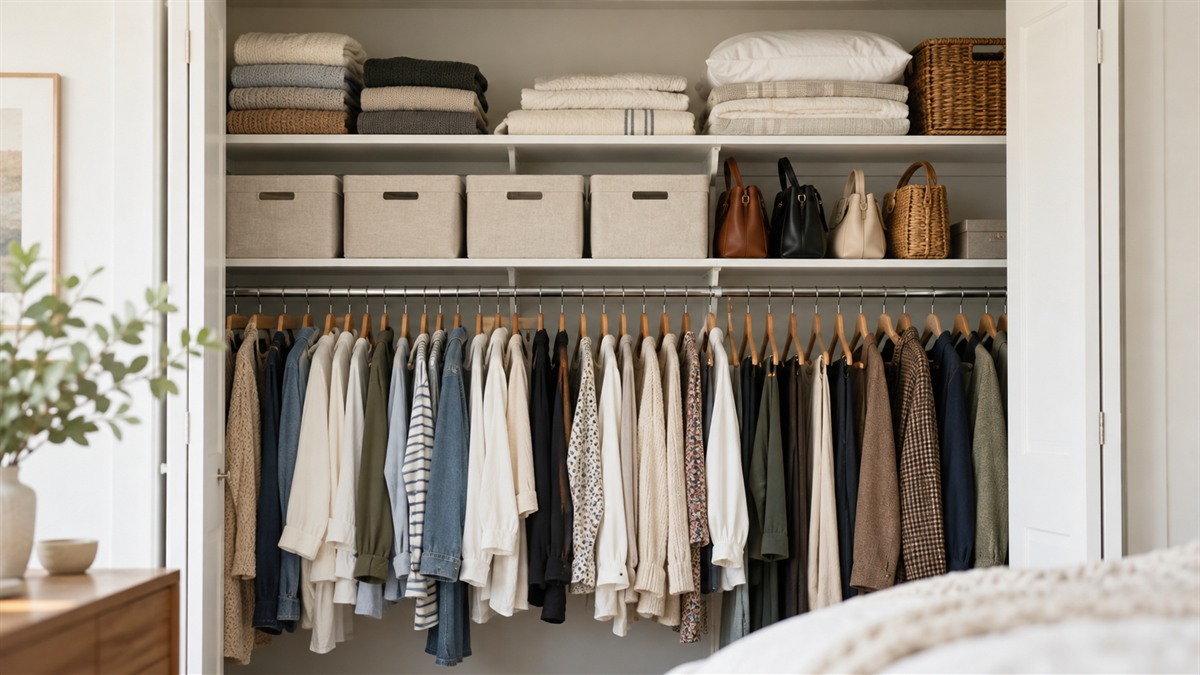
Folded clothes are the core use for closet shelves. Purdue Extension lists a half-shelf for sweaters or shirts you keep folded, and it notes that adding shelves and half-shelves can provide more storage space. A half-shelf covers only part of the closet width, so it can sit beside a rod.
Folded knits are the clearest case. A sweater folded flat is bulky, so a stack of them should stay low enough that the top one can be reached without moving the rest. The pages we opened do not give a stack height for sweaters, so this guide does not give one either. Use the size of the shelf and the reach of the person who uses it as the guide.
A simple planning step helps. Measure the width of a folded stack, then divide the shelf width by that width to see how many stacks fit side by side. Suppose a shelf is 36 inches wide and each folded sweater stack is 12 inches wide. Then 36 / 12 = 3, so three stacks fit across that shelf. These numbers are an example, not a figure from any source, but the arithmetic shows how a shelf should be planned before it is bought.
Casual shirts and shorts go on shelves for the same reason. A shirt folded on a shelf can be taken and put back in one movement, which is the reach test the Oregon State circular describes. A shirt that is pressed and hung loses very little on a rod, so the decision depends on how the closet is used, not on the type of shirt.
Hanging items stay on rods and hooks
Hanging clothes do not belong on a shelf, unless the shelf is a bin or a tray. The Oregon State circular says, “Some clothes can go on hangers, others on racks, shelves, or hooks.” It is a list, not a rule, but the logic is clear: the item decides the storage. Coats and dresses need the rod. Bags, belts, scarves and small accessories often suit hooks, which is the kind of accessory the Purdue list names.
The Purdue list of closet accessories includes several items that are useful next to a shelf. It recommends a shoe rack or bag, a metal bracket or hook for articles such as a jacket, and a second short rod for pants, shirts and skirts. The publication says that the second short rod “can increase the hanging space as much as one-third”. That figure is the publication’s own estimate, and the closet size and the rod height decide how much extra space you actually gain.
The same list includes “hanger designed to hold more than one garment”. That is useful for pants or for a set of outfits that are worn together. It saves rod length without adding a shelf, which is often the cheaper answer for a small closet.
Heavy items and tall units
Heavy items are the main safety question for a closet shelf. The CPSC report on anchoring furniture and televisions says that “The standard covers chest-type furniture and other clothing storage units taller than 30 inches.” A tall closet unit is a clothing storage unit in that sense, and the report treats tip-over as a real hazard. The report also gives a reason for caution: “Fifty pounds represents the weight of a 95th percentile 5-year-old child.” The report uses that 50-pound figure to show why climbing is a real risk, so heavy boxes and shoes should not sit on the upper shelves of a freestanding unit.
For shelves fixed to a wall, the anchor matters more than the shelf. Toggler’s anchor sheet says that “Industry safety standards recommend using only 1/4 of ultimate tensile and shear values as the maximum load per anchor.” It also says that holding strength “varies directly with the strength and condition of the substrate” and depends on “the distance of the load from the wall.” Keep heavy items close to the wall, because the Toggler sheet ties holding strength to the distance of the load from the wall. Placing the heaviest items on the lowest shelves is a practical choice on top of that, although the pages we opened do not test that point.
Heavy items that are not a safety risk still need a plan. Boxes of winter blankets, heavy shoe boxes and storage bins full of books should go on the lowest shelf that you can reach without a stool. Lighter folded knitwear and shirts can go higher, because they are easier to lift down. The best item for an upper shelf is the lightest item you use rarely.
Seasonal and occasional items
Seasonal clothes are the classic case for dead storage. Oregon State says that “Perhaps nonessentials or seldom used items may be put in “dead storage” elsewhere.” An off-season coat or a set of summer shorts does not need the best shelf in the closet. A shelf at the top, where the items are out of reach for everyday use, is a reasonable place for them, provided the item is light and the shelf is fixed properly.
The Oregon State circular notes that when clothes “do not get put back in their proper place, there is usually a reason.” A labeled shelf or bin gives each item one defined home, which is a common-sense way to act on that point. The pages we opened do not cover shared closets, so this guide does not give a split for two people.
What the pages do not cover
The Purdue and Oregon State pages do not say what items should never go into a closet. They do not cover food, chemicals, paper, electronics or documents, and this guide does not give advice on those. If an item is valuable or sensitive, keep it out of a closet that has damp walls or poor ventilation, and check the item’s own care instructions.
The pages also do not give shelf depths, rod heights or the number of folded items a shelf should hold. The Oregon State circular is from 1967, and its advice is general. Modern closet fittings may have different dimensions, so measure the closet and the items before you plan the layout.
How we chose
We chose the pages in this guide because each is an extension publication that speaks to closet storage directly, or a government safety report that speaks to tall clothing units. The Purdue 4-H publication is the most detailed on accessories and shelf placement. The Oregon State circular is older, but its rule about reach and replacement is still a good test for any shelf. The CPSC report covers the tip-over question and the load-bearing question for tall units.
We opened each page, extracted its text and checked each quoted sentence against that text before it went into the draft. We did not use any product listing, price or review score to choose the advice in this guide.
What we could not verify
The pages we opened do not give a shelf depth, rod height or weight limit for a closet shelf. We could not confirm how many sweaters or shirts a given shelf can hold, and the folded-stack example in this guide is arithmetic only.
The Oregon State circular is from 1967 and was reprinted in that year. Its advice on reach and storage is general, but its numbers and its materials may not match a modern closet. We have not replaced it with a newer extension page because we did not find one in the pages we could open.
The CPSC report is about anchoring furniture and televisions. It does not give a load figure for closet shelves. The anchor figures in this guide come from a manufacturer’s anchor sheet, and they apply to the wall type and fixing that sheet describes.
FAQ
Can I store shoes on a closet shelf?
The Purdue list includes a shoe rack or bag as a closet accessory. The pages we opened do not give a weight or size figure for shoes on a shelf. Use a rack or a bin that keeps the pairs together and keeps the heavy pairs low.
Should I put heavy boxes on a high closet shelf?
No. The CPSC report explains that tall clothing units can tip, and it notes that a child can exert a large force when climbing. Keep heavy boxes on the lowest shelf you can reach without a stool, and keep the unit anchored if the manufacturer says to.
How do I make more hanging space in a small closet?
Purdue Extension suggests a second short rod for pants, shirts and skirts, and says it can increase hanging space as much as one-third. It also suggests a hanger that holds more than one garment. Measure the closet first, because the gain depends on the rod height and the depth of the space.
What is dead storage in a closet?
The Oregon State circular uses the phrase for nonessential or seldom used items that can be kept in another place. A top shelf or a storage bin is a reasonable home for those items, as long as the item is light and easy to put back.
Should folded clothes and hanging clothes share a shelf?
Keep them separate where you can. A shelf for folded knitwear is simpler to use when no hanging items sit above it, because hanging clothes can catch on the stacks. This is practical advice, not a figure from the pages we opened. The Purdue list suggests half-shelves for folded items and rods for hanging ones, which is the same split this guide recommends.
Bottom line
Put folded clothes on shelves, hang what needs to hang, and keep heavy items low. A shelf is most useful when the items on it are easy to reach and easy to replace. For a closet with a tall unit or a wall shelf, check the tip-over and anchor guidance before you load it. For more closet layouts, see best way to organize a woman’s closet and best closet organizing ideas for small spaces.
Sources
- Purdue Extension, 4-H Home Environment Level 1, publication 4-H 1011-W: the folded-items half-shelf, the second short rod and the reach-and-placement advice
- Oregon State University Extension, Extension Circular 691, Ideas for Better Clothes Closets (reprinted 1967): the dead-storage idea, the hanging-versus-shelf rule and the reach test
- U.S. Consumer Product Safety Commission, anchoring furniture and televisions report (2015): the tall clothing unit coverage and the child-climbing load figure
- TOGGLER, Plastic Toggle Anchors sheet (manufacturer PDF): the one-quarter planning rule and the load-distance and substrate points