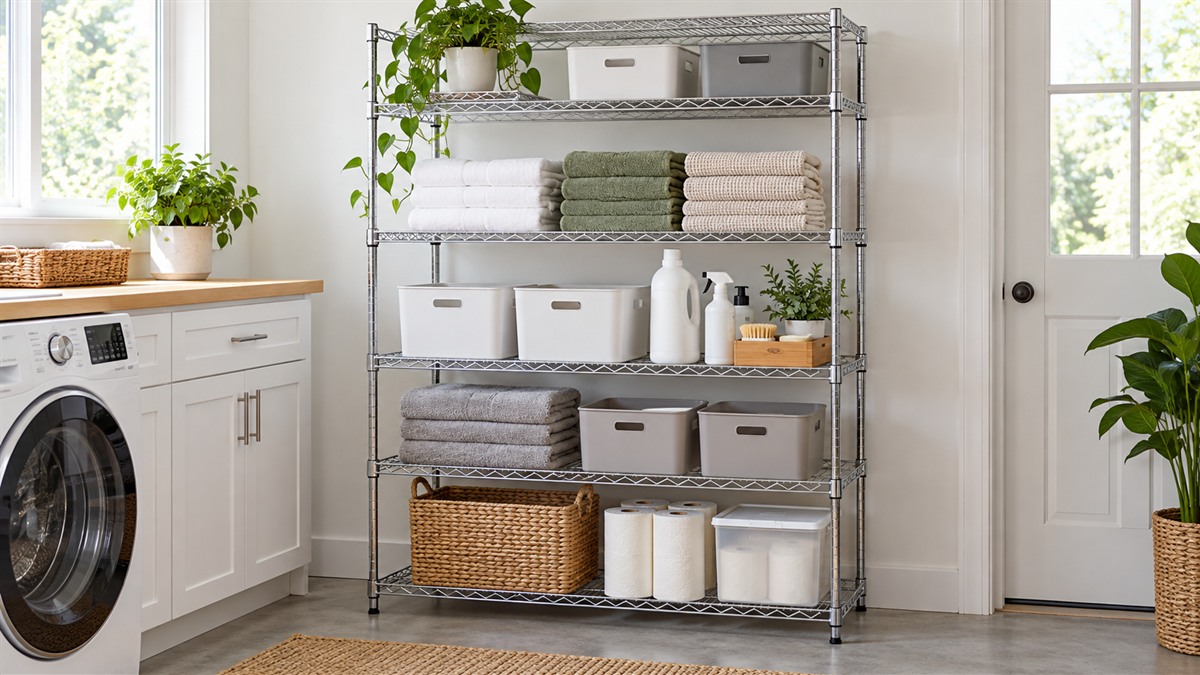
Seville Classics 5-Tier Steel Wire Shelving Review
A rolling wire rack earns its place in a garage, a classroom corner, or a home office when it can move with the job. The Seville Classics 5-Tier Steel Wire Shelving unit is built around that idea: five wire shelves, wheels for moving, leveling feet for standing still, and a black finish that suits a utility space. The facts below come from the product listing and seller description only. They have not been checked against a physical rack or measured, and several numbers conflict, which this review marks as Not confirmed rather than picking one.
Who this rack suits
This rack suits a person who needs open, adjustable storage that can be shifted around a room. A garage shelf for bins and paint cans, an office corner for printer paper and supplies, a dorm or home gym rack for towels and bags, and a classroom cart for materials all fit the layout. The listing names classroom, dorm room, garage, home gym, and office as room types, and home, kitchen, office, garage, bedroom, and closet as specific uses. Those labels are broad, which is useful: the same frame can change jobs as your needs change. For a 5-shelf metal option, see the 5-shelf metal storage rack guide.
It is a weaker choice if you need a fully enclosed cabinet, if you plan to store very heavy loads on the wheels, or if you need a wall-mounted shelf that stays fixed. The wheeled setup has a much lower load figure than the leveled setup, as explained below, so a rack that rolls with a full load is the wrong tool for a heavy job.
Dimensions and fit
The unit measures 30 inches wide, 14 inches deep, and 61.5 inches tall. The listing also gives a height of 60 inches when the unit sits on its leveling feet, which makes sense because the wheels add about an inch and a half. Those numbers matter in a tight space. Measure the footprint at 30 by 14 inches, then add the height on wheels when you check ceiling clearance, a light fixture, or a garage door track.
The listing gives a minimum required door width of 30 inches. That figure is a useful check for getting the rack through a doorway into a room, and it lines up with the unit’s own width. Tilting the frame to move it through a narrow opening can work, but measure the doorway and the path before you commit.
The shelves are 30 inches wide by 14 inches deep, so a bin or a box that is 14 inches deep fits without overhang. A deeper box will stick out past the front edge, so measure the contents you plan to store, not only the shelf.
One item field gives a second set of dimensions, 11.81 by 5.51 by 23.62 inches. That does not match the 30 by 14 by 61.5-inch figures, so the item-size field is Not confirmed. Use the main dimensions for planning, and check the carton size with the seller if you need to know box dimensions for delivery.
Load ratings and how to plan them
The listing gives two load figures, and the difference between them is the most important fact on the page. With the leveling feet in place, the description gives 1,500 pounds for the whole unit, which works out to 300 pounds per shelf. With the wheels in place, the description gives 110 pounds for the whole unit.
A separate attribute field lists 1,500 pounds as a minimum weight, which does not match the wheeled figure, so the headline capacity is Not confirmed. Plan around the lower number whenever the rack will roll. If you want to store heavy items such as tool boxes, paint, or stacked bins, set the unit on its leveling feet, lock the wheels, and load the shelves evenly, with the heaviest items low.
This split also tells you how to use the rack. Treat the wheels as a moving aid, not a load-bearing setup, and treat the feet as the setup for heavy storage. Put the heaviest item on the bottom shelf, spread the rest of the weight across the shelves, and avoid loading one corner.
Mobility: wheels and leveling feet
The unit has four 1.5-inch wheels, and two of them lock. The locks matter. A rack that rolls on a sloped garage floor or a classroom tile floor can drift, and a locked wheel keeps it in place while you load it. The four leveling feet are included as a second base. They help the frame sit flat on uneven concrete or a worn floor, and they lift the wheels off the floor when you need the rack to stay put.
The practical routine is simple: roll the rack into place, lock the two wheels, set the leveling feet so the frame sits flat, and only then add weight. Check the level before each heavy load, because a rack that sits unevenly can rack under load.
Shelf adjustment and layout
The five shelves adjust in 1-inch increments. That fine spacing lets you fit a tall paint can on a lower shelf and a shallow tray on a higher one without wasting space. Set the shelves before you load them, because moving a loaded shelf is awkward and can scrape the finish.
The listing describes the design as ideal for homes, businesses, offices, studios, garages, kitchens, and classrooms. The wire shelves are open, so you get airflow and visibility but not dust protection. Store items that are sensitive to dust in bins or covered boxes. For a kitchen wire option, see the free standing wire shelves for a kitchen guide.
Materials and finish
The product is black, with a powder-coated finish described for the steel frame. The description calls the frame solid steel. The material field, however, reads stainless steel. Those two descriptions do not agree, and the finish described is black powder coating, which is more typical of coated steel than stainless steel. The material is Not confirmed. If the metal type matters for your use, such as a damp area or a food-related use, ask the seller before buying.
The finish does not change the load figures, and it does not decide whether the rack is right for you. For most garage, office, and classroom uses, the black powder-coated look is a practical choice, since it hides scuffs better than bright chrome. For another metal shelving option, see the 5-tier metal shelving guide.
Assembly and parts
The included parts are five wire shelves, four steel poles of 3/4-inch diameter, four leveling feet, and 20 slip sleeves. Assembly instructions are provided. It does not give an assembly time, a recommended number of people, or a tool list. Plan for a flat floor and a free table or the floor itself for the frame.
Count the parts before you build. Twenty slip sleeves is a useful number: the sleeves hold the shelves on the poles, and a missing sleeve means a loose shelf. Lay out the shelves, poles, feet, and sleeves, then match them to the instruction diagram. Tighten each connection before you add weight.
Mounting: freestanding or wall-mounted
One field lists the mounting type as wall mount, while another lists the installation type as freestanding. The description supports freestanding use, with wheels and leveling feet, so the wall-mount reading does not match the rest of the page. The mounting type is Not confirmed. Use the rack as a freestanding unit, and do not plan to bolt it to a wall unless the seller confirms that the hardware is included and that wall mounting is supported.
What the specs mean for daily use
- The 30-inch width fits along a garage wall or into a classroom corner, and the shelves give you 30 inches of flat surface on each level.
- The 14-inch depth holds standard bins and boxes that are no deeper than 14 inches without overhang.
- The 61.5-inch height lets you stack several bins per shelf, but you need ceiling clearance once the wheels are on.
- The five shelves adjust in 1-inch steps, so you can sort tall paint cans, flat trays, and short bins onto the level that fits each one.
- The two locking wheels keep the rack still while you load it, which matters more than the rolling itself on a sloped floor.
- The four leveling feet give you a stable base, and they are the setup for any load you plan to keep in place.
- The open wire design lets air move through and keeps contents visible, but it does not protect items from dust.
- The 20 slip sleeves hold each shelf on its pole, so counting them before assembly is the quickest way to catch a missing part.
Questions to ask the seller before you buy
Several specifications on this page are Not confirmed, so a short message to the seller can close the gaps before you order:
- Is the 1,500-pound figure for the unit on leveling feet, and what is the total load when the unit sits on wheels?
- Is the frame steel with a black powder-coated finish, or stainless steel? The page gives both.
- Is wall mounting supported, and are any wall fixings included? The page gives both wall-mount and freestanding.
- What are the carton dimensions? The item-size field does not match the main dimensions.
- What warranty applies? The listing does not state a warranty period.
Who should skip it
Skip this rack if you need a fully enclosed storage cabinet or a shelf that resists dust, if you plan to roll a heavy load across the room, or if you need a wall-fixed shelf. Skip it if your doorway is narrower than 30 inches, or if your ceiling has less than about 62 inches of clearance once the unit sits on wheels. Skip it if you need a confirmed stainless finish for a wet or food-adjacent area, since the metal type is Not confirmed.
Category criteria for any wire shelving unit
When you compare any wire shelving rack, check the same five points. First, the footprint and the height on wheels and on feet. Second, the load figures for each setup, and whether the listing separates them. Third, the wheel locks and the leveling feet, which decide whether the rack is stable on your floor. Fourth, the shelf adjustment increment, since fine spacing fits more items. Fifth, the included parts: the number of sleeves, poles, and feet. A rack that answers all five with specific numbers is easier to plan around.
Decision checklist
Before you buy, confirm these items against your space:
- The 30-by-14-inch footprint fits the floor, with room to reach the shelves.
- The height on wheels clears your ceiling, fixtures, and door tracks.
- You plan to load heavy items only on the leveling feet, not on the wheels.
- The two wheel locks and the four leveling feet work on your floor.
- The 20 slip sleeves and five shelves match the count in the listing.
- The black finish and the metal type work for your space, with the metal type Not confirmed.
- The mounting is freestanding, since the wall-mount field is Not confirmed.
Worked example: the gap between the two setups
The feet setup is listed at 1,500 pounds for the whole unit and the wheeled setup at 110 pounds, so the difference is 1,390 pounds (1,500 – 110). The height gap is smaller: the unit is 61.5 inches tall on wheels and 60 inches on its feet, so the wheels add 1.5 inches (61.5 – 60). Plan the load around the 110-pound figure whenever the rack rolls, and keep the 1.5-inch wheel allowance in mind for ceiling clearance.
Frequently asked questions
Can I roll it with a full load? The wheeled figure is 110 pounds for the whole unit, so a full load is a poor idea on the wheels. Load it on the leveling feet instead.
Is it stable on a sloped floor? The listing does not describe the stability on a slope. Use the leveling feet and check the frame with a level before loading, and lock the wheels.
Can it hold a wall-mounted use? The mounting type is Not confirmed, and the description supports freestanding use. Do not plan a wall fixing unless the seller confirms the hardware.
What about the stated 1,500-pound load? The 1,500-pound figure appears with the leveling feet. The attribute field uses a minimum-weight label that does not match the wheels, so the headline capacity is Not confirmed. Plan around the feet figure only when the unit is set down.
Final verdict
The Seville Classics 5-Tier Steel Wire Shelving unit is a practical open rack for a garage, office, classroom, or home gym. Its 30-by-14-inch footprint is easy to place, the five shelves adjust in 1-inch steps, and the wheels with locks let you move it when needed. The leveling feet give you a stable base for heavy storage.
The load figures are the main gap. The description gives 1,500 pounds on the feet and 110 pounds on the wheels, and the headline capacity is Not confirmed, so treat the wheeled figure as the limit whenever the rack rolls. The metal type and the mounting type are also Not confirmed. If you can plan the load on the feet and keep the rack freestanding, it is a sensible open-shelf choice.
View the Seville Classics 5-Tier Steel Wire Shelving on Amazon