Best Small Bookcase for Nursery: How to Choose the Right Shelf
As an Amazon Associate we earn from qualifying purchases. Details
A small bookcase for nursery use has one job: put picture books within a child’s reach. The options in this guide are kids’ and Montessori-style bookshelves, not full adult bookcases. They differ in height, tier count, material and how much weight the listing says they can hold. This guide shows which listing details decide fit, how to think about safety in a room where children climb, and how to choose among the options. Read the listing figures closely, because several of them conflict.
Quick answer
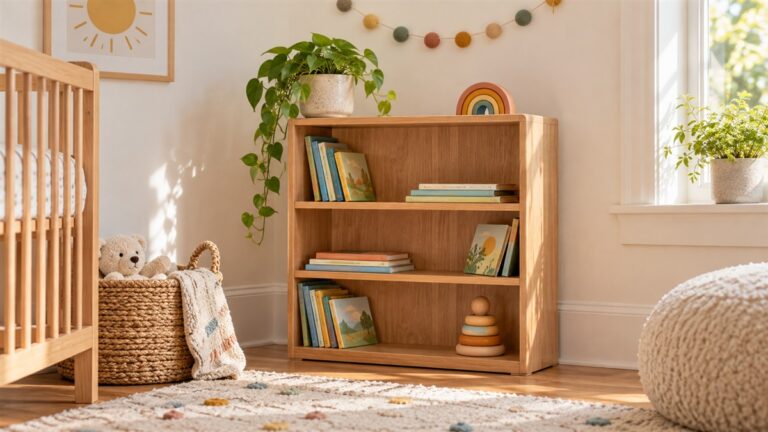
Choose a low, open wooden bookshelf with three or four tiers if your goal is a nursery shelf a toddler can reach without help. Choose a double-sided or sling-style shelf if you want covers facing the room. Choose a bamboo or fabric-pocket model only if you have checked the stated weight limit and are happy with a lighter build. The SpaceAid is a three-tier scalloped wooden shelf with a low height. Its listing says it fits a nursery or playroom, but it gives only a minimum weight figure, so check that before loading it.
What a nursery bookcase has to do
A nursery shelf has to serve three needs at once. It must be low enough for a young child to reach, stable enough that a climbing child cannot easily tip it, and small enough to fit a room that already holds a crib, a dresser and toys.
Reach matters most. Many of the listings in this comparison describe a low, open design that lets toddlers pick and return books on their own. That is a stated feature, not a guarantee of how any child will use it.
Stability matters second. Children like to climb on furniture, and unsecured furniture is a hidden hazard in every room. A nursery bookcase is still furniture, so treat it that way. Check whether the listing describes a wide base, a low center of gravity or any anti-tip support.
Size matters third. Most listings give outside dimensions. The space that matters is the inside of each tier, the height above each shelf and the room you have. Measure the wall or corner first.
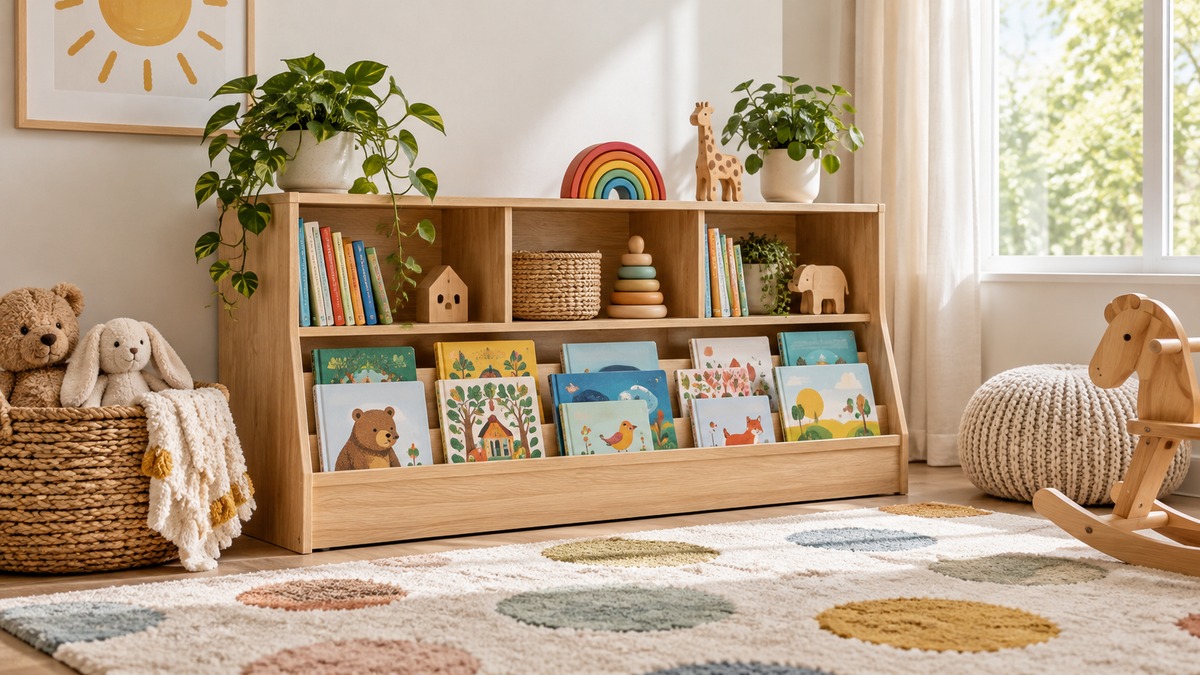
Front-facing or spine-facing display also changes the choice. Front-facing shelves show covers, which helps young children choose a book. Spine-facing shelves hold more books but hide the covers. Several listings in this set describe a front-facing sling design, so decide which you need before you compare numbers.
Reading the listing before you buy
Listings for children’s bookshelves are often inconsistent. The same figure may appear as a specification, a bullet and a title, and the three may not agree. Compare them before you trust any single number.
Start with the weight field. Some listings give a maximum weight. Others give a minimum, or give nothing at all. A minimum figure does not tell you how much the shelf can hold. Only a stated maximum gives you a limit to plan around, and even then the listing should say whether that figure applies per tier or to the whole unit.
Next, check the dimensions. Product dimensions, item dimensions and the size bullet should match. When they do not, rely on the dimension you measure yourself. The listing does not settle which figure is correct.
Then check the tier count. Some listings show one number in the specifications and a different number in the title or bullets. Count the tiers in the photos only as a rough guide, and treat the listing text as the stated figure.
Finally, look at assembly. The listings describe some options as tool-free and others as requiring a screwdriver or a drill. Read the assembly line in the specifications, not only the marketing bullet.
Safety in a room where children climb
Children like to climb on furniture. The US Consumer Product Safety Commission’s “Anchor It!” campaign exists to prevent furniture and TV tip-overs from killing and seriously injuring children. Its guidance is simple: existing furniture can be anchored with inexpensive anti-tip brackets, and new furniture often comes with anti-tip devices that should be installed right away.
Follow the manufacturer’s instructions when you secure any shelf. Do not skip the anti-tip hardware if the box includes it.
Remove tempting objects from the top of a bookcase. Toys and remote controls can lure a child to climb. Keep heavy items low, and keep the top of the shelf clear.
Wall fixing needs care. Find the wall type first. Drywall is a panel with paper facers that forms most interior walls. A stud finder helps you locate the framing behind it. Magnetic stud finders detect the metal fasteners that hold wallboard to studs, and electronic models sense changes in wall density. If studs are not where you need them, use rated anchors and follow the maker’s hardware notes. Do not assume a generic anchor will hold a load.
Freestanding shelves still need a plan. The listing may describe the unit as freestanding. That word describes how it is installed, not whether it can tip. Decide where the shelf will stand, and check that a child cannot pull it toward them from the front.
How to choose
Choose a low, open shelf with three or four tiers if:
- your child is in the toddler stage and needs to reach books without help
- the room has a clear corner or wall section for a shelf about this size
- you can check a stated weight figure before you load it
Choose a double-sided or sling-style shelf if:
- you want covers facing the room, so a child can see what each book is
- you have space for a shelf that is wider than it is tall
- you are comfortable with fabric pockets for board books and small items
Choose a bamboo or fabric-pocket model if:
- you want a lighter unit that is easier to move between rooms
- you have confirmed the stated maximum weight and it suits the books you own
- you accept that some listings give conflicting dimensions, which you will need to measure yourself
Skip a shelf with a stated minimum weight and no maximum if you plan to load it with many heavy books. Skip a shelf whose listing gives two tier counts until you confirm the number. You may not need a separate bookcase at all if a low shelf on a wall or in a closet already holds the books. For a broader look at small shelves, see small bookcases for a bedroom, bookshelves for a small room and small bedroom bookshelves.
1. SpaceAid 3-Tier Scalloped Bookshelf, Montessori Bookcase for Toddlers, Wooden Book Shelf Organizer (Low three-tier wooden shelf)
Specs from the listing (checked 2026-10-11):
- Product Dimensions: 10.7″D x 29.6″W x 27.6″H
- Number of Shelves: 3
- Item Weight: 7.53 kg
- Finish Type: Matte
- Installation Type: Freestanding
Pros
- The listing states a wood material with a matte finish and natural color
- The listing describes a low height for easy access by toddlers
- The listing states the installation type as freestanding, with three shelves
- The listing says the package includes clear assembly instructions
Cons
- The listing gives a weight capacity of minimum 3 pounds and no maximum figure
- The listing gives a minimum required door width of 29.6 inches without explaining it
- At 7.53 kg it is heavier to move than the lighter fabric options in this set
Best for: A parent who wants a low, open wooden shelf in a corner of a nursery or playroom.
Skip if: Skip it if you need a stated maximum weight before loading the shelf with books.
View on Amazon (affiliate link)
2. Solid Pine Wood Kids Bookshelf, Double-Sided Nursery Book Shelves, Portable Toddler Bookshelf (Double-sided pine and fabric shelf)
Specs from the listing (checked 2026-10-13):
- Product Dimensions: 17.7″D x 16.1″W x 12.6″H
- Item Weight: 3.8 pounds
- Installation Type: Freestanding
- Finish Type: Varnished
- Included Components: Anti-slip Pads, Handle Plate, Screw Set, Support Pole and Cloth, Triangle Plate
Pros
- The listing gives an item weight of 3.8 pounds, which is light for a wood shelf
- Four small pockets sit on the shelf for toys, pens and small items
- The listing says the kit includes anti-slip pads, a handle plate and a screw set
Cons
- The bullet gives 16 inches tall while the specification field gives 12.6 inches high
- The listing states that assembly is required but does not say which tools are needed
- The listing does not give a weight capacity
Best for: A family that wants a light, double-sided shelf with pockets for toys and books.
Skip if: Skip it if you need a stated weight limit or a confirmed height before you order.
View on Amazon (affiliate link)
3. LAMU Kids Bookshelf, 4 Tier Solid Pine Wood Toddler Bookshelf, Book Shelf for Kids Rooms, Portable (Four-tier open shelf)
Specs from the listing (checked 2026-10-13):
- Product Dimensions: 13″D x 28.5″W x 15.75″H
- Number of Shelves: 4
- Room Type: Nursery
- Installation Type: Freestanding
- Item Depth: 1.97 inches
Pros
- The listing names the nursery as the room type with four open tiers
- One bullet says it holds up to 20 books
- The listing describes a low, open design that lets toddlers reach books
Cons
- The item depth field gives 1.97 inches while the product dimensions give 13 inches deep
- The color field says Elephant while a bullet describes a soft sage color
- The listing does not state a weight capacity
Best for: A nursery where a toddler needs to reach a stack of picture books from a low shelf.
Skip if: Skip it if the color or depth matters to you, because the listing gives conflicting figures.
View on Amazon (affiliate link)
4. Toddler Bookshelf Double-Sided with 4 Tier Deep Sleeves Kids Wooden Montessori Book Rack for Baby (Double-sided four-tier toddler shelf)
Specs from the listing (checked 2026-10-13):
- Finish Type: Lacquered
- Number of Compartments: 4
- Included Components: Wooden Board, Wooden Rods, Fabric Cover, 16 Screws, Screwdriver
- Material: Wood
Pros
- The listing says the fabric cover can be removed for cleaning the pockets
- The kit includes a wooden board, wooden rods, a fabric cover, 16 screws and a screwdriver
- The listing states a lacquered finish on a wood frame with four compartments
Cons
- The listing gives no product dimensions at all
- The animal design is decorative, so the shape may not suit every room
Best for: A family who wants a double-sided wooden shelf with removable fabric pockets for frequent handling.
Skip if: Skip it if you need measured dimensions before you order, because the listing gives none.
View on Amazon (affiliate link)
5. Solid Pine Wood Montessori Bookshelf for Kids – 2-Tier Double Sided Toddler Book Organizer (Two-tier pine shelf with rounded corners)
Specs from the listing (checked 2026-10-13):
- Product Dimensions: 12″D x 15″W x 15″H
- Number of Shelves: 4
- Weight Capacity Maximum: 100 pounds
- Weight Capacity: Minimum weight: 100 pounds
- Finish Type: Lacquered
Pros
- The listing describes every corner as hand-polished into smooth, rounded edges
- The listing says it has a kid-safe water-based coating over solid pine
- The specification field states a maximum weight of 100 pounds
Cons
- The weight capacity field reads 100 pounds as both a maximum and a minimum
- The specification field gives 4 shelves while the title and bullets describe two tiers
- The included components line lists only a shelf
Best for: A parent who wants a rounded-corner pine shelf and is willing to confirm the weight figure first.
Skip if: Skip it if you need a clear weight figure, because the listing contradicts itself on it.
View on Amazon (affiliate link)
6. XiaZ Bookshelf for Kids Room Wooden Montessori Toddler Bookshelf Solid Pine C-Frame Child Book (C-frame shelf with a handle)
Specs from the listing (checked 2026-10-13):
- Product Dimensions: 16.7″D x 15.7″W x 11.8″H
- Weight Capacity Maximum: 20 pounds
- Item Weight: 2.7 pounds
- Number of Shelves: 4
- Product Care Instructions: Please note this bookshelf requires assembling, and it will take about 15 minutes to finish. And recommend to drill screws with screwdriver provided., Wipe with Damp Cloth
Pros
- The listing gives a maximum weight of 20 pounds, which is a stated limit
- The item weighs 2.7 pounds and has an integrated handle for carrying
- The listing says no wall anchors are needed and describes a low center of gravity
Cons
- One bullet says tool-free assembly while the care instructions say to drill screws with the screwdriver
- The listing does not say whether the 20-pound limit applies per shelf or to the whole unit
- The size field spells the size as Mdedium, which signals a listing error
Best for: A parent who wants a light shelf with a stated maximum and a handle for carrying between rooms.
Skip if: Skip it if you need a shelf with no tools at all, because the listing says the screws need a screwdriver.
View on Amazon (affiliate link)
7. PERFNIQUE Montessori Kids Bookshelf, Wooden Front-Facing Baby Bookcase Organizer for Toddlers (Four-tier sling shelf)
Specs from the listing (checked 2026-10-13):
- Product Dimensions: 15.7″D x 28.5″W x 12.6″H
- Number of Shelves: 4
- Finish Type: Painted
- Item Weight: 2.4 kg
Pros
- Pockets in different depths keep board books and picture books visible
- The listing states anti-tip support and non-slip pads
- The listing describes tear-resistant Oxford fabric with reinforced metal rods
Cons
- The shelf thickness field gives 15.7 inches, which does not describe a thickness
- The listing does not state a weight capacity for the unit
- The recommended use says storage while the specific use says decorative items
Best for: A nursery where a child will choose books from several depths of pocket.
Skip if: Skip it if you want a shelf made only of wood, because the listing says wood and fabric.
View on Amazon (affiliate link)
8. ELYKEN Bamboo Toddler Bookshelf, Nursery Book Shelves, Montessori Bookcase (Low bamboo shelf with a stated maximum)
Specs from the listing (checked 2026-10-13):
- Product Dimensions: 15.8″D x 29″W x 12.6″H
- Weight Capacity Maximum: 10 pounds
- Item Weight: 6 pounds
- Finish Type: Varnished
Pros
- The listing gives a maximum weight of 10 pounds and the field repeats it
- The listing states bamboo material with a varnished finish
- The listing describes smooth, rounded edges meant to protect small hands
Cons
- The item weight of 6 pounds is heavier than the lightest fabric options in this set
- The size field gives 15.6 inches and 12.8 inches, which differ from the dimensions of 15.8 and 12.6
- The minimum required door width of 3 inches does not describe the shelf's own size
Best for: A reader who wants a bamboo shelf with a clear, lower maximum weight for picture books.
Skip if: Skip it if you plan to load heavy hardcover books, because the listing states a 10-pound maximum.
View on Amazon (affiliate link)
9. AZSKY Double Sided Toddler Book Shelf, Small Wooden Book Storage for Kids, Brown Mini Children Book (Small double-sided pine shelf)
Specs from the listing (checked 2026-10-13):
- Product Dimensions: 14″D x 13.4″W x 14″H
- Number of Shelves: 2
- Item Weight: 1.5 kg
- Material: Pine
Pros
- The listing says it holds 15 to 20 books in its two shelves
- Two deep fabric pockets sit on both sides for books and magazines
- The listing describes pine wood that is easy to clean
Cons
- The specification block gives 14 inches deep while a bullet gives 15.7 inches long
- The listing gives no weight capacity
- The finish type field repeats the word pine rather than naming a finish
Best for: A small room or a corner where a compact double-sided shelf fits the space.
Skip if: Skip it if you need one wide shelf or a stated weight limit, because the listing gives neither.
View on Amazon (affiliate link)
Products that fit this
Each shelf below is a kids’ bookshelf that the listing describes for a nursery, toddler room or playroom. The write-ups focus on what the listing says and what to check before you buy.
SpaceAid: a three-tier scalloped shelf for a low nursery corner
This listing gives a single tier count with no conflicting figure. Its outside size is 10.7 inches deep, 29.6 inches wide and 27.6 inches high. That height is the tallest in this set, so check the placement against the wall and the child’s reach. The listing states Matte finish and Natural color, with a wood material. Check the Minimum Required Door Width field, which the listing gives as 29.6 inches; it does not explain what that means for a room without a door, so ask the seller. The item weighs 7.53 kg, which is heavier to move than the lighter fabric options.
A double-sided pine and fabric shelf
This shelf combines solid pine with fabric pockets in a double-sided frame. The listing says it has four small pockets for toys and pens. Its specification block gives an item weight of 3.8 pounds. The listing’s dimensions conflict: one bullet says 16 inches tall, while the specification field gives 12.6 inches high. Rely on neither until you measure your own space. The listing states that assembly is required but does not say which tools are needed.
LAMU: a four-tier open shelf for a nursery
This four-tier shelf is open and sits low to the floor. Its listing names the nursery as the room type and describes four spacious open tiers. One bullet says it holds up to 20 books. The item depth field says 1.97 inches, while the product dimensions say 13 inches deep. The color field says Elephant, but a bullet describes a soft sage color. The listing does not state a weight capacity. Check both conflicts before you choose a color for the room.
A double-sided toddler shelf with four tiers
This shelf is built from wood with a lacquered finish and fabric pockets. The listing says the fabric cover can be taken off for cleaning, which helps if children handle the shelf often. The kit includes a wooden board, wooden rods, a fabric cover, 16 screws and a screwdriver. The listing gives no product dimensions at all. If your space is tight, you will need to ask the seller for measurements before ordering.
A two-tier pine shelf with rounded corners
This pine shelf has rounded corners and a lacquered finish. The listing says it has a kid-safe water-based coating. Its specification block gives a 100-pound maximum weight, but the same field also reads 100 pounds as a minimum. The shelf count is also in conflict: the specification field says 4, while the title and bullets describe a two-tier design. Check the weight field and the tier count with the seller before you buy.
XiaZ: a C-frame shelf with a handle
This C-frame shelf is made from pine with nylon and Oxford cloth. The listing gives a maximum weight of 20 pounds and an item weight of 2.7 pounds. A handle lets an adult carry it between rooms. The listing says no wall anchors are needed, and it claims a low center of gravity. The assembly claims conflict, though. One bullet says tool-free assembly in under 10 minutes, while the care instructions say to drill the screws with the screwdriver provided and that assembly takes about 15 minutes. Treat the tool claim as unresolved.
PERFNIQUE: a four-tier sling shelf with varied pocket depths
This shelf uses wood with reinforced metal rods and Oxford fabric. Its pockets come in different depths so that board books, picture books and bedtime stories all stay visible. The listing says it has anti-tip support and non-slip pads. The specification block gives 15.7 inches as a shelf thickness, a figure that does not look like a thickness. Ask about the limit before you load it with heavy books.
ELYKEN: a low bamboo shelf with a stated maximum weight
This bamboo and Oxford cloth shelf has low, open shelves and a triangle frame. The listing gives a maximum weight of 10 pounds and an item weight of 6 pounds. Its size field differs slightly from the product dimensions: 15.6 inches and 12.8 inches against 15.8 inches and 12.6 inches. The listing also gives a minimum door width of 3 inches, which does not describe the shelf’s own size. Measure the space you plan to use rather than relying on the door figure.
AZSKY: a small double-sided pine shelf with two shelves
This small pine shelf is double-sided, with two shelves and two deep fabric pockets. It is one of the smallest in the set on the listing’s own dimensions, at 14 inches deep, 13.4 inches wide and 14 inches high. The listing says it holds 15 to 20 books. Its depth and length figures conflict: the specifications say 14 inches deep, while a bullet says 15.7 inches long. Rely on your own measurement for the space it will occupy.
How many shelves for a room of books
Suppose you have 60 picture books. One listing in this comparison says its shelf holds up to 20 books. Use that number only as a rough figure. Check the actual capacity of the shelf you buy.
Step 1: 60 ÷ 20 = 3 shelves needed for the books.
Check: 3 × 20 = 60, so the shelf count covers every book.
Step 2: if you want one empty shelf for new books, add one more tier. That gives 3 + 1 = 4 tiers.
This is a rough plan. Books vary in size and thickness, so a shelf that holds 20 slim books may hold far fewer thick ones. Measure your books before you buy.
Mistakes to avoid
Buying on the weight figure alone is the first mistake. A minimum weight figure is not a maximum, and a listing that gives both can still contradict itself.
Trusting one tier count is the second. Several listings in this set give more than one count. Confirm the number before you plan the shelf.
Assuming the box has everything you need is the third. Some kits include screws and a screwdriver. Others include only the shelf. Read the included components line before you order.
Leaving the top of the shelf open to climbing is the fourth. Clear the top, keep heavy items low, and fix the unit where the listing or the maker’s instructions say.
Ignoring the door or hallway path is the fifth. A shelf that fits the wall may not fit through the door when you move it.
Choosing a bookcase when a low shelf would do is the last. Some families need only a few books within reach, and a small wall shelf can do that job.
FAQ
Is a small bookcase for nursery use the same as a Montessori bookshelf?
Not always. Montessori-style shelves are low and open, and the listings in this guide use that word often. The name describes the design goal of letting children reach books. It does not mean a specific weight limit or a specific safety rating. Read the listing’s stated figures before you compare shelves.
How do I know a shelf will not tip over?
No listing can promise that. Look for a wide base, a low center of gravity, anti-tip hardware or a wall-fixing option. Follow the maker’s instructions and keep heavy items low. If the listing gives no anti-tip hardware, ask the seller or check the manual before you place the shelf in a play area.
How much weight can a nursery bookshelf hold?
It depends on the listing. Some list a maximum, some list a minimum, and some list nothing. Only a stated maximum gives you a number to plan around. Check whether that figure applies to each tier or to the whole unit.
Should I anchor a nursery bookshelf to the wall?
The listings in this set do not all say whether anchoring is needed. For a wall-fixed or tall unit, find the studs or use rated anchors, and follow the maker’s hardware notes. Do not assume a generic anchor will carry a set load.
Which is better for a toddler, front-facing or spine-facing?
Front-facing shelves show covers, which helps a toddler pick a book. Spine-facing shelves hold more books in less width. For a child who is still learning to choose books, front-facing is usually the better fit, and several listings describe that design.
Can I put the shelf in a closet?
Possibly, if the closet has clear floor space and the shelf fits the door opening. Measure the closet interior and the door, because a shelf that fits the closet may not fit through the door.
Are fabric-pocket shelves easy to clean?
Some listings say the fabric cover can be taken off or wiped. Others describe a wood finish that can be wiped with a damp cloth. Check the care instructions in the listing, and follow the maker’s cleaning method.
Bottom line
Choose a low, stable shelf whose listing states a clear maximum weight and a single tier count. Choose a front-facing or double-sided design if covers need to show. Choose a bamboo or fabric model only if you have checked the figures and accept a lighter build. If the listing gives a minimum weight but no maximum, or two different tier counts, ask the seller before you buy. You may not need a separate bookcase at all if a low shelf in the room already holds the books.
Sources
- CPSC Anchor It campaign: children like to climb on furniture, and anti-tip brackets can secure furniture that could tip.
- Stud finder (Wikipedia): explains that stud finders locate framing and how magnetic and electronic models differ.
- Drywall (Wikipedia): describes drywall as a panel with paper facers used in interior walls.