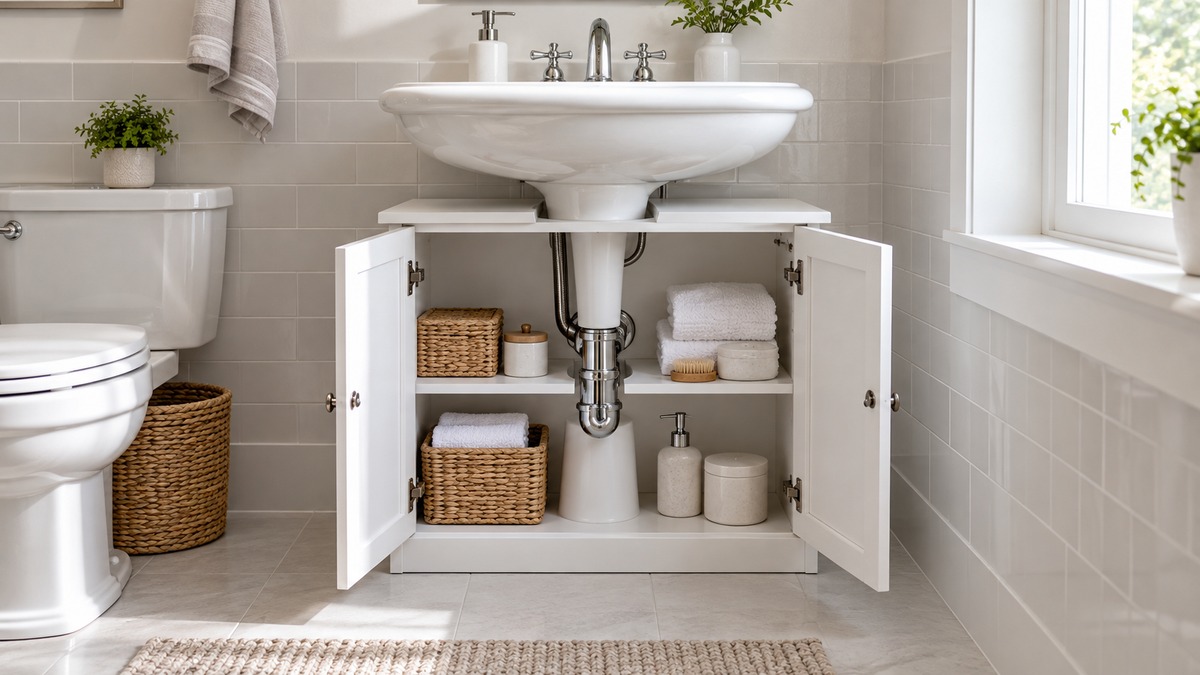
Best Pedestal Sink Shelves: Two Cabinets Compared
As an Amazon Associate we earn from qualifying purchases. Details
Pedestal sink shelves are the cabinets and shelving units that sit around the base of a pedestal sink, and many of them have a U-shaped cutout for the pipes. This guide compares the two options covered here. It sets out what each listing states about width, depth, cutout size, shelf count, doors and assembly, and it points out where a listing disagrees with itself. It also gives a measuring method for your own sink, because the cutout decides whether a cabinet fits at all.
Quick answer
Choose the wider cabinet if your floor space is at least as wide as its listed 35.4 inches and you want two adjustable shelves inside. Choose the narrower four-door-rack cabinet if your bathroom is small and you need door racks for bottles and small items. Its listed width is 23.6 inches. In both cases, check the U-shaped cutout against your pipes before you buy, because a cutout that misses the pipes makes either unit unusable.
What matters for pedestal sink shelves
Four things change which cabinet fits a pedestal sink. Check each one against your bathroom before you read the picks.
Cutout fit around the pipes
The cutout is the measurement that matters most. The wider cabinet’s listing gives a top and middle U-shape cutout of 7.9 inches by 7.9 inches, and a bottom cutout of 8.7 inches by 7.9 inches. The narrower cabinet’s listing gives a U-shaped cutout of 7.9 inches wide by 6.7 inches deep. Measure the pipe position, the sink base width and the distance from the wall to the pipes, then compare those numbers with the listed cutouts.
Width, depth and height
Measure the floor, not only the wall. The wider cabinet is listed at 35.4 inches wide, 12 inches deep and 23.5 inches high. The narrower cabinet is listed at 23.6 inches wide, 13.8 inches deep and 23.6 inches high. The narrower cabinet is deeper, so it may stick out further from the wall than the wider one. Compare the depth with the space from the wall to the front edge of the sink.
Shelves, doors and inside storage
The two listings describe storage differently. The wider cabinet includes two doors, adjustable shelves and an enclosed compartment. Its shelf count is contradictory: one field says three shelves and another says two. The narrower cabinet lists four shelves, two doors and four built-in door racks with guardrails that keep toiletries from tipping over or dropping out. The listing does not state the size of the door racks, so measure a bottle before you assume it will fit.
Weight, assembly and material
The wider cabinet lists an item weight of 12.8 kg and says assembly is required. Its material is engineered wood, and its bullets describe MDF board. The narrower cabinet lists 22.9 pounds as the item weight and 26.1 pounds as the gross weight. Its bullets describe EPA-grade particleboard. Particle board is an engineered wood product made from wood chips and a resin, pressed under heat. It is the lightest and weakest type of fiberboard, so keep the base dry and read the listing’s moisture notes before you install it.
How to choose
Choose the wider cabinet when your floor space is generous, your pipes sit inside the 7.9-inch-wide cutout range, and you want shelves that you can move up or down. The listing says the shelves offer three height settings. That flexibility helps when you store tall bottles on one shelf and towels on another. For more under-sink options, see pedestal sink storage cabinets.
Choose the narrower cabinet when your bathroom is small, your sink base is about 23.6 inches wide, and you want door racks for small bottles. The listing describes it as a fit for small bathrooms and says the deeper top surface holds facial wash and skincare supplies. Check the cutout first, because its listed depth is 6.7 inches and that is the number your pipes must clear.
Choose neither if your pipes sit outside both cutout ranges. In that case, a plumber should review the pipe layout before you buy any cabinet. For organizers that fit in the same space without a cabinet, see pedestal sink organizers and under-sink organizers.
If most of what you store is hidden, the wider cabinet’s enclosed compartment keeps cleaning supplies out of sight. If most of what you store is small and needs quick access, the narrower cabinet’s door racks put bottles within reach each time you open a door. Decide which storage style matters more before you compare the sizes.
What the listings leave out
Neither listing states a load rating for the shelves, so the safe weight of a full cabinet is unknown from the page. Neither listing states a warranty period. The wider cabinet’s listing does not give the size of its enclosed compartment, and the narrower cabinet’s listing does not give the depth of its door racks. Those gaps matter if you store heavy cleaning bottles or tall jars. Ask the seller, or check the details panel on the product page, before you buy.
The picks
Both picks are floor-standing cabinets with a U-shaped cutout. The sections below give one write-up per pick. Read them, then compare the listed sizes with your own measurements.
TEENFON: wide two-door cabinet with adjustable shelves
This cabinet is the wider of the two, listed at 35.4 inches across. It has two doors, a flat-panel door style and an enclosed compartment, and the listing describes two adjustable shelves. The listing describes three open shelves for commonly used bathroom essentials, which adds to the shelf-count question. The listing says assembly is required and includes the doors and shelves in the package.
Keehusux: four-door-rack cabinet for a smaller bathroom
This cabinet is narrower, at 23.6 inches wide, and its listing describes four built-in door racks. The cabinet is 13.8 inches deep, which gives the top surface more room than the TEENFON’s 12-inch depth. The listing describes elevated legs and anti-slip foot pads for stability. Its cutout is 7.9 inches wide and 6.7 inches deep. The listing’s door racks are a useful feature for small bottles, but they are not sized in the listing, so measure before you buy.
1. TEENFON 35.4″ Pedestal Sink Storage Cabinet with 2 Doors and Adjustable Shelves, Bathroom Sink (Best for a wide sink base)
Specs from the listing (checked 2026-10-16):
- Number of Shelves: 3
- Number Of Shelves: 2
- Product Dimensions: 12″D x 35.4″W x 23.5″H
- Installation Type: Undercounter
- Storage Options: 2 adjustable shelves, 1 enclosed compartment
- Mounting Type: Floor Mount
Pros
- The listing gives an overall size of 35.4 inches wide, 12 inches deep and 23.5 inches high, which leaves room for a wide interior.
- The listing describes two adjustable shelves with three height settings, and includes doors and shelves in the package.
Cons
- The listing contradicts itself on shelf count, with one field reading 3 and another reading 2.
- The installation type reads undercounter while the mounting type reads floor mount, so confirm how the cabinet will stand before you order.
Best for: A bathroom with floor width for a wide base and a pipe layout that sits inside the listed cutout.
Skip if: Skip it if your sink base is narrower than the listed width, or if you need exactly three shelves.
View on Amazon (affiliate link)
2. Keehusux 13.8″D Pedestal Sink Storage Cabinet with 4 Door Shelves, White (Best for smaller bathrooms with door racks)
Specs from the listing (checked 2026-10-16):
- Number of Shelves: 4
- Product Dimensions: 13.8″D x 23.6″W x 23.6″H
- Number of Doors: 2
- Item Weight: 22.9 pounds
- Finish Types: White
Pros
- The listing describes four built-in door racks with guardrails that keep stored toiletries from tipping over or dropping out.
- The listing gives an overall size of 23.6 inches wide, 13.8 inches deep and 23.6 inches high, and says it fits small bathrooms.
Cons
- The listing does not state the size of the door racks, so a tall bottle may not fit.
- The item weight is 22.9 pounds and the gross weight is 26.1 pounds, so plan for two people to lift it.
Best for: A small bathroom where door racks and a deeper top surface matter more than wide interior shelving.
Skip if: Skip it if you need more interior width, or if your sink base is wider than 23.6 inches.
View on Amazon (affiliate link)
Does the cabinet fit your floor space?
Suppose the open floor between the walls is 36 inches. Start with the wider cabinet. Subtract its listed width from the open floor, so 36 minus 35.4 equals 0.6. That leaves 0.6 inches of clearance, which is very tight and may leave the cabinet touching a wall or trim.
Now try the narrower cabinet. Subtract its listed width, so 36 minus 23.6 equals 12.4. That leaves 12.4 inches to spare, which gives you room for a side shelf or a towel bar. Next, check depth. Suppose the space from the wall to the front edge of your sink is 12 inches. The wider cabinet’s 12-inch depth fits that space exactly, while the narrower cabinet’s 13.8-inch depth is more than 12 inches, so it will project past the sink front. Recheck both subtractions before you order, and measure the actual space, because trim, pipes and the wall surface can take up room that this example does not include.
Mistakes to avoid
The first mistake is measuring the sink but not the cutout. A cabinet that is the right width can still have a cutout in the wrong place. Measure the pipe position from the wall and from the floor, then compare those numbers with the listed cutouts.
The second mistake is trusting one shelf count. The wider cabinet’s listing gives two shelf counts, so count the shelves you actually receive and confirm the number before you plan storage around it.
The third mistake is placing bottles in door racks without checking their size. The listing does not state the rack dimensions, so a tall bottle may not fit a rack that looks deep enough in a photo.
The fourth mistake is ignoring the mounting type. One listing gives undercounter as the installation type, and the same listing gives floor mount for the mounting type. Decide how the cabinet will stand before you assemble it.
The fifth mistake is choosing from the photo alone. A photo can show a cabinet that looks wider than the listed size, so compare the listed numbers with your own tape measure before you decide.
The sixth mistake is skipping the moisture check. Water left on a base can damage the material over time. Wipe up spills, keep the base dry, and follow the maker’s care notes.
Measuring checklist before you order
Work through these steps before you compare the listed sizes. Write down each number so you can check it against the listing.
- Measure the open floor width between the walls, and subtract the gap you want on each side.
- Measure the pipe position from the wall and from the floor, then compare those numbers with the cutout sizes in each listing.
- Measure from the wall to the front edge of the sink, because a deeper cabinet may stick out past the sink front.
- Note the wall type. If you plan to anchor a tall cabinet, read the maker’s instructions for the hardware that suits your wall.
- Check the floor for slope. A floor-standing cabinet on an uneven floor can rock, so use leveling feet if the product includes them.
FAQ
Will a pedestal sink cabinet fit around the pipes?
It depends on the cutout. Measure the pipe position, then compare that position with the listed cutout width and depth. A cabinet with the right width but the wrong cutout will not sit flat.
Are these cabinets for a pedestal sink only?
The narrower cabinet’s listing says it works with most pedestal and wall-mounted sinks. Check the photos and the cutout dimensions against your own sink before you order, because a listing cannot cover every sink style.
Can I store bottles in the door racks?
The narrower cabinet’s listing describes four built-in door racks. It does not state their size, so measure a bottle and compare it with the rack width before you buy.
How many shelves will the wider cabinet have?
The listing gives two different shelf counts. One field says three shelves and another says two. Confirm the number on the product page, and plan storage around the count you receive.
Do I need to assemble these cabinets?
The wider cabinet’s listing says assembly is required and includes picture instructions. The narrower cabinet’s listing includes an instruction booklet and a tools bag. Both listings describe some assembly, so set aside time before you plan to use the space.
Should I anchor a pedestal cabinet to the wall?
These cabinets are not tall, but the U.S. Consumer Product Safety Commission advises anchoring furniture that can tip, and says existing furniture can be anchored with inexpensive anti-tip brackets. The wider cabinet’s listing mentions anti-tipping. Follow the maker’s instructions for any hardware, and check the wall type first.
Is particle board a good material for a bathroom?
Particle board is an engineered wood product made from wood chips and a resin, and it is the lightest and weakest type of fiberboard. Some listings mention a moisture-resistant finish, but keep the base dry, wipe spills and read the listing’s care notes.
Bottom line
Choose the wider cabinet if you have the floor width, your pipes sit inside its cutout, and you want adjustable shelves. Choose the narrower cabinet if your bathroom is small and you want door racks and a deeper top surface. Choose neither if the cutout misses your pipes. Before you check out, measure the cutout, the floor width and the depth to the sink front, then confirm the shelf count on the listing.
Sources
- Particle board: what particle board is and how it compares with other fiberboard
- U.S. CPSC, Anchor It!: anti-tip brackets for furniture that can tip