Best Thin Shoe Organizer for Narrow Closets and Entryways
As an Amazon Associate we earn from qualifying purchases. Details
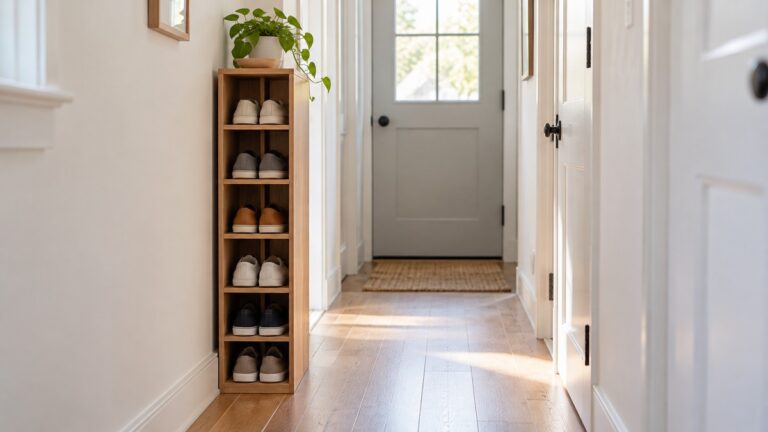
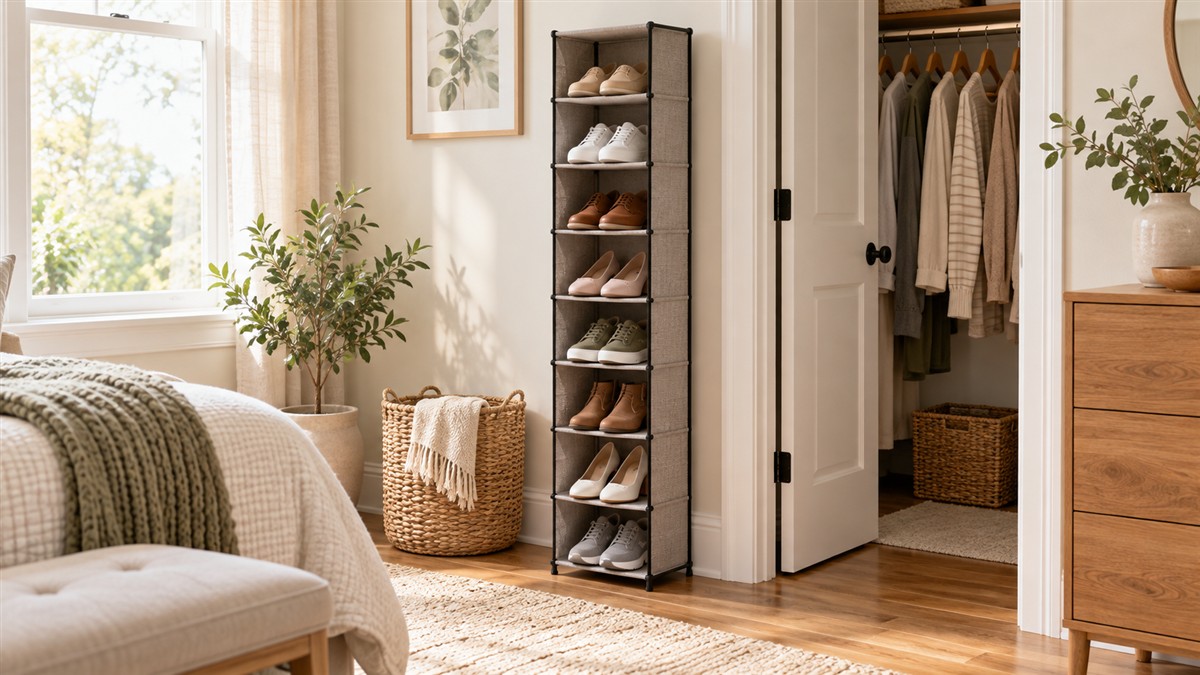
A thin shoe organizer is a shoe rack or cabinet with a slim footprint, built to fit a narrow closet, a gap by the entry door or a hallway wall. Thin can mean two different things. It can mean shallow depth from front to back, or it can mean a narrow width side to side. This guide compares three listings that describe themselves as narrow or slim, explains which measurement matters for your space, and shows how to read each listing before you order.
Quick answer
Choose the narrowest width you can fit when your gap is tight on the side and you have floor space for a tall unit. Choose a shallow-depth cabinet when the gap is shallow and you have room side to side. Pick an enclosed unit if dust or pets are a concern, and an open rack if you want quick access. Whichever you choose, check the listed height, the anti-tip hardware and the stated weight before you load it with shoes.
What matters for a thin shoe organizer
Five details change with this keyword, and each one comes from a measurement or a listed feature.
- Depth versus width. A shoe rack can be shallow and wide, or deep and narrow. The VILICK listing gives 11.8 inches deep and 17.7 inches wide. The QIVOMIX listing gives 9.4 inches deep and 31.5 inches wide. Decide which dimension your space limits before you compare capacities.
- Pairs stored versus footprint. Capacity claims are only useful next to a footprint. The VILICK listing says it holds 18-22 pairs, and the QIVOMIX listing says about 14 pairs of adult shoes. Compare pairs per square inch of floor, not the headline number alone.
- Height and anti-tip hardware. A tall shoe rack can tip. The U.S. Consumer Product Safety Commission’s Anchor It! campaign advises that existing furniture can be anchored with anti-tip brackets. The QIVOMIX listing includes an anti-tipping device. The VILICK and Tujurich listings do not state one, so plan a wall anchor if you choose either of them.
- Enclosure and dust protection. A cover or a door keeps shoes dust-free. The VILICK rack has a dust cover with a zip. The Tujurich cabinet has flip-up doors. The QIVOMIX cabinet has flip drawers, and the listing describes them as doors in one bullet.
- Stated weight. Shelves carry different loads. The VILICK listing states up to 10 lbs per layer. The QIVOMIX listing states that its top holds up to 80 pounds. The Tujurich listing does not state a weight capacity.
Products that fit this
Three listings in the research set describe themselves as narrow, slim or space-saving shoe storage. Each card below shows that listing’s own specifications and its fit evidence.
1. VILICK Shoe Rack with Cover Narrow Shoe Organizer with 4 Side Pockets 10 Tier Tall Shoe Storage (Best for a tight gap)
Specs from the listing (checked 2026-10-13):
- Product Dimensions: 11.8″D x 17.7″W x 62.2″H
- Weight Capacity Maximum: 50 pounds
- Number of Shelves: 10
- Mounting Type: Floor Mount
- Material: Fabric, Metal, Plastic
Pros
- The listing gives 17.7 inches wide and 11.8 inches deep.
- The listing says the cover has four side pockets for keys and small items.
- The listing says it stores 18-22 pairs of shoes.
Cons
- The listing states up to 10 lbs per layer and a 50-pound maximum without saying how the two figures relate.
- The listing does not state an anti-tip device, and at 62.2 inches tall the unit is tall.
Best for: Narrow gaps with floor space for a tall unit and room for a wall anchor.
Skip if: You need a built-in anti-tip device or a rigid cabinet with solid doors.
View on Amazon (affiliate link)
2. Shoe Cabinet Storage, Modern Freestanding Organizer with 2 Flip Drawers, Narrow Shoe Rack (Best for shallow spaces)
Specs from the listing (checked 2026-10-13):
- Product Dimensions: 9.4″D x 31.5″W x 38″H
- Weight Capacity Maximum: 80 pounds
- Additional Features: Anti-Tipping Device
- Number of Drawers: 2
- Material: Engineered Wood
Pros
- The listing includes an anti-tipping device that can be fixed to the wall.
- The listing says the thickened top can withstand up to 80 pounds.
- At 9.4 inches deep, it is the shallowest of the three listings.
Cons
- At 31.5 inches wide, it needs more width than the other two picks.
- The title says flip drawers while one bullet says two-door, so confirm the front style.
Best for: Entryways and hallways where depth is limited but about 31.5 inches of width is available.
Skip if: Your gap is narrower than 31.5 inches or you want many tiers instead of one cabinet.
View on Amazon (affiliate link)
3. 6-Tier Shoe Storage Cabinet with Fabric Cover, Hard Flip Doors, Holds 18–24 Pairs, Enclosed (Best for covered storage)
Specs from the listing (checked 2026-10-13):
- Product Dimensions: 12″D x 27.8″W x 41.9″H
- Number of Doors: 3
- Number of Shelves: 6
- Mounting Type: Floor Mount
- Top Material Type: Fabric
Pros
- The listing describes a slim depth of 12 inches with a narrow profile.
- The listing says the enclosed flip-up doors keep dust and pets away from shoes.
- The listing says the fabric interior wipes clean with a damp cloth.
Cons
- The listing's specifications give six drawers and three doors, while the title and bullets describe six tiers behind flip-up doors.
- No weight capacity is stated in the listing, and no anti-tip device is described.
Best for: Entryways and closets where covered storage and a narrow profile matter more than weight limits.
Skip if: You need a stated weight figure or an anti-tip device for a tall unit.
View on Amazon (affiliate link)
How to choose between them
Start with the gap, not the product. Measure three things: the width of the opening at the narrowest point, the depth from the front edge to the back wall, and the height you can use before a ceiling, a shelf or a light fixture gets in the way. Write each number on paper before you open a listing. Then compare the listed dimensions, not the marketing words.
Choose the VILICK rack if your gap is narrow and you have floor space for a tall unit. Its listed width of 17.7 inches and depth of 11.8 inches make it the narrowest of the three in width. It stores 10 tiers, and the listing says it holds 18-22 pairs. Skip it if you need an anti-tip device, because the listing does not describe one, or if you need a rigid cabinet, because its shelves are fabric.
Choose the QIVOMIX cabinet if your gap is shallow and you have about 31.5 inches of width to spare. Its listed depth of 9.4 inches is the shallowest of the three. The listing includes an anti-tipping device that can be fixed to the wall, and the top is described as able to hold up to 80 pounds. Skip it if your width is less than 31.5 inches, or if you want many tiers rather than one enclosed cabinet with a top surface.
Choose the Tujurich cabinet if you want covered, dust-protected storage with a narrow profile. The listing describes a slim depth of 12 inches and flip-up doors that keep shoes dust-free. Skip it if you need a stated weight figure, because the listing does not give one, or if you want a tall unit with an anti-tip device.
Read the specifications against the bullets before you buy. The Tujurich specifications list six drawers and three doors, while its title and bullets describe six tiers behind flip-up doors. The listing does not settle the front style, so ask the seller to confirm before you order. The VILICK listing lists 10 shelves, and its bullet says the rack can be split into several low shelves, which changes how you use the unit.
If you are choosing between a narrow rack and a wider organizer for the same wall, compare the best closed shoe organizer and the best shoe organizer for top of closet guides. They cover the enclosed and overhead layouts that a thin rack does not always solve.
Measuring a narrow gap and planning the fit
Most fit problems come from the wrong measurement, not from a weak rack. Measure the narrowest point of the gap, not the wall at the entrance. Measure the depth at the height where the top of the organizer will sit. Check for baseboards, door swing and any radiator or vent that pushes into the space.
Next, allow for the door. If the gap sits beside a door, a tall rack can block the swing or catch the door handle. Open the door fully and check the clearance with a tape measure. A rack that clears the door when closed may still hit it when opened.
Then decide where the unit will stand. A tall organizer should sit against a wall, and it should not stand alone in a room with children or pets. The CPSC advice is to anchor tall furniture and to follow the maker’s instructions. If the listing has no anti-tip device, plan an anchor that suits your wall, such as a stud mount. Check the wall type first, because drywall and masonry need different hardware.
Finally, count your pairs honestly. A listing that says 18-22 pairs assumes a certain mix of shoes. Boots, sandals and tall heels use more space than flats. Measure your own collection and leave room for growth before you commit to one unit.
If none of the three listings fits the gap, a shorter organizer may serve you better. A low unit keeps the heaviest shoes within easy reach and lowers the tip-over concern that comes with height. Compare the best tall narrow shoe cabinet with doors guide for a tall option with doors, and the best shoe storage for small closet guide for compact layouts that stay low.
Who may not need a thin organizer
Some closets do not need a thin unit at all. If the gap is wide enough for a standard rack, a thin model may hold fewer pairs than you expect. If you own only a few pairs, one shelf on the floor or a simple over-the-door rack may do the job. A thin organizer earns its place when the gap is narrow, the shoes are numerous, and the wall is solid enough to take an anchor.
Also consider whether the storage needs to be enclosed. Open racks show every pair and let you grab one quickly. Enclosed cabinets hide the clutter and protect shoes from dust, but they can make it harder to see the pair you want. Decide which trade-off suits your routine before you pay attention to the capacity numbers.
Worked example: planning a narrow entry gap
Step 1. Compare the width. The VILICK listing gives 17.7 inches wide. 20 minus 17.7 equals 2.3. That leaves 2.3 inches of side clearance, which fits. The QIVOMIX listing gives 31.5 inches wide, and the Tujurich listing gives 27.8 inches wide. Both are wider than 20 inches, so neither fits this gap.
Step 2. Compare the depth. The VILICK listing gives 11.8 inches deep. 13 minus 11.8 equals 1.2. That leaves 1.2 inches of clearance from the back wall, which is a small margin for a stud mount and a cover.
Step 3. Compare the pairs. The VILICK listing says 18-22 pairs. Your 20 pairs sit inside that range. If you use the lower end of 18 pairs, 20 minus 18 equals 2, so you would have two pairs left for the rest of your collection.
Step 4. Decide. In this gap, only the VILICK rack fits by width, and it leaves a small margin for depth. The result depends on your own measurements. Repeat the steps with your numbers before you choose.
Mistakes to avoid
- Trusting the headline capacity. A listing that says 18-22 pairs assumes a particular mix of shoes. Boots and heels take more room than flats.
- Ignoring the anti-tip hardware. A tall rack without an anti-tip device needs a wall anchor, and the anchor must suit your wall.
- Measuring the wall, not the gap. The narrowest point of the gap decides whether the unit fits.
- Forgetting the door swing. A rack that clears the door when closed can still hit it when the door opens.
- Loading the top shelf first. Heavy boots belong on lower tiers. Keep the heaviest items low, and check the stated weight per layer before you load.
- Assuming all thin racks are shallow. One of the three listings is wide but shallow, and another is narrow but deep. Measure both dimensions.
FAQ
What does thin mean for a shoe organizer?
It usually means a slim footprint, either shallow from front to back or narrow from side to side. Measure both dimensions of your gap before you decide which one matters.
How many pairs can a thin shoe organizer hold?
The listings give different claims. The VILICK listing says 18-22 pairs, and the QIVOMIX listing says about 14 pairs of adult shoes. Treat these as the listing’s estimate and count your own pairs against the footprint.
Do thin shoe racks need to be anchored to the wall?
A tall rack should be anchored, and the QIVOMIX listing includes an anti-tipping device that can be fixed to the wall. The VILICK and Tujurich listings do not state an anti-tip device, so plan a wall anchor for those units and check the wall type first.
Is a fabric cover better than a flip-up door?
Neither is better for every closet. A fabric cover with a zip keeps dust out, and a flip-up door keeps shoes hidden and less accessible to pets. Choose the closure that suits how often you reach into the unit.
Can I store things other than shoes in a narrow organizer?
The VILICK listing says it can hold boots, home decor and storage items, and the Tujurich listing names clothes, shoes and towels as recommended uses. Check the weight of any non-shoe items against the stated capacity, which the Tujurich listing does not give.
How do I clean a narrow shoe organizer?
The Tujurich listing describes a water-resistant fabric interior and smooth exterior panels that wipe clean with a damp cloth. For fabric covers, check the cleaning line on the listing before you wash them.
Should I choose a rack or a cabinet?
Choose a rack when you want quick access and can accept a little dust. Choose a cabinet when you want shoes hidden and protected. The bottom line below gives a rule you can apply to your gap.
Bottom line
Choose the VILICK rack if your gap is narrow, you have floor space for a tall unit, and you can add a wall anchor. Choose the QIVOMIX cabinet if your gap is shallow, you have about 31.5 inches of width, and you want the anti-tipping device. Choose the Tujurich cabinet if you want covered storage with a slim profile and can confirm the front style and weight limit with the seller. In every case, measure the narrowest point of the gap first.
Sources
- Anchor It! campaign, U.S. Consumer Product Safety Commission: existing furniture can be anchored with anti-tip brackets, and tall furniture should be secured to the wall.