Corner Shelf Tension: Tension-Mounted Corner Shelf Review
As an Amazon Associate we earn from qualifying purchases. Details
A corner shelf tension unit is a corner shelf held in place by pressure between two solid surfaces, usually a floor and a ceiling, instead of screws in the wall. A shelf is normally a flat plane supported by brackets or fixed to a wall, so a tension unit works differently from most of what you will compare. This guide reviews the one tension-mounted corner shelf covered here. It explains how the pole holds the shelf, what the listing states about height, capacity and mounting, and when a tension pole is the wrong choice for your corner.
Quick answer
Choose a corner shelf tension unit when you cannot or will not drill, and when your corner’s floor-to-ceiling height falls inside the range the listing states. The reviewed unit states an adjustable range of 47.72 to 123.6 inches, four tiers, and a capacity of 22 pounds. Check the listing for the exact range before you buy, because the bullets round it to 47 to 123 inches. The listing gives one capacity figure without saying whether it applies to each tier or to the whole unit. Skip it if your ceiling falls outside that range, if the floor is uneven enough to shift the pole, or if you need a load figure for each tier.
What a corner shelf tension unit is
How the pole holds the shelf
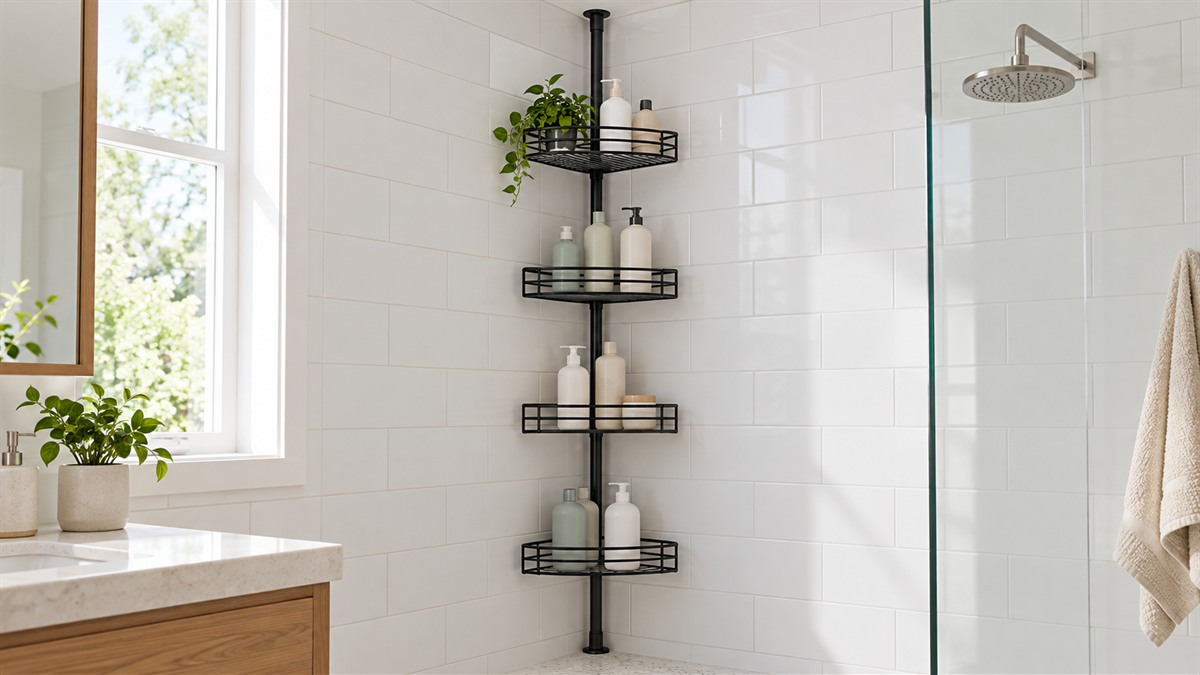
Tension mounting holds a pole between floor and ceiling by pressure. The listing says to extend the pole between the two surfaces and lock the tension, which means there are no screws to drive and no holes to patch. The tiers then hang from the pole on clips. The listing says the corner caddy installs in minutes and that the tension pole needs no drilling, which is the main reason people choose this style for rented rooms.
Tension holds only while the pole stays locked and both surfaces stay firm. Recheck the lock after you install the unit, and again whenever you load the tiers heavily. A shelf that sits on the floor and rests against the ceiling is not the same as a bracket fixed to a wall, so the wall-mount rules for studs and anchors do not apply here.
Height range is the first check
The listing states an adjustable range of 47.72 to 123.6 inches in its item highlight, and its bullets round that to 47 to 123 inches. The overall unit is 121 inches tall when fully extended, according to its dimensions. Measure the corner from the floor to the ceiling at the spot where the pole will stand, and check that the reading sits inside the range with room to spare. A corner that is taller than the range cannot be filled with this unit, and a corner that is shorter may need the pole fully compressed, which leaves less margin.
Corner geometry and depth
The listing describes an L-shaped design that hugs the corner snugly rather than bulging into the room. Its product dimensions are 11.2 inches deep and 7.8 inches wide, and the bullets say the design frees up floor space. Stand in the corner and check two things: that the front edge of the L will not block a door or a faucet, and that the baskets clear any fixtures nearby. A corner with a window sill or a towel bar at the same height may need a different tier layout, so plan the tier heights before you extend the pole.
Load and what the listing leaves out
The listing states a single capacity of 22 pounds. It does not say whether that figure is for each tier or for the whole unit, and it does not give a per-tier figure. The included parts are a buckle, four clips, two deep baskets, two shallow baskets and eight tension poles. The bullets describe open-wire baskets that let water drain, and they say the metal is coated and stainless. Plan your load around the lower figure until the seller confirms how the 22 pounds applies.
Safety around a tall unit
A tension pole that reaches the ceiling is a tall unit, and the Consumer Product Safety Commission’s Anchor It! campaign warns that children like to climb on furniture and that unsecured furniture is a hidden hazard in every room. A tension pole is not a fastened anchor, and the listing does not describe an anti-tip device. Keep heavy items on the lower tiers, avoid loading the top basket, and do not let children climb the unit or hang from its baskets. If you have young children at home, follow the maker’s instructions and consider a fixed solution instead.
Who this suits and who should skip it
Renters are the clearest fit. The listing’s item highlight describes a space-saving rack for families and renters, and its no-drill design avoids the wall repairs a fixed bracket would need. A tension unit also suits a room where you want a corner shelf that you can move when you move out. Homeowners with a finished wall and easy access to studs may prefer a fixed corner shelf, which does not depend on pressure between floor and ceiling.
Skip this style if the corner has a sloped ceiling or an uneven floor, because the pole needs firm contact at both ends to hold. Skip it if young children use the room and might climb the unit, and skip it if you need a shelf for a heavy, fixed collection of items at one height. A tension unit moves its load to the pole and the two surfaces, so a corner that cannot meet those conditions should use a different mounting method.
Products that fit this
1. HAMITOR Corner Shower Caddy Tension Pole: 4-Tier Adjustable Shelf Black (Corner shower caddy tension pole, four tiers)
Specs from the listing (checked 2026-10-16):
- Mounting Type: Tension Mount
- Product Dimensions: 11.2″D x 7.8″W x 121″H
- Number of Compartments: 4
- Capacity: 22 pounds
- Material: Metal
Pros
- L-shaped corner design that hugs the corner, per its bullets
- Four tiers with a clip buckle to adjust each tier height
- Coated metal and stainless steel with open-wire baskets that drain
Cons
- Single capacity figure of 22 pounds, not stated per tier
- Height range of 47.72 to 123.6 inches limits which corners fit
- Tension pole needs a level floor and a locked pole to hold
Best for: Corners with a floor-to-ceiling height between 47.72 and 123.6 inches where drilling is not an option
Skip if: Your ceiling falls outside 47.72 to 123.6 inches or you need a stated per-tier load
View on Amazon (affiliate link)
Only one tension-mounted corner shelf is covered here. Several corner shelves look similar but are wall-adhesive, countertop or floor-standing units, so check the mounting type on every listing before you compare them. If a tension unit does not fit your corner, look at shower corner shelf options, corner shower storage ideas and bathtub corner organizer choices, which use other mounting methods.
The tension-mounted corner shelf
This listing is a black, powder-coated metal corner caddy with four tiers. Its item highlight describes a heavy-duty, rustproof, L-shaped shelf with no drilling and a space-saving design for families and renters. The bullets say the clip buckle lets you move each tier’s height in seconds, which gives you room to fit tall conditioner bottles and short body washes on separate levels. The listing says the coated metal and stainless steel parts resist rust in humid showers, and it describes open-wire baskets that let water drain. The included parts include two deep baskets and two shallow baskets, plus side hooks for loofahs and razors.
Skip it if your floor-to-ceiling height is outside the 47.72 to 123.6-inch range, because the pole cannot reach. Also skip it if you need a per-tier load figure, since the listing gives only one capacity number, or if your corner is not reasonably level, because the listing does not describe how a tension pole behaves on an uneven floor.
Worked example: checking the height and load
Step 1, the bottom of the range: 96 minus 47.72 equals 48.28 inches of room above the minimum. Check: 47.72 plus 48.28 equals 96.00.
Step 2, the top of the range: 123.6 minus 96 equals 27.6 inches of room below the maximum. Check: 96 plus 27.6 equals 123.6.
Step 3, the load per tier: 12 pounds divided by 4 tiers equals 3 pounds per tier. Check: 3 times 4 equals 12.
Step 4, the capacity check under either reading of the listing: if the 22-pound figure is for the whole unit, 22 minus 12 equals 10 pounds of margin. If it is for each tier, 12 pounds is well under 22 for every tier. Check: 12 plus 10 equals 22.
In this scenario the corner is inside the range and the load is within the stated figure under either reading. Your corner and toiletries will differ, so run the same four steps with your own measurements before you buy.
Mistakes to avoid
Assuming the range fits your corner without measuring. Measure the floor-to-ceiling height at the exact spot, and check the listing range against that reading. Rounded figures in the bullets are not a substitute for the highlight’s range.
Treating the tension pole as a permanent fixture. Tension holds only while the lock stays firm. Recheck the pole after installation and after heavy loading, and do not rely on it to hold a full load if the lock feels loose.
Loading the top tier first. A tall unit is most stable with its weight low. Put the heaviest bottles on the lower tiers and keep the top basket for light items.
Expecting a per-tier capacity. The listing gives one figure. Until the seller confirms it, treat 22 pounds as the total load you can plan around.
Ignoring the room’s other fixtures. A corner with a window sill, a towel bar or a light switch at the same height needs its tiers planned around those points. Check the layout before you extend the pole.
Using the unit as a child’s climbing structure. The Consumer Product Safety Commission warns that children like to climb furniture, so keep the unit out of reach of climbing children and do not hang heavy items from it.
Measuring the ceiling once. A ceiling that sags or dips can read differently from one spot to another. Take the reading at two spots in the corner and use the lower of the two when you check the listing range, so the pole still fits at the point where it stands.
FAQ
What is a corner shelf tension unit?
It is a corner shelf that holds itself in place by pressure between a floor and a ceiling. A tension pole supports the tiers, so you do not need screws in the wall. This is different from a bracket shelf, which is fixed to the wall.
Does a tension corner shelf need drilling?
The listing says the tension pole needs no drilling and no screws. You still need a clear, level corner and a locked pole. Check the listing for the exact installation steps before you start.
How tall can a tension corner shelf be?
The listing states an adjustable range of 47.72 to 123.6 inches. Measure your corner first. If the floor-to-ceiling height is outside that range, the unit will not fit.
How much weight can it hold?
The listing states a capacity of 22 pounds. It does not say whether that applies per tier or to the whole unit. Plan your load below 22 pounds total, and ask the seller to confirm the per-tier figure if you need it.
Can children climb a tension shelf?
A tall unit can tip or be climbed, and the Consumer Product Safety Commission’s guidance says children like to climb on furniture. Keep the unit out of reach, keep heavy items low, and do not let children hang from the baskets.
Is a tension pole better than a wall-mounted corner shelf?
It depends on the wall and the rules of your home. A tension pole avoids drilling, which suits rented rooms. A wall-mounted shelf can hold a fixed load at a set height, which suits a permanent corner with suitable wall framing.
What should I check on the listing before ordering?
Check the height range against your corner, the capacity figure and whether it applies per tier, and the included parts. Confirm the number of tiers and the basket sizes. If any two fields disagree, treat that number as unconfirmed until you have checked it in person.
Bottom line
Choose the tension-mounted corner shelf if your floor-to-ceiling height falls inside the listed 47.72 to 123.6-inch range and you cannot drill. Skip it if the height is outside that range, if your floor is uneven, or if you need a per-tier load figure, because the listing gives only one capacity number.
Sources
- Shelf (storage), Wikipedia): a shelf is a flat, horizontal or sloping plane used for storage, often anchored to a wall or supported by brackets.
- CPSC Anchor It! campaign: the campaign warns that children like to climb on furniture and that unsecured furniture is a hidden hazard.