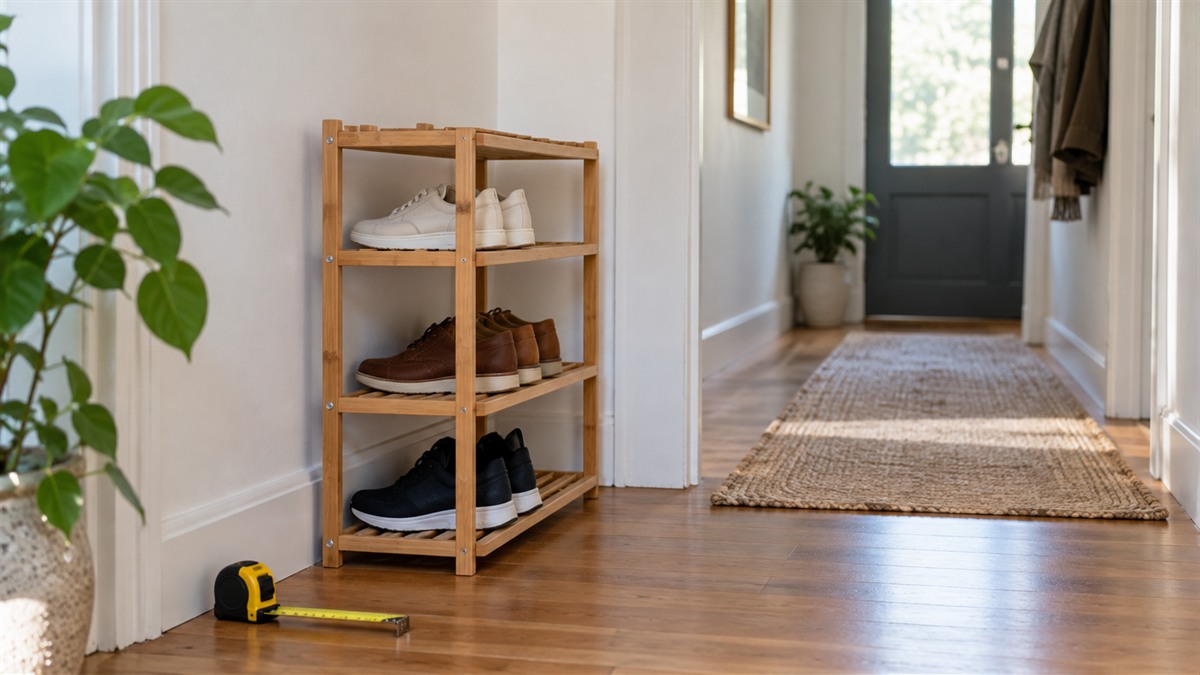
Best Narrow Shoe Rack for Small Spaces
As an Amazon Associate we earn from qualifying purchases. Details
A narrow shoe rack for small spaces needs to fit a hallway wall, a closet floor or a tight corner without blocking the path. This guide covers one freestanding shoe rack, a three-tier bamboo design, and shows how to check its measurements against your own gap before you buy. Use the figures below as the listing states them, and check the listing for anything missing.
Only shoe racks are covered here. The main question is whether a narrow rack fits your gap and holds what you plan to store, and the sections below answer that.
Quick answer
Choose this rack if your spot is at least 11 inches deep and 27 inches wide, and you want a freestanding three-tier rack for shoes. The listing states those dimensions and a 20-inch height, so measure your gap before you order. The listing does not mention doors or drawers, so treat it as an open rack. It gives a 90-pound maximum weight capacity without saying whether that is per shelf or total. Skip it if you need enclosed storage or if your space is shallower than 11 inches.
What the listing states
The listing gives these figures:
- Product dimensions: 11 inches deep, 27 inches wide and 20 inches high.
- Shelves: three tiers, listed with a 3-tier size.
- Material: bamboo, in a natural color with a polished finish.
- Weight capacity: a maximum of 90 pounds, plus a field labelled “minimum weight” at 20 pounds.
- Item weight: 3.8 pounds.
- Assembly: required, with the listing estimating about 10 minutes.
- Included components: hardware.
- Installation: freestanding, with a floor mount type.
- Room type: hallway. Recommended use: shoes.
- Minimum required door width: 27 inches.
- Care: wipe with a dry cloth.
- Returns: a bullet point describes a return process for quality problems, but the text is cut off in the listing, so read the full terms there.
What matters for a narrow shoe rack for small spaces
Footprint: depth decides whether it fits
Depth is the number that matters most in a narrow space. The listing gives the product dimensions as 11 inches deep, 27 inches wide and 20 inches high. A common rule of thumb is to measure the clear floor space, not the wall length, because baseboards, door trim and outlets reduce the usable room. The listing also gives a minimum required door width of 27 inches without explaining it, so check that figure against the doorway the rack has to pass through.
Height and tier spacing
The listing gives an overall height of 20 inches. It does not give the space between tiers, so you cannot tell from the listing how much room a boot needs before it touches the shelf above. Measure your tallest pair against the tier spacing in the manual. A common rule of thumb is to leave some clearance above the tallest item on each tier, so shoes can be lifted out without catching on the shelf above.
Load: read the capacity wording
The listing gives a maximum weight capacity of 90 pounds. It does not say whether that figure applies per shelf or to the whole rack. A separate field labels 20 pounds as a minimum weight, and the listing does not explain what that means. Do not assume each of the three tiers carries an equal share of the 90 pounds. If you plan to load heavy boots, ask the seller or check the manufacturer’s manual for a per-tier limit.
Assembly and conflicting fields
The listing says the rack requires assembly, that it takes about 10 minutes, and that its hardware is included. It does not say whether tools are included. One field gives a shelf thickness of 20 inches, which is the same figure as the rack’s height, so the two fields conflict. Rely on neither number for board thickness, and check the manual before you assume a board size.
Stacking is a claim to verify
Some bullet points say two 2-tier units can stack into a taller rack, while the title and specifications describe one 3-tier unit. Treat stacking as the listing’s claim and read the instructions before you add height. The US Consumer Product Safety Commission advises following the manufacturer’s instructions to secure furniture properly. The listing does not mention an anti-tip device, so confirm that before you build a taller stack. If you need height rather than stacking, compare thin tall shoe racks.
Measuring your space step by step
- Measure the depth at floor level, from the wall to the front edge of the spot. Note any baseboard, trim or outlet that reduces it.
- Measure the width at the narrowest point where the rack will sit.
- Measure the path the rack must travel, including the doorway. Compare it with the listing’s minimum required door width of 27 inches, which the listing does not explain.
- Check the height from the floor to the lowest obstacle, such as a shelf, a radiator or a light fixture. The listing states a height of 20 inches.
- Compare your three numbers with 11 inches deep, 27 inches wide and 20 inches high, and write down the margin in each direction.
A common rule of thumb is to keep some clear room on the front side, so you can reach the lowest tier without pulling the rack out. Treat that as a guide, not a figure from the listing.
Load, tiers and what you store
The 90-pound figure is the only load number the listing gives. It is labelled as a maximum, and the listing does not say whether it applies per shelf or to the whole rack. The 3.8-pound item weight describes the rack alone. It does not tell you what the rack can hold. Weigh your heaviest pair of boots, or estimate the weight of a full set of shoes, before you rely on the figure.
A common rule of thumb is to put heavier shoes and boots on the lowest tier, which keeps the heaviest load close to the floor. Use the upper tiers for lighter everyday shoes. This is general practice, not a claim from the listing.
Assembly, hardware and checks before loading
The listing says assembly takes about 10 minutes and that hardware is included. Lay out the parts and the hardware before you start, and count them against the manual’s parts list. The listing does not say whether tools are included, so check the manual for the tools it expects before you begin.
Do not load the rack until every connection is tight and the tiers sit level on the floor. If you plan to stack, wait until the single unit is assembled and checked, and read the stacking instructions first.
How to choose
Choose this kind of rack if the spot is open, at least 11 inches deep, and holds everyday shoes you want to see and reach. It suits a hallway, an entryway alcove or a closet floor where you do not need a door to keep things out of view.
Choose enclosed cabinet storage if dust or visible clutter is the main problem, since the listing does not describe any doors. Choose a different unit if your clear space is shallower or narrower than the listing’s measurements. For a closet floor option, see small shoe racks for a closet floor. If you want to compare other narrow options, see narrow shoe storage options.
Before you buy, check four things on the listing: the depth and width against your exact gap, the minimum door width, whether the 90-pound figure is per shelf or total, and whether tools are included for assembly.
Who may not need this rack
The listing describes a rack, not a bench, so it does not help you sit down while you change shoes. If that is the main need, this is the wrong product. You may also not need a three-tier unit at all if you own only a few pairs. The listing does not say how many pairs it holds, so count your own shoes before you buy.
A humid bathroom or an outdoor spot is unclear for this rack. The listing does not state water resistance, so check the material details before you place it in those spaces.
The ROMGUAR CRAFT rack in detail
The ROMGUAR CRAFT rack is the bamboo three-tier design. Its listing names hallway as the room type, and its bullet points also suggest bathroom, kitchen and office use. The recommended use field, however, lists shoes only, so treat the other uses as the seller’s suggestions. The listing gives a natural color and a polished finish but does not describe the decor it suits.
Its 3.8-pound item weight makes it easy to move, but the listing does not mention an anti-tip device, so check the instructions before you stack it or set it against a wall you cannot anchor.
1. ROMGUAR CRAFT 3 Tier Bamboo Shoe Rack for Closet Free Standing Wood Shoe Shelf Storage Organizer (Bamboo three-tier rack)
Specs from the listing (checked 2026-10-11):
- Product Dimensions: 11″D x 27″W x 20″H
- Number of Shelves: 3
- Weight Capacity Maximum: 90 pounds
- Material: Bamboo
- Item Weight: 3.8 pounds
- Assembly Instructions Description: The shoe rack requires assembly. Assembly instructions are provided and can be completed in approximately 10 minutes.
Pros
- The listing gives an 11-inch depth, which suits narrow floor space
- Three tiers, as stated in the size and shelf count fields
- The listing says assembly takes about 10 minutes
- Listed as bamboo in a natural color
Cons
- The listing does not say whether the 90-pound maximum is per shelf or total
- A shelf thickness field reads 20 inches, which conflicts with a board thickness
- The listing does not mention an anti-tip device
- The listing does not state whether tools are included
Best for: Narrow hallways, entryways and closet floors with at least 11 inches of clear depth
Skip if: You need enclosed storage, a footprint shallower than 11 inches, or a per-shelf weight figure
View on Amazon (affiliate link)
Two example spaces follow. Each uses the listing’s 11-inch depth and 27-inch width as the rack’s footprint.
Space A is a hallway alcove, 13 inches deep and 30 inches wide.
- Depth: 13 − 11 = 2 inches of space beyond the rack’s depth. Check: 11 + 2 = 13.
- Width: 30 − 27 = 3 inches of space beside the rack. Check: 27 + 3 = 30.
Space B is a closet floor, 12 inches deep and 28 inches wide.
- Depth: 12 − 11 = 1 inch of space. Check: 11 + 1 = 12.
- Width: 28 − 27 = 1 inch of space. Check: 27 + 1 = 28.
In Space A, the rack has some margin in both directions, though three inches of side clearance is little room to lift it into place. Measure the path to the alcove before you order. In Space B, one inch in each direction means any baseboard or trim along the floor would likely block the rack. The subtraction does not change the listing’s figures. It only shows how to subtract them from your own space.
Mistakes to avoid
- Measuring the wall length but not the clear floor depth, which trim and outlets reduce.
- Reading the 90-pound figure as a limit for each shelf.
- Skipping the minimum door width, even though the rack has to pass through that opening.
- Trusting the stacking bullet point before you read the manual.
- Assuming the rack has doors or drawers. The listing describes an open tiered rack.
- Buying for a few pairs of shoes when a smaller unit would hold them.
Floor footprint of the narrow rack
The rack lists 11 inches deep and 27 inches wide, so its footprint is 11 x 27 = 297 square inches. Measure your gap against the 27-inch width and the 11-inch depth before you order. The listing also does not say whether its 90-pound maximum is per shelf or total.
FAQ
Will this rack fit a closet floor?
It fits if your clear floor space is at least 11 inches deep and 27 inches wide. Measure the clear floor, because door trim and baseboards can reduce it.
How much weight can each shelf hold?
The listing gives a 90-pound maximum but does not say whether it is per shelf or for the whole rack. Check the manufacturer’s manual before you load heavy boots.
Does the rack need to be attached to a wall?
The listing describes the rack as freestanding and does not mention wall anchoring. Confirm the mounting details in the manual, especially if you plan to stack units.
Can it hold tall boots?
The listing gives only the overall height of 20 inches and does not state the space between tiers. Measure your tallest boots against the tier spacing in the manual before you rely on a tier.
Does assembly need tools?
It does not say tools are included, so check the manual for the tools it expects.
Is it suitable for a humid bathroom?
The listing does not state water resistance, and its recommended use is shoes. Confirm the material details before you place it in a humid bathroom.
Should I choose this or an enclosed cabinet?
Choose this rack for open, visible storage in a narrow spot. Choose an enclosed cabinet if dust or clutter matters more to you. For enclosed ideas, compare shoe storage for a small closet.
Bottom line
Buy this kind of rack if your clear floor space is at least 11 inches deep and 27 inches wide, and open, freestanding shoe storage suits you. Skip it if you need enclosed storage or a shallower footprint. Before you order, confirm the door width, the weight wording and the assembly tools on the listing.
Sources
- CPSC Anchor It! campaign: CPSC advice to follow the manufacturer’s instructions to secure furniture properly