Best Scandi Shoe Storage: 2 Options Compared
As an Amazon Associate we earn from qualifying purchases. Details
If you are looking for scandi shoe storage, the real question is less about style and more about finish, footprint and how the shoes sit. Neither product listing in this comparison uses the word Scandinavian, so this guide judges each unit on what its listing does state: size, material, cube dimensions and weight. It also flags where a listing conflicts with itself. A common rule of thumb for the look is light finishes and plain shapes, but that is a style guide, not a fact about either product. Pair counts and cube sizes are the seller’s figures, so measure your shoes before you order.
Quick answer
Choose the cube organizer if you want open, stackable storage for flat shoes such as sandals and flip flops, and you accept an espresso wood finish. Choose the freestanding nine-cubby bench if you want a unit for nine pairs and you can confirm its finish, because its color field says brown while its bullets say white. Neither listing names a Scandinavian style. If your sneakers are taller than 5.75 inches, the cube openings in the first unit will not take them, so plan a second spot for those pairs.
What matters for scandi shoe storage
Two units can share a footprint and still look different in a room. Four checks separate them.
- Finish and color. A common rule of thumb is that a Scandinavian look uses light finishes and simple shapes. Check the finish field and the color field separately, because a listing may disagree with itself.
- Open cubes or closed fronts. The cube organizer’s listing describes open cube openings and a stacking design. The bench’s listing describes nine cubbies and says nothing about doors, so assume open cubbies and confirm with photos before you buy. For more cubby styles, see shoe cubby storage.
- Material. The cube organizer is wood with a laminated finish. The bench is engineered wood, and its bullets call it “high-quality MDF board.” Medium-density fibreboard is an engineered wood product made from wood fibre, wax and a resin binder. It is generally denser than plywood and stronger than particle board, according to its encyclopedia entry, so MDF is a sturdy base for a shelf-style unit.
- Height and tip-over. The cube organizer measures between 19 and 38 inches tall when assembled, which makes it a tall unit. The bench is 17.7 inches tall. Tall units need the most care, as covered below. If floor space is tight, compare the options in narrow shoe storage before you choose.
Comparison at a glance
The table puts the two units side by side, using only the figures each listing states.
| Spec | Cube organizer | Bench-style unit |
|---|---|---|
| Product dimensions | 11.63″D x 24.09″W x 19.29″H | 11.8″D x 27.6″W x 17.7″H |
| Openings or cubbies | 15 compartments | 9 cubbies |
| Shoe count stated | Not stated; openings suit low-profile shoes | 9 pairs |
| Material | Wood | Engineered wood |
| Color field | Espresso | Brown |
| Finish field | Laminated | White |
| Item weight | 9.48 kg | 18.5 pounds |
The cube organizer’s width is 24.09 inches in the specs and 24.13 inches in its bullets. The gap is 0.04 inch (24.13 − 24.09 = 0.04), too small to change a fit, so use the spec figure for planning.
Most fit decisions here come down to shoe height. The cube openings are 5.75 inches tall, so flat shoes fit and taller sneakers may not. The bench’s listing gives no height figure for its cubbies, so measure your tallest pair before you rely on it. Measure first, then choose the unit that matches.
In practice, the two units suit different shoe shapes. The cube organizer suits sandals and flip flops, which is the shoe type its listing names. The bench suits a mixed set of nine pairs in one spot, provided the pairs are not tall. Neither unit is a clear fit for boots: the cube openings are 5.75 inches tall, and the bench’s listing gives no height figure at all. If boots are part of your collection, plan a separate spot for them before you buy either unit. A unit that fits your sandals but not your sneakers is only a partial answer, so count each shoe type before you buy.
Products that fit this
These two units match the shoe storage intent. Each card shows the listing’s own specs, pros and cons.
1. ClosetMaid 15 Cube Stackable Storage Organizer for Shoes, Bags, Crafts, Hobbies with Wood Shelves (Best for flat shoes and stacking)
Specs from the listing (checked 2026-10-13):
- Product Dimensions: 11.63″D x 24.09″W x 19.29″H
- Number of Shelves: 15
- Material: Wood
- Finish Types: Laminated
- Included Components: Installation & Assembly Hardware, Shoe Organizer
Pros
- Product dimensions 11.63″D x 24.09″W x 19.29″H
- 15 compartments, each 5.75-inch H X 4.5-inch W X 11-inch D
- Hardware included to stack units, per the bullets
Cons
- Openings fit only low-profile shoes smaller than 5.75 in. H
- Color field says Espresso, not a pale finish
- Item weight of 9.48 kg makes it heavy to move when full
Best for: Flat shoes, sandals and flip flops in an entryway or closet
Skip if: Your sneakers or boots are taller than the openings, or you want a light finish
View on Amazon (affiliate link)
2. Shoe Storage Bench Cubby with 9 Cubbies, Wood Shoe Rack Organizer Cabinet (Best freestanding cubby for nine pairs)
Specs from the listing (checked 2026-10-13):
- Product Dimensions: 11.8″D x 27.6″W x 17.7″H
- Number of Shelves: 9
- Material: Engineered Wood
- Furniture Finish: White
- Item Weight: 18.5 pounds
Pros
- Product dimensions 11.8″D x 27.6″W x 17.7″H
- Nine cubbies, per the Item Highlight field
- Bullets say included tools and labeled accessories make installation quick and easy
Cons
- Color field says Brown while the finish field and bullets say White
- No shoe height limit stated in the listing
- Item weight of 18.5 pounds makes it harder to move once set up
Best for: Nine pairs in a freestanding unit in a hallway or bedroom
Skip if: You need to store sneakers of any height, or you need a confirmed finish before buying
View on Amazon (affiliate link)
Best for flat shoes and stacking: the cube organizer
The listing gives a product dimension of 11.63″D x 24.09″W x 19.29″H and says it assembles to 19–38 inches tall. It has 15 compartments, and each opening measures 5.75-inch H X 4.5-inch W X 11-inch D. The listing says the unit is “Ideal for storing flip flops, sandals or other low-profile shoes” that are smaller than the opening. Hardware is included to stack units, and the listing says it is compatible with other stackable organizers from the same brand. The listing gives an item weight of 9.48 kg, so move it with two people if it is full. Skip it if your shoes are taller than the openings, or if you want a light, pale finish, since the color field says espresso.
Best freestanding cubby for nine pairs: the bench-style unit
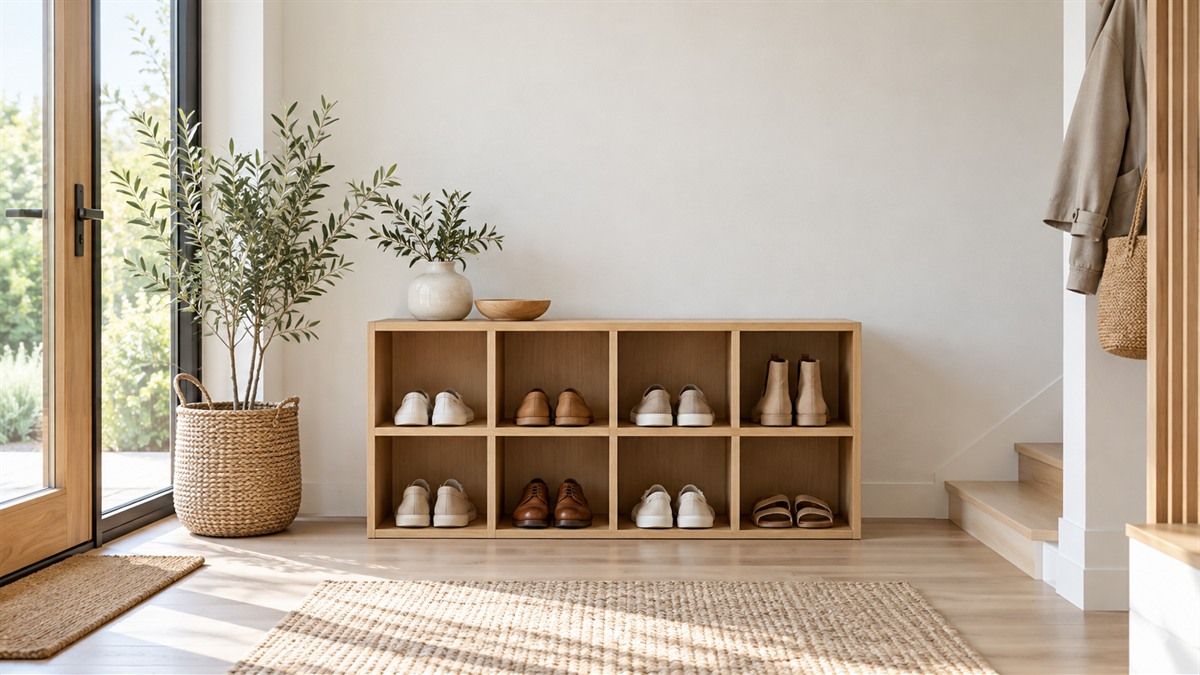
The listing gives 11.8″D x 27.6″W x 17.7″H with nine cubbies, and it says the unit can “easily store 9 pairs of shoes.” It is freestanding, and its bullets describe the simple, modern design as suitable for a range of rooms. The listing’s material field says engineered wood, and the bullets say the panels are MDF board. The color field says Brown, while the finish field says White and the bullets describe a “modern white finish,” so confirm the finish before buying. The bullets also say that included tools and labeled accessories make installation quick and easy. Skip it if you need the unit to take sneakers of any height, since the listing does not state a shoe height limit. At 18.5 pounds, it is also harder to move once it is set up.
We assume one pair per cube opening, which the listing does not state, so treat this as a planning figure only. The bench holds 9 pairs (per its listing), so 20 − 9 = 11 pairs need another home. If all 11 are low-profile shoes, the cube organizer’s 15 openings hold them with 4 openings left (15 − 11 = 4). Suppose 3 of the 11 are sneakers taller than 5.75 inches. Those 3 will not fit an opening, so 11 − 3 = 8 pairs go in the cube organizer, and 15 − 8 = 7 openings stay empty. That result tells you to keep the 3 tall pairs on the bench or in a closet, not to buy a third unit.
The depth check matters too. The cube openings are 11 inches deep, and the listing says the maximum depth to fit shoes is 11 in. A spot only 10 inches deep will not take the unit at all, so measure the wall before you order. For entryway layouts, see entryway shoe storage.
Mistakes to avoid
- Choosing by a style word the listing does not use. Neither listing states a Scandinavian design, so decide by finish and size instead.
- Trusting one color field. The bench’s color field and finish field disagree, so the finish you see in photos may not match the one you receive.
- Buying cubes for tall sneakers. The cube openings are sized for low-profile shoes, and the listing says so.
- Skipping tip-over care on tall units. The cube organizer can reach 38 inches tall, and the listing does not describe an anti-tip device.
- Treating the bench’s nine-pair figure as fixed. It is the seller’s estimate, and taller pairs take more room than flat ones.
- Ignoring the stacking weight. A stacked unit adds weight at the top, so check the item weight before you stack.
Checklist before you buy
- Pick the finish first. Decide whether you want a wood-look finish or a painted one. Then check the finish field, not only the color field.
- Measure the cube opening against your shoes. Set one shoe in the cube, then compare its height with the opening’s height in the listing.
- Count the pairs that will go in. Write down the number of pairs in each category: flats, sandals, sneakers, boots.
- Check the wall. For a tall unit, check the wall type and whether a stud is available for anchoring. A stud finder locates the framing behind the wall, so use it before drilling.
- Confirm the assembly. Read the assembly note and check that all parts are in the box before you start.
Worked example: opening height for sneakers
The cube organizer lists 11.63 inches deep and 24.09 inches wide, so its footprint is 11.63 x 24.09 = 280.17 square inches. Its cube openings are 5.75 inches tall, so a pair of sneakers taller than 5.75 inches needs a different spot. The bench lists 17.7 inches of height, which is a different figure from the cube openings, so compare the two before you choose.
FAQ
Is either unit a Scandinavian-style shoe storage unit?
The listings do not state a Scandinavian style. The cube organizer is espresso wood with a laminated finish. The bench’s finish field and bullets say white, while its color field says brown. Judge the look from the finish, not the name.
Will sneakers fit the cube organizer?
Only if they are shorter than the 5.75-inch opening height. The listing describes the openings as ideal for flip flops, sandals and other low-profile shoes, so sneakers that stand taller will not fit.
How many pairs does the bench hold?
The bullets say the unit can “easily store 9 pairs of shoes.” That is the seller’s figure, and the real count depends on how tall the shoes are.
Is the bench finish white or brown?
The color field says Brown, while the finish field says White and the bullets describe a modern white finish. Confirm the finish before buying, since the two fields disagree.
Do I need tools to assemble these?
The cube organizer’s bullets say all hardware is included and the unit is easy to assemble. The bench’s bullets say the included tools and labeled accessories make installation quick. Check the box contents against the instructions before you start.
Can I stack the cube organizer?
Yes, the listing says hardware is included to stack the unit securely. The listing also says it is compatible with other stackable organizers from the same brand.
Do tall shoe units need anti-tip hardware?
Tall units should have it. The U.S. Consumer Product Safety Commission advises that new furniture such as dressers is sold with anti-tip devices that should be installed right away. The cube organizer’s listing does not describe an anti-tip device, so plan how to secure a unit that reaches 38 inches tall.
Do I need a scandi shoe storage unit at all?
You may not. Any shoe storage with the finish and footprint you want will do. Buy a unit only when your shoes do not fit where they are now or when they need a dedicated spot.
When neither unit is the right buy
Some readers do not need a new unit. If your shoes already sit on a shelf, in a closet or on a bench you own, a purchase adds cost without changing the layout. Buy only when shoes pile up on the floor, when pairs get lost at the back of a closet, or when you want the shoes out of view. In those cases, match the unit to the shoe type first: flat pairs suit the cube organizer, and a mix of pairs suits the bench if its height limit works for you. Check the finish field before you pay for either one.
Bottom line
Choose the cube organizer if you want open, stackable storage for flat shoes and you accept its espresso finish. Choose the bench-style unit if you want nine pairs in a freestanding unit and you can confirm the finish. Neither listing uses the word Scandinavian, so decide by finish, footprint and shoe height. Measure the spot, count your pairs by type and secure any tall unit before you load it. If your shoes already fit where they are, you may not need either one.
Sources
- U.S. Consumer Product Safety Commission, Anchor It!: anti-tip devices for dressers and tip-over risk for tall furniture
- Wikipedia, Medium-density fibreboard: MDF is denser than plywood and stronger than particle board