How Deep Should Pantry Shelves Be
As an Amazon Associate we earn from qualifying purchases.
How deep should pantry shelves be? The pages we opened give no single required depth. They show a ladder of depths from 4 1/2 inches in a pantry with shallow open shelves to 24 inches in tall utility cabinets, with 12, 16 and 20 inch shelves in between. What chooses the rung is how many rows of a package you want on one shelf, how much room the door and the wall take, and whether you will reach in or pull the shelf out. This guide turns those facts into a depth worksheet with every assumption labeled.
Quick answer
- No source we opened requires a pantry shelf depth. The sources show 4 1/2 inches (an NKBA article on a pantry with open shelves), 12 inches (standard wall cabinets, Elfa and ClosetMaid), 16 and 20 inches (Elfa and ClosetMaid) and 24 inches (tall utility cabinets).
- For packaged food, the university sources lean shallow: a 1947 Oregon State bulletin says to assume single-row storage, a 1966 Oregon State publication puts small food packages on narrow shelves one row deep, and Kansas State Extension says items get pushed to the back and forgotten.
- Deep shelves suit bulk and bulky items, and pull-out shelves make deep cabinets usable.
- Cabinet depth figures can exclude the door. Subtract the door and a gap behind the items before you pick a shelf.
What “depth” means for a pantry shelf
Three different depths get called “depth.” The cabinet depth is the front-to-back size of the box. The shelf depth is the front-to-back size of the shelf itself, which in the makers’ guides is full depth for adjustable shelves. The usable depth is what is left for food after you allow for the door, any door-mounted rack and the gap you keep behind the items. The Home Decorators Collection 2025 specification guide says its cabinet depth does not include door thickness. IKEA’s page for a SEKTION high cabinet lists a system depth of 24 inches and a depth of 24 3/4 inches, a difference of 3/4 inch that the page does not explain. Differences that small can decide whether a pantry unit clears a door swing.
The 1947 Oregon State bulletin, Patterns for Kitchen Cabinets, makes the same point for its floor-to-ceiling cabinets. It says that for a cabinet in a corner, with a door that can stay open, it may be desirable to make the shelves narrower than the cabinet so that racks and hooks fit on the doors and on the sides in front of the shelves. In the scanned text we read, the row for room-temperature staples gives a cabinet depth of 18 inches and a shelf size of 12 inches in the shelf column. The bulletin does not define that column in the passages we read, and we read it as the shelf’s front-to-back size because of the door-rack passage. Treat it as an example of leaving room for the door, not as a rule.
The depths the sources actually give
The table collects every depth we found, with the document it comes from. Maker figures describe that maker’s own products. The NKBA article describes one accessible home and is not a standard.
| Depth (inches) | What it is | Source |
|---|---|---|
| 4 1/2 | Adjustable open shelves in a pantry cabinet 66 inches wide and 84 inches high | NKBA knowledge-base article |
| 8 | Wall cabinet depth the 1947 bulletin calls adequate for most articles, excluding plates, platters, vegetable dishes and large bowls | Oregon State Bulletin 446 |
| 12 | Standard wall cabinet; also Elfa and ClosetMaid shelf depth | Home Decorators and Luxxe guides; Elfa guide; ClosetMaid sheets |
| 15 | Cabinet depth for dishes in a floor-to-ceiling plan | Oregon State Bulletin 446, Table 32 |
| 16 | Elfa and ClosetMaid shelf depth; Elfa shelf baskets | Elfa guide; ClosetMaid sheets |
| 18 | Cabinet depth for staples in a floor-to-ceiling plan | Oregon State Bulletin 446, Table 32 |
| 20 | Elfa shelf depth; pull-out cabinet in the NKBA article | Elfa guide; NKBA knowledge-base article |
| 23 and 24 | Tall pantry cabinets and pull-out units; standard tall utility cabinets are 24 | Home Decorators and Luxxe guides; IKEA page; NKBA article |
The cabinet guides add the range of custom depths. Both the Home Decorators and Luxxe guides list their tall utility cabinets as 24 inches deep by default with a depth modification of 9 to 23 inches, and their wall cabinets as 12 inches deep with a modification of 5 to 15 inches. The Elfa component guide from The Container Store lists ventilated shelves in 12, 16 or 20 inch depths and shelf baskets that are 16 inches deep. Elfa’s own wire shelf page recommends the 12 inch depth for narrower spaces like hallways and shallow pantry storage, and the 16 and 20 inch depths for linen closets or standard closet storage. A ClosetMaid installation sheet says its 16 inch shelving gives additional storage capacity and is especially good for linens, boxes and shoes, and its bracket sheet has separate 12 and 16 inch positions.
Why the university sources lean shallow for packaged food
Three separate sources reach the same conclusion for packaged food by different routes. The 1947 bulletin says to plan a cabinet of minimum depth for the articles assigned to it and to assume single row storage of the articles whose size determines the depth. It calls an eight inch depth adequate for most articles in wall cabinets, except plates, platters, vegetable dishes and large mixing bowls. The 1966 Pacific Northwest extension publication prepared by Oregon State specialist Bernice Strawn says small food packages should be on narrow shelves, one row deep, not one behind the other. Kansas State University Extension’s January 2026 article says cabinets and cupboards are often trouble spots because items get pushed to the back and forgotten.
The NKBA knowledge-base article by Rosemarie Rossetti gives the same logic in a real room. Her pantry cabinet has adjustable shelves only 4 1/2 inches deep. She says they suit food in cans and boxes and that, since the shelves are shallow, all of the food is easily visible. She also describes deep storage that is built to be pulled out: a pull-out cabinet 20 inches deep with four adjustable shelves, a deep cabinet 21 inches wide, 84 inches high and 23 inches deep with four pull-out adjustable shelves, and an 18 inch wide, 84 inch high, 24 inch deep pull-out unit with shelves and hooks for hanging cleaning supplies. The pattern is shallow shelves for food and deep pull-outs for bulk or bulky things.
How many rows deep will you stack?
The sources do not give package depths, so the table uses assumptions that you should replace with a tape-measure reading of your own packages. It assumes you keep a 1 inch gap behind the items, which is our choice because the Texas A&M AgriLife Extension publication on safe home food storage says to store foods off the floor and away from walls but gives no distance. Rows deep is the whole number part of (shelf depth minus 1) divided by the package depth.
| Shelf depth (inches) | Usable depth (depth − 1) | Rows of a 3 inch package (assumed) | Rows of a 5 inch package (assumed) | Rows of an 8 inch container (assumed) |
|---|---|---|---|---|
| 4.5 | 3.5 | 1 | 0 | 0 |
| 8 | 7 | 2 | 1 | 0 |
| 12 | 11 | 3 | 2 | 1 |
| 16 | 15 | 5 | 3 | 1 |
| 24 | 23 | 7 | 4 | 2 |
The table shows why one depth cannot fit everything. A 4 1/2 inch shelf holds one row of a 3 inch package and nothing of an 8 inch container. A 24 inch shelf holds seven rows of a 3 inch package, and six of those rows are out of sight, the situation the Kansas State article and the 1966 Oregon State publication warn about. The 1966 publication says the same about large cabinets: base cabinets 24 inches deep provide more depth than you need for some items, and it suggests keeping large kettles, a Dutch oven and long-handled pans on deep shelves with the handles extending outward, then using other devices for the rest of the space. Its fixes for that space include sliding drawers, sliding shelves, a lazy Susan for a shelf 19 inches deep and 21 or more inches wide, and swing-out shelves on the doors. For freestanding wire units, the Shelving.com size guide lists a 12 inch list depth with an inner depth of 9.375 inches between the posts, so compare packages with the inner figure and not the list size.
What depth does to the NKBA storage count
NKBA Kitchen Planning Guideline 27 uses depth directly. Shelf and drawer frontage equals cabinet width in inches times the number of shelves and drawers times cabinet depth in feet, or a fraction of a foot. The guideline lists pantry frontage of 180, 230 and 310 inches for small, medium and large kitchens. Depth in feet means a shallow shelf scores low on paper, and a deep shelf scores high. The table uses a 30 inch wide cabinet with one shelf, which is our assumption, and converts each depth from the sources.
| Shelf or cabinet depth (inches) | Depth in feet | Frontage for 30 inches wide, 1 shelf |
|---|---|---|
| 4.5 | 4.5 ÷ 12 = 0.375 | 30 × 1 × 0.375 = 11.25 |
| 12 | 1.0 | 30 × 1 × 1 = 30 |
| 16 | 16 ÷ 12 = 1.333 | 30 × 1 × 1.333 = 40.0 |
| 24 | 2.0 | 30 × 1 × 2 = 60 |
A 24 inch deep shelf counts for more than five times the frontage of a 4 1/2 inch one, even though the shallow shelf is the one the NKBA article praises for visibility. The formula measures capacity on paper, and it does not ask whether you can see or reach what you stored. That is a reason to treat the NKBA count as a planning total and to use the worksheet for the shelf you build. The guideline text also says the totals for wall, base, drawer and pantry frontage can be moved up or down as long as the recommended total stays the same.
A depth worksheet for your pantry
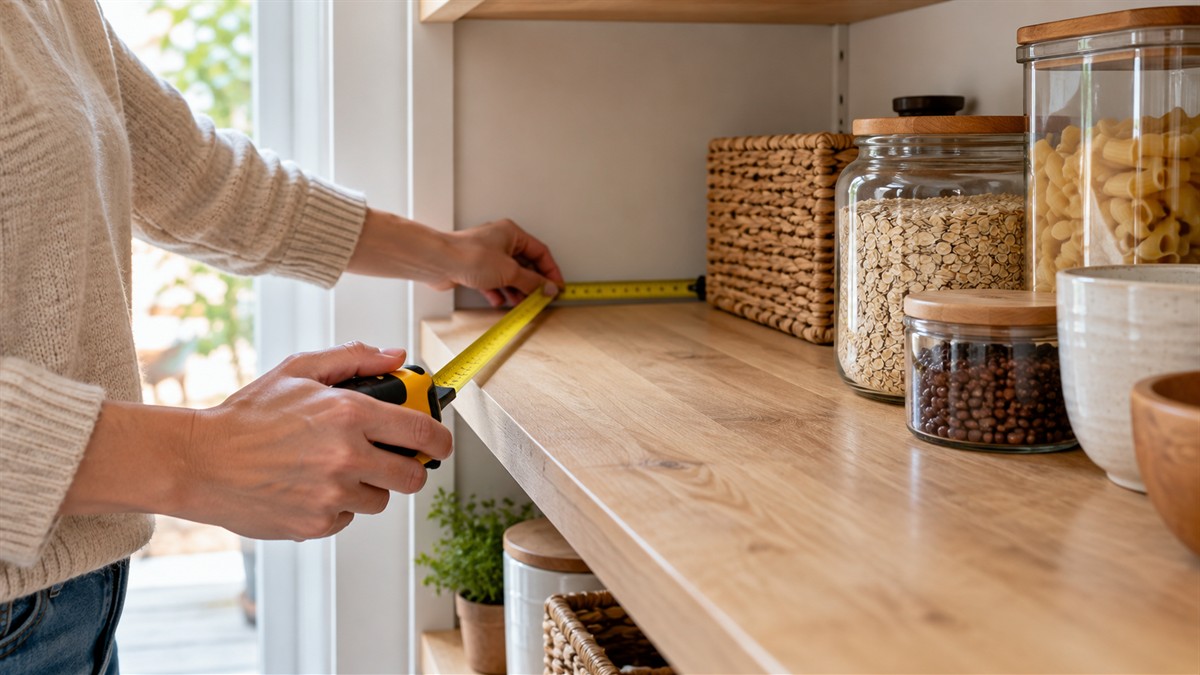
- Measure the space front to back at several heights, from the back wall to the front of the opening or the door frame. Use the smallest reading, because that is the depth every shelf has to fit.
- Subtract the door. A door that swings out of the opening takes no shelf depth. A door that closes against the front of the cabinet does, so subtract its thickness and the depth of any rack you plan to mount on it.
- Subtract your back gap. The Texas A&M publication wants food away from walls, and you decide the distance.
- Measure the front-to-back size of the packages for each tier. Compare them with the rows-deep table above.
- Pick the nearest stock depth that fits. Elfa lists 12, 16 and 20 inches, ClosetMaid shows 12 and 16, and the cabinet makers list 24 inches for tall units with a depth modification down to 9 inches.
Here is a short example in which both starting numbers are assumptions. A closet pantry is 15 inches deep at its narrowest point, and a rack on the door takes 2 inches, so 13 inches remain for shelves. A 12 inch shelf fits with 1 inch to spare. A 16 inch shelf does not fit. Keeping a 1 inch back gap, the usable depth is 11 inches, which holds two rows of a 5 inch package or one row of an 8 inch container, based on the table above. If you want more storage than that, the NKBA article and the 1966 publication show pull-out and sliding shelves as the way to use deeper space. For tall cabinets and closets, see our guides to standard reach-in closet depth, small kitchen pantry shelving and a 71 inch tall kitchen pantry cabinet.
How we chose
We looked for pages that state a depth for a pantry, cabinet or shelf, or that explain how depth affects use. We opened fourteen pages on 2026-10-21: the NKBA Kitchen Planning Guidelines, an NKBA knowledge-base article, two Oregon State publications from 1947 and 1966, a Kansas State University Extension article, a Texas A&M AgriLife Extension publication, two cabinet maker specification guides, an IKEA product page, a Container Store Elfa guide, an Elfa product page, a Shelving.com size guide and two ClosetMaid sheets. A statement went into the guide only when we found it in the text of the page. Maker documents supplied sizes for their own products. The IKEA page was used only for its two stated depths, and the Shelving.com page, a retailer chart, only for its stated dimensions. The package depths in the tables are our assumptions, and so are the 1 inch back gap and the 30 inch cabinet width.
Mistakes to avoid
- Choosing the deepest shelf because it scores highest. The NKBA formula multiplies by depth in feet, so deep shelves count for more even when items vanish at the back.
- Stacking rows of small packages. The 1947 bulletin assumes single-row storage and the 1966 publication puts small packages one row deep.
- Forgetting the door. The Home Decorators guide excludes door thickness from cabinet depth, and IKEA lists 24 and 24 3/4 inches for the same cabinet.
- Putting food against the back wall. Texas A&M says to store foods away from walls.
- Treating one home as a standard. The 4 1/2 inch shelves in the NKBA article describe one accessible pantry.
What we could not verify
What the sources do not say
None of the pages we opened states a required or recommended pantry shelf depth, the depth of a can, jar or box, a distance to leave behind food, or a depth where shelves begin to lose items. The Oregon State figures are from 1947 and 1966, and the 1947 table is read from a scan. The shelf column in that table is not defined in the passages we read. The maker guides describe their own cabinets and shelves. The sources give no load rating for a shelf of any depth, so this guide makes no load claim. The IKEA page is a product listing, and it supplies only stated dimensions here.
Frequently asked questions
What is the standard depth of a pantry shelf?
The pages we opened do not set one. Wall cabinets in two maker guides are 12 inches deep, tall utility cabinets are 24 inches, and wire shelving systems list 12, 16 and 20 inches.
Is a 12 inch shelf deep enough for a pantry?
It can be for packaged food. The 1947 bulletin and the 1966 publication both favor shallow single-row shelves, and 12 inches is the standard wall cabinet depth in the maker guides. It depends on your tallest front-to-back package.
Why do some pantries use shelves only 4 1/2 inches deep?
The NKBA article describes them as a way to keep food visible, since shallow shelves leave nothing hidden behind the front row. That is one home’s choice, not a standard.
Do deep pantry cabinets need pull-out shelves?
The NKBA article uses pull-out shelves in cabinets 20 to 24 inches deep, and the 1966 publication offers sliding shelves for deep base cabinets. The pages do not say pull-outs are required.
Does the door change how deep my shelves can be?
Yes, when the door closes in front of the cabinet. Subtract its thickness and any door rack from the space you measured.
Bottom line
Pick the shelf depth from your packages and your door, then keep food in a single row where you can see it, and use pull-outs for anything deeper.
Sources
- https://kb.nkba.org/2019/07/pull-out-pull-down-go-deep/ (opened 2026-10-21)
- https://media.nkba.org/uploads/2022/05/Kitchen-Planning-Guidelines.pdf (opened 2026-10-21)
- https://ir.library.oregonstate.edu/downloads/xs55mc43w (opened 2026-10-21)
- https://ir.library.oregonstate.edu/downloads/dj52w506g (opened 2026-10-21)
- https://extension.k-state.edu/news-and-publications/news/stories/2026/01/food-safety-organizing-the-kitchen.html (opened 2026-10-21)
- https://agrilifeextension.tamu.edu/wp-content/uploads/2025/04/safe-home-food-storages.pdf (opened 2026-10-21)
- https://images.thdstatic.com/catalog/pdfImages/19/19ce6975-51fc-4571-aeee-4fa718366225.pdf (opened 2026-10-21)
- https://pdf.lowes.com/productdocuments/a1eb9084-5b50-46c6-8c75-617601687698/48070959.pdf (opened 2026-10-21)
- https://www.ikea.com/us/en/p/sektion-high-cabinet-with-shelves-2-doors-white-sinarp-brown-s29463603/ (opened 2026-10-21)
- https://www.containerstore.com/medialibrary/pdf/WF729311_DIG_Elfa_Component_Pricing_Guide-HRspreads.pdf (opened 2026-10-21)
- https://images.homedepot-static.com/catalog/pdfImages/90/90404e96-cb01-4dd8-87a5-e537154545e8.pdf (opened 2026-10-21)
- https://pdf.lowes.com/productdocuments/d1af380f-0c6e-4e7d-92b6-c4cde568f53d/50039299.pdf (opened 2026-10-21)
- https://elfa.com/en/products/classic-by-elfa/top-hang/storage-functions/wireshelf-452725 (opened 2026-10-21)
- https://www.shelving.com/pages/wire-shelving-size-guide (opened 2026-10-21)
As an Amazon Associate we earn from qualifying purchases.