Ceiling Height and Bookshelf Size: How to Plan the Height
Affiliate disclosure: As an Amazon Associate we earn from qualifying purchases.
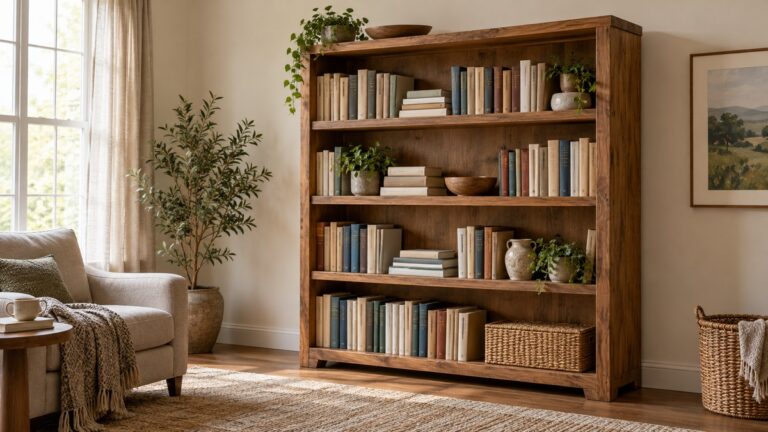
A ceiling height bookshelf plan starts with the lowest point of the ceiling, not the average height of the room. The residential code text we opened sets a minimum ceiling height of 7 feet for habitable space, and Minnesota’s version of the rule measures that height to the lowest projection from the ceiling. This guide turns those figures into inches and feet, works the clearance sums for common unit heights, and says what the sources do not cover for any particular home.
Quick answer
- Use the lowest point of the ceiling, including beams, ducts and fixtures, as the limit for the unit’s height.
- Seven feet, or 84 inches, is the minimum ceiling height for habitable space in the code text we opened. That is a floor for the room, not a typical height.
- Woodbin says bookcases are generally no higher than 84 inches, which is also 7 feet.
- Subtract the unit’s full height from the lowest ceiling point. A result of zero or less means the unit will not fit under that point.
What the codes set as a minimum
The City of Boise’s handout on section R305 states the rule for ceiling height: habitable space “shall have a ceiling height of not less than 7 feet (2134 mm).” A bookshelf sits in a habitable room, so this minimum tells you how much room the code expects, but it does not tell you how tall your bookshelf can be. The handout covers the room, not the shelf.
The Minnesota text of the same section uses the same 7-foot minimum and adds the measuring method: “The required height shall be measured from the finish floor to the lowest projection from the ceiling.” The Minnesota text labels this rule as the minimum height for new buildings. The sources we opened do not say how an existing home is measured against it, so treat the 7 feet as a reference point for the room, not a verdict on your house.
Turn the figures into inches and feet
The code figures are in feet, and the shelf guides use inches, so convert everything to inches first. Then divide by 12 to get feet. The table lists each figure used in this guide with its source.
| Figure | Inches | Feet (inches divided by 12) | Where it comes from |
|---|---|---|---|
| Minimum ceiling height for habitable space | 84 | 7.0 | Boise handout; Minnesota rule (7 feet) |
| Bookcases generally no higher than | 84 | 7.0 | Woodbin shelf guide |
| Highest shelf for sitting access, no more than | 60 | 5.0 | Woodbin shelf guide |
| Upright height for library shelving, first figure | 84 | 7.0 | RBM journal article |
| Upright height for library shelving, second figure | 90 | 7.5 | RBM journal article |
The RBM article reports that the National Information Standard Organization recommends uprights of 84 or 90 inches for single-tier steel bracket library shelving. Those are library dimensions. They give one reference point for tall shelving, not a rule for a home bookcase.
Measure the lowest point in the room
Measure the ceiling where the unit will stand, and do not rely on one reading. The Lazada guide says: “Do not assume your ceiling is uniform; take measurements at the left, center, and right points.” It also asks readers to look up for obstructions, such as ceiling fans. Record each reading, then use the lowest one as the ceiling figure. That is the method the Minnesota text describes: the height runs to the lowest projection from the ceiling, not to a typical point on it.
Work the clearance sum
Clearance equals the lowest ceiling point minus the unit’s full height. Use the same units for both numbers. The table below uses example ceiling points and unit heights, labeled as examples, to show the arithmetic. Replace them with the figures you record in your room and the listing for your unit.
| Lowest ceiling point (example) | Unit height (example) | Clearance (ceiling minus unit) | Result |
|---|---|---|---|
| 96 inches (8.0 feet) | 84 inches | 12 inches (1.0 foot) | Fits, with 12 inches to spare |
| 96 inches (8.0 feet) | 90 inches | 6 inches (0.5 foot) | Fits, with 6 inches to spare |
| 84 inches (7.0 feet) | 84 inches | 0 inches | No clearance left |
| 84 inches (7.0 feet) | 90 inches | negative 6 inches | Does not fit |
The 84-inch ceiling row is the one to watch. The code minimum for habitable space is 84 inches, and Woodbin’s ordinary bookcase limit is also 84 inches, so a room at the minimum leaves no clearance for an 84-inch unit. Any negative result means the unit does not fit under that point, however good the rest of the room looks.
Read the clearance in feet as well
A clearance in feet is the inches divided by 12. Twelve inches is 1.0 foot, 6 inches is 0.5 foot, and negative 6 inches is minus 0.5 foot. Pick one unit for the whole sum. Converting one figure to feet and another to inches in the same subtraction is the most common arithmetic slip in a height plan.
Plan the top shelf for reach
The ceiling is only half of the plan. Woodbin’s shelf guide says that “The lowest shelf should be 3 to 4 inches from the floor level.” For the top, it says that the highest shelf “should be as high as an average-sized person can comfortably reach,” which the guide puts at about 72 to 78 inches. For a seated user, it says that “the highest shelf should be no more than 60 inches above the floor.”
Use these figures to check the top shelf, not the top of the unit. A unit can clear the ceiling and still place its highest shelf where the user cannot reach it. If you are asking how much the top shelf will hold, the wire shelf weight limit page is the next question readers tend to ask. The storage ideas for a top shelf page covers the storage side of the same question.
Check the opening above each shelf
The ceiling is not the only height that matters inside a tall case. The RBM article describes a conventional setting of 33 cm (13.0 inches) from the bottom of one shelf to the top of the next, which leaves a 31 cm (12.2 inch) opening for books. The same article gives the typical height of a regular or standard book as 10.6 to 11.4 inches. Subtracting leaves 0.8 to 1.6 inches of clearance over the tallest of those books.
So the top opening of a tall unit is where the ceiling math and the book math meet. A unit that clears the ceiling can still hold the wrong books if its openings are too short. Those figures come from special collections, so use them as a reference for your own books, not as a rule for your room.
Anchor a tall unit
A tall unit under a low ceiling is the case where tip-over matters most. The Consumer Product Safety Commission’s 2022 news release says to “Anchor TVs and furniture, such as bookcases and dressers, securely to the wall.” The Anchor It! site, which the commission runs, says that “Anchoring all furniture with drawers, doors, and shelves to the wall prevents tip-over injuries and deaths”.
The sources do not name anchor hardware, the number of anchors or the point on a tall unit where they should go. For a ceiling-height plan, that means the anchoring plan for your unit should be settled before you buy it, so the height you choose is one you can secure.
Options when the ceiling is the storage plan
If the ceiling itself is part of the storage plan, the ceiling storage unit page is one place to compare. For rack-style options, the ceiling mounted storage racks compared page covers one pair, and the Jusgym vs IHDCIQ ceiling racks page covers another. If you are comparing metal shelving for a tight space instead, the 5-shelf metal storage rack and the 5-tier metal shelving pages are two places to look. For a closet with a shallow depth, the standard reach-in closet depth page is the next read, and for a compact room the bookshelf for a small room page addresses the fit question.
Buying checklist
- Record the lowest ceiling point over the spot, using the left, center and right readings.
- Convert every figure to inches before you subtract, then keep the sum in one unit.
- Subtract the unit’s full height from the lowest point, and keep the result above zero.
- Check the highest shelf against the reach figures, not only the top of the unit.
- Find the anchoring instructions for your wall before you order the unit.
How we chose
We chose the sources because each gives a ceiling minimum, a height reference or an anchoring instruction in a form a reader can check. A city handout and a state rule give the ceiling figures. A journal article gives library shelving heights. A federal campaign page gives the anchoring instruction, and a woodworking guide gives bookcase reach figures. Each figure in this guide was matched against the fetched text of its page on 2026-10-21, and each conversion is shown in the table. We do not rank units or recommend a model.
Mistakes to avoid
- Treating the 7-foot minimum as the typical ceiling height. The codes state it as a minimum for habitable space.
- Measuring to the middle of the ceiling. The Minnesota text measures to the lowest projection from the ceiling.
- Forgetting fans, beams and ducts. The Lazada measuring guide lists ceiling fans among potential obstructions to check.
- Checking the unit height but not the top shelf. Woodbin’s reach figures apply to the shelf itself.
- Leaving a tall unit unanchored. The commission’s guidance says to anchor bookcases securely to the wall.
What we could not verify
- No source we opened gives the typical ceiling height of any home or region. The figures above are minimums and references.
- No source we opened says how other cities or states apply section R305. The Boise handout is one city’s document, and the Minnesota text is one state’s rule.
- The sources do not say whether an existing home must meet the 7-foot minimum. The Minnesota text labels that rule as one for new buildings.
- No source names anchor hardware, anchor counts or the fixing point on a tall unit.
- No source gives a weight figure for a top shelf, so this guide gives none.
- The sources do not give the outside height of any bookcase listing. Read that figure from the product page for the unit you want.
FAQ
What is the minimum ceiling height for a room with a bookshelf?
The Boise handout and the Minnesota text both set 7 feet for habitable space. That is a minimum for the room in new construction. It does not describe the height of your bookshelf.
Is 84 inches the right height for a bookcase?
Woodbin says bookcases are generally no higher than 84 inches for ease of shelf access. The guide does not say that 84 inches is right for every room, so measure your own clearance first.
Does a ceiling fan count as an obstruction?
Yes, when it sits over the spot. The Lazada guide lists ceiling fans among potential obstructions to check. Measure to the lowest point of the fan, not to the ceiling beside it.
Why do library shelves use 84 or 90 inches?
The RBM article reports that the National Information Standard Organization recommends uprights of 84 or 90 inches for single-tier steel bracket library shelving. Those are library figures, so use them as a reference only.
Do I need to anchor a tall bookshelf?
The commission’s 2022 news release says to anchor bookcases and dressers securely to the wall. The sources we opened do not name the hardware, so follow the instructions supplied with the unit.
How do I convert a ceiling height to feet?
Divide the height in inches by 12. For example, 90 inches divided by 12 is 7.5 feet.
Bottom line
Subtract the unit’s full height from the lowest ceiling point, keep the result above zero, and check that the top shelf stays within the reach figures before you buy.
Sources
- City of Boise, IRC Code Handout 434, R305 Ceiling Height: https://www.cityofboise.org/media/3924/434-irc-code-section-r305-ceiling-height.pdf (opened 2026-10-21)
- Minnesota Rules 1309.0305, Section R305 Ceiling Height: https://www.revisor.mn.gov/rules/1309.0305/ (opened 2026-10-21)
- Adams, “Shelving Special Collections Materials by Size,” RBM: A Journal of Rare Books, Manuscripts, and Cultural Heritage: https://rbm.acrl.org/index.php/rbm/article/download/25940/33866 (opened 2026-10-21)
- Anchor It! campaign, U.S. Consumer Product Safety Commission: https://www.anchorit.gov/ (opened 2026-10-21)
- Woodbin, shelf design guidelines: https://woodbin.com/?p=1129 (opened 2026-10-21)
As an Amazon Associate we earn from qualifying purchases.