How to Measure a Bookshelf Before You Buy
Affiliate disclosure: As an Amazon Associate we earn from qualifying purchases.
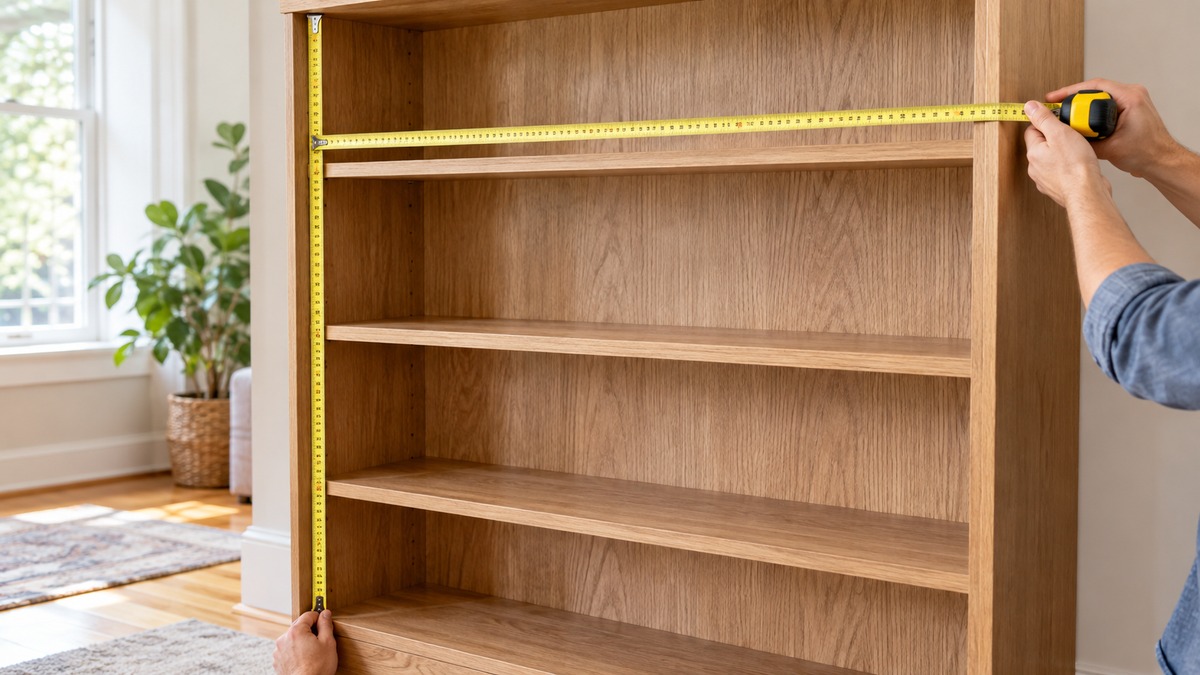
How to measure a bookshelf before you buy comes down to three numbers taken at the exact spot where the unit will stand: width, height and depth. Take the width at more than one point along the wall, take the height from the floor to the lowest point of the ceiling, and measure depth from the wall to the front edge you can allow. Then compare those numbers with the product’s outside size, not its storage space. This guide explains each step, shows the arithmetic, and lists what the sources we opened do not cover.
Quick answer
- Measure the width at three points along the wall: left, center and right. Use the narrowest reading as your limit, which is a planning rule of this guide.
- Measure the height from the finished floor to the lowest point of the ceiling, including any beam, duct or fixture that hangs lower.
- Measure the depth from the wall to the front edge you can allow, then subtract the thickness of any baseboard or skirting trim.
- Match the three numbers to the product’s outside dimensions, and check the outlets and the anchoring step before you order.
Step 1: Measure the width along the wall
A wall is seldom a perfect line, so one width reading is not enough. The Lazada guide asks readers to measure along the floor line and then take a second measurement higher up, because of bowing or uneven plaster. Its words: “Run your tape measure along the floor line, and take a second measurement higher up to account for any bowing or uneven plaster.” The same guide notes that “Plaster walls are rarely square,” so the readings at the left, center and right of the spot can differ.
Write each reading down. This guide’s planning rule is simple: use the smallest reading as the width limit. A unit that is wider than the narrowest reading will not fit at that point. The sources do not set this rule. If the wall is narrow, the bookcase ideas for small rooms page is the next place to look.
Step 2: Measure the height to the lowest ceiling point
Height needs the most care, because the lowest point governs. The Lazada guide tells readers to measure “the vertical height from the floor to the ceiling using a steel tape measure,” and to look up for obstacles. Its wording: “Look upward to identify potential obstructions such as ceiling fans,” and the guide lists other obstacles too. A fan, a light fixture or a beam can lower the usable height well below the height at the middle of the room.
Minnesota’s version of the residential code gives a clear method for ceiling height. It says that “The required height shall be measured from the finish floor to the lowest projection from the ceiling.” That rule sets a ceiling minimum for new homes, which is a different question from shelf fit. The method is still useful, because it measures to the lowest point that hangs down, not to the highest point you can see.
The reach of the shelves also limits the height you can use. Woodbin’s shelf guide says that “For ease of shelf access, bookcases are generally no higher than 84 inches.” The same guide puts the highest shelf at “about 72 to 78 inches” for an average-sized person. The table below converts these figures into feet, using inches divided by 12.
| Height figure | Inches | Feet (inches divided by 12) | What it tells you |
|---|---|---|---|
| Woodbin: bookcases generally no higher than | 84 | 7.0 | An upper reference for an ordinary bookcase |
| Woodbin: highest comfortable shelf, low end | 72 | 6.0 | The shelf an average adult can reach |
| Woodbin: highest comfortable shelf, high end | 78 | 6.5 | The top of that reach range |
| Example: lowest ceiling point you measured | 96 | 8.0 | An example input; replace it with your reading |
If you are fitting a bookshelf into a dorm room, the dorm room bookshelf size and fit page covers the same height and width questions for that setting. The example row in the table uses 96 inches only to show the conversion. No source in this guide gives a ceiling height for any home, so the number in the last row is an input you supply.
Step 3: Measure depth and allow for baseboards
Depth needs its own check. The Lazada guide says: “Finally, determine the maximum allowable depth by measuring from the wall outward.” Decide the front edge you can allow first, so the shelf does not block a walkway, a door swing or a heating vent. Then measure from the wall to that edge.
The guide also warns about trim: “Factor in the thickness of your skirting boards, as these trim pieces prevent furniture from sitting flush against the wall.” If a baseboard stops the unit from sitting flat, the usable depth is shorter than the wall-to-edge distance. The arithmetic is one subtraction. For a very small corner, the bookshelf mini rooms page is another place to start.
Usable depth equals the wall-to-edge distance minus the trim thickness. For example, a 12.0-inch allowance minus a 0.75-inch skirting thickness leaves 11.25 inches. Woodbin says that “Shelf depth for a general purpose bookshelf is usually 10 to 12 inches,” so an allowance near that range is a sensible starting point for a general-purpose unit, but the outside depth of the unit must still fit the usable figure.
Step 4: Map the floor, the outlets and the uneven spots
Once you have the numbers, mark the footprint before you buy. The Lazada guide advises: “Map out the footprint on the floor using masking tape.” Tape shows how much floor the unit will take and whether it blocks a path or a door.
Also check the wall for sockets and data points. The guide warns that “If the bookshelf covers these outlets, you will lose access to essential connections.” Plan a different position for the unit so the outlet stays usable. Note these spots on your sketch with their heights above the floor.
Floors can slope. The guide notes that “Measuring for a bookshelf on an uneven floor requires identifying the highest point of the floor within the intended footprint.” Measure the clearance from that highest point, because the top of a tall unit is the part that can meet a low ceiling or a fixture. If the floor plan leaves you short of room, the shelves for a small room guide covers the same fit question in tight spots.
Step 5: Compare the outside size with the listing
The last step is matching. The Lazada guide puts it plainly: “do not confuse the external dimensions of the unit with its internal storage capacity.” The outside width, height and depth decide whether the unit fits the wall. The inside space decides how much you can store. Use the outside figures for fit, and read the storage details separately.
The worked example below uses illustrative readings, not measurements from a real room or a real product. It shows the arithmetic you can repeat with your own numbers.
| Measurement | Example readings | Rule applied | Result |
|---|---|---|---|
| Width along the wall | 35.5, 35.0 and 35.25 inches | Narrowest reading | 35.0 inches maximum width |
| Height to the lowest ceiling point | 96 inches | Lowest point governs | 96 inches, or 8.0 feet |
| Usable depth | 12.0 inches allowed, 0.75 inch skirting | Allowance minus trim | 11.25 inches maximum depth |
In this example, a unit whose outside width is no more than 35.0 inches, whose height is no more than 96 inches and whose depth is no more than 11.25 inches fits the spot. A unit that is wider than 35.0 inches fails at the narrowest point, even if the other readings were larger. Any figure you record should go into the same table, so you can check the whole unit at once. Readers who need a specific layout for an apartment living room can read the apartment living room bookshelf page, and the Nathan James Theo 6 shelf bookcase page covers one six-shelf unit in detail.
Anchoring after you measure
Measuring the space is not the final safety step. The U.S. Consumer Product Safety Commission’s 2022 news release says to “Anchor TVs and furniture, such as bookcases and dressers, securely to the wall.” The Anchor It! site, which is run by the same agency, says that “Anchoring all furniture with drawers, doors, and shelves to the wall prevents tip-over injuries and deaths”. Plan the anchoring step before you buy, so you know which wall you will fix into.
The sources we opened do not name anchor types, screw sizes or wall materials, so this guide does not name them either. Use the hardware that comes with the unit, and follow its instructions for the wall you have measured. If the shelves themselves are a concern, the wire shelf weight limit page and the floating shelves that can hold weight page are the next questions readers tend to ask.
If the room is tight, the bookshelf for a small room guide is the next page to read. If you are still choosing between two units, the Furinno vs Sweetcrispy bookcases compared page compares the two side by side.
How we chose
This guide does not rank products or recommend a unit. We chose each source because it could be opened and read on 2026-10-21, because it says something specific about one step, and because it is a government page, a technical document or a clearly labeled guide. Where a source is a retail or woodworking guide, the text says so.
Every quotation in this guide was matched against the fetched text of its page. A summary of a page was never used as evidence. Where a source gave no number, the article says “not stated” or describes the method only. The arithmetic in the two tables uses the stated conversions and example inputs, and each example is labeled as one.
Mistakes to avoid
- Taking one width reading. The Lazada guide asks for a second reading higher up because walls can bow or have uneven plaster.
- Measuring the height to the highest point you can see. Minnesota’s method measures to the lowest projection from the ceiling.
- Forgetting the baseboard. The Lazada guide says trim thickness keeps furniture from sitting flush with the wall.
- Comparing the room to the storage space. Match the outside dimensions to the room, and read the storage details separately.
- Skipping the anchoring step. The CPSC release tells people to anchor bookcases to the wall.
What we could not verify
- No source we opened gives the outside dimensions of any particular bookshelf. Check the listing for the exact figures of the unit you want.
- No source we opened names anchor hardware, screw sizes or the wall materials that suit each one.
- The Minnesota rule is a code rule for ceiling height in new buildings. It does not say what ceiling height any home has.
- The Woodbin height and depth figures come from a woodworking guide, not from a standard.
- The Lazada guide was written with Singapore homes in mind, so its room examples may differ from yours.
FAQ
Which measurement decides whether a bookshelf fits?
Three numbers decide the fit: the narrowest width reading, the height to the lowest ceiling point, and the usable depth after the baseboard. Compare each one with the outside size of the unit.
Should I measure to the ceiling or to a beam?
Measure to the lowest point that hangs down, such as a beam, a duct or a light fixture. Minnesota’s residential code measures ceiling height from the finished floor to the lowest projection from the ceiling.
Do I subtract the baseboards from the depth?
Yes, when the trim stops the unit from sitting flush against the wall. The Lazada guide says to factor in the thickness of skirting boards for that reason.
Is the listed size of a bookshelf the same as its storage space?
No. The Lazada guide says not to confuse the external dimensions of the unit with its internal storage capacity. Use the outside size to check fit.
Do I need to anchor a bookshelf after I measure it?
The CPSC 2022 news release says to anchor bookcases and dressers securely to the wall. The sources we opened do not name the anchor type, so follow the instructions supplied with the unit.
What depth is typical for a general-purpose bookshelf?
Woodbin says the shelf depth for a general purpose bookshelf is usually 10 to 12 inches. That figure comes from one woodworking guide and is a starting point, not a rule for every bookcase.
Bottom line
Measure the narrowest width, the height to the lowest ceiling point and the usable depth after baseboards, then match those three outside numbers to the bookshelf before you buy.
Sources
- Lazada Singapore, shelf measuring guide: https://home.lazada.sg/how-to-measure-your-space-and-choose-the-right-bookshelf-size-sg-2/ (opened 2026-10-21)
- Minnesota Rules 1309.0305, Section R305 Ceiling Height: https://www.revisor.mn.gov/rules/1309.0305/ (opened 2026-10-21)
- Anchor It! campaign, U.S. Consumer Product Safety Commission: https://www.anchorit.gov/ (opened 2026-10-21)
- U.S. Consumer Product Safety Commission, 2022 news release on anchoring TVs and furniture: https://cpsc.gov/Newsroom/News-Releases/2022/CPSC-Injury-and-Fatality-Report-Shows-Despite-Some-Progress-Need-for-TV-and-Furniture-Tip-Over-Prevention-Remains-Strong (opened 2026-10-21)
- Woodbin, shelf design guidelines: https://woodbin.com/?p=1129 (opened 2026-10-21)
As an Amazon Associate we earn from qualifying purchases.