Best Toy Storage for Large Toys: Seven Listings Compared by Size, Volume and Anchoring
As an Amazon Associate we earn from qualifying purchases. Details
The best toy storage for large toys depends on the largest toy in the house and on whether you want storage that stands like furniture or sits on the floor. The seven listings in this roundup fall into two families: tall pine shelves with removable bins, and fabric boxes with lids, dividers and collapsible frames. This guide compares their stated sizes, checks the volume each listing claims against its own dimensions, and says what each listing does and does not say about stability.
Quick answer
- Measure the largest toy first. A box that is 37 inches long takes a ride-on or a large plush that a 25-inch box cannot hold, and the listings give length, width and height you can compare with that toy.
- Choose fabric boxes when you want storage that folds away. Choose pine shelves when you want the toys on view and you can fix the unit to a wall.
- Treat the tall pine units as furniture. Both wood shelves in this set are listed at 31.5 inches high, and the sources in this guide say that tall furniture such as dressers and bookcases should be anchored.
- Check the capacity figure against the outer dimensions. One stated volume in this set is larger than its outer dimensions allow, one matches its outer volume exactly, and one is well below it.
Start with the largest toy, not the box
Most people shop for toy storage by the number of bins. For large toys the better starting point is the largest item you own: the plush animal, the plastic kitchen, the ride-on, or the bundle of building sets that will not fit in a standard bin. Write its length, width and height on a piece of paper, then compare them with the listed dimensions of each box or shelf.
A box measured on its outside can hold a large toy only if the inside is large enough after the walls take their share. The listings give outer dimensions in inches, and most also give a capacity in liters or cubic feet. Those two numbers can disagree, so the next section works through the arithmetic before you rely on either one.
Toy storage needs floor space as well as interior space. The pine units are wide and shallow, and they need a wall run. The fabric boxes are deep and narrow, and they can sit in a corner or beside a bed. The footprint calculation below shows how different those two families are on the floor.
Stated size and the volume the dimensions give
The table multiplies length, width and height in inches to give a box volume in cubic inches, then converts that to cubic feet (1,728 cubic inches make one cubic foot). It sets that figure beside the capacity each listing states. Because a box with walls cannot hold more than its outside volume, a stated capacity above the outside volume needs checking.
| Listing | Outer length x width x height (inches) | Volume from outer dimensions | Capacity stated in the listing |
|---|---|---|---|
| Rocamdo black, fabric box with three lids | 38 x 14 x 16 | 8,512 cubic inches, about 4.9 cubic feet | 4.8 cubic feet |
| SoftOwl collapsible, fabric box with lid | 37 x 14 x 16 | 8,288 cubic inches, about 4.8 cubic feet | 4.8 cubic feet |
| YOLOXO collapsible, fabric box with lids | 26.8 x 13.8 x 16 | about 5,917 cubic inches, about 3.4 cubic feet | 82 liters |
| Gowee fabric box with lid and divider | 25 x 13 x 16 | 5,200 cubic inches, about 3.0 cubic feet | more than 83 liters |
| Fineonly foldable box with lid and divider | 25 x 13 x 16 | 5,200 cubic inches, about 3.0 cubic feet | about 90 liters |
Three readings follow from the table. First, the Rocamdo’s stated 4.8 cubic feet is a little under the roughly 4.9 cubic feet its outer dimensions give, which is the direction a box with walls should go. Second, the SoftOwl’s stated 4.8 cubic feet matches its outer volume exactly, which would only be true if the walls took no room; the listing does not explain the difference, so ask the seller before you assume the full interior. Third, the Fineonly’s stated 90 liters is larger than the roughly 85 liters that its 25 by 13 by 16 inch outside gives, which does not fit a box with walls. The Gowee’s “more than 83 liters” sits just under the 85 liters its outside gives, which is the more plausible pattern.
The YOLOXO’s stated 82 liters is much smaller than the roughly 97 liters its outside gives. That gap is what a box with fabric walls and a cardboard base would be expected to show, but the listing does not state the wall thickness, so the interior size is a guess until you measure a sample.
The practical lesson is to compare outer dimensions with the largest toy you own, and to treat the stated capacity as a secondary check. A toy that fits the outer length and width of a box is a better test than a capacity figure you cannot verify.
The floor footprint of the two families
The two pine units are 13.6 inches deep. The SpaceAid is listed at 56.7 inches wide and the Dclavy at 55.2 inches wide. Multiplying depth by width gives 771.1 square inches for the SpaceAid and 750.7 square inches for the Dclavy. Both are about 31.5 inches tall.
The fabric boxes take less floor. The SoftOwl is 37 by 14 inches, which gives 518 square inches. The Rocamdo is 38 by 14 inches, which gives 532 square inches. The YOLOXO is 26.8 by 13.8 inches, which gives about 370 square inches. The two 25-inch-long boxes give 325 square inches each.
That means the smallest pine unit still takes more floor than the largest fabric box. A pine unit is a wall-run decision. A fabric box is a corner or bedside decision. Put the choice in terms of your room: if the wall run is free, the pine units are easy to live with, and if the floor is what you have, the fabric families are the realistic option.
Wood shelves with bins: the anchoring question
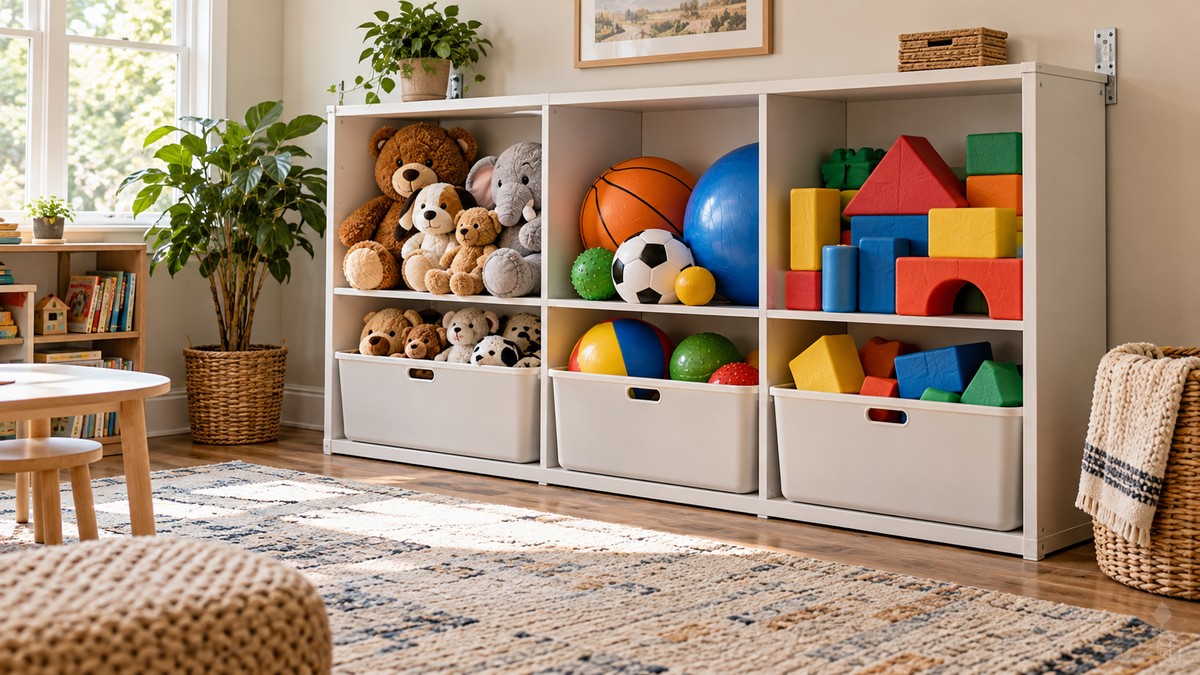
The SpaceAid and Dclavy units are multi-shelf pine furniture with removable bins. Their bullets describe the same use: toys on shelves, a bookcase look, and stuffed animals in the bins. The sources this guide relies on describe bookshelves and dressers in the same terms.
The Oklahoma State University Extension release on furniture tip-overs says: “Dressers and bookshelves can be very appealing to young children, especially when they discover they can pull out the drawers to form steps, or simply crawl up the shelves like a ladder.” Source: https://news.okstate.edu/articles/agriculture/2015/new-campaign-can-help-prevent-tv-and-furniture-tip-over-deaths-and-injuries
The University of Kansas Environment, Health and Safety tip sheet says: “Secure all furniture and mirrors with anti-tip devices.” It recommends metal brackets rather than plastic, because “Plastic can become brittle over time and break, causing anchors to fail.” It also says anchoring may mean moving the furniture “so the wall anchors can be placed in a stud”. Source: https://ehs.ku.edu/news/article/ku-ehs-april-safety-tip-preventing-furniture-and-tv-tip-overs
The University of Kentucky health column adds: “Take items off the tops of dressers and other furniture so children won’t be tempted to climb.” Source: https://uknow.uky.edu/uk-healthcare/anchor-tvs-and-furniture-prevent-injury
For a toy shelf the sources point to the same method as for any tall piece: fix it to the wall with metal brackets, anchor into a stud where you can, and keep the top free of toys that invite climbing. The sources do not test a toy shelf, so this guide does not state a weight limit for either pine unit or any load a shelf can carry with bins full.
The listings give the anchoring picture unevenly. The Dclavy bullets say its “extended base with 4 supportive feet enhances stability, reducing wobbling and tipping.” That is the listing’s own claim, and no source we opened tests it, so treat it as the seller’s statement. The SpaceAid bullets we captured describe smooth, rounded edges and a 12-bin layout, and they do not describe an anti-tip kit or a wall fixing. Neither pine unit’s bullets describe a kit in the text we captured, so a buyer should plan the anchoring as a separate step.
A practical rule follows. Put the tallest pine unit where a child cannot use the top as a step, keep heavy plush or hard toys off the upper shelves, and anchor it before it is filled. Those steps follow the sources’ advice on anchoring, on items placed on top, and on keeping heavy items low.
Fabric boxes: lids, dividers and collapsing
The fabric boxes split into three features. The first is the lid. The Rocamdo listing describes “3 flip-top lids” closed by “strong hook and loop tape”, and the Gowee and Fineonly listings include lids in their titles. The SoftOwl listing describes an “Extra Large Toy Storage Organizer with Lid.” The YOLOXO listing describes “Storage Bins with Lids.” None of the bullets we captured says whether the lid has a hinge that holds it open, and the sources we opened do not cover toy-box lids, so this guide does not make any claim about lid safety.
The second feature is the divider. The Gowee listing describes a “removable divider board” that attaches “by velcro”, and the Fineonly listing describes a detachable divider that lets you “separate toys, books, or clothes for easy access”. The Rocamdo listing describes “two dividers” that make “3 small storage cubes”. Dividers are useful when you have a mix of large and small toys, and they are a poor fit when the big toy needs the whole box.
The third feature is the collapse. The SoftOwl, YOLOXO and Rocamdo listings call their boxes collapsible, and the Fineonly listing calls its box foldable. A collapsible frame lets the box fold flat between uses, which is a real advantage in a small room. It also means the walls and base are fabric or board, so the box is less rigid than a pine shelf. The YOLOXO listing describes “3mm-thickness inserts and solid cardboard bottom”, and the Fineonly listing describes a “polypropylene (PP) board” that “keeps its shape”. Those are listing descriptions, not tests, and they tell you how the box is built rather than how it will hold up over time.
Materials and what the listings say about them
The pine units are described as solid pine. The Dclavy listing says the pine is “GRS-certified”, “odor-free, warp-resistant” and “paint-free”. The SpaceAid listing describes “solid pine wood construction”. The pine units are also the taller and wider of the two families, which is why the wall-run and anchoring points above matter most for them.
The fabric boxes use three materials in the listings: Oxford fabric for the SoftOwl, linen-look or linen fabric for the Gowee and Fineonly, and a fabric exterior with a polypropylene board for the Fineonly. The SoftOwl listing says its Oxford fabric is “built to last”, and that is a claim we did not test. The listings do not say how the fabric handles spills or repeated folding over years.
Who each design suits
A family with a playroom wall and a plan to display toys should look at the pine units first. A family that needs a box for a bedroom corner, a basement or a car trunk should look at the collapsible boxes. A household with a small child who climbs everything should anchor any tall unit first, and should choose a fabric box with a lid only where the lid’s hinge and hardware are described in the listing.
For internal reference, a shelf-first comparison of toy shelves appears in our best shelves for toy storage guide. If the item you need to store is a bench rather than a toy shelf, our best cabinet storage bench guide covers that category instead.
Our picks
The seven picks below are the seven distinct designs in the set. Each pick card gives the listing’s own pros, the limits we found in its dimensions or bullets, and the situation where it fits best. A pick is not a recommendation to buy without measuring your largest toy.
1. SpaceAid 3-in-1 Toy Storage Organizer with 4 Shelves and 12 Bins, Toy Organizers Storage 3-Tier (Pine toy shelf with four shelves and twelve bins)
Pros
- The listing gives 13.6 inches deep by 56.7 inches wide by 31.5 inches high, with four shelves and twelve bins
- The bullets describe solid pine wood construction and rounded edges on the shelf
- The bullets describe a bookcase look that suits a playroom
Cons
- The bullets we captured do not describe an anti-tip kit or a wall fixing
- Its 56.7-inch width needs a wall run, which a narrow room may not have
Best for: A playroom wall with room for a wide unit and a plan to anchor it
Skip if: You need a collapsible unit that folds flat between uses
View on Amazon (affiliate link)
2. 3-in-1 Kids Toy Storage Organizer &Bookshelf &Stuffed Animal Storage (Pine bookshelf with a stabilizing base and removable bins)
Pros
- The listing gives 13.6 inches deep by 55.2 inches wide by 31.5 inches high, with twelve removable bins
- The bullets say the extended base with four supportive feet enhances stability and reduces wobbling and tipping
- The bullets describe GRS-certified solid pine that is paint-free
Cons
- The stability claim is the seller's statement, and we did not test it
- The bullets we captured do not mention an anti-tip kit or wall anchor hardware
Best for: A playroom wall where stuffed animals and books share one tall unit
Skip if: You need a unit that stores between uses without taking up a wall
View on Amazon (affiliate link)
3. Large Toy Storage Box with Lid, Toy Chest Bin Boxes Basket with Dividers (Fabric box with a lid and a removable divider)
Pros
- The listing gives 25 inches long by 13 inches wide by 16 inches high, which it describes as more than 83 liters
- The bullets describe a removable divider board that attaches with Velcro
- The bullets say the box is large enough for large stuffed animals
Cons
- The 25-inch outer length is shorter than the 37-inch SoftOwl, so the largest toys may not fit
- The bullets do not say whether the lid has a hinge that holds it open
Best for: A room with a mix of large and small toys that benefits from a divider
Skip if: Your largest toy is longer than about 25 inches
View on Amazon (affiliate link)
4. SoftOwl Extra Large Toy Storage Organizer with Lid – Sturdy, Collapsible Toy Chest Storage Box (Large collapsible Oxford fabric box with three compartments)
Pros
- The listing gives 37 inches long by 14 inches wide by 16 inches high and 4.8 cubic feet, the largest outer size in this set
- The bullets describe reinforced handles for transport and Oxford fabric construction
- The specification rows list three compartments
Cons
- Its 518 square inches of floor is the largest of the fabric boxes, so it needs the most floor space
- Its stated 4.8 cubic feet equals the volume its outer dimensions give, which means the walls are not accounted for in the listing
Best for: A family with the largest plush or ride-on toys that needs a long box
Skip if: You have a narrow closet or a small corner
View on Amazon (affiliate link)
5. YOLOXO Toy Box Chest, Collapsible Sturdy Storage Bins with Lids, Extra Large Kids Toy Storage (Collapsible box with soft side handles)
Pros
- The listing gives 26.8 inches long by 13.8 inches wide by 16 inches high and an 82-liter capacity
- The bullets describe 3mm-thickness inserts and a solid cardboard bottom
- The bullets describe soft side handles that make the box easy to carry and move
Cons
- The stated 82 liters is much smaller than the roughly 97 liters its outer dimensions give, and the wall thickness is not stated
- The specification rows list one compartment, so there are no dividers
Best for: A bedroom or basement corner where the box needs to move and fold
Skip if: You need dividers to separate small toys from large ones
View on Amazon (affiliate link)
6. Extra Large Toy Box with Lids, Collapsible Storage Bin, 38"x16"x14",Black (Black fabric box with three flip-top lids and two dividers)
Pros
- The listing gives 38 inches long by 14 inches wide by 16 inches high, the longest outer size among the fabric boxes
- The bullets describe two removable dividers that make three storage cubes
- The bullets describe three flip-top lids closed with hook and loop tape
Cons
- The stated 4.8 cubic feet is a little under the roughly 4.9 cubic feet the outer dimensions give
- The hook and loop closure is described as gentle, but the bullets do not say how the lids stay upright when open
Best for: A household that wants three separate cubes in one long fabric box
Skip if: You want a rigid box with a solid frame
View on Amazon (affiliate link)
7. Large Toy Storage Box with Lid, Toy Chest with Divider, Foldable Organizer (Foldable linen box with a polypropylene board and a divider)
Pros
- The listing gives 25 inches long by 13 inches wide by 16 inches high and about 90 liters
- The bullets describe a polypropylene board that keeps its shape
- The bullets describe a detachable divider that lets you remove it for one large space
Cons
- The stated 90 liters is larger than the roughly 85 liters the outer dimensions give, and the listing does not explain the difference
- The 25-inch length is shorter than the longest boxes in this set
Best for: A room where the divider and a foldable frame both matter
Skip if: Your largest toy is longer than about 25 inches or you need the capacity figure to be exact
View on Amazon (affiliate link)
How we chose
- We kept listings that describe toy storage for children: pine toy shelves with bins, and fabric toy boxes with lids or dividers. We left out adult storage ottomans and general closet organizers.
- We used the outer length, width and height in each listing, and we calculated volumes from those numbers. We did not use a price, a rating or a badge.
- We grouped the seven by family, wood shelf or fabric box, and by features the bullets describe: dividers, lids, collapsibility and material.
- We used three sources that we opened and read for the anchoring and tip-over points: the Oklahoma State University Extension release, the University of Kansas EHS tip sheet and the University of Kentucky health column.
- We used only the dimensions, bullets and specification rows captured from each Amazon product page on 2026-10-21.
What we could not verify
- The sources we opened describe tip-over risk for dressers, TVs and bookcases. None of them tests a toy shelf or a toy box, so no weight limit is stated for any unit in this set.
- We found no opened source on toy-box lids, hinges or lid safety, so this guide makes no claim about whether a lid will stay open or close safely.
- The listing text does not say whether any pine unit ships with an anti-tip kit or wall fixing. The Dclavy bullets describe a base with four feet, which the listing calls stable; that is the seller’s statement only.
- The stated capacities do not match the outer dimensions for every listing. For the SoftOwl and Fineonly we could not confirm the wall thickness, so the interior volume is unverified.
- Age ranges, weight ratings and the fabric’s wear over time are not stated in the bullets we captured, so this guide does not report them.
- The listings for the two pine units describe bins and a bookcase use, but they do not show how the bins hold up when full of large toys over several years.
FAQ
Do I need to anchor a toy shelf with bins?
The sources in this guide recommend anti-tip devices for tall furniture such as dressers and bookcases, and say the anchor should go into a stud where possible. Both pine units in this set are listed at 31.5 inches high. Anchoring is the safer default, and the step is the same whether the unit holds toys or books.
Which is better for a small room, a pine shelf or a fabric box?
It depends on the wall and the floor. The pine units take between about 751 and 771 square inches of floor, while the fabric boxes take between about 325 and 532. A room with a wall run favors the shelves, and a room with a corner or a bedside favors a collapsible box.
Why do the stated capacities not match the outer dimensions?
A box with walls holds less than its outside volume, so a stated capacity above the outside volume is a warning sign. The Fineonly’s stated 90 liters is larger than the roughly 85 liters its outside gives, and the listing does not explain it. Measure the interior with a tape measure before you rely on the figure.
Can a fabric toy box hold large stuffed animals?
The Gowee listing says its box is “large enough for large stuffed animals”, and the YOLOXO listing describes a box “large enough” for stuffed animals. Those are listing claims. The most reliable test is to place the largest plush you own in the box with the lid closed, and confirm it closes.
Should I put a lid on a toy box?
A lid keeps dust and small pieces inside, and the listings describe lids on several boxes. We did not find an opened source on lid safety, so this guide does not recommend or reject lids on safety grounds. Choose the lid style that you can open and close with one hand, and check the hinge or hook-and-loop closure in the listing before you buy.
Bottom line
Measure the largest toy, then choose between a pine shelf that needs a wall and a fabric box that folds. Anchor any unit at 31.5 inches tall before you fill it, and treat the stated capacity as something to confirm against the outer dimensions.
Sources
- Oklahoma State University Extension, New campaign can help prevent TV and furniture tip-over deaths and injuries (2015): https://news.okstate.edu/articles/agriculture/2015/new-campaign-can-help-prevent-tv-and-furniture-tip-over-deaths-and-injuries
- University of Kansas Environment, Health and Safety, KU EHS April Safety Tip: Preventing Furniture and TV Tip-Overs: https://ehs.ku.edu/news/article/ku-ehs-april-safety-tip-preventing-furniture-and-tv-tip-overs
- University of Kentucky UK HealthCare (UKNow), Anchor TVs and Furniture to Prevent Injury (2022): https://uknow.uky.edu/uk-healthcare/anchor-tvs-and-furniture-prevent-injury