Best Bathroom Floor Cabinet for Small Spaces: Five Listings Compared by Footprint and Anchoring
As an Amazon Associate we earn from qualifying purchases. Details
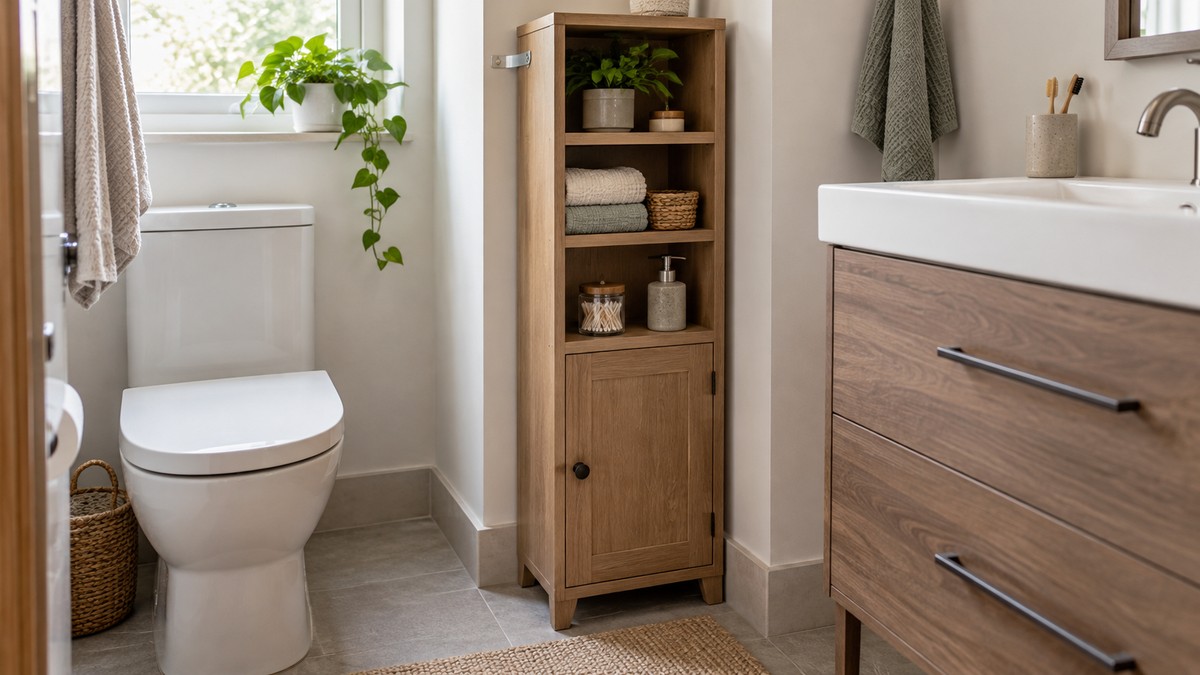
The best bathroom floor cabinet for small spaces is the narrowest one that still holds your toiletries and towels and that you can fix to the wall. The five distinct listings in this roundup range from a corner unit measured at 7.9 by 7.1 inches to a 22-inch-wide unit that needs more than twice the floor area. Measure the gap first, then choose the layout, then check how the cabinet is secured.
Quick answer
- Measure the floor gap beside the toilet or tub before you compare anything else. The footprint decides which cabinets are even possible.
- Choose drawers for small items you reach for every day, and doors for bulky spare rolls. The listings do not state clearance for either, so test the swing or pull-out space with a tape measure.
- Treat anchoring as part of the purchase. Three listings say they include an anti-tip kit, and the consumer sources in this guide say furniture should be secured with anti-tip devices, with metal brackets as the suggested option.
- Keep the room ventilated. The EPA advises keeping indoor humidity low, and a bathroom is where humidity rises fastest.
What the floor footprint decides
Each cabinet in this set has a stated depth and width in its listing. Multiplying depth by width gives the floor area it takes up, which is the number that matters when the gap is narrow.
| Brand | Listed depth x width x height (inches) | Floor area (square inches) | Anti-tip kit mentioned in bullets |
|---|---|---|---|
| Homhedy (corner unit) | 7.9 x 7.1 x 31 | 56.1 | No |
| Homhedy (door cabinet) | 7.9 x 14.6 x 31 | 115.3 | No |
| Akxomel (rattan-look doors) | 7.9 x 15.0 x 30.7 | 118.5 | Yes |
| GRUSIGN (door, drawers, tabletop) | 11.8 x 22 x 33.5 | 259.6 | Yes |
| Yaheetech (four drawers and side cupboard) | 12 x 22 x 32.5 | 264.0 | Yes |
The floor area column is depth times width, rounded to one decimal place. The corner unit uses 7.9 times 7.1, which is 56.1. The Homhedy door cabinet uses 7.9 times 14.6, which is 115.3. The Akxomel uses 7.9 times 15, which is 118.5. The GRUSIGN uses 11.8 times 22, which is 259.6. The Yaheetech uses 12 times 22, which is 264.
Compare the largest door cabinet with the Homhedy door cabinet: 259.6 divided by 115.3 is about 2.25. The two 22-inch units take up roughly twice the floor of the 14.6-inch door cabinet, and the Yaheetech takes up more still. That difference is the reason a gap of 15 inches or less rules out most of this set.
Heights are close. The shortest unit is the Akxomel at 30.7 inches and the tallest is the GRUSIGN at 33.5 inches. A height difference of two or three inches matters far less than depth when you slide a cabinet into a gap beside a toilet or a tub, because depth is the dimension that catches on the wall and the fixture edge.
The listings do not give clearance measurements, door swing, or how far a drawer projects beyond its stated depth. Those three numbers decide whether a cabinet fits in practice, and the only way to get them is to measure your own room.
Measure the gap in three steps
Start with the gap, not the store page. Take three measurements at floor level: the open width beside the toilet or tub, the depth from the wall to the front edge of the nearest fixture, and the height under any towel bar or window trim. Write each number down before you look at the listings again.
Next, leave a margin for the door or drawers. A cabinet with a door needs room for the door to swing, and a drawer unit needs room in front of it to pull the drawer out. The listings do not state either distance, so plan a margin that you can check with a piece of cardboard cut to the cabinet’s stated depth and opened as you would open the door or drawer.
Then compare the numbers with the footprints in the table. In a gap of 15 inches or less, only the Homhedy corner unit and the two 7.9-inch-deep door cabinets (Homhedy and Akxomel) are candidates. A gap of 22 inches or more opens the wide options, including the GRUSIGN and Yaheetech units. Between those two numbers, check whether the width leaves room on both sides for your hand and for the door edge.
Here is a worked example. Suppose the gap at floor level is 16 inches wide and 9 inches deep. The Homhedy door cabinet at 14.6 inches wide leaves 16 minus 14.6, which is 1.4 inches, on the side. Its 7.9-inch depth leaves 9 minus 7.9, which is 1.1 inches at the front. The Akxomel at 15 inches wide leaves 1 inch on the side. Those margins are small, and a tight fit can make a door or drawer hard to open once the cabinet is full. In a gap that size, the corner unit leaves the most floor clear, but it holds less because its listed dimensions are the smallest in this set.
If the gap is 22 inches wide and 12 inches deep, both wide units fit on paper, but the Yaheetech at 12 inches deep uses the full depth of that space. Check whether the toilet tank or the tub edge leaves 12 inches of depth at the height of the drawers, not just at the floor.
Anchoring comes first
Tall, narrow furniture can tip over, and the sources this guide relies on describe the hazard in terms of children climbing it. The University of Kansas Environment, Health and Safety tip sheet says plainly: “Secure all furniture and mirrors with anti-tip devices.” The same page explains that anchoring can require moving the furniture, “so the wall anchors can be placed in a stud”, and it recommends metal brackets: “Consider using furniture and wall anchors that are metal (such as “L” brackets). Plastic can become brittle over time and break, causing anchors to fail.”
The Oklahoma State University Extension release on furniture tip-overs names dressers and bookcases as the pieces that need anchoring. It describes why young children are drawn to them: “Dressers and bookshelves can be very appealing to young children, especially when they discover they can pull out the drawers to form steps”.
The University of Kentucky health column lists the same family of pieces and says: “TVs on stands, dressers, bookcases and even refrigerators and stoves can tip and cause serious injury or death.” It also advises: “Take items off the tops of dressers and other furniture so children won’t be tempted to climb.”
How do these sources apply to a bathroom floor cabinet? None of them tests a bathroom cabinet, and none of them says how much weight a floor cabinet can hold. What they do support is the method: fix tall, narrow furniture to the wall with metal brackets, place anchors in a stud where you can, and keep heavy items low and off the top. The same method is a reasonable starting point for a cabinet of this height, and it is the reason this guide treats anchoring as part of the purchase rather than an extra.
Three of the five listings describe an anti-tip kit. The GRUSIGN bullets describe “A reinforced anti-tip kit (pre-installed on the rear panel)”. The Yaheetech bullets say the cabinet “Includes an anti-tip kit for secure installation”. The Akxomel bullets say its cabinet “also includes an anti-tip kit”. The Homhedy door cabinet and the Homhedy corner unit do not mention an anti-tip kit in the bullets we captured, so the buyer of those units should plan the anchoring separately.
Two practical rules follow from the sources. First, a kit that comes in the box is not the same as a stud anchor: the KU page recommends placing the anchor in a stud and says a stud may mean moving the furniture. Second, a drawer that opens fully adds forward weight. The KU page lists “Multiple dresser drawers being open at the same time” among the reasons furniture becomes unstable. That source is written about dressers, but the same logic applies to a cabinet with two or more drawers, so it is reasonable to keep one drawer open at a time and to anchor any multi-drawer unit before it holds a full load of toiletries.
The KU page also lists “Heavy objects in or on top of the furniture, such as appliances or TVs” as a cause of tip-over. In a bathroom the equivalent is a heavy bottle collection or a basket of wet towels set on top of a narrow cabinet. Keep the top of a small floor cabinet for light items, and store the heavier items low.
Humidity and ventilation
A bathroom is the room where humidity climbs fastest, and floor cabinets sit in the damp zone beside the tub or toilet. The EPA guide on mold and moisture gives a clear target: “Keep indoor humidity low. If possible, keep indoor humidity below 60 percent (ideally between 30 and 50 percent) relative humidity.”
The same guide says why damp spots need attention: “Places that are often or always damp can be hard to maintain completely free of mold.” For a bathroom it recommends a practical fix: “increasing ventilation (running a fan or opening a window) and cleaning more frequently will usually prevent mold from recurring”.
Those sentences shape how to place and use a floor cabinet. The EPA guide ties damp spots to ventilation, so a spot where air can move is the sensible default. Leave a small gap at the back and sides if the wall allows it, so that air can move behind the cabinet. Avoid closing damp towels inside a closed compartment for days at a time, and wipe the cabinet’s surfaces when they get wet.
The listings describe the materials, and those descriptions matter for a damp room. The GRUSIGN listing describes “moisture-resistant MDF” and says the surface is “easy to clean”. The Yaheetech listing describes “CARB P2-compliant MDF” with metal hardware. The Akxomel listing describes engineered wood with woven rattan-look doors and metal handles. The Homhedy listings describe metal craftsmanship knobs and a magnetic door catch. None of the listings explains what its material does in steam, and this guide does not infer a moisture rating from a material name.
Hardware is worth checking in a damp bathroom. The listings name metal knobs (Homhedy) and metal handles (Akxomel), but they do not say how the finish holds up over time, so ask the seller before you buy.
Doors, drawers, or open shelves
The layouts in this set split into three groups. The first group uses doors: the two Homhedy door cabinets (one with a top display shelf and one corner unit with a door and multiple shelves) and the Akxomel with four rattan-look doors. The second group uses drawers: the Yaheetech with four smooth-gliding drawers and a side cupboard, and the GRUSIGN with one door, one open compartment, a large tabletop, two small drawers and one big drawer. The third group mixes a top surface with closed storage below, which is how the Homhedy door cabinet is described.
Doors hide the contents. They suit bulky spare rolls and cleaning supplies, and they keep the top shelf clear. Their cost is the swing: a door needs floor space in front of the cabinet, and the listings do not state how far it swings. Doors also make small items harder to reach at the back, which the Akxomel listing does not address.
Drawers show what is inside when you pull them out. They suit toothbrushes, razors, and small bottles that you reach for every day. Their cost is the forward pull: a drawer needs clearance in front of the cabinet. The Yaheetech listing describes “built-in drawer stoppers” that keep drawers from sliding out accidentally, which is a useful feature for a home with young children, but the listing does not state the stop distance, so check the drawer action when you open the box.
Open or display surfaces suit decorative items and plants. The Homhedy door cabinet’s listing says its top compartment “can display potted plants or place your cell phone”, which is the clearest use for the top surface in this set. Keep heavy items off that surface, consistent with the KU and UKY guidance on items on top of furniture.
For a bathroom, the sensible choice depends on the gap. A narrow gap of 15 inches or less points to a door cabinet with a display top or the corner unit. A gap of about 22 inches opens drawers and a tabletop, and the anchoring steps above apply to those wide units as much as to any other. Anyone who wants a larger tabletop for a bathroom counter should also read our best pedestal sink storage cabinet guide for the same width problem beside a sink. If the goal is a drawer for small items that sits under a vanity, our best under vanity organizer guide covers the same trade-off from the vanity side.
Finish and style are a matter of taste. The Akxomel rattan-look doors and the Homhedy metal knobs create different looks in the same footprint. The listings describe those looks but do not show how they age, so buy for the surface you can clean easily.
Our picks
The five picks below are the five distinct designs in the set. A second Homhedy door cabinet listing repeats the first Homhedy listing’s bullets and dimensions word for word, so it is left out rather than repeated as a sixth card. Each pick card gives the listing’s own pros, the limits we found, and the situation where it fits best.
1. Small Bathroom Storage Cabinet, Toilet Paper Storage Cabinet (Narrow door cabinet with a top display shelf)
Pros
- The listing gives 7.9 inches deep by 14.6 inches wide by 31 inches high, a floor area of about 115 square inches
- The bullets say the top compartment can display potted plants or hold a cell phone
- The bullets describe a middle compartment for toiletries and a bottom cabinet for spare items
Cons
- The bullets we captured do not mention an anti-tip kit or anchoring hardware
- The listing describes doors and shelves and no drawers, so small items sit at the back
Best for: A gap of about 15 inches beside a toilet that needs one door and a top display surface
Skip if: You need a drawer for small items or a cabinet that already includes an anti-tip kit
View on Amazon (affiliate link)
2. Small Bathroom Storage Cabinet, Narrow Toilet Paper Cabinet (Corner floor cabinet for a tight corner)
Pros
- The listing gives 7.9 inches deep by 7.1 inches wide by 31 inches high, about 56 square inches of floor
- The bullets describe a corner design with a door and multiple shelves
- The bullets describe two toilet paper compartments in the unit
Cons
- The bullets we captured do not mention an anti-tip kit
- Its listed dimensions are the smallest in this set, so it holds less than the wider units
Best for: A narrow corner beside a toilet where a slim unit fits and a wide one does not
Skip if: You need a shelf deep enough for large bottles or a drawer for small tools
View on Amazon (affiliate link)
3. Bathroom Cabinet, Modern Bathroom Floor Storage Cabinet Organizer with 1 Door and 3 Drawers (Door, drawers and tabletop in a 22-inch unit)
Pros
- The bullets describe one door, one open compartment, a large tabletop, two small drawers and one big drawer
- The bullets describe a reinforced anti-tip kit pre-installed on the rear panel
- The listing gives 11.8 inches deep by 22 inches wide by 33.5 inches high
Cons
- At 22 inches wide it covers about 260 square inches, more than twice the floor of the 14.6-inch Homhedy door cabinet
- The bullets name moisture-resistant MDF but do not say how it performs in steam
Best for: A floor space of 22 inches or more that needs drawers and a top surface
Skip if: The gap beside the toilet is under 22 inches wide
View on Amazon (affiliate link)
4. Yaheetech Small Bathroom Storage Cabinet with 4 Drawers & Door, White (Four drawers and a side cupboard with an anti-tip kit)
Pros
- The listing says the cabinet includes an anti-tip kit for secure installation
- The bullets describe built-in drawer stoppers that keep drawers from sliding out by accident
- The listing gives 12 inches deep by 22 inches wide by 32.5 inches high, with four drawers and a side cupboard with two shelves
Cons
- At 22 inches wide and 12 inches deep it has the largest floor footprint in this set, about 264 square inches
- The bullets do not say whether the kit includes wall anchors for drywall
Best for: A user who wants drawers for toiletries and a side cupboard and can anchor the unit into a stud
Skip if: You need a cabinet narrower than 22 inches
View on Amazon (affiliate link)
5. 15" Rattan Small Bathroom Cabinet 4 Doors Adjustable Shelf Oak (Four rattan-look doors in a narrow footprint)
Pros
- The listing gives 7.9 inches deep by 15 inches wide by 30.7 inches high, about 118.5 square inches of floor
- The bullets describe woven rattan-look doors with golden handles and an adjustable shelf
- The bullets say a firm suction device helps the doors open and close smoothly
Cons
- The bullets say the cabinet includes an anti-tip kit but do not say where it mounts
- It has doors and no drawers, so small items are harder to reach at the back
Best for: A narrow gap that needs a decorative cabinet with four doors
Skip if: You want drawers rather than doors
View on Amazon (affiliate link)
How we chose
- We kept only listings that describe a floor-standing or corner bathroom cabinet with a stated size from the first search page.
- We grouped the remaining five by floor footprint, which we calculated from the stated depth and width, and by layout: doors, drawers, or a mix.
- We marked each listing as mentioning an anti-tip kit only when its bullets or specification rows said so. We did not infer an anchoring kit from a cabinet’s shape.
- We removed one Homhedy door cabinet listing as a repeat of the first, because the bullet text and size are the same.
- We used only the dimensions, bullets and specification rows captured from each Amazon product page on 2026-10-21. We did not use prices, ratings, badges or seller statements outside the listing text.
- For anchoring and humidity we used four sources that we opened and read: the University of Kansas EHS tip sheet, the Oklahoma State University Extension release, the University of Kentucky health column and the US EPA mold and moisture guide.
What we could not verify
- The listings do not give clearance measurements, door swing, or the distance a drawer projects. The fit steps in this guide are a method you apply to your own room, not a promise about any one product.
- The sources we opened describe dressers, TVs and bookcases. None of them tests a bathroom floor cabinet, so we do not state a load rating or a weight limit for any cabinet in this set.
- The listings do not state the load capacity of these cabinets in the bullets we captured, and we do not report any number from a specification row as a load rating.
- We could not confirm the anti-tip hardware in each kit, the screw or anchor length, or whether the Homhedy and Akxomel units ship with any anchoring hardware at all.
- The EPA guide does not name a bathroom cabinet design or a fan size, so the ventilation advice is general, not tied to any product.
- We did not find a source that compares how different cabinet materials behave in steam over several years. The material descriptions here are the listing’s own wording.
FAQ
Do I need to anchor a bathroom floor cabinet?
The sources in this guide recommend anti-tip devices for furniture and say the anchor should go into a stud where possible. Three of the five listings say they include an anti-tip kit. If your cabinet has no kit, the step described by the University of Kansas page is to fix it with metal brackets into framing. Anchoring is a safety step, and it should be done before the cabinet holds a full load.
Which is better for a small bathroom, drawers or doors?
It depends on what you store. Drawers show small items when pulled out and need clearance in front. Doors hide bulky spare rolls and need swing clearance. The listings do not state the clearance for either layout, so measure the space in front of the cabinet before you choose.
Can I put the cabinet next to a shower?
The listings do not address shower use, so we do not say whether any cabinet in this set is built for wet areas. The EPA advice on humidity and ventilation still applies: keep the room ventilated, wipe wet surfaces, and avoid closing damp items inside a compartment for long periods. If the cabinet sits directly in the spray path, choose a different location.
Why do two listings in this set mention an anti-tip kit and three do not?
The bullets are what the listings say. We did not contact any seller, and we did not assume a kit is included when the bullets do not say so. A missing mention is not proof that a cabinet cannot be anchored, but you should plan to anchor it yourself if the listing is silent.
Is the corner unit better than a straight cabinet?
For a tight corner, the corner unit at 7.9 by 7.1 inches leaves the most floor clear. Its listing gives smaller overall dimensions than the wider units, so it will hold less. If the gap beside the toilet is wider than about 15 inches, a straight door cabinet offers more storage for the same depth.
Bottom line
Measure the gap first. Then choose the narrowest cabinet that holds the items you actually store and that you can fix to a stud with a metal bracket. If the listing does not mention an anti-tip kit, plan the anchoring yourself before you load the cabinet.
Sources
- University of Kansas Environment, Health and Safety, KU EHS April Safety Tip: Preventing Furniture and TV Tip-Overs: https://ehs.ku.edu/news/article/ku-ehs-april-safety-tip-preventing-furniture-and-tv-tip-overs
- Oklahoma State University Extension, New campaign can help prevent TV and furniture tip-over deaths and injuries (2015): https://news.okstate.edu/articles/agriculture/2015/new-campaign-can-help-prevent-tv-and-furniture-tip-over-deaths-and-injuries
- University of Kentucky UK HealthCare (UKNow), Anchor TVs and Furniture to Prevent Injury (2022): https://uknow.uky.edu/uk-healthcare/anchor-tvs-and-furniture-prevent-injury
- US Environmental Protection Agency, A Brief Guide to Mold, Moisture, and Your Home: https://www.epa.gov/mold/brief-guide-mold-moisture-and-your-home