How Much Space Between Floating Shelves?
As an Amazon Associate we earn from qualifying purchases.
How much space between floating shelves depends on what sits on them, so no single number fits every wall. The short answer: space each shelf from the tallest item it will hold, then add the clearance you want and the shelf’s own thickness. None of the sources we opened gives a standard vertical gap. They do give limits you can use, including how far apart a shelf’s brackets must sit, how full a shelf should be, and how much room the hardware needs. The steps and worked numbers below show how to combine them.
Quick answer
- No source we opened gives one vertical gap for all floating shelves. Work the gap out from the tallest item on each shelf.
- Use this sum for each shelf: tallest item, plus clearance you choose, plus shelf thickness. The example uses 2 inches of clearance and a 1-inch shelf, both assumed for illustration.
- For brackets along a shelf, IKEA’s guide for its 23-inch BURHULT shelf says to use two brackets placed a minimum of 19 inches apart.
- Leave some open space on each shelf. Cornell’s library guidance says shelves should be partially filled to allow for expansion.
Start with the tallest item on each shelf
The vertical question is about air, not about the shelf itself. Each shelf needs room for the object it holds and enough clearance to lift that object off without knocking the shelf above. The IKEA buying guide for wall shelves does not give a vertical gap, so the arithmetic below uses your own items and two assumed values that you can replace.
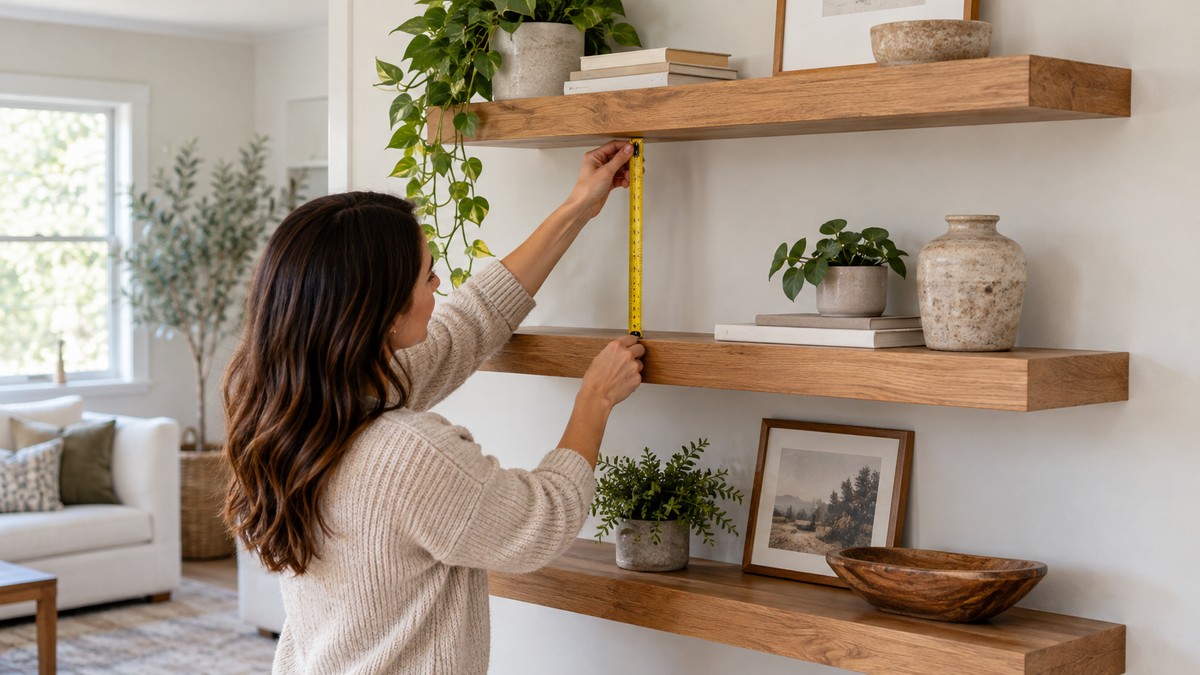
For each pair of shelves, add three numbers: the height of the tallest item on the lower shelf, the clearance you want above that item, and the thickness of the upper shelf. The total is the distance from the top of the lower shelf to the top of the upper shelf.
| Tallest item on lower shelf (inches) | Clearance above item (inches, assumed) | Shelf thickness (inches, assumed) | Distance from lower shelf top to upper shelf top (inches) |
|---|---|---|---|
| 6 | 2 | 1 | 6 + 2 + 1 = 9 |
| 9 | 2 | 1 | 9 + 2 + 1 = 12 |
| 12 | 2 | 1 | 12 + 2 + 1 = 15 |
Check the middle row: 9 + 2 + 1 = 12 inches. A 9-inch vase on a shelf spaced 12 inches apart keeps 2 inches of clearance under the upper shelf, and the 1-inch shelf takes the last inch. The table values are arithmetic, not a rule from any source. Swap in your own item height and clearance before you mark the wall.
Fit more than one pair on a wall run
Once you have one spacing, the wall run tells you how many shelves fit. Divide the run you have, measured from the top of the lowest shelf to the top of the highest, by the spacing, round down, and add one shelf. Assume the spacing is 14.5 inches, which is a 10-inch vase, 3 inches of clearance and a 1.5-inch shelf: 10 + 3 + 1.5 = 14.5 inches.
- Run of 60 inches: 60 divided by 14.5 is 4.1, so round down to 4 spacings. Four spacings use 4 × 14.5 = 58 inches, leaving 2 inches. That gives 4 + 1 = 5 shelves.
- Run of 44 inches: 44 divided by 14.5 is 3.0, so 3 spacings use 3 × 14.5 = 43.5 inches, leaving 0.5 inch. That gives 3 + 1 = 4 shelves.
The second run is tight. Half an inch of slack leaves no room for an error in the marks, so check the wall with a level before you drill.
Horizontal spacing: brackets set the minimum
Vertical gaps are only half of the question, because a floating shelf also has to sit on its brackets. IKEA’s buying guide lists the BURHULT shelf at 23 inches wide and says it is “To be completed with 2 brackets, placed a minimum of 19″ apart.” The word that matters is minimum. Brackets can sit farther apart than 19 inches, but they cannot be closer on this shelf.
| Shelf width (inches, as listed) | Bracket spacing (inches, minimum in the guide) | Total left over at the ends (inches) | Left over at each end if centered (inches) |
|---|---|---|---|
| 23 | 19 | 23 − 19 = 4 | 4 ÷ 2 = 2 |
With brackets at the 19-inch minimum and centered on a 23-inch shelf, each end has about 2 inches of shelf beyond the brackets. If you spread the brackets wider, the margin at each end shrinks, so the shelf’s ends carry less overhang. The guide gives no separate margin rule, so treat the 2-inch figure as the arithmetic result, not a stated requirement.
Leave room for books and tall objects
Cornell’s library guidance on shelving is written for collections, but its handling rules carry over to a home bookcase or a wall shelf. The guide says: “Shelves should be partially filled to allow for expansion; tightly packed shelves cause abrasion and excessive compression can impede safe removal of books.” Read that as a reason to keep spacing generous, not as a number.
The same page also says: “Adjust shelf height to accommodate tall books; very large books should be stored flat on shelves, with no more than three volumes in a stack.” For spacing, that means the tallest thing on a shelf sets the gap, and a stack counts as the sum of its volumes. Three 1.5-inch books stacked flat make 3 × 1.5 = 4.5 inches, which you then add to the spacing sum from the table above.
Check the wall and hardware before you drill
A spacing plan does not help if the wall cannot take the shelf. The IKEA guide says: “Use hardware (sold separately) suitable for the walls in your home.” It lists different anchoring for drywall or plaster with a wood stud, drywall or plaster without one, and masonry. Choose the spacing after you know which of those walls you have, because the anchor position can decide where a bracket lands.
The IKEA BILLY listing is for a freestanding bookcase, not a floating shelf, but its anchoring note is a useful reminder for any unit fixed to a wall: “Keep in mind that you need enough space between the top of the furniture and the ceiling to be able to anchor the product to the wall.” The listing does not say how much space that is. Leave room above the top shelf for the anchor and your tools before you set the highest shelf.
If you are choosing shelves for weight as well as spacing, see which floating shelves can hold weight for the product options on this site. Those product pages do not change the point of this guide: the spacing and the wall still have to match the hardware you use.
Measure each item before you mark the wall
The table only works when the tallest item is a real number. Stand the object on a flat surface, measure from that surface to its top, and include handles, lids and stems. For a stack of books, measure the stack as it will sit, not a single volume. Do the same for the item that will go on the highest shelf, because it sets the top of the layout and can decide whether that shelf sits too close to the ceiling.
Write each height on your plan next to its shelf. The sum from the first table then gives the distance for every pair, and the wall run tells you whether the whole set fits. If you are still choosing which shelves to buy, these guides on this site cover living room options: floating corner shelves for a living room and small wall shelves for a living room.
Where tight spacing causes problems
Spacing matters most where items are tall or where a shelf sits close to a fixed object. In a living room, a tall vase or a stack of books sets the gap, and decorative options are covered in decorative floating wall shelves for a living room. In a small bathroom, a shelf may sit near a towel bar or a fixture, so check the clear space on both sides before you set the level. These guides cover those rooms and make a useful next step once you have a spacing:
- floating shelves for a small bathroom
- bathroom floating shelves with a towel bar
- floating wood shelves above a toilet
- floating shelves in a white kitchen
A kitchen run has its own limit. The items you keep near the counter set the first gap, so measure them before you lay out the rest of the shelves. Keep the same sum for every pair, and check each pair against the wall before you drill.
How we chose
We searched for shelf-spacing guidance and then opened each page directly on 2026-10-21. Blog and retailer pages in the search results gave conflicting figures for the same gap, and none cited an official basis, so we left them out. We kept three pages that we opened and that state specific text: an IKEA buying guide for wall shelves, a Cornell University Library preservation tutorial, and an IKEA product page. Each quoted phrase was matched against the text of the opened page. The arithmetic uses values we assumed, and each one is labelled as an assumption.
Mistakes to avoid
- Spacing shelves by eye. A 9-inch spacing leaves only 6 inches for an item when the shelf is 1 inch thick and you want 2 inches of clearance, so a 9-inch vase will not fit. Use the sum from the table.
- Treating the bracket minimum as a target. The guide’s “minimum of 19″ apart” is the least spacing for that shelf. Wider spacing is allowed, but the ends then have less support beyond the brackets.
- Packing the shelves full. Cornell’s guidance says partially filled shelves allow for expansion, and tightly packed shelves cause abrasion.
- Ignoring the wall type. The IKEA guide gives different anchoring for drywall with a stud, drywall without one, and masonry, so the same spacing can land a bracket on the wrong kind of support.
What we could not verify
- No source we opened gives a standard vertical gap between floating shelves. The gap in this guide is arithmetic from assumed values.
- The sources we opened do not state a load for a floating shelf on drywall without a stud, so this guide gives no load figure.
- Stud spacing in a particular house is not stated in the sources we opened. Check the wall yourself before you choose a bracket position.
- The thickness of your shelf and the type of bracket are not known here. The 1-inch shelf in the examples is an assumption.
FAQ
Is there a standard gap between floating shelves?
No source we opened gives one standard gap. Work it out from the tallest item the lower shelf will hold, then add the clearance you want and the thickness of the upper shelf.
How much space should I leave for books?
No number is stated for books. Cornell’s guidance says to adjust shelf height to accommodate tall books, and to store very large books flat, with no more than three volumes in a stack. Add the stack height to your spacing sum.
How far apart should the brackets be?
IKEA’s guide for its 23-inch BURHULT shelf says to use two brackets placed a minimum of 19 inches apart. Other shelves in the same guide have different figures, so use the number printed for your own shelf.
Can I pack floating shelves close together?
You can, but the spacing has to fit the tallest item and leave room for objects to come off the shelf. Cornell says shelves should be partially filled to allow for expansion, and that tightly packed shelves cause abrasion.
What do I need to hang floating shelves safely?
Use hardware suitable for your wall, as the IKEA guide says. Its anchoring advice differs for drywall with a wood stud, drywall without one, and masonry. The sources we opened do not state a load for your wall, so check the instructions that come with your shelf.
How much space do I need above a unit for anchoring?
The IKEA BILLY listing says to keep enough space between the top of the furniture and the ceiling to anchor the product to the wall. It does not give a number, so measure the room and the hardware before you choose the top position.
Bottom line
Set the spacing for each shelf from the tallest item it will hold, plus your chosen clearance and the shelf’s thickness, then check the bracket minimum printed for that shelf.
Sources
- IKEA buying guide for wall shelves (PDF), bracket spacing and wall hardware: https://www.ikea.com/us/en/files/pdf/ef/51/ef51531e/wall-shelves_bg_april_2021.pdf (opened 2026-10-21)
- Cornell University Library, Preservation tutorial: shelving: https://chinapreservationtutorial.library.cornell.edu/content/shelving/ (opened 2026-10-21)
- IKEA BILLY bookcase 205.220.46 product page, measurements and wall anchoring note: https://www.ikea.com/us/en/p/billy-bookcase-white-20522046/ (opened 2026-10-21)
As an Amazon Associate we earn from qualifying purchases.